How telehealth expands healthcare access for Maryland families

Many Maryland families assume that quality care begins with a long drive, a crowded waiting room, and time taken away from work or school. That assumption is worth reconsidering. Telehealth, the practice of receiving medical care through secure video or phone visits, is quietly changing what care access looks like for families across the state. Remote consultations reduce travel burden for families managing children’s chronic conditions, women’s health transitions, and ongoing care needs. This article examines the real evidence, walks through what telehealth covers in Maryland, and helps your family decide when it truly makes sense to use it.
Table of Contents
- Why access matters: Barriers Maryland families face
- How telehealth works: Mechanics, models, and what’s covered in Maryland
- Evidence: What research shows about telehealth’s impact for families
- Limitations and special considerations for Maryland families
- What most families miss about telehealth (and why the future is still personal)
- Getting started with personalized telehealth in Maryland
- Frequently asked questions
Key Takeaways
| Point | Details |
|---|---|
| Major time and cost savings | Telehealth saves families significant travel, wait time, and out-of-pocket expenses per visit. |
| Quality and satisfaction match in-person | Research shows telehealth appointments deliver outcomes and satisfaction on par with traditional in-person care. |
| Broad Maryland coverage | Maryland Medicaid permanently includes audio and video telehealth for family care needs. |
| Limits and digital divide remain | Some visits still require in-person care and broadband gaps can affect rural and underserved families. |
Why access matters: Barriers Maryland families face
Most families understand healthcare access as a matter of insurance. You have it, or you don’t. But even insured families face significant barriers that have nothing to do with coverage. Time, distance, and the logistics of daily life quietly determine whether a family actually receives care.
Consider what a single specialist visit actually costs your family. It is rarely just a co-pay. There is time spent traveling, often across significant distances. For chronic conditions like juvenile idiopathic arthritis, families frequently travel an average of 60 miles to reach the right care. Multiply that over quarterly follow-up visits throughout the year, and you are looking at hundreds of miles and many hours spent behind the wheel.
The hidden costs go beyond fuel and wear on your vehicle:
- Lost work hours: Many parents use unpaid leave or limited PTO for medical appointments. A single half-day absence adds up over the course of a year.
- School disruption: Children miss instructional time, after-school activities, and the routine that supports learning.
- Childcare logistics: Getting one child to a specialist often means arranging care for other children at home.
- Emotional fatigue: Navigating appointments for a child with a complex or chronic condition is exhausting. Long travel days add unnecessary stress to an already difficult situation.
For families in Maryland’s rural areas, including parts of Western Maryland and the Eastern Shore, these barriers are compounded by limited public transportation and fewer local providers. Low-income families face the sharpest burden. Even small logistical gaps, like not having a reliable vehicle or flexible work hours, can cause a family to delay or skip care entirely.
This is not a minor inconvenience. It is a structural problem that affects health outcomes. Delayed care for chronic conditions, skipped follow-ups, and deferred women’s health visits all carry real clinical consequences over time.

How telehealth works: Mechanics, models, and what’s covered in Maryland
With barriers in mind, it is essential to see how telehealth directly addresses these challenges through practical technology and supportive state policy.
Telehealth generally falls into two categories. Synchronous telehealth means a live, real-time visit with your provider, usually by video or phone. You and your provider are connected at the same time, talking through symptoms, reviewing history, and making care decisions together. This is the most common model for primary care. Asynchronous telehealth involves sending information, images, or messages that your provider reviews on their own schedule. This model works well for minor issues, medication questions, or sharing test results.
Here is a quick look at the types of visits telehealth supports and the technology typically involved:
| Visit type | Format | Tools used |
|---|---|---|
| Well-child checkup | Synchronous video | Secure video platform |
| Chronic care follow-up | Synchronous video or audio | Video, phone |
| Women’s health consultation | Synchronous video | Secure video platform |
| Medication review | Synchronous or asynchronous | Video, messaging |
| Mental health support | Synchronous video | Secure video platform |
| Lab result review | Asynchronous | Patient portal, messaging |
In Maryland, policy has kept pace with this expansion. Maryland Medicaid permanently covers telehealth, including audio-only services, for a wide range of health needs. This means that families without reliable broadband or video-capable devices are not automatically excluded. A simple phone call can still count as a covered visit under current Maryland policy.
This coverage extends to children’s well-visits, chronic care management, behavioral health, and women’s health services. That is significant. For a mother navigating perimenopause or a child with asthma requiring routine check-ins, covered telehealth removes one more reason to delay care.
Pro Tip: Before your telehealth appointment, write down your child’s current symptoms, any medications they are taking, and the top two or three questions you want answered. Providers can cover significantly more ground when families come prepared. Good lighting and a quiet space also help make video visits more productive.
Evidence: What research shows about telehealth’s impact for families
How does telehealth actually stack up against conventional care, according to the data? The evidence is more reassuring than many families expect.
On outcomes: High family acceptability for well-child visits and chronic care management has been documented in research, with outcomes equivalent to those seen in in-person settings. For families managing conditions like asthma, diabetes, or juvenile arthritis, regular telehealth follow-ups result in similar clinical management quality without the burden of travel.
On cost: Families save an average of $156 per telehealth visit when accounting for travel, wait time, and associated costs. Over the course of a year with multiple visits, those savings add up meaningfully for a family operating on a tight budget.
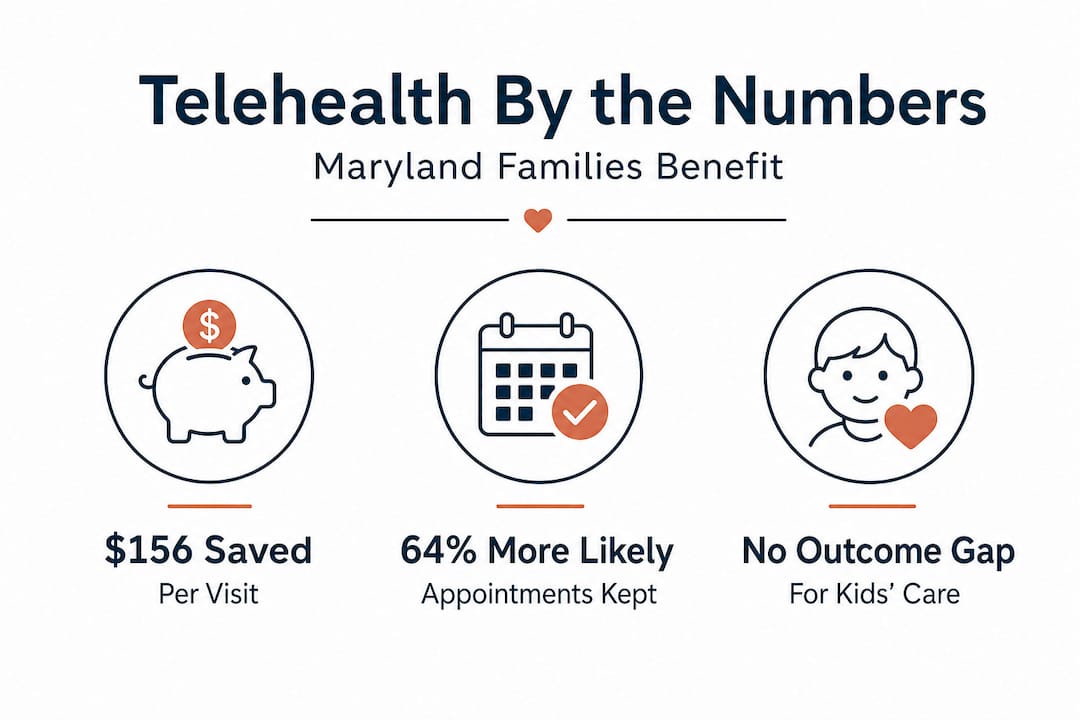
On appointment completion: Research shows families are significantly more likely to keep and complete telehealth appointments than in-person ones, with 64% higher odds of completing virtual visits. That matters because skipped appointments are one of the most consistent drivers of worsening chronic conditions. A visit that happens, even by phone, is almost always better than one that doesn’t.
Here is a side-by-side comparison of telehealth and in-person care across key dimensions:
| Factor | Telehealth | In-person |
|---|---|---|
| Average cost to family | Lower (saves ~$156/visit) | Higher (travel, time off work) |
| Appointment completion rate | 64% higher odds | Lower for complex logistics |
| Outcomes for chronic care | Equivalent | Equivalent |
| Family satisfaction | High | Varies |
| Accessibility for rural families | Strong | Limited by distance |
| Suitable for physical exam | Limited | Full range |
“Families who had regular telehealth access described feeling more in control of their child’s health, not less, because they could reach their provider without rearranging their entire week.”
This kind of continuity matters. When a family does not have to choose between keeping an appointment and staying at work, they are more likely to ask that follow-up question, report a new symptom early, or stay on track with a care plan. For families who want to understand the benefits for specific conditions, the same-day ear care benefits available through telehealth are a concrete example of how timely access changes outcomes.
Limitations and special considerations for Maryland families
While the advantages are compelling, it is also crucial to understand where telehealth’s limits lie. Telehealth is a powerful tool. It is not a universal one.
Some situations genuinely require in-person evaluation. Not all physical assessments are suited to telehealth, particularly when a provider needs to listen to heart or lung sounds, palpate an abdomen, examine a wound closely, or assess neurological function in detail. For a new complex diagnosis, a child with an unexplained rash that has spread rapidly, or a situation involving significant pain or urgent worsening, in-person care is essential.
Situations where in-person care is still the right choice:
- New symptoms that require hands-on physical examination
- Urgent or rapidly worsening conditions (high fever in an infant, difficulty breathing, chest pain)
- Initial assessment for a new complex condition
- Situations requiring on-site diagnostics like imaging or blood draws
- Any scenario where the provider cannot gather adequate clinical information remotely
The digital divide is also a real concern for Maryland families. Not every household has reliable broadband. Not every family member is equally comfortable navigating a video platform. For older adults, parents with limited English, or families in areas with poor internet infrastructure, the audio-only option Maryland Medicaid provides is an important bridge. But it does not fully resolve every equity gap.
Pro Tip: If broadband is a barrier in your area, ask your provider whether audio-only visits are available and covered under your insurance plan. Many Maryland providers are required to offer this option. Public libraries and community health centers sometimes also provide device and internet access for telehealth visits.
Provider comfort and readiness vary as well. Telehealth works best when your provider has built their practice around it, uses secure and easy-to-navigate platforms, and communicates clearly about what the visit can and cannot accomplish. Not every provider who technically offers telehealth does it with the same level of attentiveness or preparation.
The key is working with a provider who treats telehealth visits with the same thoroughness they would bring to an in-person appointment. Ask your provider directly: How do you handle follow-up after a telehealth visit? What happens if my child’s issue needs in-person evaluation? Those answers will tell you a lot.
What most families miss about telehealth (and why the future is still personal)
Most families approach telehealth the same way they approach a drive-through. Fast, convenient, and good for simple things. But that framing undersells what telehealth can actually do when it is done well.
The real shift telehealth enables is not speed. It is continuity. When a family can connect with the same provider month after month, across routine check-ins, chronic care, and acute questions, without logistical friction, that relationship deepens. Parents begin to share more. Providers notice patterns over time. Care becomes proactive rather than reactive. That is the version of telehealth most worth seeking out.
Research notes mixed practitioner acceptance, and that tension is worth naming honestly. Some providers find telehealth limiting. Others find it liberating. The families who benefit most tend to find providers who genuinely believe in the model, not those who offer it reluctantly. Practitioner buy-in shapes the quality of the interaction more than the technology does.
There is also a deeper equity question that statistics alone cannot answer. Telehealth removes geographic and time-based barriers. It does not automatically address the social determinants of health: housing instability, food insecurity, lack of transportation for in-person follow-up when needed, or language access. Providers who take telehealth seriously are the ones actively asking about those factors during virtual visits, not skipping past them because the appointment is on a screen.
The path forward involves both. Technology that removes friction, and providers who use that extra time and trust to ask better questions. The evolution of telemedicine in care delivery points toward that integration. When those two things align, telehealth stops being a workaround and starts being genuinely better care for families who have been underserved by traditional systems.
We believe the future of family health is still personal. It is just not limited by ZIP code or commute time anymore.
Getting started with personalized telehealth in Maryland
Ready to see if telehealth is right for your family? Here is how to take the next step.
Finding the right fit starts with a provider who treats every visit as part of an ongoing relationship, not a one-time transaction. At Anchor Health, we built our practice around exactly that model. Our Anchored Care℠ᴵᴾ framework is designed for Maryland families who want consistent, evidence-based primary care through secure video visits, whether you are managing a child’s asthma, navigating perimenopause, or staying on top of a chronic condition like diabetes.
We serve families across Maryland, accepting most insurance plans and offering membership options for those who want expanded, priority access. From pediatric and adolescent health to women’s health and chronic disease management, our team brings the same level of care and attention to every virtual visit. Getting started is straightforward. Visit our website to learn more, confirm your insurance, and schedule your first visit.
Frequently asked questions
Does Maryland Medicaid cover telehealth for children and women’s health?
Yes, Maryland Medicaid covers telehealth including audio-only services for children’s health, women’s health, and chronic care management under permanent policy rules.
How much money and time can a family really save with telehealth?
Families save an average of $156 per telehealth visit in combined travel, wait time, and indirect costs, and are 64% more likely to complete their appointments compared to in-person scheduling.
Are health outcomes with telehealth as good as with in-person visits for kids?
Research shows no significant outcome difference for well-child and chronic care management through telehealth compared to in-person visits, with high family satisfaction reported across studied groups.
What types of healthcare visits are best suited for telehealth?
Telehealth works well for routine check-ups, chronic condition management, medication reviews, and follow-up care, but complex physical assessments and urgent worsening conditions typically still require an in-person visit.
Blog & Information Disclaimer
Last Updated: May 23, 2026
The information provided on the Anchor Health website (https://myanchorhealthpc.com/), including but not limited to blog posts, articles, newsletters, graphics, and other materials (collectively, the "Content"), is for general informational and educational purposes only.
By accessing and using this website, you acknowledge and agree to the following terms and conditions:
The Content on this website is not intended to be a substitute for professional medical advice, diagnosis, or treatment. Always seek the advice of your physician, nurse practitioner, or other qualified health provider with any questions you may have regarding a medical condition. Never disregard professional medical advice or delay in seeking it because of something you have read on this website.
Reading, interacting with, or sharing the Content on this website does not establish a patient-provider relationship between you and Anchor Health or any of its clinicians, including Paule Valery Joseph, PhD, MBA, CRNP, FAAN. A formal patient-provider relationship is only established after you have completed the formal intake process, signed our clinical consent forms, and participated in a secure clinical consultation.
If you are experiencing a medical emergency, call 911 or seek emergency medical services immediately.
Anchor Health is a primary care practice and does not provide emergency or crisis intervention services through its website or blog.
While Anchor Health strives to provide thoughtful, evidence-based information grounded in our Anchored Care℠ model, healthcare is a rapidly evolving field. We make no representations or warranties, express or implied, about the completeness, accuracy, reliability, or suitability of the information contained in the Content. Any reliance you place on such information is strictly at your own risk.
Anchor Health is a telehealth practice providing services to patients physically located within the state of Maryland. The information provided on this blog is intended for residents of Maryland and is governed by the laws and regulations of that state. Accessing this information from outside of Maryland does not imply that our clinicians are licensed to practice medicine or provide consultations in your jurisdiction.
Content related to Weight & Metabolic Health, including discussions of GLP-1 medications or other medical therapies, is provided for educational context regarding our clinical approach. Prescriptions and specific medical recommendations are only made following a comprehensive clinical evaluation, diagnostic testing, and shared decision-making within a formal patient-provider relationship.
This website may contain links to external websites that are not provided or maintained by or in any way affiliated with Anchor Health. Please note that Anchor Health does not guarantee the accuracy, relevance, timeliness, or completeness of any information on these external websites.
To the fullest extent permitted by law, Anchor Health, its owners, and its employees shall not be liable for any direct, indirect, incidental, consequential, or punitive damag
Related posts