How telehealth handles teen mental health visits

When your teenager needs mental health support, you might assume a telehealth visit works entirely differently from sitting in a clinic office. The core clinical process is actually quite similar: a structured remote treatment involving assessment, therapy or psychiatry, and safety planning. What genuinely transforms the experience are the layers of privacy law, consent rules, and practical barriers that shape how families in Maryland navigate these visits. This guide walks you through every part of that reality, so you can approach your teen’s care with confidence rather than confusion.
Table of Contents
- What actually happens during a teen’s telehealth mental health visit?
- How privacy and consent work for teen telehealth in Maryland
- Barriers and equity gaps in telehealth for teens
- How safety and escalation are handled in tele-mental-health
- Why trust, communication, and clarity beat technology in teen telehealth
- Finding the right telehealth partner for your teen
- Frequently asked questions
Key Takeaways
| Point | Details |
|---|---|
| Structure mirrors in-person care | Telehealth teen mental health visits follow the same assessment and safety frameworks as in-person sessions. |
| Privacy/confidentiality rules vary | Parental access and teen privacy depend on Maryland law, consent choices, and specific confidentiality agreements. |
| Barriers impact access | Broadband, privacy at home, and economic factors can limit effective telehealth support for Maryland teens. |
| Safety and escalation are planned | Providers use clear processes to identify mental health risks and intervene or escalate when necessary. |
| Relationships matter most | Trust and communication between parents, teens, and providers are key to success—more than technology itself. |
What actually happens during a teen’s telehealth mental health visit?
Most parents picture telehealth as a basic video call, and while that image isn’t wrong, it’s incomplete. A well-run telehealth mental health visit follows the same clinical framework as an in-person session. The provider does not cut corners simply because the visit happens on a screen.
Here is a step-by-step look at how a typical session unfolds:
- Identity and location confirmation. The provider verifies who is in the session and where your teen is located. This is not just paperwork; it matters for legal jurisdiction and emergency response planning.
- Consent review. The provider reviews who has given consent for the visit, what information can be shared with parents, and what the teen’s confidentiality rights are under applicable law.
- Privacy boundary setting. Before the clinical conversation begins, the provider clarifies what parts of the session remain private and under what conditions that privacy could change.
- The clinical session itself. Assessment, therapeutic conversation, medication management if relevant, and review of any symptoms or concerns proceed just as they would in person.
- Safety planning and next steps. The session closes with a clear plan, including what to do if symptoms worsen, when the next visit is scheduled, and who to contact in a crisis.
Telehealth platforms can use several modalities, not just live video. These include audio-only calls, secure patient portal messaging, store-and-forward tools (which let providers review recorded data asynchronously), and remote monitoring devices. Each approach serves different needs, and your provider should explain which format suits your teen’s situation.
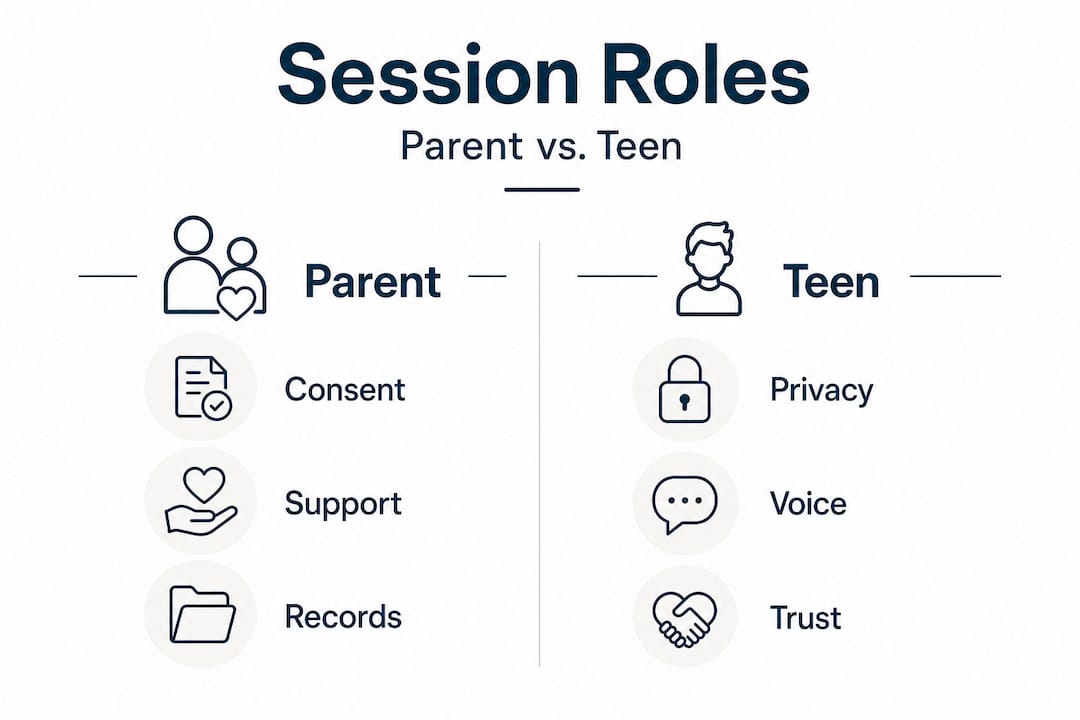
One important question parents often ask is whether they should be present during the session. The answer depends on your teen’s age, the specific services being provided, and what both you and your teen agree to. Younger adolescents often benefit from a brief joint check-in at the start or end of the visit. Older teens, especially those seeking confidential services, may need private time with the provider to speak openly.
Telehealth vs. in-person mental health visits for teens
| Feature | Telehealth | In-person |
|---|---|---|
| Clinical assessment quality | Comparable with video | Full physical observation |
| Location flexibility | Home, school, or any private space | Clinic or office only |
| Privacy from parents | Depends on setting and law | Provider-managed space |
| Crisis escalation | Requires location verification protocol | Immediate access to staff |
| Access for rural/underserved areas | Significantly better | Limited |
| Comfort for anxious teens | Often higher | Can feel intimidating |
Pro Tip: Respect your teen’s need for some private time with the provider. Teens who feel their confidentiality is honored are consistently more likely to engage honestly in therapy, which directly improves outcomes.
How privacy and consent work for teen telehealth in Maryland
Now that you know the basics, let’s look at consent and privacy, where most confusion starts for parents.
Consent is more than a form you sign before the first visit. It determines who can be in the room, who receives records, and what the provider is legally permitted to share with you. Telehealth consent requirements for minor patients involve confirming who holds legal authority, obtaining informed telehealth consent specifically, and documenting any basis for confidentiality that limits parental access.
In Maryland, behavioral health regulations define specific situations where teens can consent to their own care, independent of a parent or guardian. This matters for services like outpatient mental health treatment, substance use counseling, and certain sexual and reproductive health services. The practical effect is that your teen may have records you cannot access, depending on the service type and how the consent was structured.
Here is a clear breakdown of the main privacy and consent variables:
- Who consented: If a parent consented, parental access to records is generally protected. If the teen consented independently under state law, parental access may be limited.
- What services are involved: Some Maryland-specific programs restrict provider disclosure to parents even when the parent initiated the appointment.
- HIPAA personal representative rules: Under HIPAA, parents typically have access rights as the minor’s personal representative, but there are well-defined exceptions. These include cases where state law grants the minor consent authority, where a court has given the teen authority over their health decisions, or where the provider reasonably believes sharing information could put the teen at risk.
- Confidential agreements: Some providers offer formal confidentiality agreements with teens, especially older adolescents, that define what parents receive. Safety-based exceptions always apply.
Privacy and consent scenarios for Maryland families
| Scenario | Parent has records access? | Teen has confidentiality? |
|---|---|---|
| Parent consents for 14-year-old’s general therapy | Yes | Limited |
| Teen (16+) self-consents under Maryland law | Generally no | Yes |
| Safety emergency identified during session | Provider may notify parent | Privacy paused |
| Confidential agreement in place | Depends on agreement terms | Stronger protection |
Pro Tip: Ask your teen’s telehealth provider directly, before the first session, how they handle confidentiality and under what specific circumstances they would contact you. Getting this in writing helps everyone understand the boundaries clearly.
This upfront clarity is not about creating distance between you and your teen. It is about building a structure where your teen feels safe enough to speak honestly, which is the whole point of mental health care.
Barriers and equity gaps in telehealth for teens
Understanding consent and privacy is essential, but let’s turn to the real-world factors that can limit or enable effective telehealth care for your teen.
Not every family in Maryland has equal access to the benefits telehealth promises. Research shows that adolescent telemedicine use was distributed unevenly during the COVID-19 era, with lower rates of telehealth engagement among certain marginalized groups, including teens from lower-income households, rural communities, and racial and ethnic minority populations who already face systemic healthcare access challenges.

This is not a minor administrative concern. It shapes whether your teen actually gets connected to care at all.
The major barriers include:
- Privacy at home. Many teens live in crowded households where finding a genuinely private space for a mental health session is nearly impossible. Speaking openly about depression, anxiety, or suicidal thoughts while a sibling or parent can overhear is not realistic for most adolescents.
- Broadband access. Reliable high-speed internet is still not universal in Maryland, particularly in rural areas. A session that drops repeatedly or runs only on a slow mobile connection undermines the quality of care significantly.
- Cost and insurance coverage. Even though telehealth has expanded insurance coverage in recent years, cost-sharing, copays, and coverage gaps continue to prevent some families from using services consistently.
- Digital literacy. Not all families, and not all teens, are comfortable navigating telehealth platforms. Technical difficulties can cause anxiety before the session even begins, which is counterproductive for mental health care.
- Device availability. Some teens do not have access to a private device. Sharing a family tablet or phone raises real privacy concerns and can make honest disclosure during a session feel unsafe.
“Findings suggest that disparities in telehealth access among adolescents reflect broader social inequities. Teens with fewer resources face compounded barriers, including privacy at home, connectivity, and system-level exclusions that reduce the reach of even well-designed telehealth programs.”
If your family is working through any of these challenges, it is worth raising them directly with your teen’s provider. Good telehealth practices include problem-solving these barriers together, not assuming every family has ideal home conditions.
How safety and escalation are handled in tele-mental-health
Having discussed technical and logistical barriers, the next priority is how safety is actively managed during and after telehealth visits.
This is often the question parents care about most. If your teen is struggling with suicidal thoughts, self-harm, or a mental health crisis, what does a telehealth provider actually do? The good news is that pediatric safety protocols in telehealth include risk assessment, connection to specialists, and crisis planning as standard components of care. Providers are trained to manage these conversations remotely and to escalate when necessary.
The typical safety and escalation workflow looks like this:
- Routine screening. Every mental health visit includes standardized screening tools for depression, anxiety, and suicide risk. These are not optional or skipped because the visit is remote.
- Safety discussion. When screening reveals elevated risk, the provider engages the teen in an open conversation about current thoughts, intensity, and any means available.
- Safety planning. Together, the provider and teen build or update a safety plan. This includes warning signs, coping strategies, trusted adults, and crisis resources like 988 (the Suicide and Crisis Lifeline).
- Parental notification decision. Because mental health care for teens often involves confidentiality considerations, providers use upfront agreements to separate what parents hear versus what remains private. However, when imminent safety risk is identified, those privacy protections yield to safety. Parents are typically notified.
- Emergency resource handoff. In acute crises, the provider coordinates with emergency services, confirms the teen’s physical location (hence why location is verified at the start of every session), and facilitates a safe transition of care.
Pro Tip: Before your teen’s first telehealth visit, ask the provider specifically how they handle safety emergencies. What is their protocol if your teen discloses active suicidal ideation? What is your role as a parent, and how will you be contacted? Knowing this in advance reduces fear and builds trust in the process.
The key takeaway for parents: safety is not compromised by distance. It requires more coordination, more preparation, and more explicit communication, but skilled telehealth providers build all of that into their standard workflow.
Why trust, communication, and clarity beat technology in teen telehealth
We have walked through protocols, regulations, and risk frameworks. But here is the perspective we want to leave you with: the most important variable in your teen’s telehealth mental health care is not the platform, the bandwidth, or even the clinical credentials of the provider alone. It is the quality of communication and trust between your teen, the provider, and you.
Many parents assume that once their teen is connected to a telehealth platform, the hard part is over. In our experience, that is exactly when the real work begins. Teens are acutely sensitive to whether their privacy is genuinely respected or just nominally promised. When a provider takes ten minutes at the start of a first visit to explain clearly what is confidential, what is not, and why, that investment builds the kind of trust that makes an adolescent willing to speak honestly about what is actually going on.
The same principle applies to your role as a parent. Knowing your boundaries, understanding that limited access to certain records is not rejection but clinical necessity, and maintaining an open relationship with your teen outside of sessions all contribute more to outcomes than any technical feature of a telehealth platform.
We also want to challenge the assumption that telehealth is inherently less personal than in-person care. Relationship quality in healthcare is built through consistency, attentiveness, and follow-through. A provider who remembers what your teen shared three visits ago, who follows up on a safety plan, and who communicates clearly with you within appropriate boundaries is delivering relationship-based care regardless of whether the visit happens in a physical office or a secure video window.
Technology enables access. Trust and clear communication deliver results.
Finding the right telehealth partner for your teen
If this guide has made one thing clear, it’s that quality telehealth mental health care for teens depends on finding a provider who takes privacy, consent, and safety as seriously as you do.

At Anchor Health, we approach telehealth services for Maryland teens through our Anchored Care℠ model, which prioritizes long-term relationships, clear communication, and consistent providers who know your family over time. We take the time to explain consent and confidentiality boundaries before the first session begins, and our safety protocols are built to give both parents and teens the clarity they need to feel secure. If you are looking for a telehealth partner in Maryland who treats your teen’s mental health with the attentiveness and continuity it deserves, we are here to help you take that first step together.
Frequently asked questions
Can my teen have private sessions without me present during telehealth visits?
Yes, in many cases teens can have time alone with the provider during telehealth, but the specifics depend on state law, the consent structure, and any active safety considerations that might require parental involvement.
Who can legally consent to telehealth mental health care for my teen in Maryland?
Generally, parents or guardians must consent, but Maryland behavioral health law allows teens to consent independently in specific situations or for certain services, such as outpatient mental health treatment.
Will I always have access to my teen’s medical records from telehealth visits?
Not always; HIPAA includes exceptions to parental access, particularly when a teen has consented under state law or when a confidentiality agreement limits what parents can receive.
How do telehealth visits handle safety if my teen is at risk?
Telehealth providers follow structured safety protocols including risk screening, collaborative safety planning, and parental notification when imminent risk is identified, regardless of any existing confidentiality agreement.
What are common barriers to telehealth access for Maryland teens?
Key barriers include finding private space at home, reliable broadband, cost, and digital literacy, and research confirms these gaps disproportionately affect teens from marginalized communities.
Recommended
Blog & Information Disclaimer
Last Updated: May 23, 2026
The information provided on the Anchor Health website (https://myanchorhealthpc.com/), including but not limited to blog posts, articles, newsletters, graphics, and other materials (collectively, the "Content"), is for general informational and educational purposes only.
By accessing and using this website, you acknowledge and agree to the following terms and conditions:
The Content on this website is not intended to be a substitute for professional medical advice, diagnosis, or treatment. Always seek the advice of your physician, nurse practitioner, or other qualified health provider with any questions you may have regarding a medical condition. Never disregard professional medical advice or delay in seeking it because of something you have read on this website.
Reading, interacting with, or sharing the Content on this website does not establish a patient-provider relationship between you and Anchor Health or any of its clinicians, including Paule Valery Joseph, PhD, MBA, CRNP, FAAN. A formal patient-provider relationship is only established after you have completed the formal intake process, signed our clinical consent forms, and participated in a secure clinical consultation.
If you are experiencing a medical emergency, call 911 or seek emergency medical services immediately.
Anchor Health is a primary care practice and does not provide emergency or crisis intervention services through its website or blog.
While Anchor Health strives to provide thoughtful, evidence-based information grounded in our Anchored Care℠ model, healthcare is a rapidly evolving field. We make no representations or warranties, express or implied, about the completeness, accuracy, reliability, or suitability of the information contained in the Content. Any reliance you place on such information is strictly at your own risk.
Anchor Health is a telehealth practice providing services to patients physically located within the state of Maryland. The information provided on this blog is intended for residents of Maryland and is governed by the laws and regulations of that state. Accessing this information from outside of Maryland does not imply that our clinicians are licensed to practice medicine or provide consultations in your jurisdiction.
Content related to Weight & Metabolic Health, including discussions of GLP-1 medications or other medical therapies, is provided for educational context regarding our clinical approach. Prescriptions and specific medical recommendations are only made following a comprehensive clinical evaluation, diagnostic testing, and shared decision-making within a formal patient-provider relationship.
This website may contain links to external websites that are not provided or maintained by or in any way affiliated with Anchor Health. Please note that Anchor Health does not guarantee the accuracy, relevance, timeliness, or completeness of any information on these external websites.
To the fullest extent permitted by law, Anchor Health, its owners, and its employees shall not be liable for any direct, indirect, incidental, consequential, or punitive damag
Related posts