How Telehealth Supports Working Parents’ Health Needs

Getting a sick child to a pediatrician when you have back-to-back meetings, no backup childcare, and a commute that eats an hour each way is not a scheduling problem. It is a health access problem. Understanding how telehealth supports working parents’ health needs means recognizing that the barrier was never willingness to seek care. It was the architecture of traditional healthcare, built around people with flexible schedules and reliable transportation. Telehealth changes that architecture entirely, and the evidence behind it is stronger than most parents realize.
Table of Contents
- Key takeaways
- How telehealth reduces time and logistical burdens for working parents
- Telehealth services that fit a working parent’s life
- What the research says about telehealth effectiveness
- Practical tips to get the most from virtual care
- My honest take on telehealth for working parents
- Telehealth care built around your family’s schedule
- FAQ
Key takeaways
| Point | Details |
|---|---|
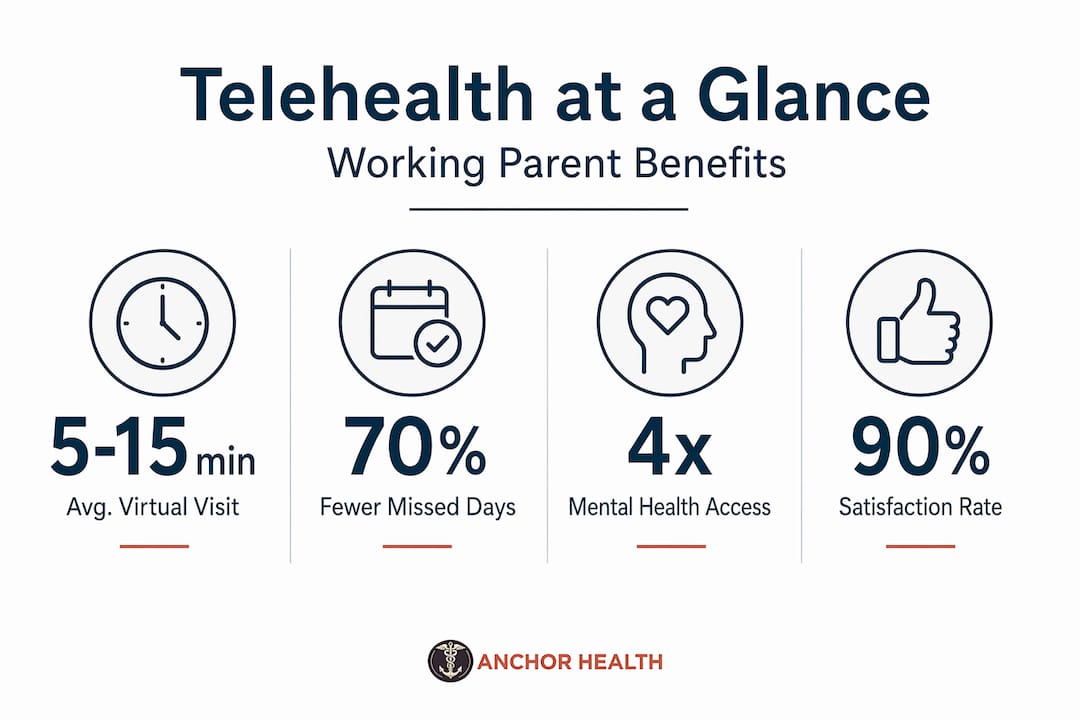
| Time savings are significant | Pediatric telehealth visits last 5 to 15 minutes, compared to 40-plus minutes of travel and waiting for in-person care. |
| Telehealth covers more than sick visits | Virtual care includes mental health, chronic condition management, parent coaching, and women’s health, not just minor illnesses. |
| Evidence supports effectiveness | Research shows telehealth parenting interventions produce meaningful stress reduction with effect sizes as high as 3.21. |
| Workplace benefits are growing | Employees with strong virtual care benefits are 1.6 times more productive and more likely to stay with their employer. |
| Preparation improves outcomes | A few simple steps before your virtual visit, like listing symptoms and having your child’s health history ready, make appointments more effective. |
How telehealth reduces time and logistical burdens for working parents
The most immediate telehealth benefit for parents is time. Not in a vague sense, but in concrete, recoverable minutes and hours that used to disappear into clinic waiting rooms.
Consider a typical in-person visit for a child with an ear infection. You notice symptoms the night before, call the pediatrician in the morning, get an appointment for 2 PM, leave work early, drive 20 minutes, wait 25 minutes past your appointment time, see the doctor for 10 minutes, drive home, and pick up a prescription. That is close to three hours of disruption for a condition that, in many cases, a provider can assess and treat virtually. Routine pediatric telehealth visits typically last just 5 to 15 minutes, and they are recommended for children aged 2 and older presenting with minor symptoms.
The logistical relief extends well beyond time. Here is what telehealth removes from the equation for most working parents:
- No transportation required. You connect from home, your car, or a private office at work.
- No waiting room exposure. Your child does not sit next to other sick kids, and you do not risk picking up something new.
- Flexible scheduling. Many telehealth providers offer early morning, evening, and weekend appointments that fit around work hours rather than competing with them.
- No disruption to siblings. You do not have to arrange care for other children while taking one to an appointment.
- Fewer missed work hours. A 15-minute virtual visit during a lunch break replaces a half-day absence.
Telehealth reduces barriers like transportation, scheduling conflicts, and illness exposure, which directly improves appointment attendance and consistency. For families managing ongoing conditions or therapy, that consistency is not a convenience. It is a clinical outcome.
Telehealth services that fit a working parent’s life
One thing that surprises many parents is how broad the range of virtual care has become. Remote healthcare for families no longer means just a quick consult for a cough. The scope of what you can address through a screen has expanded considerably.
Primary care and sick visits remain the most common entry point. Rashes, respiratory infections, urinary tract infections, seasonal allergies, and follow-up care for chronic conditions are all well-suited to virtual visits. For adults, telehealth handles prescription renewals, lab result reviews, and preventive care discussions without requiring time off.
Mental and behavioral health is where telehealth has arguably had its greatest impact on working parents specifically. Parental stress, anxiety, and burnout are not minor inconveniences. They affect your health, your work, and your children. Parent coaching via telehealth, including live video feedback during parent-child interactions, achieves outcomes comparable to in-person programs, making it genuinely practical for families who cannot commit to weekly in-person therapy sessions.

Women’s health is another area where virtual care closes a real gap. Perimenopause management, postpartum support, and reproductive health consultations are all conditions that working mothers frequently delay because of scheduling friction. Telehealth removes that friction.
Pediatric specialist access is particularly valuable for families in suburban or rural areas where specialists are scarce. Behavioral assessments, developmental consultations, and speech therapy follow-ups can all occur virtually.
Pro Tip: When choosing a telehealth provider for your family, look specifically for one that covers both adult and pediatric care under the same platform. Switching between separate providers for your health and your children’s health adds administrative burden that defeats the purpose.
A hybrid model works best for most families. Telehealth handles the majority of visits, while in-person care is reserved for situations that genuinely require physical examination, like a suspected fracture, an infant’s illness, or a complex new diagnosis.
What the research says about telehealth effectiveness
The effectiveness question is the one parents ask most often, and the research gives a clear answer: for the conditions telehealth is designed to address, it works.
A telehealth single-session intervention targeting highly stressed parents showed significant improvement in parental stress and child behavior within just two weeks, with effect sizes ranging from 1.53 to 3.21. Those are not modest results. They reflect immediate, measurable changes in agency and readiness after a single virtual contact.
The following table summarizes what the research shows across key areas relevant to working parents:
| Area | Finding | Source |
|---|---|---|
| Parental stress | Single telehealth session reduced stress significantly within 2 weeks | Springer, 2026 |
| Parenting behavior | Both telehealth and in-person delivery improved parental sensitivity | Springer, 2026 |
| Pediatric visit time | Virtual visits last 5 to 15 minutes vs. 40-plus minutes in person | Arkansas Children’s, 2026 |
| Workplace productivity | Employees with virtual care benefits are 1.6x more productive | MarketMinute, 2026 |
| Therapy attendance | Telehealth improves consistency and engagement in pediatric settings | Columbia Peds Therapy, 2026 |
One nuance worth understanding: the Attachment and Biobehavioral Catch-up program found that in-person delivery produced slightly greater gains in parental sensitivity than telehealth, though telehealth still produced significant improvements. That gap matters in some clinical contexts. For most working parents managing everyday health needs, it does not change the calculus.
“Telehealth is evolving from a crisis response to a standard productivity and retention tool in employee benefits packages.” — Industry observation, 2026
The workplace dimension deserves more attention than it typically gets. Employees with strong virtual care benefits are 1.6 times more productive and 1.5 times more likely to stay with their employer. That means advocating for telehealth coverage at work is not just a personal health decision. It is a career and financial one.
Telehealth is most effective for well-defined, recurrent health issues rather than emergencies, where in-person care remains the right choice. Knowing that boundary makes you a smarter user of both systems.
Practical tips to get the most from virtual care
Knowing that telehealth works and actually using it well are two different things. These steps help working parents get real value from every virtual visit.
- Prepare before you connect. Write down your symptoms, their duration, and any relevant history. If the visit is for your child, note their temperature, what they have eaten, and any medications given. Providers can assess more accurately when you give them a clear picture upfront.
- Choose a quiet, well-lit space. Background noise and poor lighting slow the visit down. A bedroom or home office with the door closed works better than a kitchen with the TV on.
- Have your insurance information and pharmacy details ready. If a prescription is needed, knowing your preferred pharmacy saves a follow-up call.
- Use the platform’s messaging features between visits. Many telehealth providers allow secure messaging for non-urgent questions. Use it. It saves you from booking a full appointment for a simple clarification.
- Schedule follow-ups before you end the call. If your provider recommends a check-in, book it on the spot. It takes 30 seconds and prevents the follow-up from falling off your radar.
- Know when to go in person. Telehealth works best for defined, recurring conditions. Chest pain, severe abdominal pain, high fever in an infant, or any situation where your gut says something is seriously wrong requires in-person or emergency care.
Pro Tip: If your employer offers a telehealth wellness benefit, check whether it covers your entire household. Many employee telehealth programs include a spouse and up to six dependents under a single flat-rate subscription with no copays, which is a significant financial advantage most parents overlook.
My honest take on telehealth for working parents
I have seen a lot of working parents come to telehealth skeptically, expecting a lesser version of the care they would get in person. What I have found, time and again, is that skepticism dissolves fast. Not because telehealth is perfect, but because the comparison is not really telehealth versus ideal in-person care. It is telehealth versus the appointment you kept delaying because you could not figure out the logistics.
In my experience, the parents who get the most from virtual care are the ones who treat it as a real medical relationship, not a convenience transaction. They keep their provider updated between visits. They show up prepared. They use the platform for mental health support, not just sick visits. That continuity is what separates a good telehealth experience from a forgettable one.
What I have also learned is that telehealth does not replace judgment. There are visits where I have been glad a parent came in rather than trying to manage something remotely. A trusted provider will tell you when that is the case. If yours does not, that is worth paying attention to.
My honest recommendation: find a provider who knows your family, covers your whole household, and will be direct with you about when virtual care is enough and when it is not. That relationship is the foundation everything else builds on.
— Paule
Telehealth care built around your family’s schedule
If you are a working parent in Maryland looking for a trusted provider who understands that your time matters as much as your health, Myanchorhealthpc was built with exactly that in mind.
At Myanchorhealthpc, the Anchored Care℠ model means you get a consistent primary care provider who knows your history, covers your whole family through secure video visits, and is available without the scheduling friction of traditional clinics. Services include primary care for all ages, women’s health, mental health support, pediatric and adolescent care, and weight management. For families who want to be prepared at home between visits, Myanchorhealthpc also offers practical home care essentials like digital thermometers and first aid supplies to support confident home monitoring. Accepting insurance and offering membership options, Myanchorhealthpc makes accessing telehealth services straightforward from day one.
FAQ
How does telehealth help working parents save time?
Telehealth eliminates travel and waiting room time, with pediatric virtual visits typically lasting 5 to 15 minutes compared to 40-plus minutes for in-person appointments. Parents can schedule visits around work hours, including early mornings and evenings.
Is telehealth as effective as in-person care for families?
For most common conditions and mental health support, telehealth produces outcomes comparable to in-person care. Research shows that parenting programs delivered via telehealth significantly improve parenting behaviors, though in-person delivery may hold a slight edge for certain therapy-intensive interventions.
What health issues can telehealth address for working parents?
Telehealth covers primary care sick visits, chronic condition management, mental health and stress support, women’s health, parent coaching, and pediatric consultations for children aged 2 and older with minor conditions.
Can telehealth be part of my employee benefits?
Yes. Many employers now offer telehealth wellness programs that cover employees, spouses, and up to six dependents with unlimited virtual visits and no copays, typically enrolling within 24 to 48 hours.
When should I choose in-person care over telehealth?
Choose in-person or emergency care for acute conditions like chest pain, severe injuries, high fever in infants, or any situation requiring physical examination. Telehealth works best for well-defined, recurring conditions where a visual consultation and history review are sufficient for diagnosis and treatment.
Recommended
- Digital Thermometer Archives – My Anchor Health PC – Maryland
- face mask Archives – My Anchor Health PC – Maryland
- Support Stick Archives – My Anchor Health PC – Maryland
Blog & Information Disclaimer
Last Updated: May 23, 2026
The information provided on the Anchor Health website (https://myanchorhealthpc.com/), including but not limited to blog posts, articles, newsletters, graphics, and other materials (collectively, the "Content"), is for general informational and educational purposes only.
By accessing and using this website, you acknowledge and agree to the following terms and conditions:
The Content on this website is not intended to be a substitute for professional medical advice, diagnosis, or treatment. Always seek the advice of your physician, nurse practitioner, or other qualified health provider with any questions you may have regarding a medical condition. Never disregard professional medical advice or delay in seeking it because of something you have read on this website.
Reading, interacting with, or sharing the Content on this website does not establish a patient-provider relationship between you and Anchor Health or any of its clinicians, including Paule Valery Joseph, PhD, MBA, CRNP, FAAN. A formal patient-provider relationship is only established after you have completed the formal intake process, signed our clinical consent forms, and participated in a secure clinical consultation.
If you are experiencing a medical emergency, call 911 or seek emergency medical services immediately.
Anchor Health is a primary care practice and does not provide emergency or crisis intervention services through its website or blog.
While Anchor Health strives to provide thoughtful, evidence-based information grounded in our Anchored Care℠ model, healthcare is a rapidly evolving field. We make no representations or warranties, express or implied, about the completeness, accuracy, reliability, or suitability of the information contained in the Content. Any reliance you place on such information is strictly at your own risk.
Anchor Health is a telehealth practice providing services to patients physically located within the state of Maryland. The information provided on this blog is intended for residents of Maryland and is governed by the laws and regulations of that state. Accessing this information from outside of Maryland does not imply that our clinicians are licensed to practice medicine or provide consultations in your jurisdiction.
Content related to Weight & Metabolic Health, including discussions of GLP-1 medications or other medical therapies, is provided for educational context regarding our clinical approach. Prescriptions and specific medical recommendations are only made following a comprehensive clinical evaluation, diagnostic testing, and shared decision-making within a formal patient-provider relationship.
This website may contain links to external websites that are not provided or maintained by or in any way affiliated with Anchor Health. Please note that Anchor Health does not guarantee the accuracy, relevance, timeliness, or completeness of any information on these external websites.
To the fullest extent permitted by law, Anchor Health, its owners, and its employees shall not be liable for any direct, indirect, incidental, consequential, or punitive damag
Related posts