Pediatric Primary Care: What Maryland Parents Need to Know

Most parents think pediatric primary care is about annual check-ups and making sure your child’s vaccines are up to date. That picture is incomplete. Pediatric primary care is actually a long-term, relationship-driven health framework that supports your child’s physical development, mental well-being, and family communication from infancy through adolescence. For Maryland families, the good news is that this kind of thorough, continuous care is now more accessible than ever, including through telehealth options designed to keep your care relationship strong no matter how busy life gets.
Table of Contents
- What pediatric primary care really means
- Core components and benefits for your child
- How team-based and telehealth models enhance care
- Practical tips for getting the most from your child’s primary care
- Why continuity and relationship-building matter most in pediatric care
- Get started with personalized pediatric primary care
- Frequently asked questions
Key Takeaways
| Point | Details |
|---|---|
| Whole-child support | Pediatric primary care guides your child’s health from prevention to development, not just treating sickness. |
| Access improves outcomes | Regular, preventive visits and telehealth access lead to fewer hospitalizations and better long-term health. |
| Team-based, relationship-driven | A connected care team and continuity with your provider mean more personalized and effective care for your child. |
| Telehealth complements care | Virtual visits expand access and strengthen your child’s care relationship without replacing needed in-person visits. |
What pediatric primary care really means
When parents hear “pediatric primary care,” they often picture a waiting room, a quick physical, and a nurse with a needle. The reality is far broader and more meaningful than that. Pediatric primary care is a sustained health partnership between your family and a trusted provider who knows your child’s history, tracks their growth over time, and supports their health through every stage.
The components of pediatric care are wide-ranging and evidence-based. According to the American Academy of Pediatrics (AAP), core components include preventive services, health supervision, developmental screening, immunizations, acute illness management, mental health promotion, anticipatory guidance, and family-centered communication. Each of these elements works together to form a complete picture of your child’s health, not just a snapshot from one visit.
Here is what that looks like in practice:
- Preventive care: Regular screenings and guidance to catch problems before they become serious
- Developmental screening: Checking that your child is meeting cognitive, social, and physical milestones at the right times
- Immunizations: Keeping your child protected against preventable diseases on a consistent schedule
- Acute illness management: Treating infections, injuries, and sudden illnesses with a provider who already knows your child
- Mental health support: Identifying anxiety, behavioral concerns, or mood changes early, before they escalate
- Anticipatory guidance: Preparing your family for what is coming next, whether that is starting solid foods, navigating puberty, or managing screen time
- Family-centered communication: Keeping you informed and involved in every decision about your child’s health
“Pediatric primary care is fundamentally about whole-child support. It is not just about treating illnesses. It is about building a health foundation that lasts a lifetime.”
This is also where the distinction between primary care, urgent care, and specialists becomes important. Urgent care handles one-time, acute problems. Specialists focus on specific conditions or organ systems. Primary care is the steady center of your child’s health, coordinating everything else and maintaining the relationship that makes personalized care possible.
Pro Tip: If your child sees a specialist, always loop your primary care provider in. They are the one who holds the full picture of your child’s health and can help you make sense of specialist recommendations in context.
Core components and benefits for your child
Understanding what pediatric primary care includes is one thing. Seeing the concrete benefits it delivers for your child is another. The evidence here is clear and compelling.
Children who receive consistent, relationship-based primary care experience measurably better health outcomes. Well-child visit outcomes show that children with regular well-child visits are 30% less likely to be hospitalized for preventable conditions. Quality improvement programs have increased First Five visit adherence from 25% to 78%, with care continuity reaching 74%. These are not small numbers. They represent real children staying healthier and out of the hospital.
Here are the top outcomes families see when they commit to consistent pediatric primary care:
- Fewer preventable hospitalizations: Regular monitoring catches warning signs early, reducing the likelihood of a condition becoming severe enough to require emergency or inpatient care.
- Better developmental tracking: Consistent visits mean your provider can spot subtle changes in development that might be missed in a one-time visit with an unfamiliar provider.
- Earlier intervention: Whether it is a vision problem, a learning delay, or early signs of anxiety, early identification leads to earlier support and better long-term outcomes.
- Stronger continuity of care: When your child’s provider knows their history, allergies, family context, and past concerns, every visit builds on the last rather than starting from scratch.
The following table gives you a clear view of how visit frequency and consistent care translate into real benefits:
| Age range | Recommended visit frequency | Key focus areas | Primary benefit |
|---|---|---|---|
| Newborn to 12 months | 6 to 8 visits | Growth, feeding, immunizations, development | Early detection of delays or concerns |
| 1 to 3 years | 3 to 4 visits | Language, behavior, social development | Milestone tracking and early intervention |
| 4 to 10 years | Annual visits | School readiness, nutrition, mental health | Preventive care and health education |
| 11 to 21 years | Annual visits | Puberty, mental health, risk behaviors | Adolescent guidance and continuity |
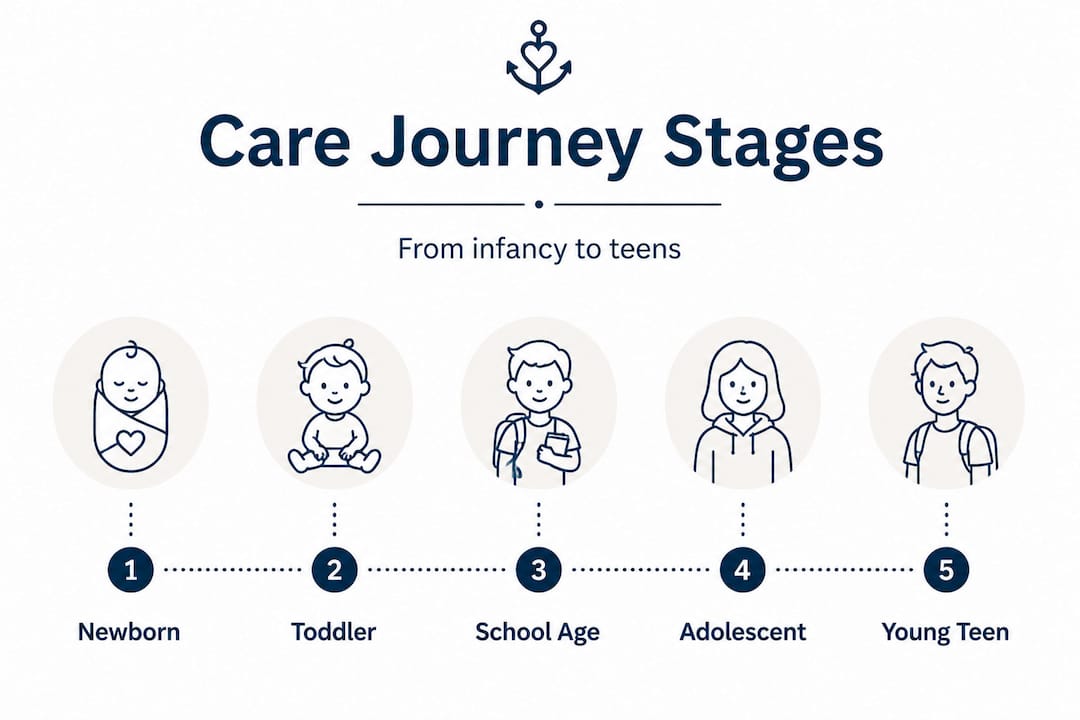
Each of these stages requires a different kind of attention. A provider who has been with your child since infancy brings context to every visit that a new or unfamiliar provider simply cannot replicate. That accumulated knowledge is one of the most undervalued assets in your child’s health.
How team-based and telehealth models enhance care
Once you understand the value of consistent pediatric primary care, the next question is how to actually access it in a way that fits your family’s life. This is where team-based pediatric care and telehealth options become genuinely transformative for Maryland families.

Team-based care means that your child’s health is supported by a coordinated group of professionals working together. This typically includes physicians, nurses, care coordinators, mental health professionals, and administrative staff, all aligned around your child’s care plan. This model enhances efficiency and deepens the relationship-building that makes primary care so effective. No single provider carries the full weight alone, and communication between team members ensures nothing falls through the cracks.
Telehealth adds another layer of access that Maryland families are finding invaluable. Evening and weekend availability, secure video visits, and the ability to connect with your care team from home mean that routine follow-ups, medication questions, and behavioral concerns do not have to wait for an opening in a busy office schedule. The “medical home” model, which prioritizes continuity, relationship-building, and personalized management, is now achievable through telehealth in ways that were not possible even five years ago.
Here is a side-by-side comparison of traditional office care versus a team-based telehealth model:
| Feature | Traditional office only | Team-based with telehealth |
|---|---|---|
| Appointment availability | Business hours only | Evenings, weekends, and on-demand |
| Care coordination | Often siloed | Integrated across providers |
| Mental health access | Usually referral-based | Often embedded in the care team |
| Follow-up ease | Requires scheduling and travel | Video visit from home |
| Continuity of care | Provider-dependent | Built into the team model |
| Parent involvement | Limited by visit time | Ongoing through digital communication |
The benefits of this model are especially clear for families managing chronic conditions, developmental concerns, or children who experience anxiety around in-person medical visits. Telehealth removes barriers without removing the relationship.
Key advantages Maryland families gain through team-based telehealth care include:
- Reduced travel time and scheduling stress
- Faster access to follow-up care after illness or diagnosis
- Consistent communication with a provider who knows your child
- Mental health support integrated into the same care relationship
- Greater flexibility for working parents managing busy schedules
Pro Tip: Use telehealth visits for follow-ups, medication reviews, and behavioral concerns. Reserve in-person visits for physical exams and immunizations. This balance keeps your care relationship strong while making the most of your time.
Practical tips for getting the most from your child’s primary care
Knowing that pediatric primary care is valuable is one thing. Actively using it well is another. Maryland parents who treat primary care as their child’s health home base, rather than a place they visit only when something goes wrong, see the biggest benefits.
Here are concrete steps you can take to maximize the value of your child’s primary care relationship:
- Keep a running list of concerns before each visit. Between appointments, jot down behavioral changes, sleep issues, appetite shifts, or anything that feels off. Visits go faster than you expect, and having a list ensures nothing gets forgotten.
- Ask about developmental milestones at every visit. Do not wait for your provider to bring it up. Ask directly: “Is my child where they should be for their age?” This keeps development front and center.
- Schedule well-child visits proactively. Do not wait until your child is sick to make an appointment. Preventive visits are the foundation of good health tracking and should be scheduled in advance, not as an afterthought.
- Request telehealth when it makes sense. Follow-up questions, prescription reviews, and behavioral concerns are often well-suited for a video visit. This keeps your care relationship active without requiring a trip to an office.
- Share your family context openly. Changes at home, school stress, family transitions, and social concerns all affect your child’s health. Your provider needs this information to give truly personalized care.
- Build a relationship, not just a record. The goal is not to check a box. It is to develop a trusted connection with a provider who knows your child well enough to notice when something has shifted.
“Enhanced access through evenings, weekends, and telehealth consistently reduces nonurgent ED visits, keeping children healthier and families out of the emergency room.”
This point matters more than it might seem. Every time a family turns to the emergency department for a concern that could have been handled by a familiar primary care provider, they lose the continuity and personalization that makes primary care so effective. Accessible telehealth options directly address this gap.
Think of your child’s primary care provider as their health home base. Every specialist visit, every illness, every developmental question comes back to that central relationship. The stronger that relationship, the better your child’s care will be across every setting.
Why continuity and relationship-building matter most in pediatric care
We talk a lot about frameworks, guidelines, and evidence-based protocols in pediatric care. All of that matters. But in our experience, the single most powerful factor in a child’s health outcomes is not which checklist their provider follows. It is whether that provider actually knows them.
A provider who has seen your child through ear infections, anxiety about starting school, a growth delay scare, and a difficult adolescent year brings something no guideline can replicate: context. They know your child’s baseline. They recognize when something is different. They understand your family’s communication style and your specific concerns as a parent. That knowledge is built over time, and it cannot be transferred in a chart summary.
This is why we believe continuity is not just a convenience. It is a clinical advantage. Children who see the same provider consistently are more likely to disclose sensitive concerns, more likely to follow through on recommendations, and more likely to have problems identified before they escalate. Parents who trust their provider ask better questions and feel more confident managing their child’s health between visits.
In Maryland, and through telehealth, this kind of continuity is now more accessible than ever before. It is not about replacing in-person care. It is about removing the barriers that cause families to drift between providers, lose their health history, and start over every time life gets complicated.
The best primary care is not about a checklist. It is about a partnership that grows with your child, adapts to your family’s needs, and remains steady through every stage of development.
Get started with personalized pediatric primary care
Maryland families deserve pediatric care that is thorough, accessible, and built around a real relationship with your child’s provider. If you have been navigating fragmented care, long waits, or providers who do not know your child’s history, there is a better way forward.
At Anchor Health, we built our pediatric and adolescent care model around exactly what the research shows matters most: continuity, relationship-building, and personalized attention delivered through secure, convenient telehealth visits. Maryland families can connect with a dedicated care team that gets to know your child over time, not just during a single appointment. Whether you are looking for well-child care, developmental support, mental health guidance, or ongoing management of a chronic condition, we are here to partner with you. Explore our pediatric services and take the first step toward anchored, relationship-based care for your child.
Frequently asked questions
What is the difference between pediatric primary care and urgent care?
Pediatric primary care provides ongoing, comprehensive health management and relationship-based care, while urgent care handles one-time acute illnesses or injuries without continuity or long-term tracking.
How often should my child have well-child visits?
Well-child visits should be scheduled regularly as recommended by your provider. Children with regular well-child visits are 30% less likely to be hospitalized for preventable conditions, which underscores why consistency matters.
Can telehealth replace in-person pediatric visits?
Telehealth expands access and supports continuity of care, but it complements rather than fully replaces in-person visits, which are still needed for physical exams, immunizations, and certain evaluations.
Why is continuity with one provider important?
Seeing the same provider over time builds trust, preserves your child’s health history, and supports the medical home model that research consistently links to better outcomes and more personalized care.
Article generated by BabyLoveGrowth
Blog & Information Disclaimer
Last Updated: May 23, 2026
The information provided on the Anchor Health website (https://myanchorhealthpc.com/), including but not limited to blog posts, articles, newsletters, graphics, and other materials (collectively, the "Content"), is for general informational and educational purposes only.
By accessing and using this website, you acknowledge and agree to the following terms and conditions:
The Content on this website is not intended to be a substitute for professional medical advice, diagnosis, or treatment. Always seek the advice of your physician, nurse practitioner, or other qualified health provider with any questions you may have regarding a medical condition. Never disregard professional medical advice or delay in seeking it because of something you have read on this website.
Reading, interacting with, or sharing the Content on this website does not establish a patient-provider relationship between you and Anchor Health or any of its clinicians, including Paule Valery Joseph, PhD, MBA, CRNP, FAAN. A formal patient-provider relationship is only established after you have completed the formal intake process, signed our clinical consent forms, and participated in a secure clinical consultation.
If you are experiencing a medical emergency, call 911 or seek emergency medical services immediately.
Anchor Health is a primary care practice and does not provide emergency or crisis intervention services through its website or blog.
While Anchor Health strives to provide thoughtful, evidence-based information grounded in our Anchored Care℠ model, healthcare is a rapidly evolving field. We make no representations or warranties, express or implied, about the completeness, accuracy, reliability, or suitability of the information contained in the Content. Any reliance you place on such information is strictly at your own risk.
Anchor Health is a telehealth practice providing services to patients physically located within the state of Maryland. The information provided on this blog is intended for residents of Maryland and is governed by the laws and regulations of that state. Accessing this information from outside of Maryland does not imply that our clinicians are licensed to practice medicine or provide consultations in your jurisdiction.
Content related to Weight & Metabolic Health, including discussions of GLP-1 medications or other medical therapies, is provided for educational context regarding our clinical approach. Prescriptions and specific medical recommendations are only made following a comprehensive clinical evaluation, diagnostic testing, and shared decision-making within a formal patient-provider relationship.
This website may contain links to external websites that are not provided or maintained by or in any way affiliated with Anchor Health. Please note that Anchor Health does not guarantee the accuracy, relevance, timeliness, or completeness of any information on these external websites.
To the fullest extent permitted by law, Anchor Health, its owners, and its employees shall not be liable for any direct, indirect, incidental, consequential, or punitive damag
Related posts