How to find telehealth providers accepting new Maryland patients

Searching for a telehealth provider in Maryland who is actually accepting new patients can feel like hitting a wall, especially when you are managing a chronic condition, navigating a health transition, or trying to coordinate care for your whole family. Many Maryland residents spend hours calling offices, only to be told there are no openings or that telehealth is not available for their insurance. This guide walks you through every step, from understanding what Maryland telehealth actually covers to finding the right provider, verifying their availability, and knowing exactly what to expect on your first visit.
Table of Contents
- What to know before you search for a Maryland telehealth provider
- How to find a telehealth provider accepting new Maryland patients
- Common telehealth pitfalls and how to avoid them
- What to expect after booking your first telehealth appointment
- Why preparation is the hidden key to telehealth success in Maryland
- Get started with telehealth primary care for Maryland families
- Frequently asked questions
Key Takeaways
| Point | Details |
|---|---|
| Check requirements first | Verify your insurance, needed technology, and what services are telehealth-eligible to avoid wasted effort. |
| Use trusted sources | Insurer directories, Medicaid lists, and local clinics are your most reliable tools for finding current providers. |
| Confirm consent and enrollment | Make sure the provider is Maryland-licensed and that all patient consent paperwork is complete before your visit. |
| Telehealth isn’t for everything | Emergencies and some complex care still need in-person appointments—know when telehealth is and isn’t appropriate. |
| Prepare for your visit | Collect necessary documents, prepare questions, and check your tech in advance for the smoothest telehealth experience. |
What to know before you search for a Maryland telehealth provider
Before you start calling clinics or scrolling through directories, it helps to understand how telehealth works in Maryland and what you are actually entitled to. This groundwork saves you time and prevents frustrating dead ends.
Telehealth defined clearly: In Maryland, telehealth means receiving medical care through a secure, two-way audio-video connection between you and a licensed provider. It is not a phone call to a nurse line or a chat with a bot. It is a real clinical visit conducted remotely. Maryland Medicaid reimburses synchronous telehealth visits (audio-video, or audio-only for certain services) for primary care by enrolled providers, with patient consent required, and it is available statewide.
Who can provide telehealth in Maryland: Not every online provider qualifies. The provider must be licensed in Maryland and enrolled with your insurance plan or Medicaid. Providers based in other states cannot legally treat Maryland patients via telehealth for ongoing primary care unless they hold a Maryland license.
Here is a quick overview of what Maryland telehealth typically covers:
| Service type | Covered via telehealth? | Notes |
|---|---|---|
| Primary care visits | Yes | Must use enrolled, MD-licensed provider |
| Chronic condition monitoring | Yes | Medication refills and check-ins qualify |
| Mental health counseling | Yes | Widely covered, including Medicaid |
| Annual physical exams | Partial | Some components require in-person |
| Lab work and imaging | No | Must be completed in-person |
| Emergency care | No | Call 911 or go to the ER |
Before your first visit, make sure you have these ready:
- A device with a working camera and microphone (smartphone, tablet, or laptop)
- A stable internet connection
- Your insurance card and member ID
- A list of current medications and dosages
- Any relevant medical records or recent lab results
- Your signed or verbal consent for the telehealth visit (your provider will walk you through this)
Pro Tip: If you use Medicaid, ask your plan specifically whether audio-only visits are covered for your situation. Some services allow audio-only when video is not accessible, which can be a helpful option for patients without reliable internet.
How to find a telehealth provider accepting new Maryland patients
Once you understand the basics needed for Maryland telehealth, it is time to actually start your search. Here is how to move forward, step by step.
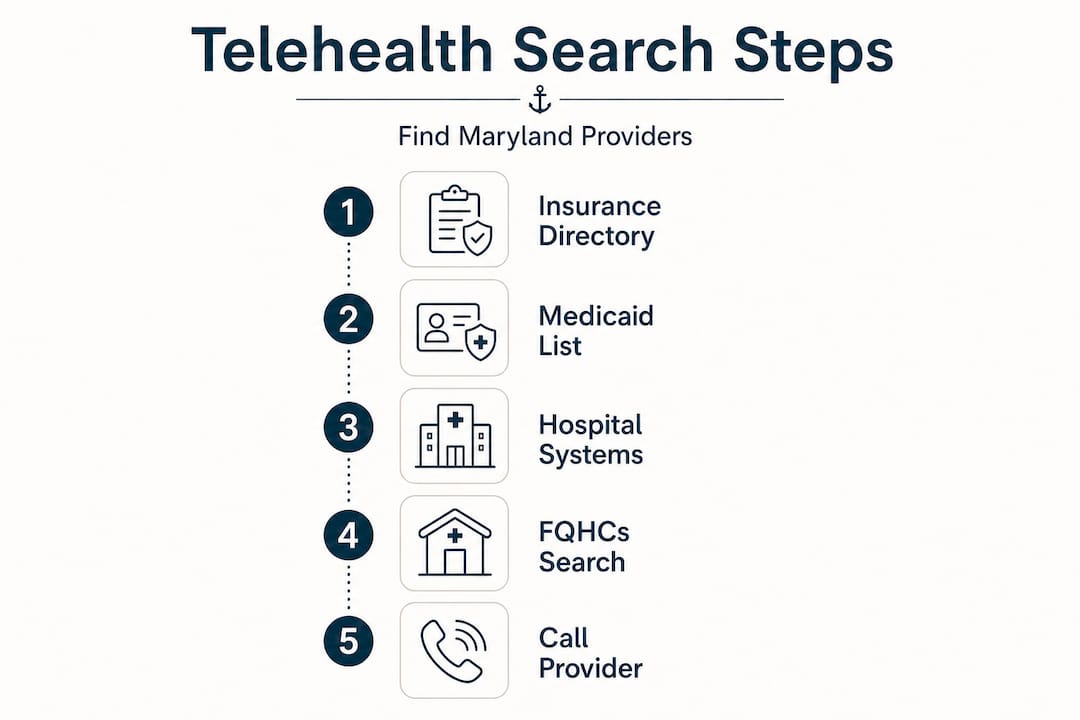
Step 1: Start with your insurance directory. Log into your insurance plan’s website and use the “find a provider” tool. Filter by “telehealth available” and “primary care.” Make sure to also filter by “accepting new patients” if that option exists. Not all directories are updated in real time, so treat this as your starting list, not your final answer.
Step 2: Check the Maryland Medicaid provider list. If you have Medicaid, visit the Maryland Department of Health’s provider enrollment portal. Enrolled telehealth providers are listed there, and you can cross-reference them with your managed care organization (MCO) to confirm coverage. Synchronous telehealth requires a secure audio-video connection and audio-only is allowed for some Medicaid services, so confirm which format your preferred provider uses.
Step 3: Search local hospital systems and federally qualified health centers (FQHCs). Many Maryland hospital networks, including those in the Baltimore metro area and suburban counties, have expanded their telehealth offerings significantly. FQHCs in particular serve patients regardless of ability to pay and often have telehealth slots available.

Step 4: Look at dedicated telehealth primary care practices. Maryland-based telehealth-only practices often have more flexibility with scheduling and new patient onboarding. These practices are built around virtual care, so the technology, consent processes, and follow-up systems tend to be smoother than a traditional clinic that added telehealth as an afterthought.
Step 5: Call and ask the right questions. When you reach a practice, ask these directly:
- Are you currently accepting new patients for telehealth primary care?
- Do you accept my specific insurance plan?
- Can you manage chronic conditions like diabetes, hypertension, or thyroid disease via telehealth?
- What technology platform do you use, and is it HIPAA-compliant?
- How quickly can I get a first appointment?
Here is a comparison of common search approaches to help you decide where to invest your time:
| Search method | Typical wait time | Pros | Cons |
|---|---|---|---|
| Insurance online directory | 1 to 3 days to verify | Confirms coverage upfront | Often outdated on availability |
| Medicaid provider portal | 2 to 5 days | Accurate enrollment status | Less user-friendly interface |
| Hospital system websites | Same day to 1 week | Integrated care, lab access | May have longer new patient waits |
| Dedicated telehealth practices | Same day to 3 days | Built for virtual care, faster onboarding | May not offer in-person follow-up |
| FQHC or community health center | 1 to 2 weeks | Sliding scale fees, broad services | Higher demand, longer waits |
Pro Tip: Keep a simple spreadsheet as you search. Record each provider’s name, phone number, insurance status, telehealth platform, and whether they are accepting new patients. This prevents you from calling the same office twice and helps you compare options side by side.
Common telehealth pitfalls and how to avoid them
After you have identified potential providers, it is crucial to spot and avoid the missteps that could waste your time or compromise your care.
The most important thing to understand first: telehealth is not for emergencies. If you or a family member is experiencing chest pain, difficulty breathing, a stroke, or any life-threatening situation, call 911 immediately. Telehealth providers cannot dispatch emergency services or perform physical interventions. This is a hard boundary, and no reputable telehealth provider will try to manage an acute emergency remotely.
Beyond emergencies, here are the most common mistakes Maryland patients make:
- Using a provider who is not enrolled in Maryland Medicaid. Even if a provider accepts your commercial insurance, they may not be enrolled with your specific Medicaid plan. Always verify enrollment before booking.
- Skipping the consent process. Maryland telehealth requires patient consent before a visit. Providers must document this. If a provider skips this step, that is a red flag.
- Assuming all primary care services transfer to telehealth. Some services, like physical exams for chronic conditions that require hands-on assessment, still need to be done in person. Telehealth is well-suited for monitoring and medication refills, but not every clinical need.
- Not confirming your technology setup in advance. A failed video connection at the start of your appointment wastes your time and the provider’s. Test your camera, microphone, and internet connection at least 15 minutes before your visit.
- Incomplete insurance verification. Calling to confirm a provider accepts your insurance is not the same as confirming your specific plan and benefit tier is covered. Ask for the exact billing codes or have your insurer confirm coverage in writing when possible.
“Telehealth is not appropriate for emergencies. Patients experiencing a medical emergency should call 911. Providers must be enrolled and licensed in Maryland, and patient consent is required before each telehealth encounter.” Maryland Medicaid Telehealth Program Policy Guide, May 2025.
Pro Tip: If you manage a chronic condition like hypertension, diabetes, or asthma, ask your provider during your first visit to create a written care plan that outlines what can be handled via telehealth and what will require an in-person visit. This prevents confusion later and keeps your care consistent.
What to expect after booking your first telehealth appointment
With a provider lined up, here is what you and your family can expect from your first telehealth visit and how to ensure it goes smoothly.
Appointment confirmation: Most telehealth practices send a confirmation email or text with a secure link to the video platform. You may also receive intake forms to complete before the visit. Fill these out completely. Incomplete intake paperwork is one of the most common reasons first appointments run over time or get rescheduled.
Here is a step-by-step look at what a typical first telehealth visit looks like:
- Log in early. Join the video session 5 to 10 minutes before your scheduled time to troubleshoot any technical issues.
- Consent confirmation. Your provider will confirm your consent to receive care via telehealth. This is a required step in Maryland.
- Health history review. Expect your provider to review your medical history, current medications, allergies, and the reason for your visit. Have this information ready.
- Clinical assessment. The provider will ask questions, observe you visually, and may ask you to describe symptoms in detail. Some providers use remote monitoring tools for blood pressure or glucose if you have the equipment at home.
- Care plan and next steps. Your provider will outline a treatment plan, which may include prescriptions, lab orders, referrals, or a follow-up telehealth visit.
- Visit summary. Many practices send an after-visit summary to your patient portal. Review it and save a copy for your records.
For patients managing ongoing conditions, telehealth is well-suited for monitoring and refills, but physical exams that require hands-on assessment will still need to happen in person at some point.
Here is a quick reference for what telehealth handles well versus what still requires an in-person visit:
| Clinical need | Telehealth appropriate? | Typical follow-up |
|---|---|---|
| Medication refill for known condition | Yes | Telehealth follow-up in 30 to 90 days |
| Blood pressure monitoring check-in | Yes | Remote or telehealth |
| New symptom evaluation (non-emergency) | Often yes | May require in-person if exam needed |
| Annual wellness exam | Partial | In-person component typically needed |
| Lab result review | Yes | Telehealth |
| Skin condition assessment | Sometimes | Photos may suffice; in-person if unclear |
If you run into problems after booking, contact your provider’s patient support line first. If the issue involves insurance billing, call your insurer’s member services line and reference the specific date of service and provider name.
Why preparation is the hidden key to telehealth success in Maryland
Reflecting on the Maryland telehealth landscape, here is what most guides do not tell you: the gap between a frustrating telehealth experience and a genuinely useful one almost always comes down to preparation, not technology.
We see this pattern consistently. Patients who take 20 minutes before their first visit to gather their records, write down their questions, and test their video connection get far more out of that appointment than patients who log in unprepared and try to reconstruct their health history from memory. This is especially true for complex or chronic conditions, where the details matter.
There is also a consent and paperwork issue that catches many people off guard. Maryland’s telehealth consent requirements are not just bureaucratic formalities. They protect you. When a provider walks you through consent carefully, that is a sign they are operating within proper clinical and legal standards. If a provider rushes past consent or skips it entirely, pay attention to that.
Our perspective is this: the best telehealth relationships are built on the same foundation as the best in-person relationships, which is continuity, trust, and clear communication. A provider who knows your history, understands your goals, and checks in consistently will always outperform a provider you see once for a quick prescription. If your situation is complex, request written visit summaries after every appointment and keep your own organized record of diagnoses, medications, and care plans. You are your own best advocate, and good documentation makes every future visit more efficient.
Do not settle for fragmented, episodic care just because it is convenient. Maryland telehealth, done right, can offer the same depth of relationship-based care as a traditional practice, sometimes even more so, because it removes the barriers that keep people from showing up consistently.
Get started with telehealth primary care for Maryland families
You now have a clear, practical roadmap for finding and connecting with a telehealth provider in Maryland who is genuinely accepting new patients and equipped to support your family’s needs. The next step is putting it into action.
At Anchor Health, we built our practice around exactly the kind of care this guide describes: consistent, relationship-based, and designed for Maryland families navigating real health challenges. Whether you are managing a chronic condition, supporting a child’s health, or exploring options for managing perimenopause symptoms and other health transitions, we are here to provide attentive, thorough care through secure video visits. We accept insurance and offer membership options for enhanced access. Explore our Maryland telehealth care options and find out how to get started with a provider who will actually know your name.
Frequently asked questions
Are Maryland telehealth appointments covered by Medicaid?
Yes, Maryland Medicaid reimburses synchronous telehealth visits with enrolled providers when patient consent is documented, and coverage is available statewide across primary care services.
Do I need special technology for telehealth in Maryland?
You need a reliable internet connection and a device with a working camera and microphone for most visits; audio-only is allowed for some Medicaid services when video is not accessible.
Can telehealth be used for all medical issues?
No, telehealth is not appropriate for emergencies and some services, including hands-on physical exams and lab work, still require an in-person visit.
How do I know if a telehealth provider is accepting new Maryland patients?
Check your insurer’s online provider directory and filter for telehealth availability, then call the practice directly to confirm new patient status and ask about their specific telehealth policies and insurance enrollment.
Article generated by BabyLoveGrowth
Blog & Information Disclaimer
Last Updated: May 23, 2026
The information provided on the Anchor Health website (https://myanchorhealthpc.com/), including but not limited to blog posts, articles, newsletters, graphics, and other materials (collectively, the "Content"), is for general informational and educational purposes only.
By accessing and using this website, you acknowledge and agree to the following terms and conditions:
The Content on this website is not intended to be a substitute for professional medical advice, diagnosis, or treatment. Always seek the advice of your physician, nurse practitioner, or other qualified health provider with any questions you may have regarding a medical condition. Never disregard professional medical advice or delay in seeking it because of something you have read on this website.
Reading, interacting with, or sharing the Content on this website does not establish a patient-provider relationship between you and Anchor Health or any of its clinicians, including Paule Valery Joseph, PhD, MBA, CRNP, FAAN. A formal patient-provider relationship is only established after you have completed the formal intake process, signed our clinical consent forms, and participated in a secure clinical consultation.
If you are experiencing a medical emergency, call 911 or seek emergency medical services immediately.
Anchor Health is a primary care practice and does not provide emergency or crisis intervention services through its website or blog.
While Anchor Health strives to provide thoughtful, evidence-based information grounded in our Anchored Care℠ model, healthcare is a rapidly evolving field. We make no representations or warranties, express or implied, about the completeness, accuracy, reliability, or suitability of the information contained in the Content. Any reliance you place on such information is strictly at your own risk.
Anchor Health is a telehealth practice providing services to patients physically located within the state of Maryland. The information provided on this blog is intended for residents of Maryland and is governed by the laws and regulations of that state. Accessing this information from outside of Maryland does not imply that our clinicians are licensed to practice medicine or provide consultations in your jurisdiction.
Content related to Weight & Metabolic Health, including discussions of GLP-1 medications or other medical therapies, is provided for educational context regarding our clinical approach. Prescriptions and specific medical recommendations are only made following a comprehensive clinical evaluation, diagnostic testing, and shared decision-making within a formal patient-provider relationship.
This website may contain links to external websites that are not provided or maintained by or in any way affiliated with Anchor Health. Please note that Anchor Health does not guarantee the accuracy, relevance, timeliness, or completeness of any information on these external websites.
To the fullest extent permitted by law, Anchor Health, its owners, and its employees shall not be liable for any direct, indirect, incidental, consequential, or punitive damag
Related posts