When Should You Take Your Child to a Telehealth Doctor?
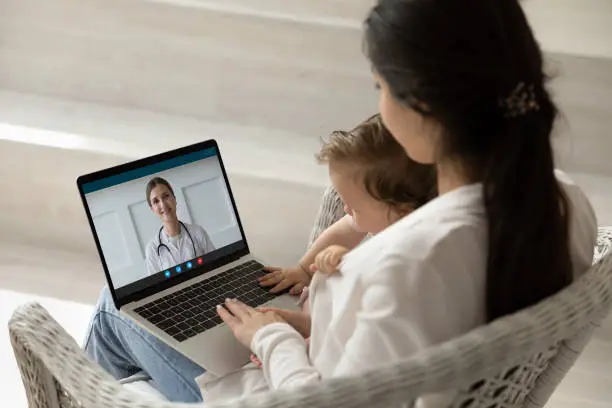
The question Maryland parents are asking more often — and the clear framework for knowing when a video visit is the right call, and when it isn’t.
Most parents have been there: your child wakes up uncomfortable, and you’re mentally running through the options — telehealth visit, urgent care, pediatrician office, emergency room. The right answer depends on what’s actually happening. And for Maryland families who have access to a trusted telehealth primary care provider, the decision can often be made with a single call.
Here’s an honest framework for when pediatric telehealth works well, when it doesn’t, and why having a consistent provider changes the equation entirely.
Conditions That Telehealth Handles Well
Pediatric telehealth is more capable than most parents expect — particularly for the kinds of health concerns children have most often.
Ear infection follow-ups. If your child was recently diagnosed and treated, a telehealth check-in three to five days later is entirely appropriate. The provider knows the history and can assess whether the treatment is working or whether the next step is needed. Initial diagnosis typically requires an in-person exam, but follow-up management is well-suited to video.
Rashes. Many pediatric rashes evaluate clearly on camera — eczema flare-ups, heat rash, mild contact dermatitis, and viral exanthems. The key is having a provider who can recognize what’s visible and knows when a rash needs to be seen in person (fever plus rash, or a pattern that warrants labs). On camera, context and history matter as much as what’s visible.
Behavioral concerns and ADHD follow-ups. Anxiety, school frustration, changes in mood or sleep, ADHD medication check-ins — these conversations often happen better on video than in an exam room. Your child is in their familiar space. The conversation can be more relaxed and honest. Behavioral health monitoring doesn’t require a stethoscope.
Allergy and asthma management. Seasonal flare-ups, controller medication adjustments, refill requests for maintenance medications — these are routine telehealth encounters. A provider who knows your child’s baseline can adjust a plan without an office visit.
School physicals and sports clearances. The conversation around school physicals — vaccination review, developmental screening, activity clearance — often fits well via telehealth. Some circumstances require in-person measurement, but many families are surprised how much of a routine physical is discussion-based rather than hands-on.
General sick-day questions. Is this fever something to worry about? How long is too long? When should I bring them in? A primary care provider who knows your child is the right first call for these questions. They can triage, advise, and direct you appropriately — without you sitting in an urgent care waiting room for a virus that just needs fluids and rest.
When In-Person or Emergency Care Is Needed
Responsible telehealth doesn’t blur these lines. Some situations require hands-on assessment, and a good provider tells you so clearly.
Take your child to urgent care or the ER when you see:
Difficulty breathing — labored breathing, rapid breathing, or ribs visible with each breath warrants immediate in-person evaluation
High or persistent fever in infants under 3 months — these require in-person assessment, not a video call
Suspected ear infection (first time) — otoscope examination is the standard; telehealth can triage, but direct visualization is needed for first-time diagnosis
Abdominal pain that's significant or worsening — palpation and physical exam are essential for evaluating abdominal complaints
Suspected fracture or significant injury — imaging and physical exam are both required
Rash with fever and systemic symptoms — some rash-plus-fever combinations need urgent in-person assessment
Any situation where your instinct says something is wrong — a provider who takes parents seriously will tell you to go in, not convince you everything is fine over video

The goal of pediatric telehealth isn’t to replace every in-person visit. It’s to reduce unnecessary visits, get answers faster, and ensure that when in-person care is needed, you’re directed there with context — rather than arriving at urgent care with no records and a provider who has never met your child.
Why Continuity Changes Everything
The most important variable in pediatric telehealth isn’t the technology. It’s whether the provider on the other end knows your child.
A provider who has seen your child four times has a mental model of their baseline — what their typical ear complaints look like, how they usually respond to certain treatments, whether last month’s behavioral shift is new or part of a longer pattern. That context transforms a video visit from a generic clinical encounter into something much more precise.
At Anchored Care™, pediatric care is built around this kind of continuity. We track growth over time, maintain vaccination history, document behavioral and developmental patterns, and build a relationship with both the child and the family. When you call with a question, we’re not starting from scratch.
Whole-Family Care Under One Roof
There’s a practical reason families benefit from seeing the same provider across generations: your health context intersects. A parent managing chronic stress, an adolescent with anxiety, and a younger child with behavioral concerns — these don’t exist in isolation. A provider who cares for the whole household sees the connections that separate providers miss.
For Maryland families in Rockville, Bethesda, Silver Spring, Baltimore, Annapolis, and Frederick, Anchored Care™ offers telehealth pediatric primary care for children ages 5 and up — alongside adult primary care for every member of the household. Read more about pediatric and adolescent care at Anchor Health.
The right call for your child’s health is usually simpler when you have a provider who already knows them. That relationship is what whole-family telehealth care is built on — and it’s what makes the difference between guessing and knowing.
Anchor Health. Steady. Thoughtful. Human.
Blog & Information Disclaimer
Last Updated: May 23, 2026
The information provided on the Anchor Health website (https://myanchorhealthpc.com/), including but not limited to blog posts, articles, newsletters, graphics, and other materials (collectively, the "Content"), is for general informational and educational purposes only.
By accessing and using this website, you acknowledge and agree to the following terms and conditions:
The Content on this website is not intended to be a substitute for professional medical advice, diagnosis, or treatment. Always seek the advice of your physician, nurse practitioner, or other qualified health provider with any questions you may have regarding a medical condition. Never disregard professional medical advice or delay in seeking it because of something you have read on this website.
Reading, interacting with, or sharing the Content on this website does not establish a patient-provider relationship between you and Anchor Health or any of its clinicians, including Paule Valery Joseph, PhD, MBA, CRNP, FAAN. A formal patient-provider relationship is only established after you have completed the formal intake process, signed our clinical consent forms, and participated in a secure clinical consultation.
If you are experiencing a medical emergency, call 911 or seek emergency medical services immediately.
Anchor Health is a primary care practice and does not provide emergency or crisis intervention services through its website or blog.
While Anchor Health strives to provide thoughtful, evidence-based information grounded in our Anchored Care℠ model, healthcare is a rapidly evolving field. We make no representations or warranties, express or implied, about the completeness, accuracy, reliability, or suitability of the information contained in the Content. Any reliance you place on such information is strictly at your own risk.
Anchor Health is a telehealth practice providing services to patients physically located within the state of Maryland. The information provided on this blog is intended for residents of Maryland and is governed by the laws and regulations of that state. Accessing this information from outside of Maryland does not imply that our clinicians are licensed to practice medicine or provide consultations in your jurisdiction.
Content related to Weight & Metabolic Health, including discussions of GLP-1 medications or other medical therapies, is provided for educational context regarding our clinical approach. Prescriptions and specific medical recommendations are only made following a comprehensive clinical evaluation, diagnostic testing, and shared decision-making within a formal patient-provider relationship.
This website may contain links to external websites that are not provided or maintained by or in any way affiliated with Anchor Health. Please note that Anchor Health does not guarantee the accuracy, relevance, timeliness, or completeness of any information on these external websites.
To the fullest extent permitted by law, Anchor Health, its owners, and its employees shall not be liable for any direct, indirect, incidental, consequential, or punitive damag

Related posts