How to Request Medication Refill Through Telehealth

Running out of medication because you can’t get a same-week appointment is one of the most frustrating parts of managing a chronic condition. You know what you need, your condition is stable, and yet the system makes you wait. The good news is that when you request medication refill through telehealth, you skip the waiting room entirely. This guide walks you through exactly who qualifies, how to prepare, what happens step by step, and how to avoid the most common mistakes that delay prescriptions.
Table of Contents
- Key takeaways
- Who qualifies for a telehealth medication refill
- What to have ready before your appointment
- Step-by-step guide to the refill process
- Troubleshooting common refill problems
- What happens after your telehealth refill visit
- My honest take on telehealth refills and where patients go wrong
- Managing your medications with Myanchorhealthpc
- FAQ
Key takeaways
| Point | Details |
|---|---|
| Eligibility matters first | Most stable, non-controlled medications qualify for telehealth refills; controlled substances often require in-person visits. |
| Preparation speeds approval | Having your medication list, recent labs, and pharmacy details ready before the appointment reduces delays significantly. |
| eScripts arrive quickly | Electronic prescriptions typically reach your pharmacy within 30 minutes to 2 hours after your telehealth visit. |
| Telehealth is a real consultation | Providers follow the same clinical standards remotely as they do in person; refills are never automatic. |
| Standing refill plans save time | Patients with stable conditions can set up recurring refill protocols to minimize repeated scheduling. |
Who qualifies for a telehealth medication refill
Not every prescription can be renewed through a video visit, and understanding the boundaries upfront saves you time and frustration. The good news is that roughly 85% of routine refills for non-controlled medications can be handled through virtual consultations. That covers a wide range of conditions: hypertension, diabetes, thyroid disorders, asthma, depression, anxiety, and many others where your health has been stable for some time.
Here is what typically makes you eligible:
- Your condition is stable and well-managed with your current medication
- You have an existing relationship with the provider or practice
- Your last relevant labs or monitoring results are recent and on file
- You are not experiencing new or worsening symptoms that require a physical exam
- The medication is not a federally controlled substance in Schedule II through V
Controlled substances are a firm boundary. Prescribing controlled substances via telehealth remains highly regulated, and most providers require an in-person evaluation even when federal flexibilities exist. If your medication falls into this category, your provider will tell you directly and guide you toward the right next step.
Telehealth refill consultations are also not the right fit for new medications, significant dose changes, or situations where your provider needs to physically examine you. Telehealth is a full medical consultation, not a workaround for clinical safety. Your provider reviews your health history, current symptoms, and medication adherence before issuing any prescription.
Pro Tip: If you are a new patient at a telehealth practice, schedule a general primary care visit first rather than a refill-only appointment. Establishing your medical history with the provider makes future refill requests faster and smoother.
What to have ready before your appointment
Preparation is the single biggest factor in whether your telehealth refill request gets approved in one visit or requires a follow-up. Providers can only make safe prescribing decisions based on the information you give them. Patients who bring complete medication details and recent test results consistently move through the process faster.
Gather the following before your appointment:
- Full medication list: Name, dose, and frequency for every medication you take, including over-the-counter supplements
- Remaining supply: Know how many days of medication you have left so your provider can time the refill appropriately
- Recent lab results: Blood pressure readings, blood glucose logs, thyroid panels, or any monitoring data relevant to your medication
- Side effect history: Any changes in how you feel on the medication, even minor ones, should be reported honestly
- Preferred pharmacy: Name, address, and phone number of the pharmacy where you want the prescription sent
- Insurance information: Confirm your coverage for telehealth visits before you book, since billing varies by plan
Choosing the right telehealth platform also matters more than most patients realize. Some platforms offer one-off refill visits while others provide ongoing care with dosage adjustments and side-effect monitoring over time. For complex or long-term conditions, a practice that knows your full health history will always serve you better than a transactional refill service.
Pro Tip: Take a photo of each medication bottle before your appointment. It gives you an instant reference for the exact drug name, dose, and manufacturer, which prevents errors when the provider is writing the prescription.
Step-by-step guide to the refill process
Once you are prepared, the actual process of completing a telehealth medication request is straightforward. Here is how it works from start to finish.
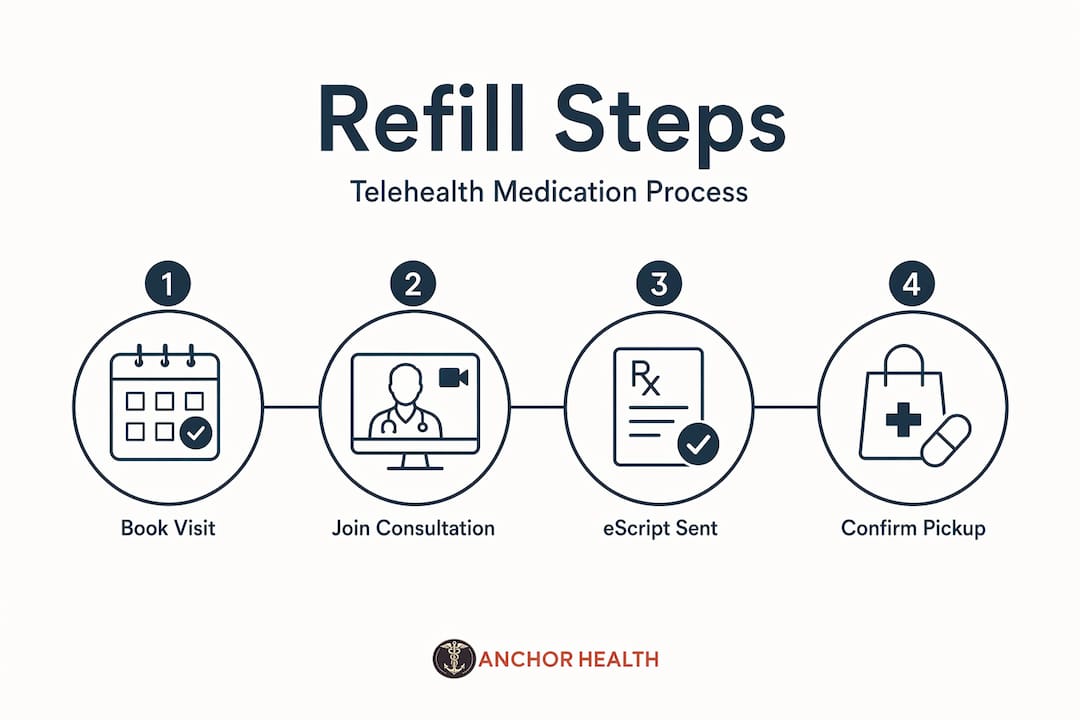
Step 1: Schedule the right appointment type
When booking, look for a visit labeled “medication refill,” “prescription renewal,” or “chronic care follow-up.” Selecting the correct visit type helps your provider prepare and keeps the appointment focused. Most platforms allow online scheduling 24 hours a day.
Step 2: Join the virtual consultation
Log in a few minutes early to test your audio and video. During the visit, your provider will review your medication history, ask about any side effects or changes in your health, and may ask about your recent monitoring results. Be direct and honest. If you have missed doses or noticed new symptoms, say so. Providers are not there to judge; they need accurate information to prescribe safely.

Step 3: Receive your electronic prescription
If your provider approves the refill, they issue an electronic prescription (eScript) directly to your pharmacy. eScripts typically reach the pharmacy within 30 minutes to 2 hours after your visit ends. You do not need to do anything to trigger this step; it happens automatically through the provider’s prescribing system.
Step 4: Confirm and pick up or receive delivery
Call or check your pharmacy’s app to confirm the prescription arrived. Many pharmacies now offer same-day or next-day delivery, so ask about that option if traveling to the pharmacy is inconvenient.
| Step | Patient action | Typical timing |
|---|---|---|
| Schedule visit | Book refill appointment online | 5 minutes |
| Prepare documents | Gather meds, labs, pharmacy info | Before appointment |
| Attend consultation | Video visit with provider | 10 to 20 minutes |
| eScript issued | Provider sends prescription electronically | Within 2 hours |
| Pharmacy processing | Confirm receipt, arrange pickup or delivery | Same day to 24 hours |
Pro Tip: Ask your provider at the end of the visit whether you qualify for a 90-day supply instead of a 30-day supply. Many insurers cover this, and it cuts the number of refill appointments you need each year by two thirds.
Troubleshooting common refill problems
Even when you prepare well, refill requests can hit a wall. Knowing why providers decline requests, and how to respond, keeps you from losing days of medication.
The most common reasons a provider will not issue a refill through telehealth include:
- Overdue lab work that the medication requires for safe monitoring (for example, metformin and kidney function, or thyroid medication and TSH levels)
- New symptoms that suggest your condition may have changed and needs a physical exam
- A controlled substance that falls outside telehealth prescribing rules
- No established relationship with the patient or insufficient medical history on file
If your refill is declined, ask your provider exactly what is needed to proceed. Most declines are not permanent. They are requests for more information or a specific next step, such as a lab draw or an in-person visit.
Providers will not issue refills without current labs when those labs are clinically required. This is a safety standard, not a bureaucratic hurdle. The fastest way through it is to schedule the lab work immediately and book a follow-up telehealth visit once results are available.
For urgent situations where you are about to run out, emergency pharmacy refill protocols may allow your pharmacist to provide a short-term supply. Contact your pharmacy and your provider’s office at the same time. Do not wait to see if one resolves the situation on its own.
Staying ahead of refills is the most effective strategy overall. Standing refill protocols in some health systems allow automatic renewal for stable patients with current labs, which removes the need to schedule a visit every time. Ask your provider whether your medications and health status qualify for this kind of arrangement.
What happens after your telehealth refill visit
The appointment ending does not mean the process is complete. A few follow-up steps protect you from gaps in your medication supply.
Here is what to expect and do after your visit:
- Confirm the eScript: Call your pharmacy or check their app within a few hours to verify the prescription arrived. Occasionally, technical issues delay transmission, and catching this early prevents a gap.
- Review the prescription details: Confirm the drug name, dose, quantity, and number of refills match what your provider discussed with you.
- Schedule any recommended follow-up: If your provider mentioned labs or an in-person exam, book that appointment before you leave the telehealth platform. Delaying it often leads to the same problem at your next refill.
- Plan your next refill date: Mark your calendar for two weeks before your medication runs out. This gives you buffer time if any issues arise.
- Ask about delivery options: Many pharmacies partner with delivery services. Setting this up once means your medication arrives at your door going forward.
Patients who get prescriptions renewed through telehealth regularly report that telehealth-enabled medication management improves their adherence by 25 to 40%. The convenience removes the friction that causes people to delay refills or skip doses. When refilling is easy, staying on your medication becomes the path of least resistance.
My honest take on telehealth refills and where patients go wrong
I have worked with enough patients managing ongoing prescriptions to see a clear pattern. The people who get the most out of telehealth refills are not necessarily the most tech-savvy. They are the most prepared and the most honest with their providers.
What I have seen trip people up most often is treating the telehealth appointment as a formality. They log in expecting a quick approval and get frustrated when the provider asks detailed questions or requests labs. Here is the truth: that thoroughness is exactly what you want from your provider. A provider who rubber-stamps refills without reviewing your current health status is not protecting you.
I have also seen patients avoid mentioning side effects because they are worried the provider will change their medication. That instinct works against them. Honest reporting leads to better prescribing decisions, and often the provider can address a side effect without changing the medication at all.
The other thing I would tell anyone managing a chronic condition: build a relationship with one consistent provider rather than shopping across multiple telehealth platforms for the fastest refill. Telehealth refills work best when your provider knows your full history. That continuity is what turns a refill visit into actual medical care rather than a transaction.
— Paule
Managing your medications with Myanchorhealthpc
At Myanchorhealthpc, we built our Anchored Care℠ model specifically for patients who need consistent, attentive care without the friction of traditional office visits. Maryland residents can schedule a telehealth visit with a provider who knows your health history, reviews your medications carefully, and sends eScripts directly to your preferred pharmacy.
We also know that managing your health at home means having the right tools on hand. Whether you need a digital thermometer to monitor a fever between visits or support sticks for daily comfort, our practice supports your full care experience. Reach out to our team to learn how we can simplify your ongoing medication management and keep your care continuous, safe, and genuinely personal.
FAQ
Can you request a medication refill through telehealth?
Yes. Most stable, non-controlled medications can be refilled through a telehealth visit. Your provider conducts a full consultation before issuing any prescription.
How long does a telehealth refill appointment take?
Most telehealth refill consultations last 10 to 20 minutes, with the electronic prescription sent to your pharmacy within 30 minutes to 2 hours after the visit.
Can controlled substances be refilled via telehealth?
Generally, no. Controlled substances remain tightly regulated for telehealth prescribing, and most require an in-person evaluation regardless of your existing provider relationship.
What if my telehealth refill request is denied?
Ask your provider what specific step is needed, such as lab work or an in-person visit, and address it promptly. For urgent gaps, contact your pharmacy about emergency short-term supply options while you arrange the required follow-up.
How do I make future telehealth refills easier?
Ask your provider about standing refill protocols for stable medications, keep your labs current, and schedule refill appointments at least two weeks before your supply runs out to avoid any gaps.
Recommended
- Support Stick Archives – My Anchor Health PC – Maryland
- Bandage Archives – My Anchor Health PC – Maryland
- Digital Thermometer Archives – My Anchor Health PC – Maryland
- face mask Archives – My Anchor Health PC – Maryland
Blog & Information Disclaimer
Last Updated: May 23, 2026
The information provided on the Anchor Health website (https://myanchorhealthpc.com/), including but not limited to blog posts, articles, newsletters, graphics, and other materials (collectively, the "Content"), is for general informational and educational purposes only.
By accessing and using this website, you acknowledge and agree to the following terms and conditions:
The Content on this website is not intended to be a substitute for professional medical advice, diagnosis, or treatment. Always seek the advice of your physician, nurse practitioner, or other qualified health provider with any questions you may have regarding a medical condition. Never disregard professional medical advice or delay in seeking it because of something you have read on this website.
Reading, interacting with, or sharing the Content on this website does not establish a patient-provider relationship between you and Anchor Health or any of its clinicians, including Paule Valery Joseph, PhD, MBA, CRNP, FAAN. A formal patient-provider relationship is only established after you have completed the formal intake process, signed our clinical consent forms, and participated in a secure clinical consultation.
If you are experiencing a medical emergency, call 911 or seek emergency medical services immediately.
Anchor Health is a primary care practice and does not provide emergency or crisis intervention services through its website or blog.
While Anchor Health strives to provide thoughtful, evidence-based information grounded in our Anchored Care℠ model, healthcare is a rapidly evolving field. We make no representations or warranties, express or implied, about the completeness, accuracy, reliability, or suitability of the information contained in the Content. Any reliance you place on such information is strictly at your own risk.
Anchor Health is a telehealth practice providing services to patients physically located within the state of Maryland. The information provided on this blog is intended for residents of Maryland and is governed by the laws and regulations of that state. Accessing this information from outside of Maryland does not imply that our clinicians are licensed to practice medicine or provide consultations in your jurisdiction.
Content related to Weight & Metabolic Health, including discussions of GLP-1 medications or other medical therapies, is provided for educational context regarding our clinical approach. Prescriptions and specific medical recommendations are only made following a comprehensive clinical evaluation, diagnostic testing, and shared decision-making within a formal patient-provider relationship.
This website may contain links to external websites that are not provided or maintained by or in any way affiliated with Anchor Health. Please note that Anchor Health does not guarantee the accuracy, relevance, timeliness, or completeness of any information on these external websites.
To the fullest extent permitted by law, Anchor Health, its owners, and its employees shall not be liable for any direct, indirect, incidental, consequential, or punitive damag
Related posts