How Telehealth Supports Women in Remote Areas

If you live far from the nearest clinic, getting consistent medical care is not just inconvenient. It can feel genuinely out of reach. Understanding how telehealth supports women in remote areas matters because the gap between need and access is wider than most people realize. One in three women spend roughly a full month every year managing their own healthcare, and 30% say it actively interferes with other parts of their lives. For women in rural or remote communities, that burden is compounded by distance, limited specialists, and fragmented care systems that were never designed with them in mind.
Table of Contents
- Key takeaways
- How telehealth supports women’s healthcare access in remote regions
- Telehealth services that directly benefit women
- Technology and human connection in telehealth
- Challenges women face with telehealth and how to address them
- My perspective on telehealth’s role in rural women’s health
- How Myanchorhealthpc supports women’s health remotely
- FAQ
Key takeaways
| Point | Details |
|---|---|
| Telehealth reduces travel burden | Women in remote areas can access primary care, mental health, and reproductive services without long drives. |
| Continuity of care improves outcomes | Consistent virtual provider relationships support better management of chronic and reproductive health conditions. |
| Integrated services matter most | Telehealth works best when it combines primary care, mental health, and women’s health under one coordinated framework. |
| Technology needs human support | Digital tools are most effective when paired with trusted community health workers and reliable infrastructure. |
| Barriers are real but manageable | Digital literacy gaps and privacy concerns can be addressed with the right provider and support resources. |
How telehealth supports women’s healthcare access in remote regions
The most immediate benefit is simple: you do not have to drive two hours each way to see a doctor. For women managing children, farm schedules, or demanding work hours in rural settings, that travel time is often the single biggest reason care gets postponed or skipped entirely. Telehealth reduces travel time, improves provider communication, and increases a patient’s ability to self-manage chronic conditions. Those are not small wins. They are the difference between catching something early and dealing with a crisis later.
Beyond convenience, telehealth meaningfully improves how care is coordinated. Women often serve as the default medical coordinators not just for themselves but for their entire families. 43% of women are responsible for sharing their own medical records between providers, creating an unseen administrative load that falls almost entirely on their shoulders. A good telehealth provider consolidates that process, keeping records in one place and maintaining a consistent relationship with you over time.
Here is what telehealth specifically addresses for women in remote areas:
- Reduced travel costs and time for routine check-ins, prescription renewals, and follow-up appointments
- Improved specialist access through referral networks that connect rural patients to urban expertise via video
- Flexible scheduling that fits around work, caregiving, and seasonal demands rather than requiring you to rearrange your entire day
- Privacy for sensitive topics like reproductive health, mental health, or domestic concerns that may feel uncomfortable to discuss in a small-town clinic where everyone knows everyone
- Continuity with a single provider who knows your history, rather than rotating urgent care visits with strangers
Pro Tip: When evaluating a telehealth provider, ask specifically whether you will see the same clinician at each visit. Continuity matters far more than convenience alone, especially for managing ongoing health conditions.
Telehealth services that directly benefit women
Not all telehealth platforms are built the same. The ones that genuinely serve women in remote areas offer more than a quick video call for a sinus infection. Here are the core service areas that make the biggest difference:
-
Virtual primary care. This covers your annual wellness visits, chronic disease management (think diabetes, hypertension, thyroid conditions), medication management, and preventive screenings. A consistent primary care provider who knows you over time is far more effective than episodic urgent care visits. Telehealth’s primary value lies in continuity beyond the exam room, which is especially critical for conditions like high-risk pregnancy or ongoing gynecologic concerns.
-
Mental health support. Rural women face elevated rates of depression and anxiety, often with fewer local resources than their urban counterparts. Telehealth therapy and psychiatric care remove the geographic barrier entirely. You can connect with a licensed counselor or psychiatrist from your home, on a schedule that works for you, without the stigma that sometimes accompanies seeking mental health care in a tight-knit community.
-
Reproductive health services. This includes contraception counseling, pregnancy support, fertility questions, and menopausal care. 54% of women suspect their symptoms are connected but are treated as disconnected issues, and fewer than one in five say their providers always factor in hormones. A telehealth provider focused on whole-woman care addresses this directly by looking at your health picture as a whole rather than treating each symptom in isolation.
-
Perimenopause and menopause management. This is one of the most underserved areas in rural women’s health. Symptoms like irregular cycles, mood changes, sleep disruption, and cognitive shifts are often dismissed or misattributed. A telehealth provider with specific expertise in this area can offer evidence-based support, including hormone therapy discussions, lifestyle guidance, and monitoring over time. Flexible scheduling and telehealth have been shown to meaningfully reduce the impact of menopause symptoms on daily functioning, with 48% of women identifying flexible access as a vital tool.
-
Integrated care coordination. The most effective telehealth models do not silo your care. They connect your primary care provider with your mental health support and your reproductive health management so that your providers are working from the same understanding of your health.
Technology and human connection in telehealth
There is a temptation to think of telehealth as purely a technology solution. It is not. The most effective digital health programs in rural areas succeed because they combine technology with trusted human relationships, not because they replace those relationships.
| Approach | What it does well | Where it falls short |
|---|---|---|
| Technology only | Scales access, reduces cost, enables 24/7 monitoring | Misses social context, trust gaps, digital literacy barriers |
| Community health workers only | Builds trust, reaches underserved populations, culturally informed | Limited clinical scope, no specialist access |
| Integrated model | Combines clinical expertise with local trust and ongoing monitoring | Requires coordination and infrastructure investment |
Successful remote care extends trusted clinical relationships through community health workers supported by digital tools, rather than replacing human networks with apps. In practice, this means a telehealth provider who maintains a consistent relationship with you, while also being able to loop in community resources or specialists when needed.
Reliable technology infrastructure matters too. Virtual hospitals depend on biomedical services that maintain equipment reliability and connectivity, which is the backbone of safe remote care. Quality telehealth providers invest in HIPAA-compliant systems, 24/7 patient engagement support, and care coordination staffing that keeps your care consistent even when your internet signal is not perfect.

Pro Tip: Before your first telehealth appointment, test your internet connection and video platform at least 30 minutes early. If connectivity is unreliable, ask your provider whether phone-only visits are an option as a backup.
Challenges women face with telehealth and how to address them
Telehealth is not without real limitations, and being honest about them helps you navigate them more effectively.
-
Digital literacy gaps. Not every woman in a remote area has grown up using video platforms or electronic health portals. If technology feels unfamiliar, look for providers who offer onboarding support or phone-based alternatives. You should not have to be tech-savvy to access good care.
-
Device and internet access. Reliable broadband is still not universal in rural America. Some telehealth providers offer audio-only options for low-bandwidth situations. Community libraries and rural health clinics sometimes provide devices and connections for telehealth appointments.
-
Privacy in shared households. In a home with thin walls or family members nearby, discussing sensitive health topics can feel uncomfortable. Plan your appointment for a time when you have privacy, or use headphones. A good provider will ask about your comfort level at the start of every visit.
-
Fragmented or impersonal care. If a telehealth platform rotates you through different providers at each visit, you lose the continuity that makes virtual care genuinely effective. Fragmented care and isolated treatment of overlapping symptoms are among the top drivers of dissatisfaction in women’s healthcare. Seek out providers who commit to long-term relationships, not one-off encounters.
-
Scope of care limitations. Telehealth cannot replace physical exams, imaging, or lab work. A strong telehealth provider will coordinate in-person services when needed, rather than pretending every concern can be managed remotely.
My perspective on telehealth’s role in rural women’s health
I’ve worked with enough women navigating remote health access to know that the problem is rarely a lack of motivation. It is a lack of infrastructure that was built with their realities in mind.
What I’ve seen consistently is that basic virtual visits, while helpful, are not enough on their own. The women who benefit most from telehealth are the ones connected to providers who treat their care as an ongoing relationship rather than a series of transactions. When a provider knows your history, your family context, and your specific health patterns, a 20-minute video call can accomplish what a fragmented in-person system never could.
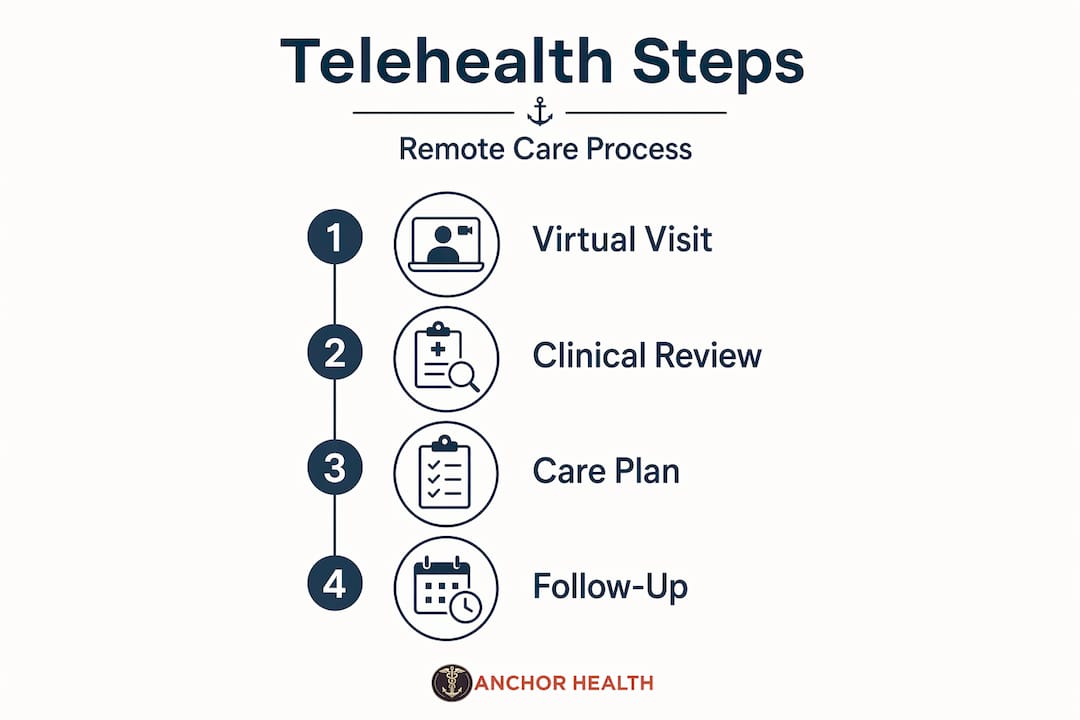
What I’ve also learned is that policy and infrastructure gaps remain significant. Broadband access, insurance coverage for telehealth services, and licensure laws that restrict cross-state care all limit what is possible. These are not problems individual women can solve alone. But you can advocate for yourself by choosing providers who prioritize continuity, asking hard questions about care coordination, and refusing to accept episodic care as the standard.
The most encouraging thing I’ve witnessed is women using telehealth not just to manage illness but to take genuine ownership of their health, on their own terms, from wherever they live. That shift in agency matters as much as any clinical outcome.
— Paule
How Myanchorhealthpc supports women’s health remotely
If you are looking for telehealth care that takes your full health picture seriously, Myanchorhealthpc offers relationship-based primary care, women’s health services, and mental health support through secure video visits. The practice’s Anchored Care℠ᴵᴾ model is built around continuity, meaning you work with a consistent provider who knows you over time, not a rotating roster of strangers.
For women managing their health from home, having the right tools alongside your telehealth care matters. Myanchorhealthpc offers practical at-home health products including digital thermometers for remote monitoring and support devices for symptom management. If you are navigating perimenopause or hormonal changes, their detailed guide on perimenopause symptoms is a strong starting point for understanding what to expect and how to manage it with proper clinical support. Myanchorhealthpc accepts insurance and offers membership options for enhanced access, currently serving patients across Maryland.
FAQ
How does telehealth help women in rural areas access care?
Telehealth eliminates the need for long-distance travel to access primary care, mental health support, and reproductive health services. Women in remote areas can connect with a consistent provider via secure video visit, improving care continuity and reducing the time and cost burden of in-person appointments.
What women’s health services are available through telehealth?
Most quality telehealth platforms offer virtual primary care, mental health counseling, reproductive health management, perimenopause and menopause support, and chronic disease management. Integrated providers coordinate these services so your care is not fragmented across disconnected specialists.
Is telehealth private and secure for sensitive health topics?
Yes. Reputable telehealth providers use HIPAA-compliant platforms that protect your health information. You can also take steps on your end, such as using headphones and scheduling appointments when you have privacy, to make conversations about sensitive topics more comfortable.
What if my internet connection is unreliable in a rural area?
Many telehealth providers offer audio-only phone visit options for patients with low-bandwidth connections. Community libraries and rural health clinics may also provide access to devices and reliable internet for telehealth appointments.
How do I find a telehealth provider that offers continuity of care?
Ask directly whether you will see the same clinician at every visit and how your records are managed across appointments. Providers built around long-term patient relationships, rather than on-demand urgent care models, are far better suited to managing ongoing women’s health needs remotely.
Recommended
- Digital Thermometer Archives – My Anchor Health PC – Maryland
- Support Stick Archives – My Anchor Health PC – Maryland
- 503 Service Unavailable
Blog & Information Disclaimer
Last Updated: May 23, 2026
The information provided on the Anchor Health website (https://myanchorhealthpc.com/), including but not limited to blog posts, articles, newsletters, graphics, and other materials (collectively, the "Content"), is for general informational and educational purposes only.
By accessing and using this website, you acknowledge and agree to the following terms and conditions:
The Content on this website is not intended to be a substitute for professional medical advice, diagnosis, or treatment. Always seek the advice of your physician, nurse practitioner, or other qualified health provider with any questions you may have regarding a medical condition. Never disregard professional medical advice or delay in seeking it because of something you have read on this website.
Reading, interacting with, or sharing the Content on this website does not establish a patient-provider relationship between you and Anchor Health or any of its clinicians, including Paule Valery Joseph, PhD, MBA, CRNP, FAAN. A formal patient-provider relationship is only established after you have completed the formal intake process, signed our clinical consent forms, and participated in a secure clinical consultation.
If you are experiencing a medical emergency, call 911 or seek emergency medical services immediately.
Anchor Health is a primary care practice and does not provide emergency or crisis intervention services through its website or blog.
While Anchor Health strives to provide thoughtful, evidence-based information grounded in our Anchored Care℠ model, healthcare is a rapidly evolving field. We make no representations or warranties, express or implied, about the completeness, accuracy, reliability, or suitability of the information contained in the Content. Any reliance you place on such information is strictly at your own risk.
Anchor Health is a telehealth practice providing services to patients physically located within the state of Maryland. The information provided on this blog is intended for residents of Maryland and is governed by the laws and regulations of that state. Accessing this information from outside of Maryland does not imply that our clinicians are licensed to practice medicine or provide consultations in your jurisdiction.
Content related to Weight & Metabolic Health, including discussions of GLP-1 medications or other medical therapies, is provided for educational context regarding our clinical approach. Prescriptions and specific medical recommendations are only made following a comprehensive clinical evaluation, diagnostic testing, and shared decision-making within a formal patient-provider relationship.
This website may contain links to external websites that are not provided or maintained by or in any way affiliated with Anchor Health. Please note that Anchor Health does not guarantee the accuracy, relevance, timeliness, or completeness of any information on these external websites.
To the fullest extent permitted by law, Anchor Health, its owners, and its employees shall not be liable for any direct, indirect, incidental, consequential, or punitive damag
Related posts