What Is a Primary Care Medical Home: Family Guide

Most people hear “primary care medical home” and picture a special clinic or a building where you live with your doctor. That’s one of the most common misunderstandings in healthcare today. A primary care medical home is not a place at all. It’s a model of care, a framework built around you and your family that makes healthcare more coordinated, more personal, and genuinely more effective. Understanding this distinction can change how you choose providers, manage chronic conditions, and get the most from every medical interaction you have.
Table of Contents
- Key takeaways
- What is a primary care medical home, exactly
- Real benefits families experience with medical homes
- Common misconceptions about the medical home model
- How to find and engage with a medical home
- My perspective on why medical homes matter more than ever
- How Myanchorhealthpc supports your care at home
- FAQ
Key takeaways
| Point | Details |
|---|---|
| Not a physical location | A primary care medical home is a care philosophy, not a building or single facility. |
| Seven guiding principles | The model is built on principles like whole-person care, coordinated services, and enhanced access. |
| Better outcomes for families | Medical homes improve quality, reduce costs, and increase satisfaction for patients and clinicians. |
| Chronic condition support | Continuous, team-based care makes medical homes especially valuable for managing ongoing health needs. |
| Find certified practices | NCQA recognition helps families identify practices that genuinely meet medical home standards. |
What is a primary care medical home, exactly
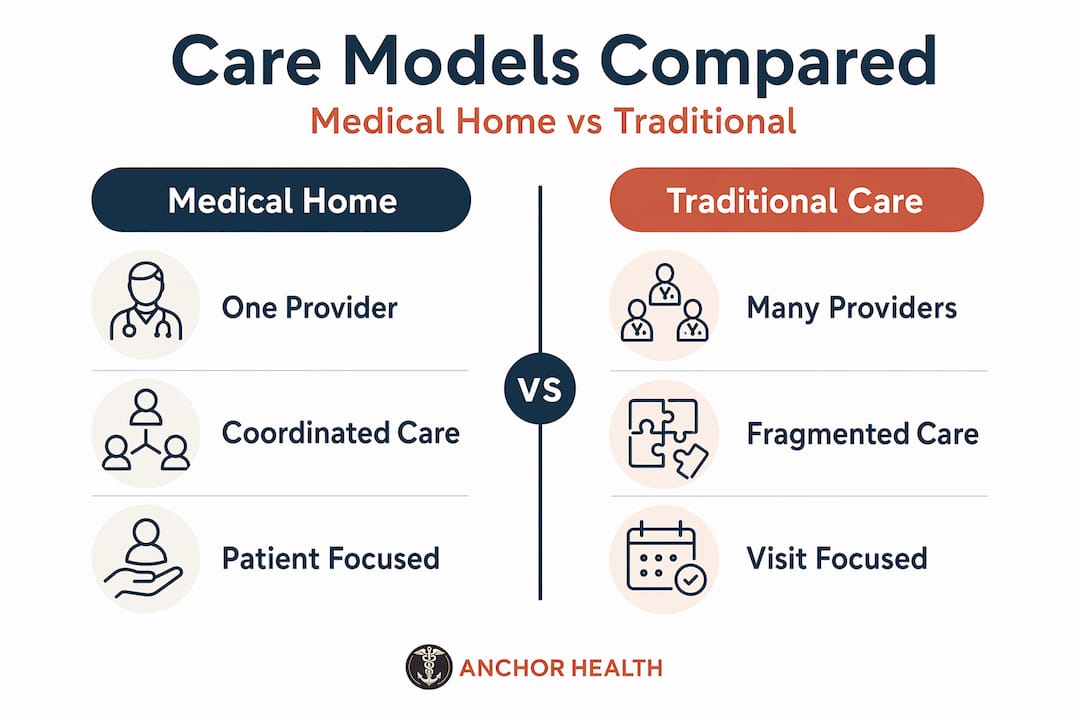
The clearest way to understand the definition of medical home is this: it’s a primary care model where one consistent provider, usually a physician or advanced practice clinician, leads a coordinated team that takes responsibility for the majority of your health needs over time. The goal is whole-person care, not just treating one symptom or condition at one visit.
Seven core principles anchor this model, endorsed by major medical organizations. Here’s what each one means for you as a patient:
| Principle | What it means for you |
|---|---|
| Personal physician | You have one dedicated provider who knows your history |
| Physician-directed practice | Your provider leads a coordinated care team on your behalf |
| Whole-person orientation | Your physical, mental, and preventive needs are all addressed |
| Coordinated care | Specialists, hospitals, and community services work together |
| Quality and safety | Evidence-based practices guide your treatment decisions |
| Enhanced access | Shorter waits, extended hours, and after-hours communication |
| Appropriate payment | Payment structures support the time needed for thorough care |
The distinction between philosophy and location matters more than most patients realize. A medical home is a philosophy and care coordination model that transforms your role from passive recipient to active healthcare partner. You’re not receiving care that happens to you. You’re working with a team that knows you, tracks your health over time, and proactively connects the dots between your different needs.
Pro Tip: When you’re evaluating a new primary care practice, ask directly: “Do you operate as a patient-centered medical home?” Practices committed to this model will know exactly what you mean and be able to describe their team structure and care coordination processes clearly.
To get a broader picture of family primary care across different life stages, it helps to see how the medical home approach applies from childhood through adulthood.
Real benefits families experience with medical homes
Understanding how a medical home works in practice means looking at what changes for you and your family day to day. The differences are meaningful, and the research behind them is solid.
Here are the core benefits patients and families consistently experience:
- Shorter wait times and extended hours. Medical homes prioritize access, often offering same-day or next-day appointments, evening availability, and telehealth options so you don’t have to wait weeks for routine care.
- After-hours support. When your child develops a fever at 10 p.m., a true medical home offers a way to reach your care team rather than defaulting to an emergency room. This alone reduces unnecessary ER visits and associated costs.
- Coordinated specialist referrals. Your primary care provider doesn’t just hand you a phone number. They communicate directly with specialists, share your records, and follow up on outcomes. You stay informed throughout.
- Preventive care that doesn’t fall through the cracks. Because the same team tracks your health longitudinally, screenings, immunizations, and wellness checks are proactively scheduled rather than forgotten between visits.
- Better management of chronic conditions. Patients with diabetes, hypertension, asthma, or other ongoing conditions benefit significantly from the continuous, monitored care a medical home provides.
Medical homes improve population health, quality, patient satisfaction, and clinical outcomes while reducing overall costs. That’s not a small claim. It reflects consistent findings across multiple studies and health systems.
The impact on health equity is also worth naming directly. PCMH combined with stable insurance has been shown to eliminate healthcare disparities for racial and ethnic minorities, improving access in rural and underserved communities where fragmented care has historically caused the most harm.

Pro Tip: To get the most from your medical home, bring a written list of all your current providers, medications, and recent test results to your first appointment. The care team can only coordinate effectively when they have a full picture of your health history from the start.
Common misconceptions about the medical home model
Even people who’ve heard the term “medical home” often carry assumptions that don’t match reality. Clearing up these misunderstandings helps you set realistic expectations and advocate more effectively for the care you deserve.
| Misconception | Reality |
|---|---|
| It’s a physical building or clinic | It’s a care model and philosophy, not a location |
| It covers all specialist and hospital costs | It coordinates care but doesn’t change your insurance coverage |
| Medical home and direct primary care are the same | DPC is a payment model; medical home is a care philosophy |
| Any primary care office qualifies | Only practices meeting specific standards qualify as medical homes |
| It’s only relevant for sick or elderly patients | It benefits people of all ages, including healthy children and adults |
The confusion between direct primary care and medical home models is especially common. Direct primary care, often called DPC, is a membership-style payment arrangement where you pay a monthly fee directly to your doctor, bypassing insurance for primary care services. A medical home, by contrast, is about how care is delivered, not how it’s paid for. A practice can be both a DPC practice and a medical home, or neither, or just one of the two.
Another frequent misunderstanding involves specialist and hospital coverage. Your medical home coordinates those services and ensures communication flows between your providers. It doesn’t automatically pay for them. Your insurance coverage remains the determining factor for cost. Knowing this prevents frustrating surprises when a specialist bill arrives.
The certification question also matters. Not every practice that calls itself a medical home has earned that designation through a recognized process. NCQA recognition signals that a practice has met rigorous standards for team-based care, accessibility, and coordinated care quality. It’s the clearest external validation available to families evaluating their options.
How to find and engage with a medical home
Finding a genuine primary care medical home takes more than a quick internet search. Here’s a practical sequence to follow:
-
Search for NCQA-recognized practices. The National Committee for Quality Assurance maintains a searchable directory of practices that have earned Patient-Centered Medical Home recognition. Start there before searching general provider directories.
-
Ask targeted questions during your first contact. Specifically ask whether the practice uses a team-based care model, how after-hours concerns are handled, and how they coordinate with specialists and hospitals. Vague answers are a signal.
-
Understand their care coordination process. A true medical home will describe a specific process for managing referrals, following up on test results, and communicating between your different providers. If they can’t explain it clearly, coordination may not be happening in practice.
-
Review their quality metrics. Many NCQA-recognized practices share data on patient satisfaction, preventive care completion rates, and chronic disease management outcomes. Ask for this information or look for it on their website.
-
Clarify communication channels. Find out whether you can message your care team directly, whether telehealth is available, and what the expected response time is for non-urgent questions. These factors determine how accessible your medical home actually is in daily life.
-
Establish your role as an active partner. A medical home works best when patients engage consistently. Attend scheduled wellness visits even when you feel healthy, keep your contact information updated, and communicate changes in your health status between appointments.
State-level investment in this model is growing. California, for example, has set a target of directing 15% of all healthcare spending toward primary care by 2034, using multipayer models that specifically support advanced medical home functions like care management. What this means practically is that more practices in more states are being incentivized to adopt the medical home framework, which expands your options as a patient.
Nationally, less than 48.6% of families reported that their child received coordinated, ongoing, comprehensive care in a well-functioning medical home as of recent data. The national target is 53.6%. There is room to grow, and your active engagement as a healthcare consumer moves that number in the right direction.
My perspective on why medical homes matter more than ever
I’ve spent years watching families navigate a healthcare system that was never designed with continuity in mind. The default experience for most people is a series of disconnected appointments with providers who have incomplete information about each other’s decisions. The medical home model is the clearest antidote to that fragmentation I’ve seen.
What strikes me most is how much the model asks of both sides. Providers commit to accountability across the full arc of a patient’s health, not just the presenting complaint. Patients commit to engagement, communication, and showing up consistently. When both sides honor that commitment, the outcomes are genuinely different. I’ve seen families with complex chronic conditions finally get organized, proactive care rather than reactive crisis management.
The honest challenge is that care teams in medical homes are increasingly accountable for the majority of an individual’s health needs over time, and not every practice has built the infrastructure to deliver on that promise. Certification matters. Asking the right questions matters. Patients who understand what a medical home should look and feel like are the ones who find practices that actually deliver it.
The future of this model points toward even greater integration of telehealth, mental health, and community-based resources. For families navigating busy schedules, chronic conditions, or health transitions, that future is worth seeking out now, not later.
— Paule
How Myanchorhealthpc supports your care at home
At Myanchorhealthpc, we built our Anchored Care℠ model around the same principles that define a patient-centered medical home: continuity, coordination, and care that knows you over time. As a Maryland-based telehealth primary care provider, we deliver thorough, relationship-based care through secure video visits for all ages, from pediatric and adolescent health to chronic condition management and women’s health.
For families taking an active role in their health, Myanchorhealthpc also offers practical home care tools, including digital thermometers for health monitoring at home, support sticks for daily wellness support, and protective supplies like bandages and face masks that keep your family prepared. Good primary care extends beyond the visit, and we’re here to support that every step of the way.
FAQ
What does “primary care medical home” mean?
A primary care medical home is a model of care, not a physical location, where a consistent provider leads a coordinated team responsible for your whole-person health needs over time. It emphasizes ongoing relationships, coordinated services, and patient-centered care rather than isolated visits.
How is a medical home different from traditional primary care?
In traditional primary care, each visit is often treated independently, with limited coordination between providers. A medical home integrates your care across specialists, hospitals, and community resources with one accountable team tracking your health continuously.
Who benefits most from a primary care medical home?
Everyone benefits, but families managing chronic conditions, children with complex health needs, and individuals navigating multiple specialists see the greatest impact because coordinated, continuous care prevents gaps that fragmented systems routinely create.
How do I know if a practice is a real medical home?
Look for practices with NCQA Patient-Centered Medical Home recognition, which signals the practice meets verified standards for team-based, accessible, and coordinated care. Ask about their after-hours support, referral process, and care team structure.
Does a medical home change what my insurance covers?
No. A medical home is a care delivery model, not an insurance product. Your insurance coverage for specialists, hospitals, and medications remains the same. What changes is how well your care is coordinated across those services.
Recommended
- Family Primary Care Best Practices for Every Age
- face mask Archives – My Anchor Health PC – Maryland
- Support Stick Archives – My Anchor Health PC – Maryland
- Digital Thermometer Archives – My Anchor Health PC – Maryland
Blog & Information Disclaimer
Last Updated: May 23, 2026
The information provided on the Anchor Health website (https://myanchorhealthpc.com/), including but not limited to blog posts, articles, newsletters, graphics, and other materials (collectively, the "Content"), is for general informational and educational purposes only.
By accessing and using this website, you acknowledge and agree to the following terms and conditions:
The Content on this website is not intended to be a substitute for professional medical advice, diagnosis, or treatment. Always seek the advice of your physician, nurse practitioner, or other qualified health provider with any questions you may have regarding a medical condition. Never disregard professional medical advice or delay in seeking it because of something you have read on this website.
Reading, interacting with, or sharing the Content on this website does not establish a patient-provider relationship between you and Anchor Health or any of its clinicians, including Paule Valery Joseph, PhD, MBA, CRNP, FAAN. A formal patient-provider relationship is only established after you have completed the formal intake process, signed our clinical consent forms, and participated in a secure clinical consultation.
If you are experiencing a medical emergency, call 911 or seek emergency medical services immediately.
Anchor Health is a primary care practice and does not provide emergency or crisis intervention services through its website or blog.
While Anchor Health strives to provide thoughtful, evidence-based information grounded in our Anchored Care℠ model, healthcare is a rapidly evolving field. We make no representations or warranties, express or implied, about the completeness, accuracy, reliability, or suitability of the information contained in the Content. Any reliance you place on such information is strictly at your own risk.
Anchor Health is a telehealth practice providing services to patients physically located within the state of Maryland. The information provided on this blog is intended for residents of Maryland and is governed by the laws and regulations of that state. Accessing this information from outside of Maryland does not imply that our clinicians are licensed to practice medicine or provide consultations in your jurisdiction.
Content related to Weight & Metabolic Health, including discussions of GLP-1 medications or other medical therapies, is provided for educational context regarding our clinical approach. Prescriptions and specific medical recommendations are only made following a comprehensive clinical evaluation, diagnostic testing, and shared decision-making within a formal patient-provider relationship.
This website may contain links to external websites that are not provided or maintained by or in any way affiliated with Anchor Health. Please note that Anchor Health does not guarantee the accuracy, relevance, timeliness, or completeness of any information on these external websites.
To the fullest extent permitted by law, Anchor Health, its owners, and its employees shall not be liable for any direct, indirect, incidental, consequential, or punitive damag
Related posts