How to Choose Telehealth Primary Care for Your Family

Finding reliable primary care for your family feels harder than it should. Appointments book weeks out, office hours rarely fit around school drop-offs, and getting three kids seen in the same day can seem almost impossible. That’s exactly why more families are choosing to choose telehealth primary care as their go-to framework for ongoing health management. In medicine, this model is more formally called virtual primary care, and it covers everything from annual wellness visits to chronic disease follow-up, all through secure video. This guide walks you through what it actually involves, how to assess your family’s specific needs, and what to look for when selecting the right provider.
Table of Contents
- Key takeaways
- What telehealth primary care means for busy families
- Assessing your family’s healthcare needs
- How to select a telehealth family doctor
- Making the most of your telehealth visits
- Common challenges and how to handle them
- My perspective on choosing virtual primary care
- How Myanchorhealthpc supports your family’s care
- FAQ
Key takeaways
| Point | Details |
|---|---|
| Know your family’s needs first | Identify ages, chronic conditions, and the types of visits your family uses most before comparing providers. |
| Insurance details matter most | Confirm telehealth coverage, referral rules, and copay structures with your plan before your first visit. |
| Pediatric suitability has limits | Telehealth works well for stable, visually assessable conditions in children, but some situations require in-person care. |
| Continuity beats convenience | A consistent virtual provider who knows your family’s history delivers better outcomes than rotating urgent care apps. |
| Prepare every visit like an office visit | Gathering symptoms, questions, and medication lists ahead of time leads to more productive appointments. |
What telehealth primary care means for busy families
Virtual primary care, also called telehealth primary care, is the delivery of ongoing, relationship-based medical care through secure video or phone. It is not the same as a one-off urgent care app. The distinction matters. When families understand what is telehealth primary care for busy families in this fuller sense, they stop treating it as a last resort and start using it as their main healthcare home.
The benefits are concrete and practical:
- Flexible scheduling. Evening and weekend slots are far more common with telehealth providers than traditional offices.
- No travel or waiting rooms. You save 60 to 90 minutes per visit on average, which adds up fast across a family of four.
- Continuity of care. You see the same provider repeatedly, which means they know your child’s asthma history and your own blood pressure trends.
- Accessible chronic management. Follow-ups for conditions like ADHD, diabetes, or anxiety work very well in a virtual format.
- Behavioral and mental health support. Video therapy for mental health and autism spectrum support are clinically validated uses for pediatric telehealth.
Where telehealth falls short is equally worth knowing. Newborns and infants under age two typically need hands-on exams. Acute injuries, high fevers with serious distress, and anything requiring physical assessment, like listening to breath sounds in a sick toddler, are better handled in person. Telehealth is suitable for pediatric care when symptoms can be reliably described or visually demonstrated and where a physical exam is unlikely to change the management plan.
Pro Tip: If your child is over age four and the concern is something you can clearly describe and show on camera, a telehealth visit will usually get you the same clinical answer as an office trip.
Assessing your family’s healthcare needs
Before you compare any providers, take twenty minutes to map out what your family actually needs from primary care. This step prevents you from signing up for a service that looks good on the surface but misses the mark for your specific situation.
Work through the following questions honestly:
- Who needs care and how often? A household with a teenager managing anxiety, a parent with type 2 diabetes, and a seven-year-old has very different needs than a household of healthy adults.
- What specialties matter? Pediatric care, women’s health, and behavioral health each require specific training. Not every telehealth platform offers all three under one roof.
- How comfortable is your household with technology? Reliable internet and a device with a working camera are the minimum. If connectivity is spotty at your address, factor that in.
- What does your insurance cover? Referral rules and costs for virtual visits vary by plan. Some insurance plans treat telehealth visits at the same cost as in-person care, while others impose restrictions or require prior authorization.
The insurance question deserves extra attention. Families using insured telehealth services should understand authorization workflows before booking, because improper navigation can lead to denied claims or unexpected billing. Call your insurer and ask specifically: Does this provider accept my plan? Do telehealth visits require a referral? Are mental health visits covered at the same rate?
You can also learn more about how family primary care options differ by age group before starting your search.
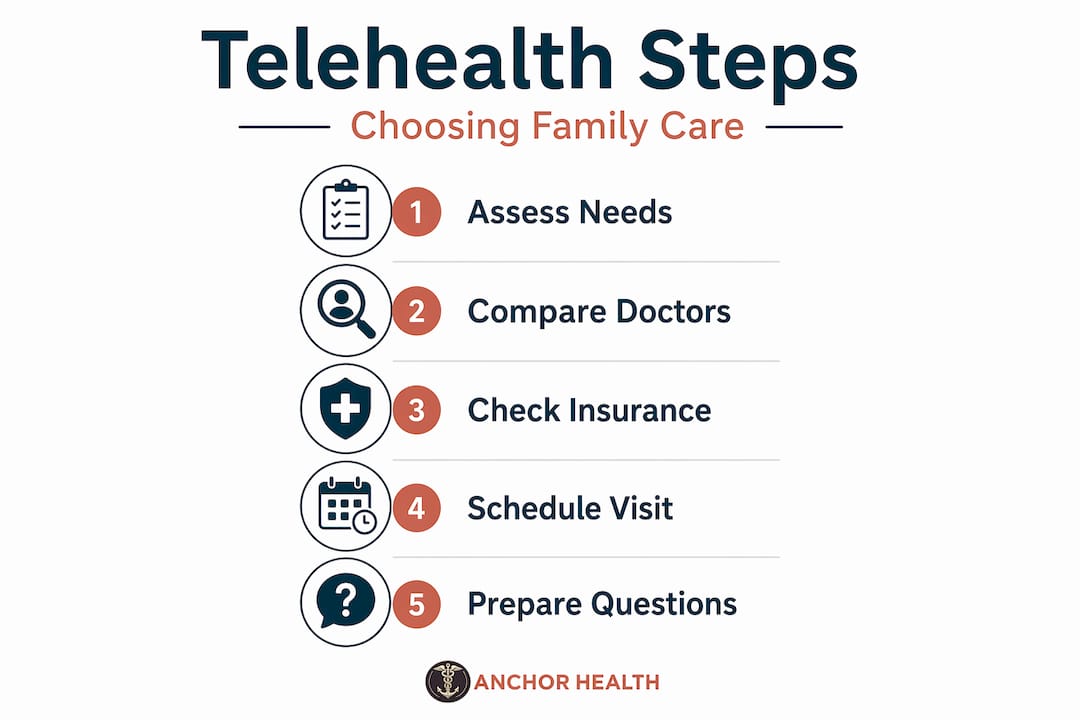
How to select a telehealth family doctor
This is where preparation pays off. Use the following steps to move from a general interest in virtual care to a confident choice in a provider.
- Confirm geographic eligibility. Telehealth providers must be licensed in the state where the patient is located. A provider licensed only in California cannot legally treat your Maryland family, regardless of how strong their reviews are.
- Check age and specialty coverage. Ask whether the practice sees children, what the minimum age is, and whether the same provider handles both pediatric and adult visits. Keeping your family with one practice builds the continuity that drives better outcomes.
- Evaluate the booking process. Can you schedule same-week appointments? Is there a patient portal or app? Scheduling via an established patient app reduces friction for busy families considerably.
- Review communication options. Can you message your provider between visits? Is there a nurse or care coordinator who responds to quick questions? This matters for parents who need a fast answer about a rash or a medication refill.
- Compare cost structures. Some practices offer membership models that provide enhanced access and longer visits for a monthly fee. Others bill per visit through insurance. Neither is inherently better. The right model depends on how frequently your family uses primary care.
- Look for reviews that address continuity. A five-star rating for “fast service” tells you less than a review that says “we’ve seen the same doctor for two years and she knows my son’s full history.”
| What to compare | Why it matters |
|---|---|
| State licensing | Provider must be licensed where you live |
| Age range covered | Confirms care for children and adults |
| Insurance accepted | Prevents billing surprises after visits |
| Appointment availability | Reflects how accessible care will actually be |
| Communication tools | Determines ease of follow-up between visits |
Pro Tip: Ask the practice directly: “Will my family see the same provider consistently?” If the answer is vague, that’s a meaningful signal about their care model.
Making the most of your telehealth visits
Once you’ve chosen a provider, the quality of your care is partly in your hands. Telehealth visits reward families who come prepared.
Before the appointment:
- Write down the specific symptom, when it started, and anything that makes it better or worse.
- Have a current medication list ready, including dosages and any supplements.
- Know your child’s weight and recent temperature if the visit is for illness.
- Prepare two or three focused questions so you don’t leave the call missing key information.
During the call, place your device at eye level with good lighting in front of you. If your child is the patient, keep them close enough to the camera that the provider can see their face, eyes, and any visible symptoms. Family members or caregivers can join via a secure video link before or during the appointment, which is especially helpful when a grandparent or co-parent needs to be included.
Understand the limits ahead of time. Telehealth works best when a visual and symptomatic assessment is sufficient and no hands-on exam is required. If your provider recommends an in-person follow-up, take that recommendation seriously. It is not a failure of the technology. It is the system working correctly.
“The goal is not to replace in-person care entirely. The goal is to get the right care at the right time, without unnecessary friction for your family.”
Common challenges and how to handle them
Even with a good provider in place, families sometimes hit obstacles. Here’s what comes up most often and how to work through it.
- Technical problems during a call. Test your audio and video before the appointment starts. If a call drops mid-visit, most providers have a protocol to call you directly or reconnect through the portal. Keep your provider’s office phone number saved in your contacts.
- Insurance confusion after a visit. Authorization and referral requirements vary by plan and patient category. If a claim is denied, request an itemized explanation from your insurer and ask your provider’s billing team to reclassify or resubmit if appropriate.
- Physical exams that telehealth cannot replace. When a pediatric visit involves a condition that requires hands-on assessment, your provider should tell you clearly and refer you to an in-person site. If they don’t, ask directly: “Does my child need to be seen in person for this?”
- Privacy questions. Reputable telehealth providers use HIPAA-compliant video platforms. Before your first visit, confirm that the platform is encrypted and that your family’s records are stored securely. You should receive a notice of privacy practices before or at your first appointment.
My perspective on choosing virtual primary care
I’ve spent years watching families navigate the healthcare system, and the families who get the most out of telehealth are almost never the ones with the fastest internet connection. They’re the ones who treat their virtual provider the same way they would a trusted family doctor they’ve known for a decade.

The biggest misconception I encounter is that telehealth is primarily a convenience play. It is. But when families choose a provider for convenience alone, without checking whether that provider has pediatric training, accepts their insurance, or even offers continuity across visits, they end up frustrated. Fast access to a rotating pool of strangers is not the same as relationship-based care.
What I tell families is this: the provider selection decision is worth one careful afternoon of your time. Check licensing, verify insurance, ask about their model for ongoing relationships. Then commit to that provider the same way you would a brick-and-mortar practice. Bring your full history to the first visit. Show up prepared. Build the relationship over time.
Telehealth can genuinely deliver everything traditional primary care offers for the majority of your family’s health needs. But it works best when it mirrors the structure of good in-person care, including consistency, thoroughness, and a provider who actually knows your family.
— Paule
How Myanchorhealthpc supports your family’s care
If you’re ready to move from research to action, Myanchorhealthpc offers telehealth primary care built around exactly the kind of continuity this article has described. The practice covers care for all ages, including pediatric and adolescent health, women’s health, and behavioral support, all through secure video visits in Maryland. There’s no rushed appointment, no rotating roster of providers you’ve never met before.

For families with children, their pediatric telehealth resource explains in detail what virtual care can and can’t do for kids at different ages. If you want a broader picture of how telehealth fits your family’s access to care, Maryland families and telehealth access is worth reading before you book. Myanchorhealthpc accepts insurance and also offers membership options for families who want enhanced access and longer visits.
FAQ
What does telehealth primary care actually cover?
Virtual primary care covers wellness visits, chronic disease management, prescription refills, behavioral health, and sick visits for stable conditions. It does not replace care that requires a physical exam or hands-on testing.
Is telehealth appropriate for my child?
Children over age four with stable symptoms that can be visually assessed are generally good candidates. Newborns, serious distress, and conditions requiring hands-on exams should be seen in person.
How do I confirm my insurance covers telehealth visits?
Call your insurer directly and ask whether virtual visits are covered, whether referrals are required, and what the copay structure is. Cost and referral rules for telehealth vary significantly by plan.
Can multiple family members be on the same telehealth call?
Yes. Many providers allow a parent, caregiver, or family member to join the visit through a secure link. Confirm this option when you book so the provider can set up the call accordingly.
How is choosing virtual primary care different from a telehealth urgent care app?
A telehealth primary care provider maintains your ongoing records, manages chronic conditions, and sees you consistently over time. Urgent care apps typically offer one-off visits with no continuity, which limits the quality of care for anything beyond simple acute concerns.
Recommended
- Family Primary Care Best Practices for Every Age
- Telehealth for Kids Explained: What Parents Need to Know
- How telehealth expands healthcare access for Maryland families
- Digital Thermometer Archives – My Anchor Health PC – Maryland
Blog & Information Disclaimer
Last Updated: May 23, 2026
The information provided on the Anchor Health website (https://myanchorhealthpc.com/), including but not limited to blog posts, articles, newsletters, graphics, and other materials (collectively, the "Content"), is for general informational and educational purposes only.
By accessing and using this website, you acknowledge and agree to the following terms and conditions:
The Content on this website is not intended to be a substitute for professional medical advice, diagnosis, or treatment. Always seek the advice of your physician, nurse practitioner, or other qualified health provider with any questions you may have regarding a medical condition. Never disregard professional medical advice or delay in seeking it because of something you have read on this website.
Reading, interacting with, or sharing the Content on this website does not establish a patient-provider relationship between you and Anchor Health or any of its clinicians, including Paule Valery Joseph, PhD, MBA, CRNP, FAAN. A formal patient-provider relationship is only established after you have completed the formal intake process, signed our clinical consent forms, and participated in a secure clinical consultation.
If you are experiencing a medical emergency, call 911 or seek emergency medical services immediately.
Anchor Health is a primary care practice and does not provide emergency or crisis intervention services through its website or blog.
While Anchor Health strives to provide thoughtful, evidence-based information grounded in our Anchored Care℠ model, healthcare is a rapidly evolving field. We make no representations or warranties, express or implied, about the completeness, accuracy, reliability, or suitability of the information contained in the Content. Any reliance you place on such information is strictly at your own risk.
Anchor Health is a telehealth practice providing services to patients physically located within the state of Maryland. The information provided on this blog is intended for residents of Maryland and is governed by the laws and regulations of that state. Accessing this information from outside of Maryland does not imply that our clinicians are licensed to practice medicine or provide consultations in your jurisdiction.
Content related to Weight & Metabolic Health, including discussions of GLP-1 medications or other medical therapies, is provided for educational context regarding our clinical approach. Prescriptions and specific medical recommendations are only made following a comprehensive clinical evaluation, diagnostic testing, and shared decision-making within a formal patient-provider relationship.
This website may contain links to external websites that are not provided or maintained by or in any way affiliated with Anchor Health. Please note that Anchor Health does not guarantee the accuracy, relevance, timeliness, or completeness of any information on these external websites.
To the fullest extent permitted by law, Anchor Health, its owners, and its employees shall not be liable for any direct, indirect, incidental, consequential, or punitive damag
Related posts