Telehealth for Kids Explained: What Parents Need to Know

Most parents assume that a video call with a doctor is a compromise. A fallback for when you can’t get a real appointment. The truth is more reassuring. Telehealth for kids explained properly reveals that many pediatric conditions are managed just as effectively through a secure video visit as they are in a clinic room. This guide walks you through exactly how virtual healthcare for children works, when it makes sense to use it, what to prepare, and when your child genuinely needs to be seen in person.
Table of Contents
- Key takeaways
- Telehealth for kids explained: how visits actually work
- Benefits of telehealth for kids
- When telehealth works and when it does not
- How to prepare for your child’s telehealth visit
- Insurance, cost, and coverage basics
- My perspective on pediatric telehealth
- Pediatric telehealth care with Myanchorhealthpc
- FAQ
Key takeaways
| Point | Details |
|---|---|
| Telehealth quality is real | Studies show pediatric telehealth outcomes often match in-person visits for many common conditions. |
| Know when to use it | Telehealth works well for stable symptoms, chronic condition follow-ups, and behavioral health concerns. |
| Preparation matters | Having medication lists, pharmacy info, and symptom notes ready makes visits faster and more effective. |
| Insurance usually covers it | Most health plans and Medicaid/CHIP programs cover pediatric telehealth, though specifics vary by state and plan. |
| Some situations require in-person care | Infants under 3 months with fever, respiratory distress, and emergencies always need in-person evaluation. |
Telehealth for kids explained: how visits actually work
Pediatric telehealth is the delivery of medical care to children through technology, typically a secure video call, though phone and messaging tools are also used. Telemedicine covers a wide range of services including primary care, mental health therapy, chronic disease management, dermatology consultations, developmental screening, and even lactation support.
Here is how a typical pediatric telehealth visit flows from start to finish:
- Schedule the appointment. You book online or by phone, selecting a time that works for your family. Many practices offer same-day or next-day availability for acute concerns.
- Complete intake forms. Before the visit, you will fill out a brief health history or update your child’s existing record. This is also where you note current symptoms, medications, and any questions.
- Join the virtual waiting room. At the appointment time, you log in through a secure link or app. Families join a virtual waiting room and are connected to the provider when they are ready. Specialists or interpreters can join the same call if needed.
- The video encounter. The clinician will ask you to describe symptoms, observe your child on camera, and may ask you to assist with a visual exam. You might be asked to look in your child’s throat, press gently on their abdomen, or hold the camera close to a rash. Your narration and the camera become the clinician’s tools.
- Wrap-up and follow-up. The provider shares their assessment, sends prescriptions directly to your pharmacy if needed, and outlines any follow-up steps. You receive a visit summary electronically.
Your role as a parent during the visit is more active than it would be in a clinic. You are the clinician’s eyes and hands. That is not a limitation. It is a feature of the model that works well when you are prepared.
Pro Tip: Before the visit starts, do a quick camera test. Point your phone or tablet at a bright window and practice zooming in on your child’s face, throat, and skin. Knowing how to position the camera saves time and helps the clinician see what they need.
Benefits of telehealth for kids
The advantages of virtual healthcare for children go well beyond convenience, though convenience alone is significant. No travel time, no waiting room exposure, no disrupting your child’s school day for a 15-minute visit.
The benefits of telemedicine for kids include:
- Comparable quality of care. Telehealth outcomes are often comparable to in-person visits for many pediatric conditions. Many visits can be resolved through conversation and visual observation alone, without a hands-on exam.
- Reduced germ exposure. Waiting rooms in pediatric clinics concentrate sick children in one space. A telehealth visit eliminates that exposure entirely, which matters especially for immunocompromised children or newborns.
- Better access to specialists. Families in rural areas or those without reliable transportation can access pediatric specialists, mental health providers, and developmental experts without a long drive.
- Lower antibiotic prescribing. Research published in JAMA Network Open found that telemedicine integrated with primary care is linked to lower antibiotic prescribing rates for respiratory infections in children, consistent with clinical guidelines. That is a meaningful public health benefit.
- Less stress for anxious children. Children who experience medical anxiety often do better in familiar surroundings. Being at home, in their own space, with their own comfort items, can make a clinical conversation feel less threatening.
“Telemedicine does not mean lower quality care for many pediatric conditions. Studies show that outcomes are often comparable to in-person visits, and many visits can be handled through conversation alone.” — Children’s Mercy
For families managing ongoing conditions like asthma, ADHD, or eczema, telehealth services for youth offer a consistent way to check in with a trusted provider without the friction of repeated clinic visits.
When telehealth works and when it does not
Understanding the limits of telehealth is just as important as knowing its strengths. Not every situation is appropriate for a video visit, and knowing the difference keeps your child safe.
Conditions well-suited to telehealth
Telehealth is generally appropriate when symptoms are behavioral, developmental, or related to a stable chronic condition. It also works well when a parent can reliably describe and show the symptoms on camera, when no physical exam finding would change the treatment plan, and when the child is older than 4 years.
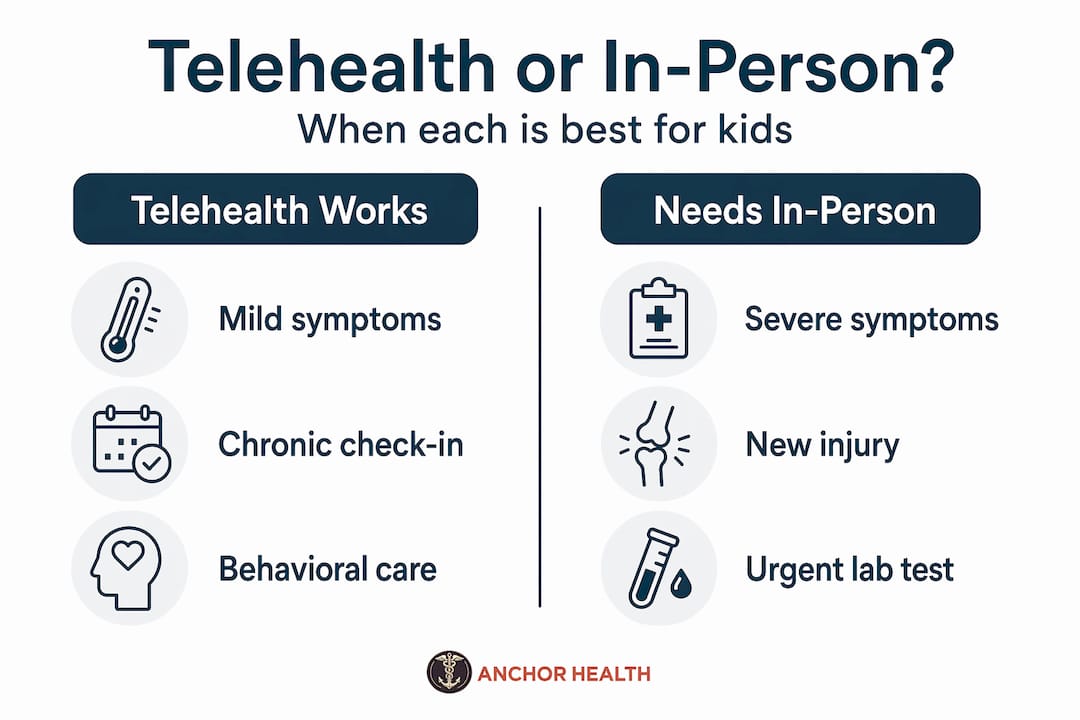
| Suitable for telehealth | Requires in-person care |
|---|---|
| Mild cold, cough, or congestion | Difficulty breathing or respiratory distress |
| Rash with no systemic symptoms | Fever in infants under 3 months |
| ADHD or behavioral health follow-up | Suspected fractures or injuries needing imaging |
| Chronic condition check-ins (asthma, eczema) | Abdominal pain that is severe or worsening |
| Developmental screening and concerns | Any situation requiring hands-on physical exam |
| Mental health therapy sessions | Suspected ear infections in very young children |
The American Academy of Pediatrics advises that telehealth is suitable for nonemergency, stable pediatric care and is not a replacement for urgent or emergency visits. If your child has a high fever and is under three months old, call your provider immediately and go to an emergency room. Do not wait for a video appointment.
Telehealth is a complement to your child’s overall care. It is one tool in a broader framework, not a substitute for every clinical need. Knowing which primary care concerns fit which setting is something you can explore further in this guide to family primary care practices.
Pro Tip: When you are unsure whether your child’s situation is right for telehealth, call the provider’s office before booking. A brief triage call can confirm whether a video visit is appropriate or whether your child needs to be seen in person.
How to prepare for your child’s telehealth visit
Preparation is the single biggest factor in whether a pediatric telehealth visit goes smoothly. Parents often overlook the practical details that make a real difference in visit quality.
Here is what to have ready before you log in:
- Medication list. Write down every medication your child takes, including the dose and frequency. Include vitamins and supplements. This helps the clinician complete a medication review without back-and-forth.
- Pharmacy information. Know your preferred pharmacy name, location, and phone number. If a prescription is needed, this speeds up the process significantly.
- Symptom notes. Jot down when symptoms started, how they have changed, and anything that makes them better or worse. Photos of rashes, swelling, or visible symptoms taken before the visit are extremely useful.
- Your questions. Write them down. It is easy to forget what you wanted to ask once the visit starts.
On the technical side, charge your device fully before the appointment. Test your internet connection. Find a quiet, well-lit room where your child can sit comfortably and where you have privacy. For older children and adolescents, privacy during the visit is not just a courtesy. It is clinically important. Teenagers are more likely to share honest information about mental health, substance use, or sexual health when they feel they are not being overheard.
If your video connection fails during the visit, do not panic. Audio-only telehealth can be used when patients cannot access or do not consent to video, with specific billing rules that most providers are prepared to handle. Switching to a phone call mid-visit is a recognized and covered option in many states.

Pro Tip: For younger children, have a comfort item nearby and let them know the doctor will be on the screen before the visit starts. A brief, calm explanation reduces resistance and helps the visit start on a positive note.
Insurance, cost, and coverage basics
One of the most common questions parents have about online pediatric consultations is whether their insurance will cover the visit. The short answer is: most of the time, yes, but the details vary.
Here is what you need to know:
- Most major health plans cover telehealth. Virtual care services may include wellness exams, urgent care visits, and prescriptions sent directly to pharmacies. Coverage and costs depend on your specific health plan and state laws.
- Medicaid and CHIP coverage is state-specific. Most states now require Medicaid and CHIP programs to cover pediatric telehealth services, but the scope of coverage varies. Check your state’s Medicaid website or call member services directly.
- Copays are often the same as in-person visits. Some plans charge the same copay for a telehealth visit as they do for a clinic visit. Others have reduced or waived telehealth copays. Review your benefits summary or call your insurer before your first visit.
- Video visits and audio-only visits may be billed differently. Audio-only telehealth has its own billing codes and reimbursement rules. If you need to switch from video to phone during a visit, confirm with your provider how that affects your coverage.
- Verify before you book. Call your insurance company and ask specifically whether pediatric telehealth visits with your chosen provider are covered under your plan. Ask about deductibles, copays, and any prior authorization requirements.
Choosing telehealth through a trusted primary care practice, rather than a general urgent care app, also makes a difference. Continuity with a consistent provider means your child’s history is known, follow-up is built in, and care decisions are made with context.
My perspective on pediatric telehealth
I’ve worked alongside families navigating pediatric telehealth long enough to notice a consistent pattern. Parents who go in skeptical come out surprised. Not because the technology is impressive, but because the visit actually addressed what their child needed.
What I’ve learned is that the quality of a telehealth visit depends far less on the platform and far more on two things: the parent’s ability to describe and show what is happening, and the provider’s willingness to take the time to listen. When both are present, the visit works.
I’ve also seen the other side. Families who booked a telehealth visit for a situation that genuinely needed a physical exam, and who left frustrated because the visit could not give them what they needed. That is not a failure of telehealth. It is a mismatch between the tool and the situation.
My honest take: telehealth is not a lesser version of care. For the right conditions, it is often the better option. Fewer disruptions, less exposure, more comfort for the child. The key is knowing when it fits and being prepared when it does.
— Paule
Pediatric telehealth care with Myanchorhealthpc
At Myanchorhealthpc, we offer pediatric and adolescent telehealth visits for Maryland families through secure video appointments built around continuity and relationship-based care. Our Anchored Care℠ model means your child is seen by a provider who knows their history, not a rotating roster of strangers.

We also carry a selection of at-home health essentials to support your family between visits. A reliable digital thermometer is one of the most useful tools you can have before a telehealth visit. Accurate temperature readings help your provider make faster, more confident decisions. We also offer bandages and support sticks for minor injury management at home. If your family is ready to experience telehealth primary care that actually takes its time with you, visit Myanchorhealthpc to learn more and schedule your first visit.
FAQ
What conditions can telehealth treat in children?
Telehealth is effective for a broad range of pediatric concerns including minor illnesses, rashes, ADHD follow-ups, chronic condition management, developmental screening, and mental health therapy. It is not appropriate for emergencies or situations requiring a hands-on physical exam.
How does telehealth work for children during the visit?
A parent joins a secure video call with the provider, describes symptoms, and uses the camera to show the clinician what they need to see. The provider conducts a visual assessment, asks questions, and develops a care plan, including prescriptions if needed.
Is telehealth safe for kids?
Yes. Telehealth platforms used by licensed providers are required to meet privacy and security standards. The AAP supports telehealth for nonemergency pediatric care when used appropriately and through trusted providers.
Does insurance cover pediatric telehealth visits?
Most major health plans and state Medicaid programs cover pediatric telehealth, though copays, deductibles, and covered services vary. Contact your insurer directly to confirm your child’s specific coverage before booking.
When should I take my child to the ER instead of using telehealth?
Go to the emergency room for respiratory distress, fever in infants under 3 months, suspected fractures, severe abdominal pain, or any situation where your child appears seriously unwell. Telehealth is for stable, nonemergency conditions only.
Recommended
- Family Primary Care Best Practices for Every Age
- Digital Thermometer Archives – My Anchor Health PC – Maryland
- face mask Archives – My Anchor Health PC – Maryland
Blog & Information Disclaimer
Last Updated: May 23, 2026
The information provided on the Anchor Health website (https://myanchorhealthpc.com/), including but not limited to blog posts, articles, newsletters, graphics, and other materials (collectively, the "Content"), is for general informational and educational purposes only.
By accessing and using this website, you acknowledge and agree to the following terms and conditions:
The Content on this website is not intended to be a substitute for professional medical advice, diagnosis, or treatment. Always seek the advice of your physician, nurse practitioner, or other qualified health provider with any questions you may have regarding a medical condition. Never disregard professional medical advice or delay in seeking it because of something you have read on this website.
Reading, interacting with, or sharing the Content on this website does not establish a patient-provider relationship between you and Anchor Health or any of its clinicians, including Paule Valery Joseph, PhD, MBA, CRNP, FAAN. A formal patient-provider relationship is only established after you have completed the formal intake process, signed our clinical consent forms, and participated in a secure clinical consultation.
If you are experiencing a medical emergency, call 911 or seek emergency medical services immediately.
Anchor Health is a primary care practice and does not provide emergency or crisis intervention services through its website or blog.
While Anchor Health strives to provide thoughtful, evidence-based information grounded in our Anchored Care℠ model, healthcare is a rapidly evolving field. We make no representations or warranties, express or implied, about the completeness, accuracy, reliability, or suitability of the information contained in the Content. Any reliance you place on such information is strictly at your own risk.
Anchor Health is a telehealth practice providing services to patients physically located within the state of Maryland. The information provided on this blog is intended for residents of Maryland and is governed by the laws and regulations of that state. Accessing this information from outside of Maryland does not imply that our clinicians are licensed to practice medicine or provide consultations in your jurisdiction.
Content related to Weight & Metabolic Health, including discussions of GLP-1 medications or other medical therapies, is provided for educational context regarding our clinical approach. Prescriptions and specific medical recommendations are only made following a comprehensive clinical evaluation, diagnostic testing, and shared decision-making within a formal patient-provider relationship.
This website may contain links to external websites that are not provided or maintained by or in any way affiliated with Anchor Health. Please note that Anchor Health does not guarantee the accuracy, relevance, timeliness, or completeness of any information on these external websites.
To the fullest extent permitted by law, Anchor Health, its owners, and its employees shall not be liable for any direct, indirect, incidental, consequential, or punitive damag
Related posts