Benefits of Membership-Based Primary Care for Families

Membership-based primary care is a model where patients pay a flat monthly or annual fee for direct, enhanced access to primary healthcare services, bypassing traditional insurance billing entirely. Also called direct primary care (DPC), this approach has gained recognition from organizations like the American Academy of Family Physicians (AAFP) as a patient-centered alternative to conventional insurance-driven medicine. The benefits of membership-based primary care are concrete: longer appointments, predictable costs, direct communication with your doctor, and stronger continuity of care that measurably reduces hospitalizations. For families and individuals tired of rushed visits and surprise bills, understanding this model is the first step toward choosing healthcare that actually fits your life.
1. What are the primary benefits of membership-based primary care?
Membership-based primary care delivers improved access and longer appointments as its most immediate advantages. Instead of a 10-minute slot with a physician managing thousands of patients, you get a provider who knows your history, your family, and your health goals.
The core advantages include:
- Longer visits. DPC practices cap patient panels at 400 to 800 patients per physician, enabling appointments of 30 to 60 minutes. That is two to four times longer than the average traditional primary care visit.
- Direct communication. You can reach your doctor by text, phone, or email. No call center, no triage nurse, no waiting three days for a callback.
- Transparent pricing. A flat monthly fee covers most primary care services. There are no co-pays, no surprise bills, and no claim denials.
- Wholesale labs and medications. Many membership practices pass wholesale pricing on labs and prescriptions directly to patients, reducing out-of-pocket costs significantly.
Pro Tip: Ask any membership practice for a written list of included services before you enroll. Some practices include minor procedures, EKGs, and chronic disease management in the base fee. Others bill separately for these. Knowing the scope upfront prevents unexpected charges.
The primary care membership advantages here are not abstract. When your doctor has time to ask follow-up questions and you can send a message at 9 p.m. about a symptom, the quality of care you receive changes in practical, measurable ways.

2. How membership-based care improves health outcomes
The health outcome data behind physician continuity is striking. Higher physician continuity is associated with 7.4% to 10.4% lower Medicare spending and 5.5% to 8.6% lower hospitalization odds. That means patients who consistently see the same doctor spend less and get admitted to hospitals less often. This is not a marginal difference. It represents thousands of dollars and real reductions in serious health events.
The longevity data is equally compelling. Having a usual source of primary care reduces 15-year mortality risk and adds at least 2.1 years of median survival for adults aged 65 to 84. For older family members managing chronic conditions, this finding alone makes the case for prioritizing continuity.
Patient experience scores in DPC practices reinforce these outcomes. A Medical Economics survey found that DPC patients score 97% for contact and access, 90% for comprehensiveness, and 82% for continuity, with a Net Promoter Score of 85. These numbers reflect what patients actually feel, not just what providers claim.
| Outcome measure | DPC / membership care result |
|---|---|
| Contact and access score | 97% patient satisfaction |
| Comprehensiveness of care | 90% patient satisfaction |
| Continuity of care | 82% patient satisfaction |
| Net Promoter Score | 85 (exceptionally high for healthcare) |
| Hospitalization odds reduction | 5.5% to 8.6% lower with high continuity |
The pattern is consistent: when a patient sees the same provider repeatedly, over time, with enough appointment time to address real concerns, health outcomes improve. Membership models are specifically designed to create those conditions.
3. Membership-based care vs. traditional insurance-based primary care
The structural differences between these two models affect every part of your healthcare experience, from how you book an appointment to what you pay when you leave.
| Feature | Membership-based care | Traditional insurance-based care |
|---|---|---|
| Pricing model | Flat monthly fee | Co-pays, deductibles, and claims |
| Visit length | 30 to 60 minutes typical | 10 to 15 minutes average |
| Appointment availability | Same-day or next-day common | Days to weeks for routine visits |
| After-hours access | Text, phone, or email to your doctor | After-hours nurse line or urgent care |
| Billing complexity | No claims, no denials | Insurance coding and prior authorizations |
| Surprise bills | Eliminated | Common |
| Hospital and specialist coverage | Requires separate insurance | Covered under plan with co-pays |
The one area where traditional insurance holds a clear advantage is coverage breadth. Membership care is not insurance. It does not cover hospitalizations, specialist visits, imaging, or emergency care. Most families pair a DPC membership with a high-deductible health plan (HDHP) to cover those scenarios while keeping primary care costs predictable and accessible.
The administrative simplicity of membership care is also worth naming directly. Eliminating insurance billing removes the overhead that forces traditional practices to see 25 to 30 patients per day just to stay financially viable. That overhead reduction is what gives membership physicians the time to actually practice medicine. For a deeper look at how patient-centered care models compare in practice, the concept of a primary care medical home offers useful context.
4. What families should consider when choosing membership care
Choosing a membership-based primary care practice requires more than comparing monthly fees. The right fit depends on your family’s specific health needs, how you use healthcare, and what your existing insurance covers.
Key factors to evaluate:
- Service scope. Confirm exactly which services are included in the monthly fee. Preventive visits, sick visits, chronic disease management, and minor procedures may or may not be bundled. Families should map covered services carefully before enrolling.
- Clinician continuity. Ask whether you will consistently see the same provider. Practices with high clinician turnover or large rotating panels undercut the continuity benefit that drives better outcomes.
- Insurance coordination. You still need insurance for hospitals, specialists, and imaging. Evaluate whether your current plan or a new HDHP pairs well with the membership fee structure.
- Telehealth availability. For busy families, a practice that offers telehealth access for Maryland families or your state means fewer disruptions to work and school schedules.
- Panel size. Ask how many patients your prospective physician manages. A panel above 1,000 patients signals that the practice may not deliver the access and time it promises.
Pro Tip: Before signing up, schedule a meet-and-greet visit with the physician. Ask directly: “How quickly can I reach you after hours, and what is your typical response time?” The answer tells you more about real access than any marketing language.
The real-world health benefits of membership models depend on actual usage of direct communication and engagement tools, not just contractual access. A membership you do not use fully delivers far less value than one where you text your doctor, keep your annual visits, and engage proactively with your health.
5. Typical membership costs and healthcare budgeting
Membership fees are more predictable than most families expect. Average monthly fees run $20 to $49 per month for children and $50 to $100 per month for adults, with family rates varying by practice. A family of four might pay $150 to $250 per month total for primary care access.
To put that in context:
- A single urgent care visit without insurance typically costs $150 to $200.
- A traditional primary care co-pay runs $30 to $60 per visit, before any deductible applies.
- A family with two adults and two children making six primary care visits per year could easily spend $360 to $720 in co-pays alone, not counting deductible costs.
The most cost-effective approach for many families is pairing a DPC membership with an HDHP. The lower HDHP premium offsets the membership fee, and the membership covers the routine primary care visits that would otherwise count toward a high deductible. The result is lower total annual spending with better access to care.
Wholesale pricing on labs and medications adds further savings. A lipid panel that costs $80 through insurance billing may cost $8 through a DPC practice’s wholesale lab account. These savings accumulate meaningfully over a year, particularly for families managing chronic conditions or children who need frequent visits. For families with teenagers, understanding preventive care for teens can help you estimate how often you will actually use primary care services and whether a membership makes financial sense.
Key takeaways
Membership-based primary care delivers measurable advantages in cost, access, and health outcomes when patients actively use the direct communication and continuity features the model provides.
| Point | Details |
|---|---|
| Continuity drives outcomes | Higher physician continuity links to 5.5% to 8.6% lower hospitalization odds and reduced Medicare spending. |
| Transparent pricing reduces financial stress | Flat monthly fees eliminate co-pays, claim denials, and surprise bills for primary care services. |
| Longer visits improve care quality | Panels capped at 400 to 800 patients allow 30 to 60 minute appointments versus the 10-minute standard. |
| Membership is not a replacement for insurance | Families still need insurance for hospitals, specialists, and emergency care alongside their membership. |
| Active engagement determines real value | The health benefits depend on using direct access tools, not just paying the monthly fee. |
Why continuity is the benefit most families overlook
When families research membership-based primary care, they focus on cost and convenience. Both matter. But after observing how patients actually experience this model, the benefit that changes lives most consistently is continuity. Not access speed. Not price transparency. The relationship itself.
I have seen patients who spent years cycling through different providers at urgent care centers and large health systems, never building a medical history with anyone. When they moved to a membership model and started seeing the same physician consistently, something shifted. Their doctor began noticing patterns. A recurring headache became a blood pressure conversation. A child’s frequent ear infections prompted a hearing evaluation that had been overlooked for two years. These are not dramatic interventions. They are the result of a provider who has enough time and enough history to connect the dots.
The data from JABFM and the Springer longevity study confirms what I observe in practice: continuity is not a soft benefit. It is a clinical one. The challenge is that continuity requires effort from both sides. You have to show up, use the direct communication channel, and engage with your provider between visits. A membership that sits unused delivers the same outcome as a gym membership you never use.
My recommendation for families evaluating this model: prioritize finding a physician you trust over finding the lowest monthly fee. The relationship is the product. Everything else, the price, the telehealth access, the lab discounts, supports that relationship. Choose accordingly.
— Paule
How Myanchorhealthpc supports personalized family care
Myanchorhealthpc is a Maryland-based telehealth primary care provider built around the principles this article describes: continuity, access, and time. Through the Anchored Care℠ model, patients connect with a consistent provider via secure video visits, with direct communication built into every membership option.
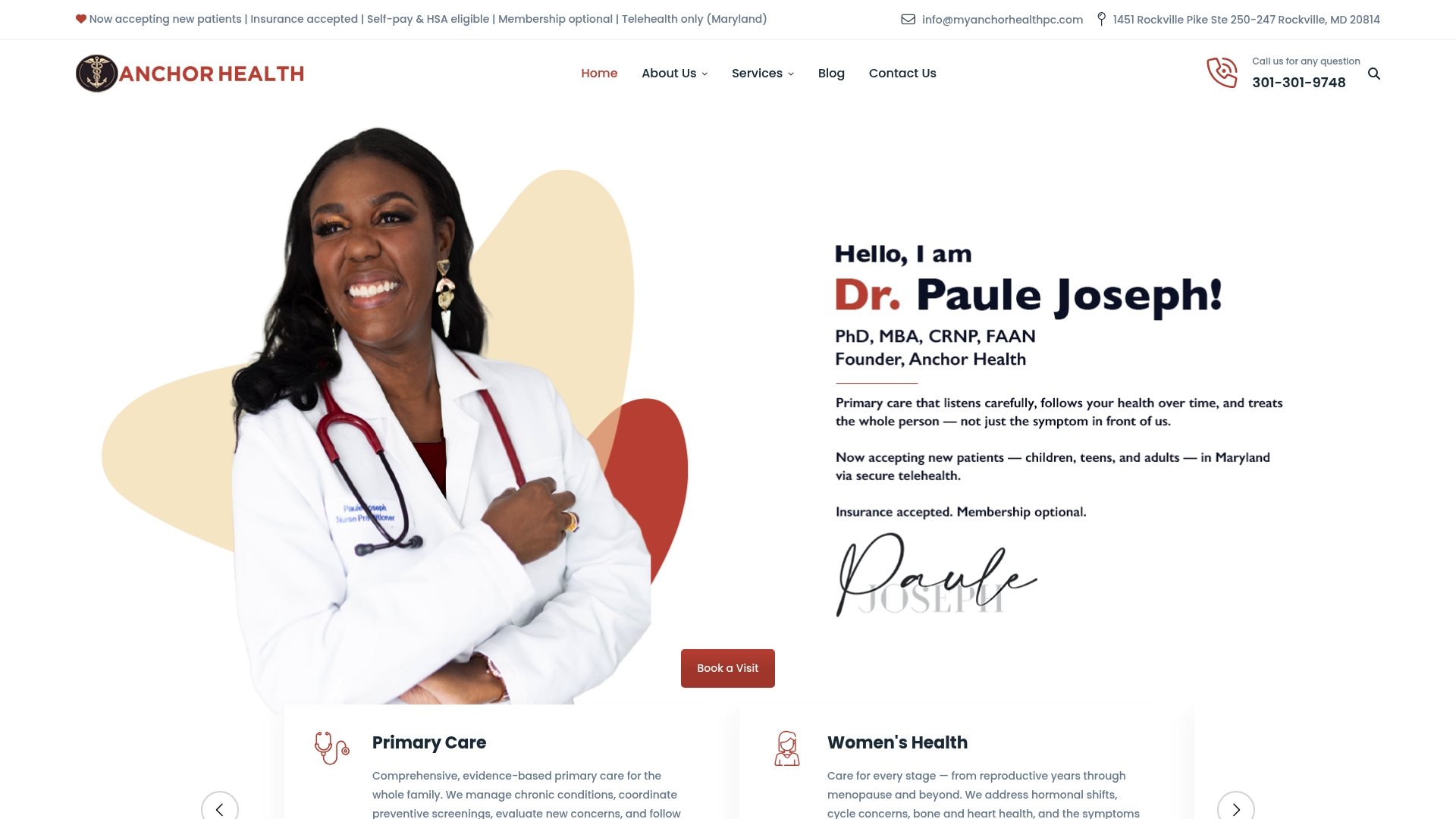
Whether you are managing a chronic condition, coordinating care for your children, or simply looking for a primary care relationship that does not feel rushed, Myanchorhealthpc offers membership options designed to fit your family’s needs. Explore what a primary care medical home looks like in practice, or learn how telehealth for kids can make pediatric primary care more accessible for your household. Visit Myanchorhealthpc to learn more.
FAQ
What is membership-based primary care?
Membership-based primary care, also called direct primary care (DPC), is a model where patients pay a flat monthly fee for direct access to primary care services without insurance billing. It covers routine and preventive care but does not replace insurance for hospitals or specialists.
How much does a primary care membership typically cost?
Monthly fees average $20 to $49 for children and $50 to $100 for adults, depending on the practice. Many families pair a membership with a high-deductible health plan to reduce total annual healthcare spending.
Does membership-based care improve health outcomes?
Yes. Higher physician continuity, which membership models are designed to support, is associated with 5.5% to 8.6% lower hospitalization odds and reduced healthcare spending, according to JABFM research.
Do I still need health insurance with a DPC membership?
Yes. Membership care covers primary care only. You still need insurance for hospitalizations, specialist visits, emergency care, and imaging. Most members carry an HDHP alongside their membership.
How do I know if a membership practice offers true continuity?
Ask about panel size and clinician turnover before enrolling. Practices with panels under 800 patients and low turnover are most likely to deliver the consistent patient-provider relationship that drives better outcomes. Validated measures like the PCPCM tool can also help you assess care continuity at a specific practice.
Recommended
- Family Primary Care Best Practices for Every Age
- What Is a Primary Care Medical Home: Family Guide
- How to Choose Telehealth Primary Care for Your Family
- Top 4 familyclinic.clinic Alternatives Providers 2026
Blog & Information Disclaimer
Last Updated: May 23, 2026
The information provided on the Anchor Health website (https://myanchorhealthpc.com/), including but not limited to blog posts, articles, newsletters, graphics, and other materials (collectively, the "Content"), is for general informational and educational purposes only.
By accessing and using this website, you acknowledge and agree to the following terms and conditions:
The Content on this website is not intended to be a substitute for professional medical advice, diagnosis, or treatment. Always seek the advice of your physician, nurse practitioner, or other qualified health provider with any questions you may have regarding a medical condition. Never disregard professional medical advice or delay in seeking it because of something you have read on this website.
Reading, interacting with, or sharing the Content on this website does not establish a patient-provider relationship between you and Anchor Health or any of its clinicians, including Paule Valery Joseph, PhD, MBA, CRNP, FAAN. A formal patient-provider relationship is only established after you have completed the formal intake process, signed our clinical consent forms, and participated in a secure clinical consultation.
If you are experiencing a medical emergency, call 911 or seek emergency medical services immediately.
Anchor Health is a primary care practice and does not provide emergency or crisis intervention services through its website or blog.
While Anchor Health strives to provide thoughtful, evidence-based information grounded in our Anchored Care℠ model, healthcare is a rapidly evolving field. We make no representations or warranties, express or implied, about the completeness, accuracy, reliability, or suitability of the information contained in the Content. Any reliance you place on such information is strictly at your own risk.
Anchor Health is a telehealth practice providing services to patients physically located within the state of Maryland. The information provided on this blog is intended for residents of Maryland and is governed by the laws and regulations of that state. Accessing this information from outside of Maryland does not imply that our clinicians are licensed to practice medicine or provide consultations in your jurisdiction.
Content related to Weight & Metabolic Health, including discussions of GLP-1 medications or other medical therapies, is provided for educational context regarding our clinical approach. Prescriptions and specific medical recommendations are only made following a comprehensive clinical evaluation, diagnostic testing, and shared decision-making within a formal patient-provider relationship.
This website may contain links to external websites that are not provided or maintained by or in any way affiliated with Anchor Health. Please note that Anchor Health does not guarantee the accuracy, relevance, timeliness, or completeness of any information on these external websites.
To the fullest extent permitted by law, Anchor Health, its owners, and its employees shall not be liable for any direct, indirect, incidental, consequential, or punitive damag
Related posts