Reactive vs Preventive Healthcare: What You Need to Know

Reactive healthcare is defined as medical care delivered after symptoms appear, while preventive healthcare is proactive care designed to stop illness before it starts. Understanding what is reactive vs preventive healthcare matters more than most people realize. The CDC reports that 60% of adults have at least one chronic condition, and chronic diseases drive $4.9 trillion in annual U.S. healthcare costs. That scale makes the choice between these two approaches one of the most consequential health decisions you and your family can make.
What are the key differences between reactive and preventive healthcare?
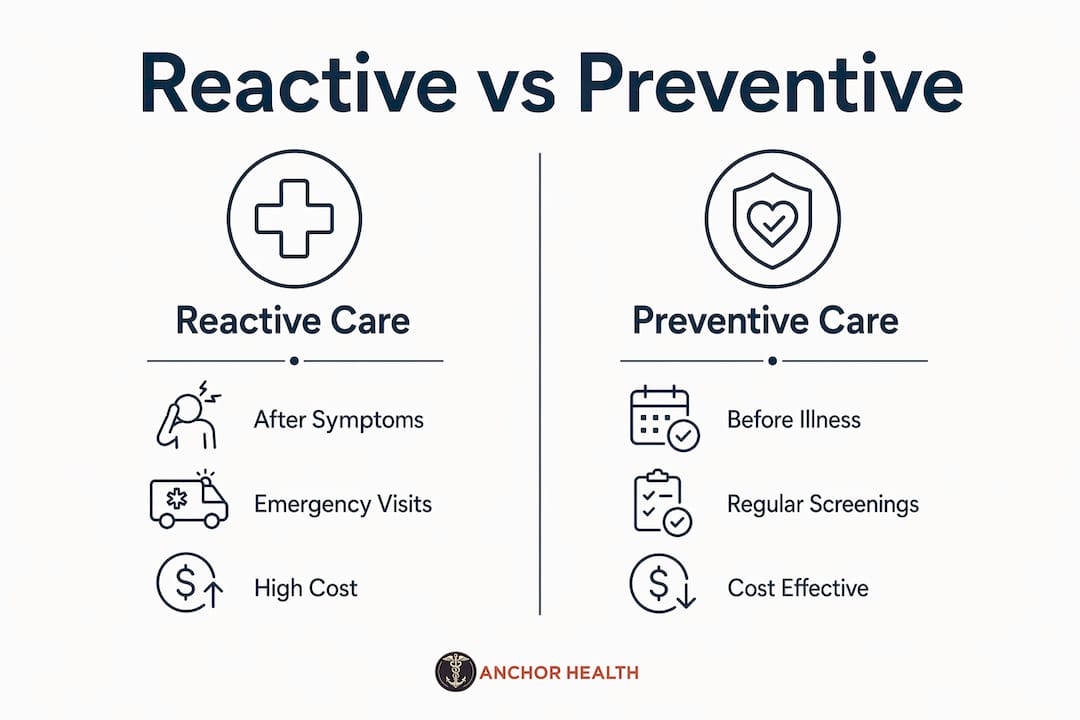
Reactive healthcare responds to a problem that already exists. You develop chest pain, visit the emergency room, and receive treatment. Preventive healthcare, by contrast, involves scheduled care designed to catch or eliminate risks before they become emergencies. The distinction is timing: one approach waits, the other acts first.
Preventive care includes annual wellness visits, blood pressure and cholesterol screenings, cancer screenings, and immunizations. Reactive care is episodic and symptom-driven, meaning you only engage the healthcare system when something feels wrong. That gap between visits is where silent risks grow.

The cost difference is significant. Reactive care relies on expensive late-stage interventions like ER visits and intensive pharmaceutical management. Preventive care reduces those costs through early intervention, often catching conditions when they are far cheaper and easier to treat.
| Feature | Reactive care | Preventive care |
|---|---|---|
| Timing | After symptoms appear | Before illness develops |
| Visit type | Episodic, unscheduled | Scheduled, routine |
| Common services | ER visits, urgent prescriptions | Screenings, immunizations, wellness exams |
| Cost profile | Higher due to late-stage treatment | Lower through early detection |
| Health goal | Treat existing illness | Reduce risk and maintain wellness |
The practical difference shows up clearly in two scenarios. A patient who skips annual checkups and ends up hospitalized for an undetected heart condition is experiencing reactive care at its most costly. A patient who gets a routine lipid panel, catches elevated cholesterol early, and adjusts diet and medication is experiencing preventive care at its most effective.
How does preventive healthcare impact chronic disease and healthcare costs?
Chronic disease is the defining health challenge of our time. The CDC’s data shows that lifestyle-linked conditions account for the vast majority of that $4.9 trillion annual cost burden. Preventive care directly targets the root causes of those conditions.
The body has a remarkable capacity for recovery when given the right inputs. Experts at the Pritikin Longevity Center note that with proper nutrition, sleep, exercise, and stress management, the body can resist and often reverse lifestyle-linked chronic illnesses like metabolic syndrome. That reversal potential is what makes early preventive action so powerful.
Preventive care also reduces long-term reliance on medication and invasive procedures. Lifestyle changes supported by preventive care can reverse early-stage chronic diseases before they require costly pharmaceutical management. For families managing chronic disease through telehealth, this translates to fewer hospitalizations and a better quality of life over time.
Key benefits of preventive care for chronic disease include:
- Early detection of conditions like hypertension and prediabetes, when they are most treatable
- Reduced medication dependence through lifestyle interventions before drug therapy becomes necessary
- Lower emergency care use by managing risk factors before they trigger acute events
- Better long-term outcomes through consistent monitoring and relationship-based care
A balanced healthcare model that integrates prevention with reactive emergency care yields better health outcomes and greater system sustainability. Neither approach alone is sufficient. The goal is to use each where it is most effective.
What are common misconceptions about preventive healthcare?
The biggest misconception is that feeling fine means you are fine. Cardiovascular and metabolic risks are often completely asymptomatic for years. High blood pressure, elevated blood sugar, and early-stage arterial disease rarely produce noticeable symptoms until they cause a serious event. Routine screening catches what your body does not announce.
A second misconception is that preventive care is a standard checklist applied to everyone. Preventive care is highly personalized, based on individual risk profiles that account for age, sex, genetics, and environment. A 28-year-old woman with a family history of breast cancer needs a different screening schedule than a 28-year-old woman without that history. Personalization is not optional. It is the point.
The healthcare system itself creates a third barrier. The traditional fee-for-service structure incentivizes brief, symptom-focused visits. A typical 15-minute appointment leaves little room for the kind of deep preventive risk assessment that actually changes outcomes. Patients often need to advocate for longer, more thorough wellness visits.
“Preventive care requires consistent longitudinal monitoring rather than one-off screenings. Tracking trends in key health metrics over years is what allows providers to detect subtle health shifts before they become serious conditions.”
Pro Tip: Before your next wellness visit, write down your family health history, current medications, and any lifestyle changes from the past year. Bringing that information gives your provider the context needed for a real preventive assessment, not just a quick checkup.
Understanding age-specific preventive practices helps you ask the right questions at the right time. The screenings that matter at 22 are different from those that matter at 45.
How can families apply preventive and reactive care effectively?
Effective healthcare for your family is not a choice between prevention and reaction. It is knowing when to use each. Reactive care remains essential and life-saving for emergencies and acute conditions. Sole reliance on reactive care diminishes system efficiency and worsens public health outcomes over time. The goal is a framework that uses both well.
Here is a practical approach for families:
- Schedule annual wellness visits for every family member, regardless of whether anyone feels sick. These visits establish baseline metrics and catch silent risks early.
- Track key health numbers including blood pressure, cholesterol (lipid panel), and blood sugar (HbA1c) consistently over time. Effective preventive care requires longitudinal monitoring, not single data points.
- Know your risk profile. Ask your provider which screenings apply to your age, sex, and family history. Do not assume a standard checklist covers your specific situation.
- Use telehealth for preventive management. Telehealth primary care makes it easier to schedule routine visits, follow up on lab results, and manage chronic conditions without taking a full day off work.
- Reserve the ER for true emergencies. For non-urgent acute issues like minor infections or medication questions, a primary care provider handles these faster and at lower cost than an emergency room.
Pro Tip: Ask your primary care provider to review your preventive screening schedule at every annual visit. Screening recommendations change as you age, and a consistent provider who knows your history will catch gaps that a one-time visit never would.
Telehealth primary care is particularly well suited to preventive health management. It removes the friction of scheduling, travel, and wait times that cause people to skip routine visits. For busy families, that convenience is not a luxury. It is what makes consistent preventive care realistic.
Key Takeaways
Preventive healthcare consistently outperforms reactive care in reducing chronic disease burden, lowering long-term costs, and improving quality of life when applied consistently and personalized to individual risk.
| Point | Details |
|---|---|
| Reactive care treats, preventive care protects | Reactive care responds to symptoms; preventive care stops illness before it starts. |
| Chronic disease costs are preventable | Lifestyle-linked conditions drive $4.9 trillion in annual U.S. costs, most of which early intervention can reduce. |
| Feeling fine is not a health strategy | Cardiovascular and metabolic risks are often asymptomatic for years, making routine screening non-negotiable. |
| Personalization defines effective prevention | Risk-based screening accounts for age, sex, genetics, and environment, not a one-size checklist. |
| Telehealth makes prevention accessible | Removing scheduling friction helps families maintain consistent preventive care rather than defaulting to reactive visits. |
Why I think we have the reactive model backwards
I have spent years watching people engage with healthcare only when something breaks. The reactive model feels intuitive because it mirrors how we handle most problems: wait until there is a crisis, then fix it. But health does not work that way. The conditions that kill most Americans build silently over decades.
What strikes me most is how the system reinforces this pattern. A 15-minute visit designed around a chief complaint cannot deliver a real preventive assessment. Patients leave with a prescription but no conversation about what drove the problem in the first place. The fee-for-service structure rewards volume, not depth.
The families I see make the biggest gains are the ones who treat their annual wellness visit as seriously as a performance review. They come prepared, they ask about their numbers, and they build a relationship with a provider who knows their history. That continuity is what turns a routine checkup into genuine prevention.
The uncomfortable truth is that most people will not change their approach until something goes wrong. My advice: do not wait for the crisis. Find a provider who has the time and the framework to work with you proactively. The whole-person care model that integrates mental, metabolic, and physical health into one relationship is the closest thing to a real prevention strategy that exists in primary care today.
— Paule
Telehealth primary care and your family’s preventive health
Myanchorhealthpc delivers primary care through secure video visits, making it practical for busy families to stay consistent with preventive care rather than defaulting to the ER when something feels off.
Through Myanchorhealthpc’s Anchored Care℠ᴵᴾ model, patients receive relationship-based care that tracks health metrics over time, schedules age-appropriate screenings, and manages both acute and chronic conditions in one place. That continuity is what separates genuine prevention from a one-off checkup. If you are ready to build a healthcare routine that works before illness strikes, choosing telehealth primary care for your family is a practical first step. Myanchorhealthpc also shows how telehealth reduces ER dependence by keeping preventive care consistent and accessible.
FAQ
What is the reactive healthcare definition?
Reactive healthcare is medical care delivered in response to symptoms or an existing illness, such as an ER visit or urgent prescription. It treats problems after they develop rather than preventing them.
What are common preventive care examples?
Preventive care examples include annual wellness visits, blood pressure and cholesterol screenings, cancer screenings, immunizations, and HbA1c testing for diabetes risk. These services are scheduled based on age, sex, and individual risk factors.
Why does preventive care cost less than reactive care?
Preventive care catches conditions early, when treatment is simpler and cheaper. Reactive care often involves late-stage interventions like hospitalization or intensive drug therapy, which carry significantly higher costs.
Does having no symptoms mean you do not need preventive care?
No. Cardiovascular and metabolic conditions are frequently asymptomatic for years before causing a serious event. Routine screening detects these risks before symptoms appear, which is the core purpose of preventive care.
How does telehealth support preventive healthcare?
Telehealth removes scheduling and travel barriers that cause people to skip routine visits. It allows patients to maintain consistent preventive care, follow up on lab results, and manage chronic conditions through a trusted provider relationship.
Recommended
- Preventive Care for Ages 18–25: Your 2026 Guide
- Benefits of Women Preventive Screenings: 2026 Guide
- Family Primary Care Best Practices for Every Age
- Examples of Preventive Care for Kids: Parent’s Guide
Blog & Information Disclaimer
Last Updated: May 23, 2026
The information provided on the Anchor Health website (https://myanchorhealthpc.com/), including but not limited to blog posts, articles, newsletters, graphics, and other materials (collectively, the "Content"), is for general informational and educational purposes only.
By accessing and using this website, you acknowledge and agree to the following terms and conditions:
The Content on this website is not intended to be a substitute for professional medical advice, diagnosis, or treatment. Always seek the advice of your physician, nurse practitioner, or other qualified health provider with any questions you may have regarding a medical condition. Never disregard professional medical advice or delay in seeking it because of something you have read on this website.
Reading, interacting with, or sharing the Content on this website does not establish a patient-provider relationship between you and Anchor Health or any of its clinicians, including Paule Valery Joseph, PhD, MBA, CRNP, FAAN. A formal patient-provider relationship is only established after you have completed the formal intake process, signed our clinical consent forms, and participated in a secure clinical consultation.
If you are experiencing a medical emergency, call 911 or seek emergency medical services immediately.
Anchor Health is a primary care practice and does not provide emergency or crisis intervention services through its website or blog.
While Anchor Health strives to provide thoughtful, evidence-based information grounded in our Anchored Care℠ model, healthcare is a rapidly evolving field. We make no representations or warranties, express or implied, about the completeness, accuracy, reliability, or suitability of the information contained in the Content. Any reliance you place on such information is strictly at your own risk.
Anchor Health is a telehealth practice providing services to patients physically located within the state of Maryland. The information provided on this blog is intended for residents of Maryland and is governed by the laws and regulations of that state. Accessing this information from outside of Maryland does not imply that our clinicians are licensed to practice medicine or provide consultations in your jurisdiction.
Content related to Weight & Metabolic Health, including discussions of GLP-1 medications or other medical therapies, is provided for educational context regarding our clinical approach. Prescriptions and specific medical recommendations are only made following a comprehensive clinical evaluation, diagnostic testing, and shared decision-making within a formal patient-provider relationship.
This website may contain links to external websites that are not provided or maintained by or in any way affiliated with Anchor Health. Please note that Anchor Health does not guarantee the accuracy, relevance, timeliness, or completeness of any information on these external websites.
To the fullest extent permitted by law, Anchor Health, its owners, and its employees shall not be liable for any direct, indirect, incidental, consequential, or punitive damag
Related posts