Same Day Mastitis Telehealth to Keep You Nursing Safely

Telehealth can safely evaluate and treat most cases of breastfeeding mastitis without an in-person visit. A clinician can review your symptoms, examine the affected area over video, and send a breastfeeding-compatible antibiotic to your pharmacy the same day if you need one. What telehealth cannot do is manage an abscess or sepsis. Those require an in-person exam, imaging, or drainage right away.
TL;DR:
- Telehealth can effectively assess and prescribe treatment for most breastfeeding mastitis cases without in-person visits, except in situations involving abscesses or sepsis.
- Most cases respond well to conservative home care lasting one to two days, with antibiotics usually showing improvements within 48 to 72 hours.
- Antibiotics like penicillins and cephalosporins are safe during breastfeeding, and stopping nursing is rarely necessary if treatment is started early.
- Symptoms such as a firm lump, worsening fever, spreading redness, or signs of systemic infection require immediate in-person evaluation and possibly imaging or drainage.
- Proper telehealth visit preparation includes light-filled space, symptom documentation, and questions about breastfeeding safety and red flags for escalation.
Table of Contents
- What Happens During a Breastfeeding Mastitis Telehealth Visit?
- Conservative Home Care to Start Right Away
- Which Medications Are Safe While Breastfeeding?
- When Do You Need In-Person Care Instead?
- How to Prepare for Your Telehealth Visit
- What to Expect After Your Visit
- How Anchor Health Approaches Mastitis Care by Telehealth
- Why Mastitis Telehealth Beats the Wait-and-See Approach
- Book a Mastitis Telehealth Visit With Anchor Health
- Sources
What Happens During a Breastfeeding Mastitis Telehealth Visit?
A mastitis telehealth visit follows a clear sequence, and knowing it ahead of time helps you feel less rattled when you’re the one holding a hot, aching breast at 11 p.m.
Your clinician will start with your history: when the redness or lump appeared, whether you have chills or a fever, and how feeding or pumping has changed recently. Next comes a visual exam over video. You’ll be asked to show the affected area in good light so the clinician can look for wedge-shaped redness, skin changes, or a mass that feels different from typical engorgement. They’ll also ask about your breastfeeding technique and latch, since a poor latch or missed feeds are common triggers.
The visit typically covers:
- Symptom timeline and fever check (temperature over 101°F raises concern for a systemic infection)
- Video inspection of the breast for redness, swelling, or a firm, fluctuant area
- Screening questions to rule out abscess or, in rare persistent cases, inflammatory breast cancer
- Review of feeding frequency, pumping habits, and any recent changes in routine
- E-prescription sent electronically to your pharmacy if antibiotics are warranted
If your clinician suspects an abscess or something that doesn’t fit a typical infection pattern, they’ll refer you for imaging or an in-person evaluation rather than guessing over video. Most telehealth visits accept insurance or self-pay, and prescriptions are routed to your preferred pharmacy before you’ve even ended the call.
Conservative Home Care to Start Right Away
You don’t have to wait for your appointment to start feeling better. The Academy of Breastfeeding Medicine’s Protocol #36 reframed mastitis as an inflammatory spectrum rather than something you have to “clear out” through aggressive pumping, and that shift changes what good home care actually looks like.
- Keep feeding or pumping on a normal, comfortable schedule. Don’t skip feeds, but don’t over-pump either.
- Nurse or pump on the affected side first when your baby is willing, using a comfortable position that lets the breast drain evenly.
- Rest as much as your household allows. Mastitis is inflammatory, and your body needs energy to fight it.
- Take ibuprofen for pain and swelling, following your clinician’s dosing guidance.
- Apply a cold compress after feeds to calm inflammation. Warm compresses right before a feed can help with letdown, but skip prolonged heat, which can worsen swelling.
- Use gentle, light strokes toward the underarm during a feed instead of deep massage. Hard kneading around inflamed tissue tends to aggravate it, not fix it.
Pro Tip: Resist the urge to “pump it all out.” Emptying the breast completely and repeatedly can trigger oversupply, and oversupply is one of the quiet drivers of recurring mastitis.
Give conservative care for about half a day to a full day. If you feel meaningfully better, keep going. If your fever climbs, the pain sharpens, or nothing has shifted, that’s your signal to bring in a clinician for antibiotics.
Which Medications Are Safe While Breastfeeding?
Most first-line mastitis antibiotics are considered compatible with breastfeeding, and stopping nursing is rarely necessary or recommended. Mayo Clinic guidance notes that penicillins and cephalosporins are typically preferred because they pass into milk in very small amounts and have a long safety record in nursing mothers.
Common choices include:
- Dicloxacillin, often the go-to first-line option for typical bacterial mastitis
- Cephalexin, used when penicillin allergy or other factors make it a better fit
- A 10 to 14 day course in most cases, which matters because stopping early is how infections come back
For pain, acetaminophen is usually the safest first choice. Ibuprofen is commonly used at doses up to 1,600 mg per day, though your provider will set the exact dose for your situation. If you’re unsure about a specific drug and your infant’s exposure, LactMed is the resource clinicians themselves check, and your baby’s pediatrician can weigh in on anything specific to your child.
When Do You Need In-Person Care Instead?
Telehealth has real limits, and a good clinician will tell you exactly where those limits sit rather than stretching a video visit past what it can safely handle.
Get in-person care right away if you notice:
- A firm, fluctuant lump that feels like a fluid pocket rather than diffuse swelling (possible abscess)
- Fever that keeps climbing instead of responding to 24 to 48 hours of antibiotics
- Redness spreading rapidly beyond the original area, or streaking
- Confusion, rapid heart rate, or other signs of a body-wide infection
An abscess usually needs an ultrasound to confirm and often aspiration or drainage, neither of which can happen over video. Your telehealth clinician’s job in that moment is fast, direct referral, not a delayed workaround.
How to Prepare for Your Telehealth Visit
A little prep turns a rushed, painful appointment into a productive one where you actually get the answers you need.
- Find a well-lit spot and wear a top that’s easy to lift or unbutton for the exam.
- Take a couple of photos of the affected area now, in case the redness changes by the time you’re seen.
- Note when symptoms started, your temperature if you’ve checked it, and your feeding or pumping schedule for the past day.
- List any drug allergies and medications you’re currently taking, including supplements.
- Ask directly: Is it safe to keep breastfeeding? Do I need antibiotics, and which one? What red flags should send me back to a clinician? When should I check in again?
If a lactation consultant referral would help with an underlying latch issue, ask about that too. Many telehealth practices coordinate that referral as part of the same visit rather than sending you to find one on your own.
What to Expect After Your Visit
Conservative care alone tends to show some relief within 12 to 24 hours. Once appropriate antibiotics are started, most patients notice real improvement within 48 to 72 hours. If nothing has budged by then, that’s not a “wait and see” situation. It’s a reason to reconnect with your clinician.
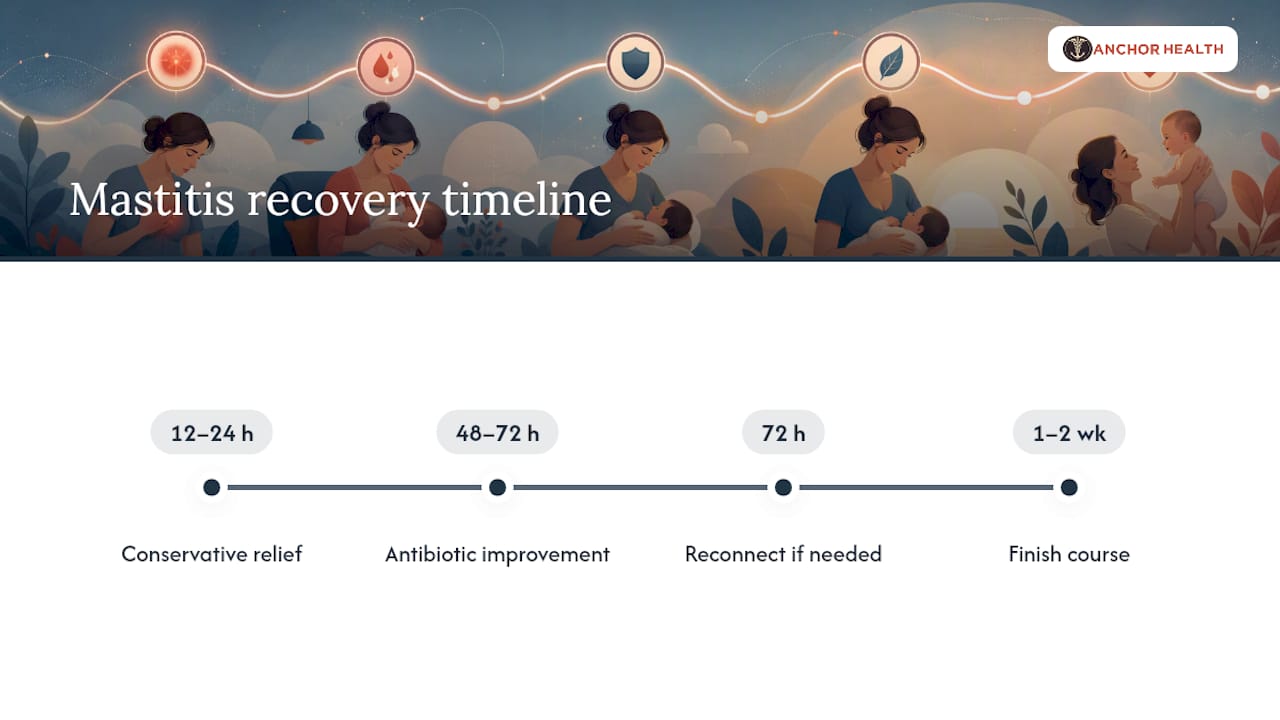
Antibiotic courses usually last about one to two weeks, and finishing the full course matters even after you feel fine. Follow-up can happen through a quick telehealth check-in, a referral to a lactation consultant for feeding mechanics, or coordination with your baby’s pediatrician if anything about the infant’s feeding pattern needs a second look.
How Anchor Health Approaches Mastitis Care by Telehealth
Anchor Health built its Anchored Care℠ᴵᴾ model around the idea that rushed, fragmented visits are exactly wrong for a condition like mastitis, where timing and follow-through decide the outcome. Visits run long enough to cover your history, exam, and medication questions without feeling hurried, and the same clinician can follow you from the first symptom through resolution.
That continuity means your prescription gets sent to your pharmacy the same day, your triage follows established, evidence-based screening for red flags, and a referral to a lactation consultant happens as part of your care plan rather than as an afterthought. The provider accepts insurance, self-pay, and offers membership options for families who want faster follow-up access. [Author credentials and patient outcome data to be added.]
Why Mastitis Telehealth Beats the Wait-and-See Approach
The biggest mistake in mastitis care isn’t choosing telehealth over an in-person visit. It’s waiting two or three days to reach anyone at all, hoping a hot compress and grit will handle what’s actually a spreading bacterial infection. Conventional advice tends to treat mastitis as something you either tough out or immediately escalate to antibiotics, and both extremes miss the point of Protocol #36’s guidance: this is a spectrum, and the right response depends on where you sit on it.
What the evidence actually supports is a fast, low-friction path to a clinician who can look at you within hours, not days, and rule out the things that genuinely need urgent attention. Speed matters more than the setting. A same-day video visit that catches a red flag early beats a delayed in-person appointment that lets an abscess form.
If you take one thing from this, prioritize getting eyes on the problem within a day of symptoms starting, whether those eyes are on a screen or in a room. The format matters far less than the timing.
— Paule
Book a Mastitis Telehealth Visit With Anchor Health
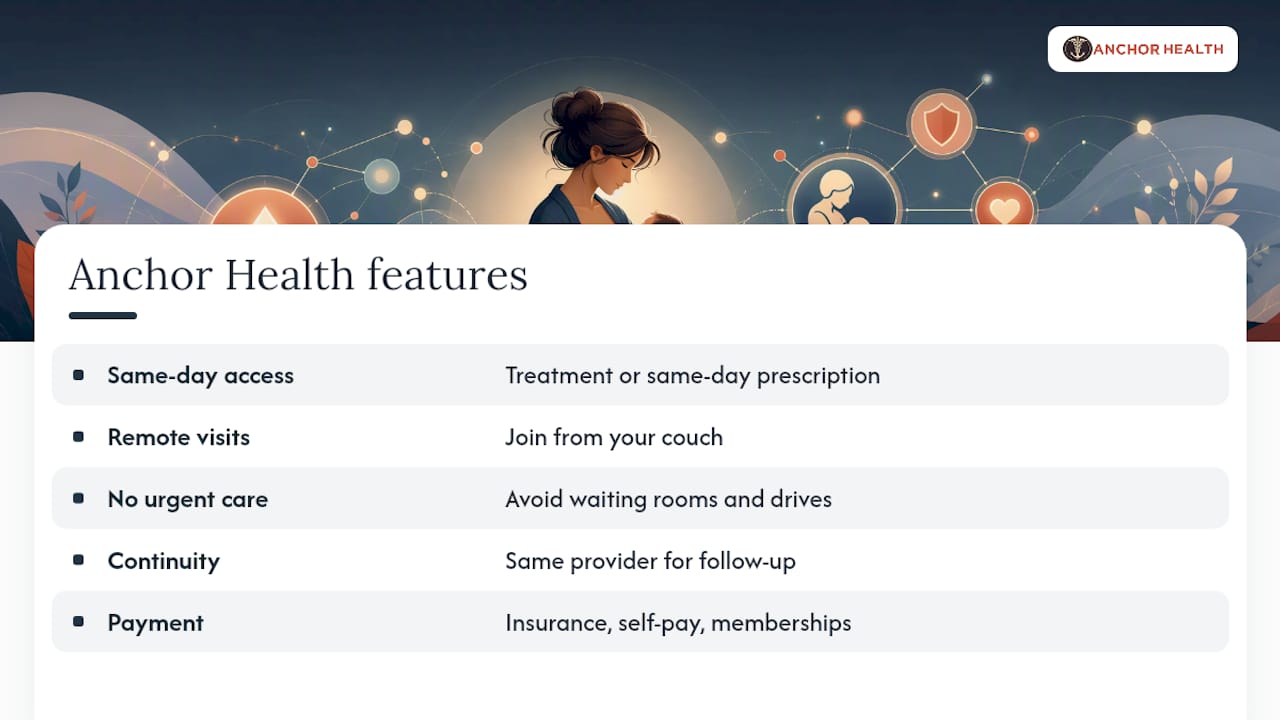
This telehealth provider aims to get you in front of a clinician promptly after you notice symptoms, rather than days later after symptoms have worsened. There’s no urgent care waiting room, no juggling a feverish newborn in a car seat. You log in from your couch, show the clinician what’s going on, and walk away with either a treatment plan or a same-day prescription sent straight to your pharmacy.
Visits are built around continuity, so the same provider who treats your mastitis can follow up on your recovery, coordinate a lactation consultant referral if needed, and support you throughout your breastfeeding journey. The provider accepts insurance and self-pay, with membership options for families who want faster access to follow-up care.
If you’re weighing where to book, see how to choose telehealth primary care for your family and schedule your visit today.
This article is general information, not a substitute for advice from a qualified doctor. Consult a qualified healthcare professional about your own circumstances before acting on anything here.
Sources
- Mastitis: What to do when your breasts are painfully inflamed — Harvard Health
- Mastitis: Diagnosis and treatment — Mayo Clinic
- Academy of Breastfeeding Medicine Protocol #36 — PubMed
- Medication safety and breastfeeding — AAFP
Recommended
- Postpartum Care Telehealth Benefits for New Mothers
- UTI Telehealth Treatment: What to Expect and When It Works
- How Telehealth Handles Sick Child Visits for Families
Blog & Information Disclaimer
Last Updated: May 23, 2026
The information provided on the Anchor Health website (https://myanchorhealthpc.com/), including but not limited to blog posts, articles, newsletters, graphics, and other materials (collectively, the "Content"), is for general informational and educational purposes only.
By accessing and using this website, you acknowledge and agree to the following terms and conditions:
The Content on this website is not intended to be a substitute for professional medical advice, diagnosis, or treatment. Always seek the advice of your physician, nurse practitioner, or other qualified health provider with any questions you may have regarding a medical condition. Never disregard professional medical advice or delay in seeking it because of something you have read on this website.
Reading, interacting with, or sharing the Content on this website does not establish a patient-provider relationship between you and Anchor Health or any of its clinicians, including Paule Valery Joseph, PhD, MBA, CRNP, FAAN. A formal patient-provider relationship is only established after you have completed the formal intake process, signed our clinical consent forms, and participated in a secure clinical consultation.
If you are experiencing a medical emergency, call 911 or seek emergency medical services immediately.
Anchor Health is a primary care practice and does not provide emergency or crisis intervention services through its website or blog.
While Anchor Health strives to provide thoughtful, evidence-based information grounded in our Anchored Care℠ model, healthcare is a rapidly evolving field. We make no representations or warranties, express or implied, about the completeness, accuracy, reliability, or suitability of the information contained in the Content. Any reliance you place on such information is strictly at your own risk.
Anchor Health is a telehealth practice providing services to patients physically located within the state of Maryland. The information provided on this blog is intended for residents of Maryland and is governed by the laws and regulations of that state. Accessing this information from outside of Maryland does not imply that our clinicians are licensed to practice medicine or provide consultations in your jurisdiction.
Content related to Weight & Metabolic Health, including discussions of GLP-1 medications or other medical therapies, is provided for educational context regarding our clinical approach. Prescriptions and specific medical recommendations are only made following a comprehensive clinical evaluation, diagnostic testing, and shared decision-making within a formal patient-provider relationship.
This website may contain links to external websites that are not provided or maintained by or in any way affiliated with Anchor Health. Please note that Anchor Health does not guarantee the accuracy, relevance, timeliness, or completeness of any information on these external websites.
To the fullest extent permitted by law, Anchor Health, its owners, and its employees shall not be liable for any direct, indirect, incidental, consequential, or punitive damag
Related posts