Best Anchorltc.com Alternatives for Telehealth Primary Care

The top alternatives to Anchor Health for telehealth primary care in the United States are Teladoc Health, Amwell, MDLIVE, and One Medical. Each offers accessible, relationship-focused care with national reach and insurance acceptance, making them credible options for families and individuals who want more than a one-off virtual visit.
Here is a quick look at what each brings:
- Teladoc Health: Broad primary care services with integrated behavioral health, accepted by most major insurers, and available in all 50 states.
- Amwell: Coordinated primary and specialty care with a strong focus on patient experience and technology usability, well suited for families managing multiple care needs.
- MDLIVE: Flexible membership pricing, 24/7 access, and a wide insurance network, making it a practical choice for patients who value convenience and cost control.
- One Medical: Membership-based hybrid care blending telehealth with in-person visits, built around long-term provider relationships and personalized attention.
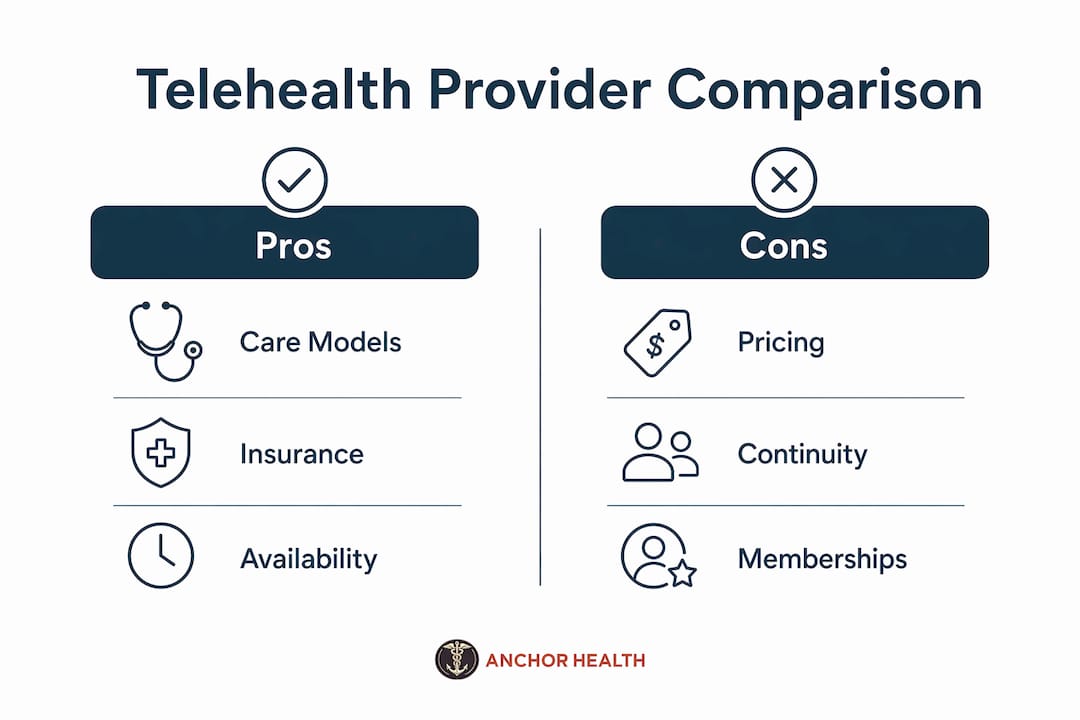
How do Anchor Health alternatives compare on care model, insurance, and availability?
The four providers differ meaningfully on how they structure care, what they charge, and where they operate. Choosing the right fit depends on whether you prioritize continuity, cost, or clinical breadth.
| Provider | Service scope | Relationship-based care model | Insurance acceptance and pricing | State availability | Best for |
|---|---|---|---|---|---|
| Teladoc Health | Primary care, behavioral health, chronic disease, urgent care | Assigned care teams available; continuity varies by plan | Most major insurers; per-visit and subscription options | All 50 states | Wide service scope and insurance-friendly pricing |
| Amwell | Primary, specialty, and urgent care; pediatrics | Ongoing provider relationships supported through platform | Major commercial and government insurers; per-visit fees | All 50 states | Families needing coordinated, multi-specialty care |
| MDLIVE | Primary care, urgent care, behavioral health | Care continuity available; emphasis on convenience | Broad insurer network; membership plans available | All 50 states | Flexible pricing and 24/7 access |
| One Medical | Primary care, preventive care, women’s health, pediatrics | Strong long-term provider relationships; hybrid model | Amazon Prime membership; insurance billed separately | — | Hybrid in-person and telehealth with deep provider bonds |
Teladoc Health operates one of the largest telehealth networks in the country, covering primary care, mental health, and chronic condition management under one platform. Its care team model means patients can request the same provider across visits, though consistency depends on plan type. For patients whose insurers already cover Teladoc, out-of-pocket costs can be minimal.
Amwell stands out for its clinical breadth. Families dealing with a child’s recurring condition alongside a parent’s chronic illness can coordinate both through the same platform. The technology interface is consistently rated as intuitive, and Amwell’s partnerships with health systems give it a clinical depth that pure telehealth startups often lack.
MDLIVE is the most accessible entry point for patients without employer-sponsored telehealth. Its membership tiers let patients pay a predictable monthly fee rather than per-visit charges, which adds up quickly for families with frequent care needs. The 24/7 availability is a genuine differentiator for urgent concerns that arise outside business hours.

One Medical takes the most deliberate approach to the provider relationship. Patients are matched with a primary care physician they see consistently, whether in person or via video. The Amazon Prime membership pricing makes it unusually affordable for Prime subscribers, though patients still bill their insurance separately for clinical services.
How to choose the right telehealth primary care provider for your family
Selecting a telehealth provider is a decision worth taking seriously. As NAIC guidance notes about healthcare coverage decisions broadly, rushing into a choice without a clear care strategy often leads to gaps in coverage or mismatched services. The same principle applies here.
Work through these criteria before committing:
- Service needs: List every condition or care type your family currently manages, including mental health, pediatrics, women’s health, or chronic disease. Match that list against each provider’s documented service scope.
- Insurance coverage: Call your insurer directly to confirm which telehealth platforms are in-network. A provider that looks affordable on its website may cost significantly more if it bills out-of-network.
- Provider qualifications: Look for board-certified physicians and licensed therapists on the clinical team. Platforms that publish their credentialing standards openly signal a commitment to clinical quality.
- Technology usability: Download the app before you sign up. A platform that is difficult to navigate under normal circumstances becomes a real problem during a stressful health moment.
- Relationship and continuity: Ask whether the platform allows you to request the same provider for follow-up visits. Episodic care, where you see a different clinician every time, limits the quality of chronic disease management and preventive planning. Research on personalized care models consistently shows that continuity improves outcomes over time.
- Pricing and membership: Compare total annual cost across plans, not just the monthly fee. Factor in per-visit charges, prescription costs, and any services excluded from the base plan.
Pro Tip: Before you finalize a provider, schedule one introductory visit and pay attention to whether the clinician reviews your full history or treats it as a standalone encounter. That single interaction tells you more about the care model than any marketing page.
Caregivers managing healthcare access barriers often find that telehealth removes the logistical friction of in-person visits, but only when the platform is genuinely easy to use and the care team is consistent. Prioritize long-term relationship over short-term convenience, especially for children and patients with ongoing conditions.
Myanchorhealthpc offers a relationship-centered alternative worth considering
If the providers above feel large and impersonal, Myanchorhealthpc takes a different approach. It is a Maryland-based telehealth primary care practice built around the Anchored Care℠ᴵᴾ model, which prioritizes long-term, evidence-based relationships over episodic treatment.
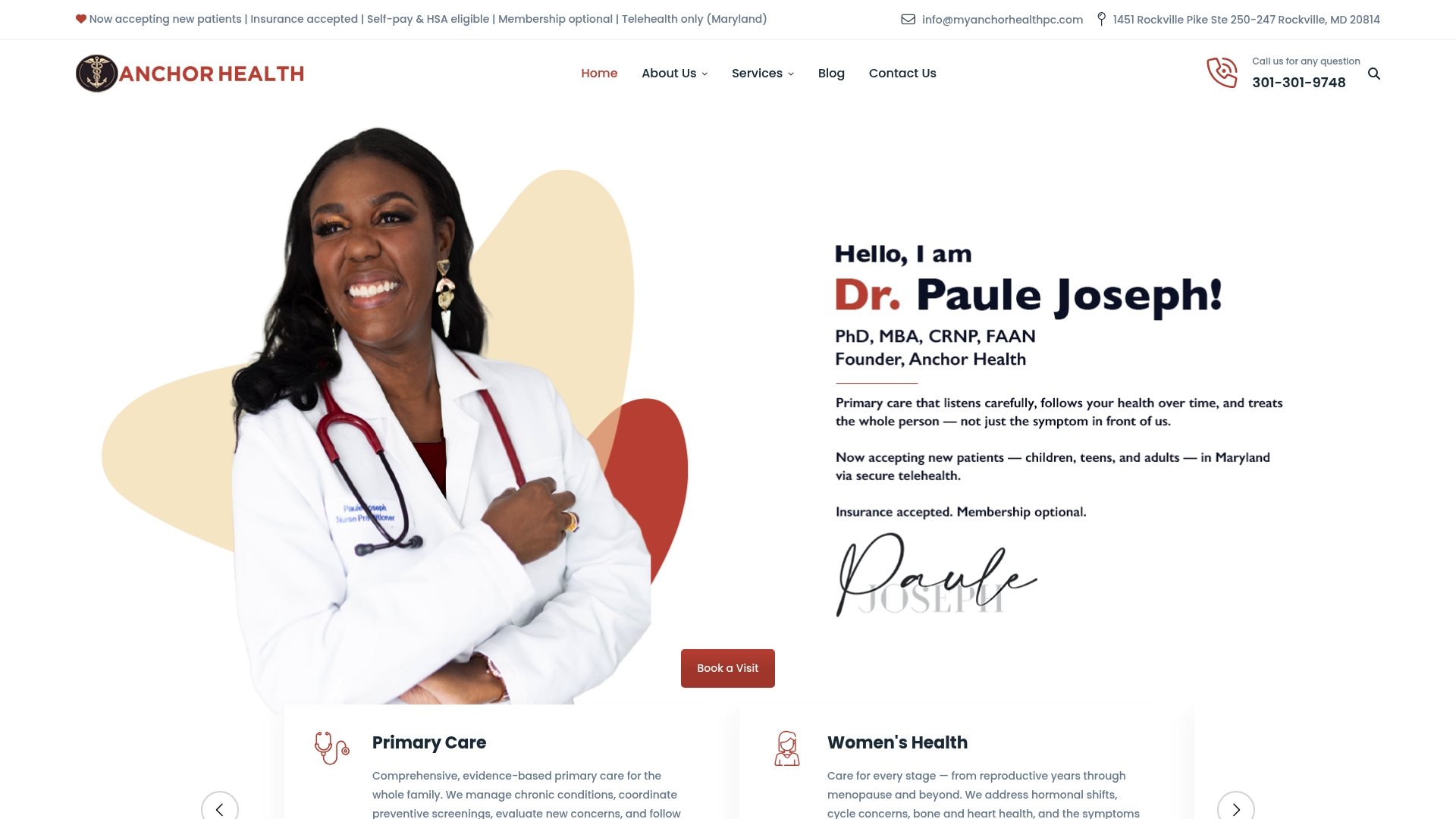
Services cover general primary care for all ages, women’s health, mental and emotional health support, weight and metabolic health management including GLP-1 medications, and pediatric and adolescent care. All visits happen through secure video, and the practice accepts insurance with membership options for patients who want enhanced access. For Maryland families who want a consistent provider who genuinely knows their history, choosing telehealth primary care through Myanchorhealthpc is worth a close look alongside the national platforms above.
Key Takeaways
The strongest telehealth primary care alternatives to Anchor Health differ most on care continuity, insurance structure, and geographic reach, so matching those factors to your family’s actual needs is the most reliable way to choose.
| Point | Details |
|---|---|
| Top alternatives | Teladoc Health, Amwell, MDLIVE, and One Medical each offer relationship-based telehealth primary care with national availability. |
| Care continuity matters | Providers that allow consistent provider assignment deliver better outcomes for chronic conditions and preventive care. |
| Insurance first | Confirm in-network status with your insurer before selecting a platform to avoid unexpected out-of-pocket costs. |
| Evaluate before committing | One introductory visit reveals more about a provider’s care model than any published plan description. |
| Myanchorhealthpc | Maryland families seeking a consistent, relationship-focused provider can consider Myanchorhealthpc’s Anchored Care℠ᴵᴾ model as a personalized alternative. |
Recommended
- How to Choose Telehealth Primary Care for Your Family
- Top 3 gfhdpc.net Alternatives for Telehealth Providers 2026
- Top 6 Affordable Employee Benefits Providers 2026
- Top 3 primarycareandweightmanagement.com alternatives 2026
Blog & Information Disclaimer
Last Updated: May 23, 2026
The information provided on the Anchor Health website (https://myanchorhealthpc.com/), including but not limited to blog posts, articles, newsletters, graphics, and other materials (collectively, the "Content"), is for general informational and educational purposes only.
By accessing and using this website, you acknowledge and agree to the following terms and conditions:
The Content on this website is not intended to be a substitute for professional medical advice, diagnosis, or treatment. Always seek the advice of your physician, nurse practitioner, or other qualified health provider with any questions you may have regarding a medical condition. Never disregard professional medical advice or delay in seeking it because of something you have read on this website.
Reading, interacting with, or sharing the Content on this website does not establish a patient-provider relationship between you and Anchor Health or any of its clinicians, including Paule Valery Joseph, PhD, MBA, CRNP, FAAN. A formal patient-provider relationship is only established after you have completed the formal intake process, signed our clinical consent forms, and participated in a secure clinical consultation.
If you are experiencing a medical emergency, call 911 or seek emergency medical services immediately.
Anchor Health is a primary care practice and does not provide emergency or crisis intervention services through its website or blog.
While Anchor Health strives to provide thoughtful, evidence-based information grounded in our Anchored Care℠ model, healthcare is a rapidly evolving field. We make no representations or warranties, express or implied, about the completeness, accuracy, reliability, or suitability of the information contained in the Content. Any reliance you place on such information is strictly at your own risk.
Anchor Health is a telehealth practice providing services to patients physically located within the state of Maryland. The information provided on this blog is intended for residents of Maryland and is governed by the laws and regulations of that state. Accessing this information from outside of Maryland does not imply that our clinicians are licensed to practice medicine or provide consultations in your jurisdiction.
Content related to Weight & Metabolic Health, including discussions of GLP-1 medications or other medical therapies, is provided for educational context regarding our clinical approach. Prescriptions and specific medical recommendations are only made following a comprehensive clinical evaluation, diagnostic testing, and shared decision-making within a formal patient-provider relationship.
This website may contain links to external websites that are not provided or maintained by or in any way affiliated with Anchor Health. Please note that Anchor Health does not guarantee the accuracy, relevance, timeliness, or completeness of any information on these external websites.
To the fullest extent permitted by law, Anchor Health, its owners, and its employees shall not be liable for any direct, indirect, incidental, consequential, or punitive damag
Related posts