Functional Primary Care: What You Need to Know

Functional primary care is defined as a model that combines conventional primary care with functional medicine principles, focusing on root-cause health management, prevention, and continuous clinician-patient relationships rather than isolated symptom treatment. Unlike a standard 15-minute office visit, this approach uses longer appointments, advanced diagnostic testing, and direct physician access to build a complete picture of your health. Practices like Myanchorhealthpc and models such as Anchored Care℠ᴵᴾ represent how this framework is being delivered today, including through telehealth. If you are managing a chronic condition, working on preventive wellness, or simply tired of fragmented care, understanding how this model works is the first step toward choosing care that actually fits your life.
What is functional primary care and how does it work?
Functional primary care is the integration of traditional family medicine with functional medicine principles, creating a patient-centered approach that treats the whole person rather than individual symptoms. The standard industry term for the broader discipline is functional medicine, and functional primary care applies those principles within the structure of ongoing, longitudinal primary care rather than one-off specialty consultations. This distinction matters because it means your functional primary care provider handles your annual physicals, chronic disease management, referrals, and preventive care, all while applying root-cause thinking to every visit.
The model places a strong emphasis on lifestyle factors including nutrition, sleep, stress, and movement as foundational to healing and chronic condition management. Practices create individualized care plans that address these factors directly, rather than defaulting to medication as the first and only response. Advanced diagnostic testing often includes 80 to 120 individual parameters, covering hormones, gut health, inflammatory markers, and metabolic function, going well beyond what a standard annual panel captures.

Continuity is the structural backbone of this model. You see the same clinician over time, which means your provider accumulates context about your health history, your patterns, and your goals. That accumulated knowledge is not incidental. It is the mechanism by which this model delivers better outcomes.
How does functional primary care differ from traditional primary care?
The differences between functional and traditional primary care are concrete and measurable, not just philosophical.
-
Appointment length. New patient visits at integrative and functional practices last 45 to 90 minutes to review full health history and lifestyle in context. Traditional primary care visits average closer to 15 minutes. That time difference determines how much your provider can actually learn about you in a single encounter.
-
Diagnostic scope. Functional primary care uses advanced lab testing beyond standard panels, including hormone panels, gut health markers, and inflammatory and metabolic indicators, to uncover root causes rather than confirm diagnostic labels. A standard annual physical rarely includes these parameters.
-
Physician access and continuity. In functional primary care, you have direct access to your clinician, often through secure messaging, telehealth visits, or same-day scheduling. This is not the norm in high-volume conventional practices where patients frequently see different providers at each visit.
-
Payment structure. Many functional primary care practices operate on membership or direct primary care models rather than pure fee-for-service billing. This structure gives clinicians the time and flexibility to practice the way this model requires.
-
Lifestyle and preventive focus. Nutrition, sleep quality, stress load, and physical activity are treated as clinical data points, not lifestyle suggestions. Your provider builds these into your care plan with the same rigor applied to medications or lab results.
Pro Tip: Before your first functional primary care visit, write a detailed symptom timeline going back at least two to three years. Detailed symptom timelines and comprehensive health histories are foundational in these visits, enabling differential diagnosis and truly personalized care plans.
What are the benefits of continuity and relationship-based care?
Continuity of care is not a soft benefit. It produces measurable clinical and financial outcomes that are well-documented in peer-reviewed research.
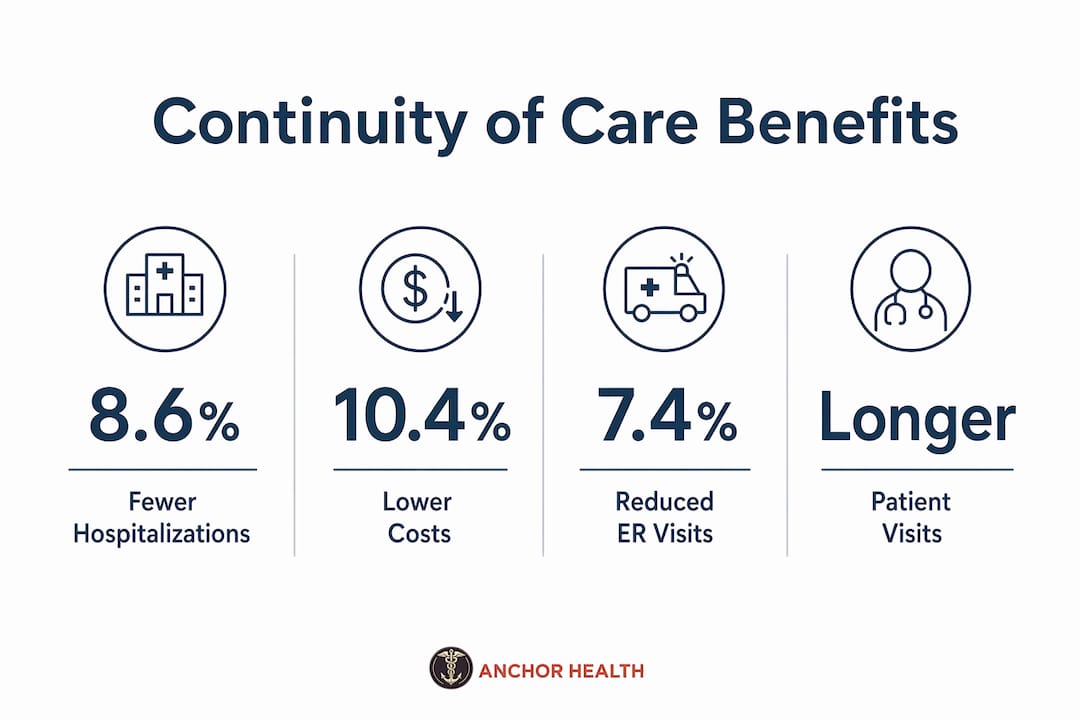
Patients seeing high-continuity physicians had 5.5% to 8.6% fewer hospitalizations and 7.4% to 10.4% lower costs over one year compared to patients with fragmented care. That means seeing the same provider consistently is not just more comfortable. It is clinically protective and economically significant.
Continuity indices are measurable metrics used in research to quantify how consistently a patient sees the same provider. High scores on these indices correlate strongly with reduced emergency visits, lower hospitalization rates, and better chronic disease management. Functional primary care is structured specifically to maximize this score, because the entire model depends on an ongoing relationship rather than episodic encounters.
For people managing chronic conditions such as type 2 diabetes, thyroid dysfunction, or autoimmune disorders, this continuity translates into tighter monitoring, faster medication adjustments, and a provider who notices subtle changes before they become serious problems. For those focused on preventive wellness, it means your provider tracks your trajectory over years, not just your status at a single appointment.
| Outcome | Research finding |
|---|---|
| Hospitalization reduction | 5.5%–8.6% fewer hospitalizations with high-continuity physicians |
| Cost reduction | 7.4%–10.4% lower overall healthcare costs over one year |
| Emergency visit reduction | Fewer emergency visits linked to sustained clinician-patient relationships |
| Chronic disease management | Tighter monitoring and faster adjustments through ongoing provider knowledge |
| Preventive care effectiveness | Long-term trajectory tracking improves early detection and intervention |
Effective functional primary care practices also provide explicit continuity plans for patients, including who they see, how to reach their provider, and how care is managed through lab changes or medication adjustments. If a practice cannot clearly answer those questions, that is a signal worth taking seriously.
What services and conditions does functional primary care address?
Functional primary care covers a broader scope than most people expect. It is not a specialty service reserved for complex or unusual cases. It is designed to serve as your primary medical home while applying a more thorough, root-cause framework to everything it manages.
Chronic conditions commonly supported include:
- Fatigue and low energy, including adrenal and thyroid-related dysfunction
- Hormone imbalances across all life stages, including perimenopause and andropause
- Digestive disorders such as irritable bowel syndrome, small intestinal bacterial overgrowth, and food sensitivities
- Autoimmune conditions including Hashimoto’s thyroiditis and rheumatoid arthritis
- Metabolic dysfunction, including insulin resistance, prediabetes, and weight management challenges
- Cardiovascular risk factors such as elevated inflammation, lipid imbalances, and hypertension
Preventive and wellness services typically include:
- Comprehensive annual physicals with advanced lab panels
- Nutritional assessment and personalized dietary guidance
- Sleep evaluation and intervention
- Stress and mental health support integrated into primary care
- Pediatric and adolescent health, including developmental and behavioral concerns
- Women’s health, including reproductive and hormonal care
Functional primary care also coordinates integrative therapies, including targeted supplementation, mind-body practices, and referrals to specialists in acupuncture, physical therapy, or behavioral health when clinically indicated. The goal is not to replace conventional medicine but to use it alongside lifestyle-based interventions for a more complete result. Practices like Myanchorhealthpc extend this model through telehealth access in Maryland, making these services available without requiring in-person visits for every encounter.
How do membership models support functional primary care delivery?
The financial structure of a practice determines what kind of care it can actually deliver. This is not a minor operational detail. It is the reason functional primary care often requires a different payment model than conventional insurance-based practices.
Modern fee-for-service payment models do not adequately reimburse the time and team-based work required for continuous, comprehensive care. A 60-minute visit that reviews labs, adjusts a care plan, and addresses three chronic conditions generates roughly the same reimbursement as a 15-minute visit for a single complaint. That structural mismatch is why many functional primary care practices have moved toward direct primary care or membership-based models that reduce insurance billing complexity and restore clinical time.
| Payment model | Key features | Best for |
|---|---|---|
| Traditional insurance | Volume-based, short visits, limited access | Acute, episodic care needs |
| Direct primary care | Monthly fee, no insurance billing, unlimited access | Patients wanting direct, ongoing access |
| Membership-based | Monthly or annual fee, enhanced access, may accept insurance | Patients wanting both insurance coverage and added benefits |
| Hybrid model | Insurance for labs and referrals, membership for primary care | Patients managing chronic conditions with complex needs |
Membership models give clinicians the time to practice the way functional primary care requires. Longer visits, proactive outreach, care coordination, and direct messaging are all financially viable when the practice is not dependent on billing volume. For patients, this typically means same-week or same-day scheduling, direct access to their provider, and a care plan that evolves with them over time rather than resetting at each visit.
Pro Tip: When evaluating a membership-based functional primary care practice, ask specifically how continuity is maintained if your primary provider is unavailable. A well-run practice will have a clear answer covering coverage protocols, shared records, and how transitions are managed.
Key takeaways
Functional primary care delivers better outcomes because it combines root-cause medicine, extended visits, and continuous clinician relationships within a single, longitudinal care framework.
| Point | Details |
|---|---|
| Root-cause focus | Advanced testing and detailed health histories replace symptom-only management. |
| Continuity drives outcomes | High-continuity care reduces hospitalizations by up to 8.6% and costs by up to 10.4%. |
| Longer visits matter | Appointments of 45 to 90 minutes allow comprehensive evaluation that 15-minute visits cannot replicate. |
| Membership models enable quality | Direct primary care and membership structures give clinicians the time to practice this model properly. |
| Broad scope of care | Functional primary care addresses chronic conditions, preventive wellness, and integrative therapies under one provider. |
Why continuity is the feature most patients underestimate
People researching functional primary care often focus on the testing. They want to know which labs are included, whether hormones are covered, and how the nutrition guidance works. Those are reasonable questions. But after years of observing how this model actually performs, the most underrated feature is continuity, and most patients do not realize its value until they experience its absence.
A provider who has seen you for two years knows that your fatigue in October is different from your fatigue in March. They know your stress patterns, your medication history, and the three things you tried that did not work. That accumulated clinical knowledge cannot be replicated in a new patient intake form, no matter how thorough.
The misconception I see most often is that functional primary care is primarily about supplements and specialty labs. It is not. The labs are a tool. The supplements are a tool. The relationship is the framework that makes those tools useful. Without continuity, you are just getting expensive testing with no one who knows you well enough to interpret it in context.
When choosing a provider, look for explicit answers to three questions: Who will you see at every visit? How do you reach them between visits? What happens to your care plan if something changes? A practice that cannot answer those questions clearly is not delivering functional primary care. It is delivering functional medicine consultations, which is a different and more limited thing.
Myanchorhealthpc’s Anchored Care℠ᴵᴾ model is built around exactly these principles, and it is worth understanding what a primary care medical home actually means before you commit to any provider.
— Paule
Start your functional primary care journey with Myanchorhealthpc
If you are ready to move from reactive, fragmented care to a model built around your health goals, Myanchorhealthpc offers telehealth-based functional primary care for Maryland residents through its Anchored Care℠ᴵᴾ framework. Secure video visits mean you get comprehensive, relationship-based care without rearranging your schedule around in-person appointments. Labs are completed locally before your visit, so your provider arrives prepared with your full picture.
Myanchorhealthpc accepts insurance and offers membership options for patients who want enhanced access and longer visits. Whether you are managing a chronic condition, focused on preventive wellness, or navigating a health transition, the membership-based primary care model is designed to give your provider the time and continuity to actually help. Explore your options and find the care structure that fits your life.
FAQ
What is functional primary care?
Functional primary care is a model that applies functional medicine principles, including root-cause analysis, advanced testing, and lifestyle-based interventions, within the structure of ongoing primary care. It differs from a one-time functional medicine consultation by providing continuous, longitudinal care from a consistent provider.
How long are functional primary care appointments?
New patient visits typically last 45 to 90 minutes, compared to the standard 15-minute primary care visit. Follow-up appointments are also longer than conventional care to allow thorough review of labs, symptoms, and care plan progress.
Does functional primary care accept insurance?
Many functional primary care practices accept insurance for standard services such as labs and referrals, while using membership or direct primary care fees to cover extended visits and care coordination. Myanchorhealthpc accepts insurance and also offers telehealth primary care membership options for Maryland residents.
What conditions does functional primary care treat?
Functional primary care addresses chronic conditions including fatigue, hormone imbalances, autoimmune disorders, metabolic dysfunction, and digestive issues, alongside preventive wellness, women’s health, and pediatric care. Personalized nutrition, supplementation, and lifestyle-based interventions are integrated into every care plan.
Why does continuity of care matter in this model?
Patients with high-continuity physicians have measurably fewer hospitalizations and lower overall healthcare costs compared to those with fragmented care. Continuity allows your provider to track your health trajectory over time, catch changes early, and make informed adjustments based on your full history rather than a single visit snapshot.
Recommended
- Family Primary Care Best Practices for Every Age
- What Is a Primary Care Medical Home: Family Guide
- How to Choose Telehealth Primary Care for Your Family
- Benefits of Membership-Based Primary Care for Families
Blog & Information Disclaimer
Last Updated: May 23, 2026
The information provided on the Anchor Health website (https://myanchorhealthpc.com/), including but not limited to blog posts, articles, newsletters, graphics, and other materials (collectively, the "Content"), is for general informational and educational purposes only.
By accessing and using this website, you acknowledge and agree to the following terms and conditions:
The Content on this website is not intended to be a substitute for professional medical advice, diagnosis, or treatment. Always seek the advice of your physician, nurse practitioner, or other qualified health provider with any questions you may have regarding a medical condition. Never disregard professional medical advice or delay in seeking it because of something you have read on this website.
Reading, interacting with, or sharing the Content on this website does not establish a patient-provider relationship between you and Anchor Health or any of its clinicians, including Paule Valery Joseph, PhD, MBA, CRNP, FAAN. A formal patient-provider relationship is only established after you have completed the formal intake process, signed our clinical consent forms, and participated in a secure clinical consultation.
If you are experiencing a medical emergency, call 911 or seek emergency medical services immediately.
Anchor Health is a primary care practice and does not provide emergency or crisis intervention services through its website or blog.
While Anchor Health strives to provide thoughtful, evidence-based information grounded in our Anchored Care℠ model, healthcare is a rapidly evolving field. We make no representations or warranties, express or implied, about the completeness, accuracy, reliability, or suitability of the information contained in the Content. Any reliance you place on such information is strictly at your own risk.
Anchor Health is a telehealth practice providing services to patients physically located within the state of Maryland. The information provided on this blog is intended for residents of Maryland and is governed by the laws and regulations of that state. Accessing this information from outside of Maryland does not imply that our clinicians are licensed to practice medicine or provide consultations in your jurisdiction.
Content related to Weight & Metabolic Health, including discussions of GLP-1 medications or other medical therapies, is provided for educational context regarding our clinical approach. Prescriptions and specific medical recommendations are only made following a comprehensive clinical evaluation, diagnostic testing, and shared decision-making within a formal patient-provider relationship.
This website may contain links to external websites that are not provided or maintained by or in any way affiliated with Anchor Health. Please note that Anchor Health does not guarantee the accuracy, relevance, timeliness, or completeness of any information on these external websites.
To the fullest extent permitted by law, Anchor Health, its owners, and its employees shall not be liable for any direct, indirect, incidental, consequential, or punitive damag
Related posts