How insurance covers telehealth family visits in Maryland

Most Maryland families assume that if a service is covered in person, it’s automatically covered the same way by video. That assumption leads to real surprises when the bill arrives. Maryland has made meaningful progress in protecting telehealth access, but the rules are more layered than a simple yes or no. Coverage depends on your plan type, how each visit is categorized, how your provider bills the service, and whether your insurer is even bound by Maryland’s parity law. This guide walks you through each of those layers so your family can use telehealth confidently and avoid costly coverage gaps.
Table of Contents
- How Maryland insurance defines and covers telehealth family visits
- What counts as preventive care, behavioral health, and routine visits in telehealth?
- Key requirements and pitfalls for insurance telehealth claims
- Making the most of telehealth coverage: What Maryland families should do next
- A deeper look: Why maximizing telehealth benefits means more than knowing the law
- Access expert guidance for your family’s telehealth journey
- Frequently asked questions
Key Takeaways
| Point | Details |
|---|---|
| Parity rule basics | Insurers in Maryland must usually cover telehealth visits at the same rate as in-person care if all conditions are met. |
| Coverage depends on category | Preventive, routine, and behavioral health visits use different billing rules, affecting what is covered and what you pay. |
| Each family member billed | Insurance treats family telehealth visits as individual services, not as a bundled group appointment. |
| Check plan status | Self-insured or employer-sponsored plans may not follow Maryland’s state parity rules; verify your plan specifics. |
| Be proactive | Clarify coverage, ask providers about billing, and keep records to maximize the benefits of telehealth for your family. |
How Maryland insurance defines and covers telehealth family visits
With the confusion laid out, let’s start by understanding exactly how Maryland insurance now treats telehealth family visits under the law.
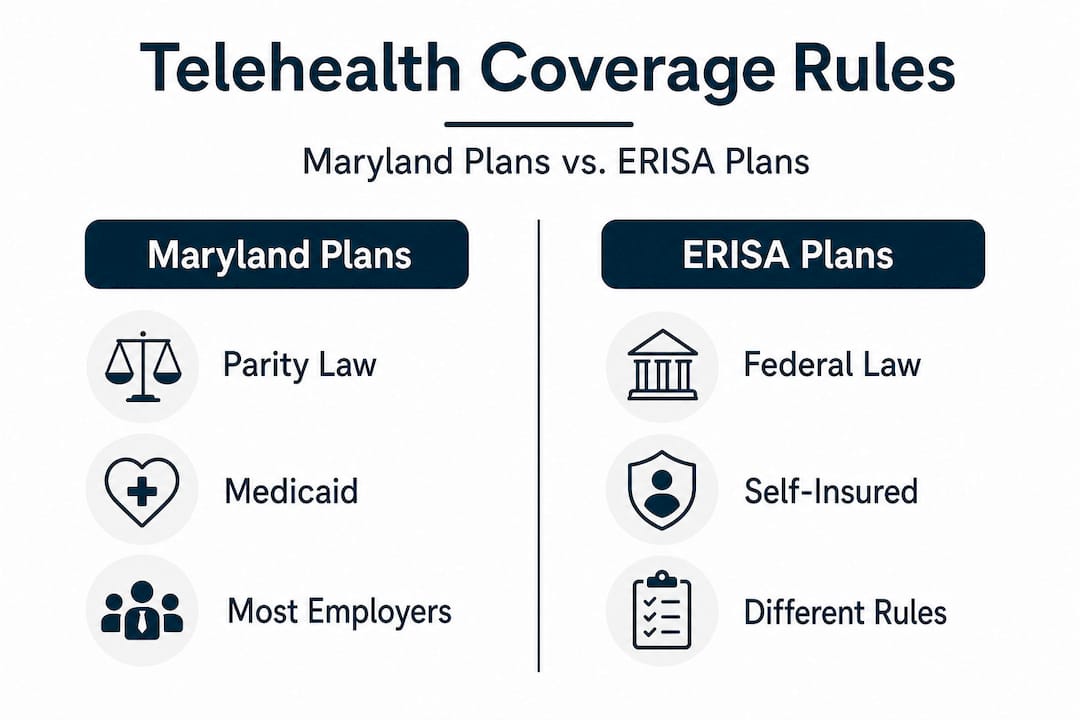
Telehealth family visits are not a single bundled benefit. They are a collection of individual services, each billed separately for each patient, each subject to its own coverage rules. When your family logs into a video visit, the provider is not billing one “family appointment.” They are billing distinct service codes for each person seen, and each code must independently qualify for coverage under your plan.
Maryland has taken a strong stance on access. The Preserve Telehealth Access Act of 2025 establishes that Maryland regulates telehealth reimbursement so that, for covered services, many insurers (including Medicaid) must reimburse appropriately delivered telehealth on the same basis and at the same rate as in-person care. This is called parity, and it is a meaningful protection. But parity only applies when the service is already covered by your plan and when the telehealth visit meets specific delivery standards.
Key fact: Maryland’s parity law does not create new covered services. It ensures that services already covered in person cannot be reimbursed at a lower rate simply because they were delivered via telehealth.
For Maryland Medicaid specifically, synchronous telehealth includes real-time, interactive two-way audio and video (and for some services, audio only), and reimbursement applies when the service is otherwise covered and program rules are met. “Synchronous” simply means the provider and patient are communicating live, not through recorded messages or email.
Here is a quick comparison of how different plan types handle telehealth coverage in Maryland:
| Plan type | Bound by Maryland parity law | Telehealth modality required | Notes |
|---|---|---|---|
| Maryland-regulated private insurance | Yes | Live audio/video (synchronous) | Must reimburse at in-person rate |
| Maryland Medicaid | Yes | Audio/video; some audio-only | Subject to program-specific rules |
| ERISA/self-insured employer plans | No | Varies by plan | State law may not apply |
| Medicare | Federal rules apply | Varies; some in-person requirements | CMS sets the rules, not Maryland |
Key things to keep in mind about telehealth coverage:
- Your plan must already cover the service for parity to apply
- The visit must use a qualifying technology (usually live video)
- Each family member’s services are billed and reviewed individually
- Medicaid and private plans follow similar parity rules but have different program-level details
What counts as preventive care, behavioral health, and routine visits in telehealth?
Now that you know telehealth can be reimbursed like in-person care, it’s critical to recognize that coverage and out-of-pocket costs hinge on how your visit is categorized.

Not all telehealth visits cost the same. The category assigned to your visit determines whether you pay nothing, a copay, or your full deductible. This is where many families get caught off guard.
Preventive care covers services like well-child visits, annual wellness exams, and recommended screenings. When billed correctly as preventive, these visits are often covered at $0 cost-sharing under the Affordable Care Act. But whether a telehealth visit qualifies as preventive depends on the specific procedure code used and how your plan classifies that service. As CareFirst’s 2026 benefit summary makes clear, preventive coverage and virtual visit cost-sharing can be governed by different plan lines of business, meaning the same visit could be free or subject to cost-sharing depending on how it is billed.
Routine and sick visits follow standard cost-sharing rules. If your child has a fever and you connect with a provider by video, that is typically billed as an office visit, not a preventive visit. You would owe your normal copay or deductible amount.
Behavioral health and family therapy carry their own rules. For Medicare beneficiaries receiving mental health telehealth services at home, CMS rules require in-person visits before and periodically between telehealth mental health sessions. This affects families where a parent or grandparent is on Medicare and participating in family therapy sessions. You can also review telemedicine benefits comparison resources to understand how these categories compare across different plan structures.
Here is a step-by-step way to think about how your visit will be categorized:
- Identify the specific service being provided (wellness exam, sick visit, therapy session, etc.)
- Ask your provider which procedure code they plan to use for billing
- Confirm with your insurer whether that code is covered as preventive or as a regular office visit
- Ask whether the telehealth modality (video vs. audio only) affects how the code is processed
- Request an estimate of your expected cost-sharing before the visit
Pro Tip: Call your insurance member services line before scheduling a telehealth visit and ask specifically, “Is procedure code [X] covered as preventive under my plan when delivered via telehealth?” Getting this confirmed in writing or by reference number protects you if a dispute arises later.
| Visit type | Typical cost-sharing | Telehealth parity applies? | Watch out for |
|---|---|---|---|
| Preventive well-child visit | $0 (if coded correctly) | Yes | Incorrect billing code |
| Sick or urgent visit | Copay or deductible | Yes | Audio-only limitations |
| Behavioral health session | Copay or deductible | Yes | Medicare in-person requirements |
| Annual adult wellness exam | $0 (if coded correctly) | Yes | Plan-specific exclusions |
Key requirements and pitfalls for insurance telehealth claims
Understanding categories is just the start. Knowing how to get a claim paid and what could go wrong is just as vital for families using telehealth.
Even when a service is covered and delivered correctly, a claim can still be denied. The most common reason is a technical error in how the visit was documented or billed. Insurers have specific requirements that must be met before they will process a telehealth claim, and missing even one detail can result in a denial or a delay.
UnitedHealthcare’s telehealth reimbursement policy confirms that insurers commonly require the telehealth modality and coding details to match the covered in-person service, including place-of-service codes and live interactive audio and video requirements. Place-of-service (POS) codes are numbers that tell the insurer where the service was delivered. Telehealth visits use specific POS codes (such as code 02 for telehealth provided in a location other than the patient’s home, or code 10 for telehealth provided in the patient’s home). If the wrong code is used, the claim may be denied even if everything else is correct.
Important: Always confirm with your provider that they are using the correct telehealth place-of-service code and any required telehealth modifier codes before your visit is submitted to insurance.
Here are the most common pitfalls that lead to denied telehealth claims for Maryland families:
- Wrong place-of-service code: The provider uses an in-person POS code instead of a telehealth-specific one
- Missing telehealth modifier: Some insurers require a specific modifier code to flag the visit as telehealth
- Audio-only when video is required: The visit was conducted by phone when the plan requires live video
- No documented consent: Some insurers require proof that the patient consented to telehealth services
- Non-covered service billed: The specific procedure code is not on the plan’s covered service list
- Out-of-network provider: The telehealth provider is not in your plan’s network, triggering different cost-sharing
- ERISA plan assumptions: Families assume Maryland’s parity law applies, but their employer’s self-insured plan is not subject to state regulation
That last point deserves extra attention. Many families covered through large employers have what is called an ERISA or self-insured plan. These plans are governed by federal law, not Maryland’s insurance regulations. You can explore ERISA plan handling to better understand how these plans operate. If your employer self-funds its health benefits, Maryland’s telehealth parity law may simply not apply to your coverage.
Pro Tip: Look at your insurance card or benefits documents for language like “self-funded,” “self-insured,” or “administered by [insurer name] on behalf of [employer].” If you see those phrases, contact your HR department to confirm whether Maryland’s telehealth parity rules apply to your specific plan.
Making the most of telehealth coverage: What Maryland families should do next
Armed with knowledge on coverage, categories, and common pitfalls, here is how your family can confidently benefit from telehealth.
The families who get the most out of telehealth are the ones who treat coverage verification as a routine step, not an afterthought. A few minutes of preparation before each visit can prevent hours of frustration after an unexpected bill.
As a critical Maryland-specific nuance, telehealth parity protections apply to many Maryland-regulated plans and Medicaid, but ERISA and self-insured employer plans may not fall under state insurance regulation in the same way. Always confirm whether your plan is state-regulated or self-insured before assuming parity applies. You can also review self-insured telehealth rules for additional context on how employer plan structures affect your benefits.
Follow this checklist before scheduling a telehealth visit for any family member:
- Confirm your plan type: Ask HR or your insurer whether your plan is state-regulated or self-insured
- Verify telehealth coverage: Call member services and confirm the specific service is covered via telehealth
- Ask about cost-sharing: Find out whether the visit will be billed as preventive or as a regular office visit
- Check provider network status: Confirm your telehealth provider is in-network for your plan
- Review consent requirements: Ask your provider what consent forms are needed before the visit
- Request billing details after the visit: Ask how each family member’s services were coded and billed
- Keep records: Save the member services reference number, the date of your call, and the name of the representative you spoke with
Statistic to know: Maryland’s telehealth parity law now covers a broad range of state-regulated plans, but because ERISA plans represent a significant portion of employer-sponsored coverage nationally, a meaningful number of Maryland families may not have automatic parity protections. Checking your plan type is not optional; it is the first step in knowing your rights.
When scheduling behavioral health visits, ask your provider directly whether any in-person sessions are required under your plan or under Medicare rules. Do not assume that a fully virtual care model will apply to every service your family needs.
A deeper look: Why maximizing telehealth benefits means more than knowing the law
Maryland’s telehealth parity law is a genuine achievement. It means that for most state-regulated plans and Medicaid, your family should not pay more simply because a visit happened by video instead of in person. That is worth recognizing. But we have seen, time and again, that the law’s promise and a family’s actual experience do not always match.
The real-world barrier is rarely the law itself. It is the space between what the law says and how your specific insurer, your specific provider, and your specific plan documents interpret and apply it. A claim denied for a missing modifier code is not a legal failure. It is an administrative one, and it is entirely preventable.
One thing that surprises many families is the reality of “group” telehealth visits. It feels efficient to have two children and a parent all seen in one video session. But most plans process and pay for each individual’s service separately. If that session is not documented and billed correctly for each person, one or more claims may be denied. Asking your provider upfront how each family member will be billed is one of the simplest and most effective steps you can take.
We also believe that continuity matters enormously here. Families who work with a consistent provider over time build a relationship where the provider knows your plan, knows your family’s billing history, and can advocate for correct coding on your behalf. That kind of ongoing relationship is not just good medicine. It is good coverage management. Building a routine of checking coverage, communicating with your provider, and keeping records transforms telehealth from a convenience into a reliable, well-functioning part of your family’s healthcare.
Access expert guidance for your family’s telehealth journey
Navigating Maryland’s telehealth insurance rules is manageable, but it is much easier with a trusted provider who already understands the landscape.

At Anchor Health, we work with Maryland families every day to make telehealth primary care straightforward, covered, and genuinely useful. Our Anchored Care℠ model means we know your family’s history, your plan details, and how to communicate with insurers on your behalf. Whether you need help confirming coverage for a well-child visit, scheduling preventive care by video, or understanding how behavioral health sessions will be billed, we are here to guide you through each step. Reach out to our team to schedule a visit or ask questions about your coverage before your next appointment.
Frequently asked questions
Does my Maryland insurance have to cover telehealth the same as in-person visits?
Most Maryland-regulated plans, including Medicaid, must reimburse covered telehealth services at the same rate as in-person care when all requirements are met. Self-insured employer plans may not be subject to this rule.
Is preventive care always free with telehealth in Maryland?
Preventive telehealth visits are usually covered at $0 cost-sharing if your plan lists them as preventive, but this depends on how each service is billed. As CareFirst’s 2026 benefit summary shows, preventive coverage and virtual visit cost-sharing can be governed by different plan lines of business.
Can a single telehealth visit cover multiple family members at once?
No. Insurance typically processes each patient’s service separately, even when family members participate in the same session. Maryland Medicaid’s telehealth policy ties coverage to whether each billed service corresponds to a covered provider and patient interaction.
Do ERISA or self-insured employer plans have to follow Maryland’s telehealth coverage rules?
No. Self-insured plans are typically governed by federal law and may not be subject to Maryland’s insurance parity requirements. Always check with your HR department or plan administrator to confirm.
Are there special rules for behavioral health family telehealth visits?
Yes. CMS rules require an in-person visit before and periodically between telehealth mental health sessions for Medicare beneficiaries receiving care at home. Check with your provider about whether these requirements apply to your family’s situation.
Blog & Information Disclaimer
Last Updated: May 23, 2026
The information provided on the Anchor Health website (https://myanchorhealthpc.com/), including but not limited to blog posts, articles, newsletters, graphics, and other materials (collectively, the "Content"), is for general informational and educational purposes only.
By accessing and using this website, you acknowledge and agree to the following terms and conditions:
The Content on this website is not intended to be a substitute for professional medical advice, diagnosis, or treatment. Always seek the advice of your physician, nurse practitioner, or other qualified health provider with any questions you may have regarding a medical condition. Never disregard professional medical advice or delay in seeking it because of something you have read on this website.
Reading, interacting with, or sharing the Content on this website does not establish a patient-provider relationship between you and Anchor Health or any of its clinicians, including Paule Valery Joseph, PhD, MBA, CRNP, FAAN. A formal patient-provider relationship is only established after you have completed the formal intake process, signed our clinical consent forms, and participated in a secure clinical consultation.
If you are experiencing a medical emergency, call 911 or seek emergency medical services immediately.
Anchor Health is a primary care practice and does not provide emergency or crisis intervention services through its website or blog.
While Anchor Health strives to provide thoughtful, evidence-based information grounded in our Anchored Care℠ model, healthcare is a rapidly evolving field. We make no representations or warranties, express or implied, about the completeness, accuracy, reliability, or suitability of the information contained in the Content. Any reliance you place on such information is strictly at your own risk.
Anchor Health is a telehealth practice providing services to patients physically located within the state of Maryland. The information provided on this blog is intended for residents of Maryland and is governed by the laws and regulations of that state. Accessing this information from outside of Maryland does not imply that our clinicians are licensed to practice medicine or provide consultations in your jurisdiction.
Content related to Weight & Metabolic Health, including discussions of GLP-1 medications or other medical therapies, is provided for educational context regarding our clinical approach. Prescriptions and specific medical recommendations are only made following a comprehensive clinical evaluation, diagnostic testing, and shared decision-making within a formal patient-provider relationship.
This website may contain links to external websites that are not provided or maintained by or in any way affiliated with Anchor Health. Please note that Anchor Health does not guarantee the accuracy, relevance, timeliness, or completeness of any information on these external websites.
To the fullest extent permitted by law, Anchor Health, its owners, and its employees shall not be liable for any direct, indirect, incidental, consequential, or punitive damag
Related posts