Preventive sexual health care: A complete Maryland guide

Preventive sexual health care is far more than an annual STI test. For Maryland residents, it covers a connected set of services, from vaccinations and cancer screenings to contraception counseling, hormonal health support, and mental wellness, all tailored to your age, risk level, and life stage. Telehealth has made these services significantly more accessible, allowing you to consult with a trusted provider, receive mailed test kits, and manage follow-up care without leaving home. This guide walks through everything included in a well-rounded preventive sexual health plan, and how you can access it conveniently across Maryland.
Table of Contents
- What does preventive sexual health care include?
- Preventive sexual health care for women in transition
- Adolescent sexual health: First visits and confidentiality in Maryland
- Advanced strategies: New prevention tools, self-testing, and DoxyPEP
- Our perspective: Why accessible preventive sexual health care matters beyond the checklist
- Connect with trusted preventive sexual health care from home
- Frequently asked questions
Key Takeaways
| Point | Details |
|---|---|
| Beyond just STI tests | Preventive sexual health care includes screenings, counseling, vaccines, and education tailored to age and risk. |
| Support across life stages | Services adapt for women in pregnancy, menopause, and other transitions for best protection. |
| Confidential telehealth access | Maryland residents can receive key preventive services discreetly via telehealth, including mailed kits. |
| New prevention tools | Options like self-testing and DoxyPEP are expanding, but require provider guidance for safe, effective use. |
What does preventive sexual health care include?
Preventive sexual health care is a broad framework of services designed to catch problems early, reduce risk, and support long-term well-being. It is not a single appointment or a single test. It is an ongoing relationship between you and a consistent provider who understands your history, your risks, and your goals.
The core services include:
- STI testing: Regular STI testing covers chlamydia, gonorrhea, syphilis, HIV, and hepatitis, tailored by age, risk, sexual history, and symptoms through provider discussions, self-tests, or self-collection kits mailed directly to labs.
- Vaccinations: The HPV vaccine is recommended through age 26 for most adults, and through age 45 for some. Hepatitis A and B vaccines are also part of standard sexual health prevention.
- Cancer screenings: Cervical cancer screening (Pap tests), anal cancer screening for higher-risk individuals, and testicular self-exam education are all included.
- Contraception services: Counseling on options, prescriptions, and follow-up management for pills, patches, rings, IUDs, implants, and emergency contraception.
- Sexual health counseling: Discussions about consent, healthy relationships, sexual function, gender identity, and mental health connections to sexual well-being.
- Preconception and prenatal care: Folic acid supplementation, genetic risk discussions, and screening for conditions that could affect pregnancy outcomes.
How recommendations adapt by life stage
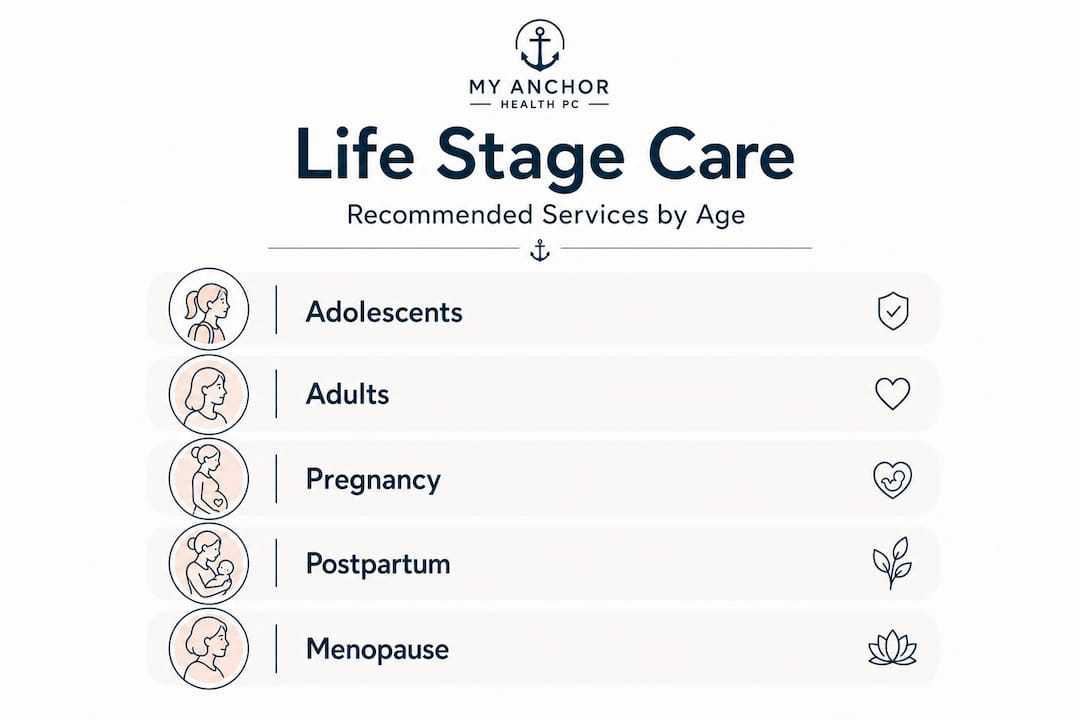
Not every person needs the same services at the same time. Preventive recommendations shift based on age, gender, sexual activity, and underlying health conditions. The table below summarizes key services by life stage.
| Life stage | Key preventive services |
|---|---|
| Adolescents (13 to 18) | HPV vaccine, STI education, confidential counseling, mental health screening |
| Young adults (19 to 26) | STI testing, HPV vaccine completion, contraception, Pap test (21+) |
| Adults (27 to 45) | Pap tests every 3 to 5 years, STI screening by risk, contraception, preconception planning |
| Pregnancy and postpartum | Gonorrhea/syphilis screening, gestational diabetes, preeclampsia screening, breastfeeding support |
| Perimenopause and beyond | Pap tests through age 65, STI screening if sexually active, hormonal health management |
For women specifically, preventive services covered without cost include Pap tests for ages 21 to 65, gonorrhea and syphilis screening for higher-risk or pregnant individuals, the HPV vaccine, contraception counseling and methods, breastfeeding support, folic acid, gestational diabetes screening, and preeclampsia screening.
Telehealth fits naturally into this framework. A provider can review your history, order labs, send test kits to your home, and discuss results in a secure video visit. For many Marylanders, this removes the logistical barriers that often cause people to skip preventive appointments altogether. For those interested in understanding genetic risk factors alongside sexual health planning, reviewing practical genetic screening steps can add another layer of informed decision-making.
Preventive sexual health care for women in transition
Women’s preventive sexual health needs do not stay static. They shift significantly during pregnancy, the postpartum period, and the transition into menopause. Each stage brings new screening priorities, new risks, and new opportunities for education and support.
Pregnancy and preconception
Before pregnancy, the focus is on optimizing health and reducing risk. This includes confirming immunity to STIs that could harm a developing baby, reviewing contraception, and discussing folic acid supplementation. Understanding your genetic background is increasingly relevant here. Learning about preconception genetic testing benefits can help you and your provider identify inherited conditions before conception, giving you more options and more time to plan.
During pregnancy, covered preventive services include gonorrhea and syphilis screening, gestational diabetes testing, preeclampsia screening, and breastfeeding support. These are not optional extras. They are evidence-based services that directly protect maternal and infant health.

Postpartum and beyond
The postpartum period is often underserved in preventive care. Many women focus entirely on the newborn and delay or skip their own follow-up appointments. Telehealth addresses this directly. A video visit can cover postpartum mood screening, contraception resumption, and sexual health concerns without requiring you to arrange childcare or transportation.
The comparison below shows where telehealth excels versus when in-person care is necessary.
| Service | Telehealth appropriate | In-person required |
|---|---|---|
| STI counseling and test kit orders | Yes | No |
| Postpartum mood screening | Yes | No |
| Contraception counseling and prescriptions | Yes | No |
| Pap test | No | Yes |
| IUD insertion or removal | No | Yes |
| Pelvic exam | No | Yes |
| Hormonal symptom management (menopause) | Yes | No |
Menopause and genitourinary syndrome
Genitourinary syndrome of menopause (GSM), which includes vaginal dryness, discomfort during sex, and urinary changes, affects a significant number of women but is frequently underreported. Telehealth makes it easier to have these conversations privately and without embarrassment. A provider can review symptoms, discuss treatment options like topical estrogen or vaginal moisturizers, and monitor response over time, all through secure video visits.
Pro Tip: If you are approaching menopause and still sexually active, do not assume STI risk disappears. Many providers see increased STI rates in adults over 50 partly because this group is less likely to use condoms or discuss risk with a provider. Keep sexual health on your preventive agenda at every stage.
Adolescent sexual health: First visits and confidentiality in Maryland
Younger Marylanders have their own set of preventive needs. Adolescent sexual health visits are structured differently from adult appointments, with a strong emphasis on education, confidentiality, and building trust before any clinical services are introduced.
Here is what a first reproductive health visit for a teen typically includes:
- Confidential discussion: The provider speaks with the adolescent privately, separate from parents or guardians, to allow honest conversation about sexual activity, relationships, and concerns.
- Education on anatomy and health: Age-appropriate information about puberty, reproductive health, and how the body works.
- Sexuality and gender identity: A non-judgmental space to discuss questions about sexual orientation or gender identity, without assumption or pressure.
- Preventive services: HPV vaccine review, STI education, and contraception information if relevant. Testing is offered based on individual risk, not assumed for all teens.
- Trauma-informed screening: Providers are trained to recognize signs of abuse, coercion, or unsafe relationships and to respond with care rather than alarm.
- Mental health connection: Emotional well-being and sexual health are discussed together, recognizing that anxiety, depression, and relationship dynamics all intersect.
“Initial reproductive health visits for adolescents (13 and older) focus on preventive services, education, confidentiality, sexuality and gender discussions, and trauma-informed care.” — American College of Obstetricians and Gynecologists
Telehealth and adolescent care
Telehealth can be a particularly good fit for adolescent sexual health because it removes the discomfort of sitting in a waiting room or facing a provider in person for the first time. However, it requires thoughtful setup. Parents or guardians typically need to consent to telehealth services for minors, but the actual clinical conversation should still include private time between the provider and the teen. We work with families to make this structure clear and comfortable from the start.
Maryland law allows minors to consent to certain sexual health services independently, including STI testing and treatment. Knowing this can reduce barriers for teens who might otherwise avoid care entirely.
Advanced strategies: New prevention tools, self-testing, and DoxyPEP
Beyond standard screenings, innovative strategies are entering mainstream preventive care. Some are well-established. Others are newer and require careful guidance from a provider before use.
At-home and self-collection testing
Self-collection kits allow you to collect samples at home, mail them to a certified lab, and receive results digitally. This approach works for chlamydia, gonorrhea, HIV, syphilis, and hepatitis testing. It removes the need for a clinic visit and significantly reduces the time between deciding to test and actually doing it.
Key points to understand about self-testing:
- Accuracy is high when kits are used correctly, but provider confirmation is still recommended for positive results before treatment begins.
- Follow-up matters. A positive result from a home kit should be followed by a telehealth or in-person visit to confirm, treat, and screen for co-infections.
- Kits do not replace comprehensive care. They are a tool within a broader preventive relationship, not a substitute for it.
DoxyPEP: What it is and who may benefit
DoxyPEP (doxycycline post-exposure prophylaxis) is an antibiotic strategy taken within 72 hours after a potential STI exposure. Research shows it reduces chlamydia by 79% (relative risk 0.21), syphilis by 80% (relative risk 0.20), and gonorrhea modestly (relative risk 0.88 overall). It has been primarily studied in men who have sex with men (MSM) and people using PrEP, with emerging data showing a 64% chlamydia reduction in adherent female sex workers.
DoxyPEP is not appropriate for everyone. Important considerations include:
- Antibiotic resistance: Widespread use of doxycycline raises legitimate concerns about resistance, particularly for gonorrhea and other bacteria. This is an active area of research.
- Microbiome effects: Regular antibiotic use can disrupt gut and vaginal microbiota, with effects that are not yet fully understood for long-term DoxyPEP use.
- Risk compensation: Some studies note that people using DoxyPEP may reduce condom use, potentially offsetting some protective benefit.
- Not a standalone solution: DoxyPEP works best as part of a broader prevention plan that includes regular testing, vaccination, and provider communication.
Pro Tip: If you think DoxyPEP might be relevant to your situation, bring it up directly with your provider. It is a legitimate and evidence-supported option for certain individuals, but the decision should be made with full knowledge of your health history, current medications, and risk profile. Do not obtain or use it without medical guidance.
For those preparing for any type of lab-based testing, reviewing a DNA test preparation guide can help you understand what to expect from sample collection and result interpretation.
Our perspective: Why accessible preventive sexual health care matters beyond the checklist
We see a lot of focus in public health messaging on the checklist. Get tested. Get vaccinated. Schedule your Pap. These reminders are valuable, and we support them fully. But in our experience, the checklist alone does not move the needle on community health outcomes.
What actually changes outcomes is trust. When a person feels genuinely heard by their provider, when they are not rushed, not judged, and not handed a pamphlet instead of a real conversation, they come back. They ask the questions they were embarrassed to ask the first time. They tell their provider about the relationship concern or the symptom they almost did not mention. That is where prevention actually happens.
Telehealth, used thoughtfully, creates more of those moments. It lowers the barrier to entry. It removes the parking lot, the waiting room, and the awkward gown. For a parent managing three kids and a full-time job, a 20-minute video visit at noon is the difference between getting care and skipping it for another six months.
We also believe strongly that stigma is a public health problem. When people feel shame around sexual health, they delay testing, avoid disclosing symptoms, and disengage from care systems entirely. Normalizing these conversations, starting in adolescence and continuing through every life stage, is one of the most effective preventive tools we have. It costs nothing and requires only a consistent, caring provider relationship.
Prevention is not a one-time event. It is a continuous, evolving conversation between you and a provider who knows you well enough to notice when something has changed. That is the model we believe in, and it is the model that genuinely protects health over time.
Connect with trusted preventive sexual health care from home
If you have been putting off a sexual health conversation because it felt inconvenient, uncomfortable, or unclear where to start, telehealth removes most of those barriers. Maryland residents can access confidential, expert preventive sexual health care from wherever they are most comfortable.
At Anchor Health, we offer telehealth care with MyAnchor Health that covers the full range of preventive sexual health services, including provider consultations, lab orders, mailed test kits, contraception management, and ongoing follow-up. Whether you are navigating a health transition, managing a chronic condition, or simply overdue for a preventive visit, we make it easy to get started on your schedule. Reach out today to connect with a provider who will take the time to understand your full picture, not just your last test result.
Frequently asked questions
How often should adults get STI tests as part of preventive care?
Testing frequency depends on your age, sexual activity, and risk factors. STI testing frequency is tailored by age, risk, sexual history, and symptoms, so discussing a personalized schedule with your provider is the most reliable approach.
Can I get preventive sexual health care services by telehealth in Maryland?
Yes, many preventive services are available via telehealth to Maryland residents, including provider consultations, counseling, and self-collection kits mailed to labs for STI screening.
Is preventive sexual health care free for women in Maryland?
Many services are covered without extra cost for eligible women, including Pap tests, screenings, HPV vaccine, and contraception counseling, depending on your insurance plan.
What does DoxyPEP do, and who should consider it?
DoxyPEP is a post-exposure antibiotic strategy that reduces chlamydia and syphilis risk significantly and gonorrhea modestly, primarily studied in MSM and PrEP users, with emerging data for women. Talk to a provider to determine if it fits your situation.
Are adolescent sexual health visits in Maryland confidential?
Yes, adolescent reproductive health visits prioritize confidentiality and education, and Maryland law allows minors to consent independently to certain sexual health services, including STI testing and treatment.
Blog & Information Disclaimer
Last Updated: May 23, 2026
The information provided on the Anchor Health website (https://myanchorhealthpc.com/), including but not limited to blog posts, articles, newsletters, graphics, and other materials (collectively, the "Content"), is for general informational and educational purposes only.
By accessing and using this website, you acknowledge and agree to the following terms and conditions:
The Content on this website is not intended to be a substitute for professional medical advice, diagnosis, or treatment. Always seek the advice of your physician, nurse practitioner, or other qualified health provider with any questions you may have regarding a medical condition. Never disregard professional medical advice or delay in seeking it because of something you have read on this website.
Reading, interacting with, or sharing the Content on this website does not establish a patient-provider relationship between you and Anchor Health or any of its clinicians, including Paule Valery Joseph, PhD, MBA, CRNP, FAAN. A formal patient-provider relationship is only established after you have completed the formal intake process, signed our clinical consent forms, and participated in a secure clinical consultation.
If you are experiencing a medical emergency, call 911 or seek emergency medical services immediately.
Anchor Health is a primary care practice and does not provide emergency or crisis intervention services through its website or blog.
While Anchor Health strives to provide thoughtful, evidence-based information grounded in our Anchored Care℠ model, healthcare is a rapidly evolving field. We make no representations or warranties, express or implied, about the completeness, accuracy, reliability, or suitability of the information contained in the Content. Any reliance you place on such information is strictly at your own risk.
Anchor Health is a telehealth practice providing services to patients physically located within the state of Maryland. The information provided on this blog is intended for residents of Maryland and is governed by the laws and regulations of that state. Accessing this information from outside of Maryland does not imply that our clinicians are licensed to practice medicine or provide consultations in your jurisdiction.
Content related to Weight & Metabolic Health, including discussions of GLP-1 medications or other medical therapies, is provided for educational context regarding our clinical approach. Prescriptions and specific medical recommendations are only made following a comprehensive clinical evaluation, diagnostic testing, and shared decision-making within a formal patient-provider relationship.
This website may contain links to external websites that are not provided or maintained by or in any way affiliated with Anchor Health. Please note that Anchor Health does not guarantee the accuracy, relevance, timeliness, or completeness of any information on these external websites.
To the fullest extent permitted by law, Anchor Health, its owners, and its employees shall not be liable for any direct, indirect, incidental, consequential, or punitive damag
Related posts