How Telehealth Handles After-Hours Family Concerns
After-hours telehealth is defined as virtual medical care delivered outside standard clinic hours through a structured, three-tiered system that combines AI triage, on-call providers, and emergency routing. Understanding how telehealth handles after-hours family concerns gives caregivers a clear framework for making faster, safer decisions when a child spikes a fever at 10 p.m. or a parent wakes up with chest tightness on a Sunday. Platforms like Teladoc and systems with Electronic Health Record (EHR) integration have made this kind of responsive, documented care widely accessible. The result is a model that resolves most concerns without an emergency room visit, while still directing true emergencies to the right place immediately.
How do modern AI triage systems classify after-hours calls?
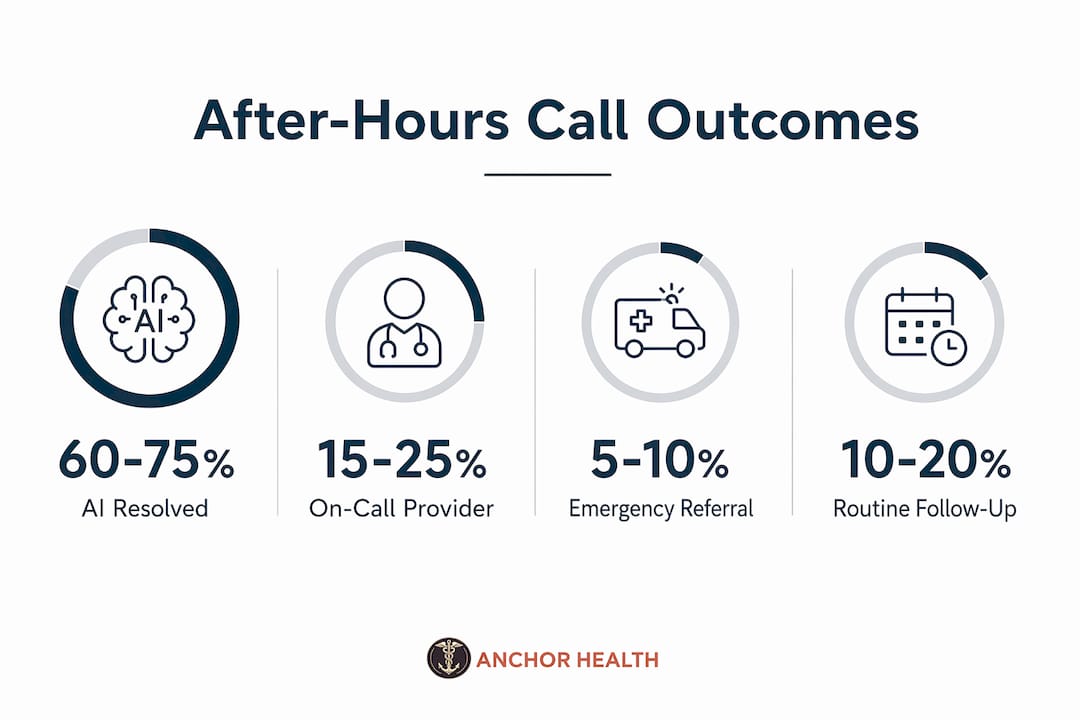
AI triage is the first layer every family encounters in after-hours telehealth, and it does most of the work. AI resolves 60–75% of routine requests instantly, without any human provider involvement. That means the majority of calls about mild fevers, rashes, or repeat prescription questions are handled before a physician ever picks up the phone.
The technology behind this is more structured than most families realize. AI voice agents use clinically validated question sequences to classify each call by urgency. The system asks about symptom onset, severity, and specific red flags like difficulty breathing or loss of consciousness. It does not guess. It follows a clinical protocol designed by physicians.

| Call Type | Percentage of After-Hours Calls | Typical Outcome |
|---|---|---|
| Routine (mild symptoms, refills) | 60–75% | Resolved by AI instantly |
| Urgent (needs provider review) | 15–25% | Escalated to on-call provider |
| Emergency (life-threatening signs) | 3–5% | Routed to 911 or emergency line |
One design feature families should know: these systems are built to over-escalate, not under-escalate. If a caller insists something feels wrong, or if the AI detects ambiguity in the answers, the system defaults to escalation. Safety is the priority, not efficiency.
Pro Tip: Before calling after-hours, write down the symptom timeline, any medications taken, and the patient’s temperature or pain level. AI triage systems ask for this information in sequence, and having it ready cuts call time significantly.
What role do on-call providers play after hours?
When AI triage identifies a concern that needs clinical judgment, approximately 15–25% of calls escalate to an on-call provider. This is where the quality of your telehealth relationship matters most. A provider who already knows your family’s medical history can give precise, personalized guidance. A stranger reading a chart cold cannot.
Familiarity allows for more precise guidance, including tailored pain management recommendations or decisions about whether a prescription refill is appropriate without an in-person visit. This is the core advantage of relationship-based telehealth over episodic, on-demand services.
On-call providers in these systems typically handle:
- Symptom assessment for issues like ear pain, urinary symptoms, or worsening coughs
- Pain management guidance when a patient has a known condition and needs dosing clarification
- Prescription decisions for medications already in the patient’s history
- Mental health check-ins when a family member reports acute anxiety or emotional distress
- Referral coordination when the provider determines in-person care is needed the next morning
Communication happens through video visits, phone calls, or secure messaging, depending on what the situation requires. Video is preferred when visual assessment adds value, such as evaluating a rash or checking for signs of dehydration. For straightforward questions, a phone call or secure text is faster and equally effective.
Pro Tip: If your telehealth provider offers a patient portal, update your family’s medication list and allergy records before you ever need after-hours care. On-call providers access this information in real time, and accurate records lead to better decisions.
Patients who use providers familiar with their background benefit most from this model. For families managing sick child visits through telehealth, continuity is not a luxury. It is a clinical advantage.
How does telehealth manage true emergencies after hours?
Telehealth is not designed to replace emergency services, and well-built systems make that boundary clear and fast. Only 3–5% of after-hours calls are classified as true emergencies, but those calls receive immediate routing to 911 or a dedicated emergency line without delay.
Families should know which symptoms trigger this automatic escalation:
- Difficulty breathing or shortness of breath that is sudden or severe
- Seizures or loss of consciousness
- Unresponsiveness or extreme confusion
- Chest pain with sweating or arm pain
- Severe allergic reactions including throat swelling or hives spreading rapidly
- Signs of stroke including facial drooping, arm weakness, or slurred speech
- Serious injuries including deep lacerations, suspected fractures, or head trauma
Telehealth platforms cannot perform physical exams, and that limitation is clinically significant. A provider on a video call cannot listen to lung sounds, palpate an abdomen, or assess true neurological function. For any symptom on the list above, the right answer is always emergency services, not a video visit.
Understanding this boundary is not a weakness of telehealth. It is a feature of a well-designed system. Families who understand when telehealth suffices and when emergency care is necessary make faster, better decisions under pressure. The goal is to use each resource for what it does best.
Telehealth vs. the ER after hours: benefits and limitations
The financial case for after-hours telehealth is direct. Unnecessary ER visits cost between $1,500 and $3,000 per visit. Telehealth resolves the majority of after-hours concerns at a fraction of that cost, often with no facility fee at all.
| Scenario | After-Hours Telehealth | Emergency Room |
|---|---|---|
| Low-grade fever in a child | Appropriate, fast, low cost | Unnecessary, expensive |
| Rash with no breathing issues | Appropriate with visual assessment | Typically unnecessary |
| Repeat prescription needed | Appropriate if history is documented | Not the right setting |
| Chest pain with sweating | Not appropriate, route to ER | Correct and necessary |
| Seizure or loss of consciousness | Not appropriate, call 911 | Correct and necessary |
| Severe abdominal pain | Ambiguous, provider judgment needed | Often the safer choice |
Beyond cost, EHR integration documents every after-hours encounter and makes it visible to the daytime care team. That means your primary care provider sees what happened at 11 p.m. when you walk in the next morning. Fragmented care, where the night provider and the day provider have no shared record, is one of the most common causes of medication errors and missed diagnoses.
Telehealth supports families managing non-emergency issues like low-grade fevers, minor rashes, and repeat prescriptions conveniently from home. This reduces unnecessary travel and stress during hours when clinics are closed and families are already stretched thin.
The limitation is real, though. Telehealth is not appropriate for ambiguous presentations where a physical exam would change the clinical decision. When in doubt, a good on-call provider will tell you to go in. That honesty is a sign of a trustworthy system.
How can families use after-hours telehealth effectively?
Getting the most from after-hours telehealth requires some preparation before a crisis happens. The families who use these systems well are the ones who set them up in advance.
- Choose a provider with true EHR integration. Documented continuity is what separates relationship-based telehealth from a random on-demand service. Myanchorhealthpc’s Anchored Care℠ model is built on this principle.
- Register your family before you need care. Most platforms require account setup, insurance verification, and medical history entry. Do this on a calm Tuesday, not at midnight.
- Know your provider’s after-hours protocol. Ask directly: Does your practice use AI triage? Who is the on-call provider? How do I reach them?
- Prepare before every call. Have symptom onset time, current medications, allergies, and temperature or pain scale ready. This speeds up AI triage and gives providers the information they need.
- Understand escalation outcomes. If the AI or provider tells you to go to urgent care or the ER, follow that guidance. The system is designed to be conservative for your safety.
- Have a backup plan. Know the location of your nearest urgent care center and emergency room. Telehealth is one layer of a complete care strategy, not the only layer.
Families managing pediatric telehealth should also review what symptoms are appropriate for virtual care versus in-person evaluation. Resources from Garden State Medical Group outline after-hours care versus ER decisions clearly for parents navigating this exact question.
Patients unable to reach providers are three times more likely to switch practices within 12 months. That statistic reflects something real: when families cannot get a response after hours, they lose trust in the relationship. Choosing a provider who has invested in a reliable after-hours system is a decision that protects your family’s continuity of care.
Key takeaways
After-hours telehealth works best when AI triage, on-call providers, and EHR documentation operate as a connected system rather than separate parts.
| Point | Details |
|---|---|
| AI handles most calls instantly | 60–75% of after-hours concerns are resolved by AI triage without provider involvement. |
| On-call providers need your history | Providers with access to your records give more precise guidance than unfamiliar on-demand services. |
| Emergencies require 911, not telehealth | Symptoms like seizures, chest pain, and breathing difficulty must go to emergency services immediately. |
| EHR integration prevents fragmented care | Documented after-hours encounters keep your daytime provider fully informed. |
| Preparation improves every call | Registering early and having symptom details ready makes AI triage faster and provider consultations more effective. |
What i’ve learned about after-hours telehealth and family trust
After working closely with families navigating after-hours care, one pattern stands out clearly. The families who feel most confident are not the ones who never have a health scare at 2 a.m. They are the ones who already know what their telehealth system will do when that moment arrives.
The technology is genuinely impressive. AI triage that follows clinically validated protocols, EHR systems that connect night and day care, and on-call providers who can pull up a child’s full history in seconds represent a real shift in what families can access from home. But the technology only works well when the underlying provider relationship is solid.
My honest concern is with families who treat after-hours telehealth as a substitute for a primary care relationship rather than an extension of one. On-demand platforms that connect you with a random provider each time offer convenience, but they cannot replicate the precision that comes from a provider who knows your child’s baseline, your family’s history, and your specific concerns. That gap shows up most clearly after hours, when there is no time to build context from scratch.
The families I would encourage most are the ones managing multiple children, chronic conditions, or complex health transitions. For them, choosing a provider who prioritizes telehealth benefits for caregivers and documented continuity is not a preference. It is a practical necessity.
— Paule
Finding the right telehealth primary care for your family
Choosing a telehealth provider is one of the most consequential health decisions a family makes, and after-hours responsiveness should be a primary factor in that decision.

Myanchorhealthpc is a Maryland-based telehealth primary care practice built on the Anchored Care℠ model, which prioritizes long-term, documented relationships over episodic visits. The practice covers pediatric and adolescent health, women’s health, mental and emotional health, and general primary care for all ages, all through secure video visits. If you are evaluating your options, the guide on choosing telehealth primary care for your family is a practical starting point. It covers what to look for in after-hours protocols, EHR integration, and provider continuity before you commit to a practice.
FAQ
What is after-hours telehealth triage?
After-hours telehealth triage is a structured process where AI systems classify incoming health calls by urgency and route them to the appropriate response, whether that is automated guidance, an on-call provider, or emergency services.
Can telehealth prescribe medications after hours?
Yes, on-call providers can prescribe or refill medications after hours when the patient’s history supports it and the clinical situation is appropriate. Controlled substances and new medications requiring physical assessment are typically excluded.
What symptoms should never be handled by telehealth?
Difficulty breathing, seizures, chest pain with sweating, unresponsiveness, and signs of stroke require immediate emergency care, not a telehealth visit. These red-flag symptoms always require in-person evaluation.
How does EHR integration help after-hours care?
EHR integration documents every encounter and makes it visible to your daytime provider, preventing fragmented care and ensuring consistent follow-up after an after-hours visit.
Is after-hours telehealth covered by insurance?
Most major insurance plans cover telehealth visits, including after-hours consultations, though coverage details vary by plan and state. Confirming coverage with your provider before your first after-hours call is the most reliable approach.
Recommended
- How to Choose Telehealth Primary Care for Your Family
- How to Attend a Telehealth Visit as a Caregiver
- How Telehealth Handles Sick Child Visits for Families
- Managing Family Health Appointments Remotely in 2026
Blog & Information Disclaimer
Last Updated: May 23, 2026
The information provided on the Anchor Health website (https://myanchorhealthpc.com/), including but not limited to blog posts, articles, newsletters, graphics, and other materials (collectively, the "Content"), is for general informational and educational purposes only.
By accessing and using this website, you acknowledge and agree to the following terms and conditions:
The Content on this website is not intended to be a substitute for professional medical advice, diagnosis, or treatment. Always seek the advice of your physician, nurse practitioner, or other qualified health provider with any questions you may have regarding a medical condition. Never disregard professional medical advice or delay in seeking it because of something you have read on this website.
Reading, interacting with, or sharing the Content on this website does not establish a patient-provider relationship between you and Anchor Health or any of its clinicians, including Paule Valery Joseph, PhD, MBA, CRNP, FAAN. A formal patient-provider relationship is only established after you have completed the formal intake process, signed our clinical consent forms, and participated in a secure clinical consultation.
If you are experiencing a medical emergency, call 911 or seek emergency medical services immediately.
Anchor Health is a primary care practice and does not provide emergency or crisis intervention services through its website or blog.
While Anchor Health strives to provide thoughtful, evidence-based information grounded in our Anchored Care℠ model, healthcare is a rapidly evolving field. We make no representations or warranties, express or implied, about the completeness, accuracy, reliability, or suitability of the information contained in the Content. Any reliance you place on such information is strictly at your own risk.
Anchor Health is a telehealth practice providing services to patients physically located within the state of Maryland. The information provided on this blog is intended for residents of Maryland and is governed by the laws and regulations of that state. Accessing this information from outside of Maryland does not imply that our clinicians are licensed to practice medicine or provide consultations in your jurisdiction.
Content related to Weight & Metabolic Health, including discussions of GLP-1 medications or other medical therapies, is provided for educational context regarding our clinical approach. Prescriptions and specific medical recommendations are only made following a comprehensive clinical evaluation, diagnostic testing, and shared decision-making within a formal patient-provider relationship.
This website may contain links to external websites that are not provided or maintained by or in any way affiliated with Anchor Health. Please note that Anchor Health does not guarantee the accuracy, relevance, timeliness, or completeness of any information on these external websites.
To the fullest extent permitted by law, Anchor Health, its owners, and its employees shall not be liable for any direct, indirect, incidental, consequential, or punitive damag
Related posts