How to Balance Caregiving Work with Telehealth

Telehealth is defined as the delivery of healthcare services through secure video, phone, or digital communication, and it gives working caregivers a practical way to manage medical needs without leaving their jobs or their loved ones behind. The challenge of trying to balance caregiving work with telehealth is real: caregiving responsibilities often collide with work schedules, leaving little room for in-person appointments or care coordination. Research shows that only 17.31% of family caregivers currently use telehealth guidance services, yet those who do report better caregiving competence and lower rates of depression. That gap represents a significant missed opportunity. Myanchorhealthpc, a Maryland-based telehealth primary care provider, is built specifically for families navigating exactly this kind of pressure.
What does it take to balance caregiving work with telehealth?
Effective telehealth for caregivers requires three things: the right technology, a simple organizational system, and a clear understanding of what virtual care can and cannot do. Without all three, caregivers often end up more stressed, not less.
The technology you actually need
The technology barrier is smaller than most caregivers expect. A smartphone or tablet with a stable internet connection handles the majority of telehealth visits. You do not need specialized equipment or a dedicated device. What matters more is consistency: the same device, the same quiet space, and a working camera and microphone every time.
Limiting tech to a light tech stack of one calendar, one notes app, and one communication channel reduces caregiver stress and makes it easier for other helpers to step in. That finding matters because caregiving rarely falls on one person alone. When your system is simple, a sibling, neighbor, or paid helper can pick it up without a learning curve.
Pro Tip: Store all medical documents, test results, and insurance cards in a shared cloud folder like Google Drive. Label folders by year and provider so anyone on the care team can find what they need in under a minute.
Organizing care alongside your work calendar
Shared calendars are the backbone of remote caregiving. Scheduling telehealth appointments the same way you schedule work meetings prevents double-booking and makes caregiving visible to your employer if you need flexibility. Pair the calendar with a simple notes document that tracks medications, upcoming appointments, and open questions for the doctor.

Professional care management services cost $75–$300 per hour and can fill coordination gaps that telehealth alone cannot cover. These services handle logistics like medication delivery, transportation for in-person visits, and communication between specialists. They work best as a complement to telehealth, not a replacement for it.
| Organizational tool | Best use | Who benefits most |
|---|---|---|
| Shared cloud folder | Medical records, insurance documents | Multi-caregiver households |
| Shared calendar | Appointment scheduling, reminders | Working caregivers with fixed hours |
| Notes app | Visit summaries, medication lists | Caregivers attending visits remotely |
| Automated bill pay | Recurring medical expenses | Long-distance caregivers |
| Care management service | Complex coordination, in-person gaps | Caregivers without local support |
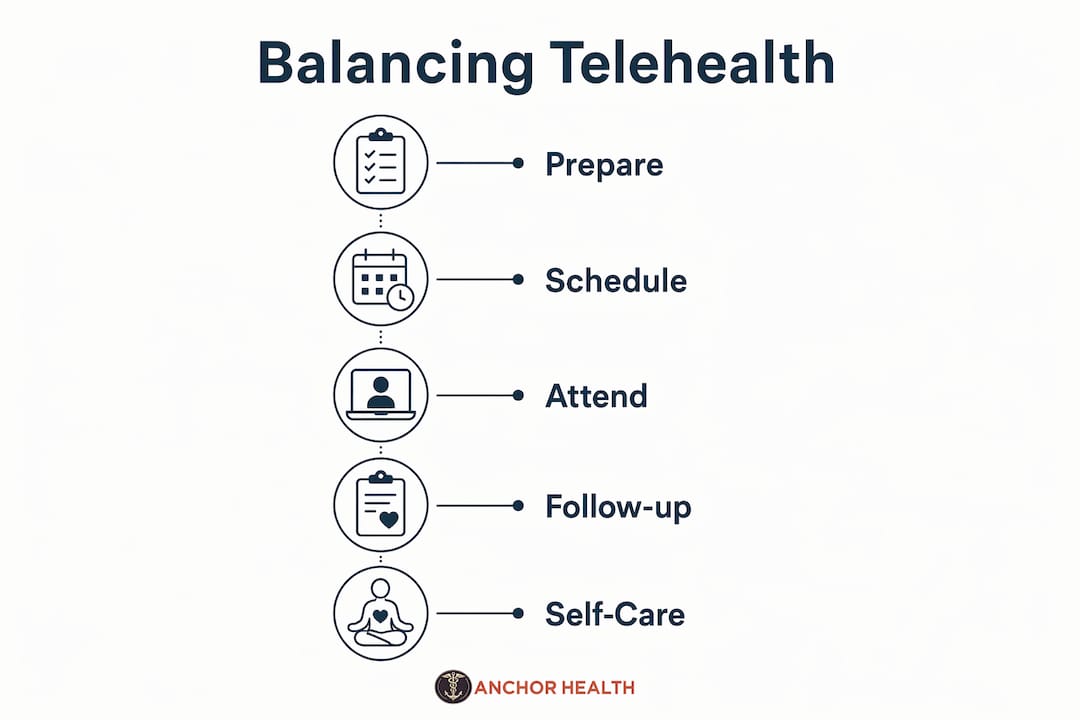
How do you prepare for and follow up on telehealth visits?
Preparation is the single biggest factor in whether a telehealth visit produces a clear care plan or a vague conversation. Caregivers who prepare questions in advance and summarize visits afterward get measurably better outcomes for the people they support.
Before the visit
- Write down the top three concerns or questions you want the provider to address.
- List all current medications, including over-the-counter supplements, with dosages.
- Note any recent changes in symptoms, behavior, or daily function.
- Test the device, camera, and microphone at least 15 minutes before the appointment.
- Confirm the appointment link or dial-in number and have it ready on screen.
Caregiver advocacy in telehealth visits includes preparing notes before visits and clarifying care plans afterward, especially when the patient has cognitive impairment. Advocacy does not mean speaking for the patient. It means making sure the patient’s voice is heard and that the care plan is understood before the call ends.
During the visit
Stay nearby to assist with technology without taking over the conversation. The care recipient should speak directly to the provider whenever possible. Your role is to fill in gaps, not to narrate. If the provider uses medical terms the patient does not understand, ask for a plain-language explanation before the visit ends.
Pro Tip: Use the last two minutes of every telehealth visit to confirm three things: the diagnosis or assessment, the next step, and when to follow up. Write these down while the provider is still on screen.
After the visit
- Summarize the visit in a shared notes document within one hour while details are fresh.
- Set medication reminders or update existing ones based on any changes.
- Schedule the follow-up appointment before closing the calendar.
- Share the summary with any other caregivers or family members involved in care.
A first telehealth visit checklist helps caregivers build this habit from the start. The goal is to turn each visit into a documented care plan, not just a conversation.
How do you fit telehealth appointments into a full workday?
The most effective caregivers treat telehealth appointments like recurring work meetings: scheduled, protected, and non-negotiable. Flexibility is the core advantage of virtual care, and using it deliberately is what separates caregivers who manage well from those who burn out.
Systemizing recurring caregiving tasks reduces management time by 60–70%, potentially dropping weekly caregiving hours from 7 to under 3. That kind of reduction is only possible with structure. Without it, caregiving expands to fill every available hour.
Scheduling strategies that work
- Book telehealth appointments during lunch breaks or the first 30 minutes of the workday when focus demands are lower.
- Use your employer’s flexible work policy to shift start and end times on appointment days.
- Batch caregiving tasks: handle calls, refills, and scheduling in one dedicated block rather than scattered throughout the day.
- Set a weekly caregiving hour, a fixed time each week to review the care plan, check in with the care recipient, and update the shared calendar.
Boundaries that protect your work and your health
Over-managing caregiving erodes the care recipient’s independence and accelerates caregiver burnout. A green-light system helps: unless there is a specific problem, you do not check in. Structured routines replace constant monitoring. This approach builds trust and reduces the mental load of caregiving without reducing the quality of care.
Common mistakes that lead to burnout include responding to every non-urgent message immediately, skipping your own medical appointments to prioritize the care recipient’s schedule, and failing to delegate tasks that a paid helper or local contact could handle. Telehealth reduces the time cost of medical appointments, but it does not automatically reduce the emotional cost. Boundaries do.
How does telehealth help caregivers avoid burnout?
Telehealth increases access to mental health counseling, routine check-ups, and preventive screenings for caregivers, reducing stress and improving overall well-being. The research is clear: caregivers who use telehealth services report lower depressive symptoms than those who do not.
Mean caregiver depression scores in one study were 9.69 ± 1.46, with higher telehealth use linked to better mental health outcomes. That number reflects a population under significant strain. Telehealth does not eliminate that strain, but it removes the logistical barriers that prevent caregivers from getting help.
Scheduling your own care without losing a workday
The most common reason caregivers skip their own appointments is time. A telehealth visit with a primary care provider takes 20–30 minutes and requires no travel, no waiting room, and no half-day away from work. That accessibility changes the calculation entirely.
Pro Tip: Schedule your own telehealth check-up the same week you schedule the care recipient’s appointment. Pairing them reduces the mental effort of remembering two separate tasks and makes your health a standing priority.
Emotional load management is the other side of burnout prevention. Telehealth connects caregivers to mental health providers who specialize in caregiver stress, grief, and role strain. These are not luxury services. They are the difference between a caregiver who sustains their role for years and one who reaches a breaking point in months. Telehealth benefits for caregivers extend well beyond the care recipient’s health.
The effectiveness of telehealth depends on support infrastructure, not just the technology itself. Caregivers need providers who understand their dual role and can coordinate care accordingly. A consistent primary care relationship, rather than episodic urgent care, is what makes telehealth sustainable over time.
Key Takeaways
Working caregivers who use telehealth with a clear system, strong advocacy habits, and firm boundaries reduce both their management time and their risk of burnout significantly.
| Point | Details |
|---|---|
| Start with a light tech stack | One calendar, one notes app, and one communication channel covers most caregiving coordination needs. |
| Prepare and follow up on every visit | Write questions before and summarize care plans after each telehealth appointment to improve outcomes. |
| Schedule caregiving like work | Fixed blocks and batched tasks prevent caregiving from expanding into every available hour. |
| Use telehealth for your own health | Booking your own check-ups via telehealth removes the time barrier that causes caregivers to skip care. |
| Set a green-light system | Structured routines replace constant monitoring and protect both caregiver and care recipient independence. |
Telehealth works best when you stay in your lane
I have seen caregivers approach telehealth visits as if they are the patient’s spokesperson, answering every question, redirecting the provider, and leaving the care recipient with almost no voice in their own care. The intention is good. The result is not.
The most effective caregivers I have observed treat telehealth as a hybrid tool, not a full replacement for in-person care. Video visits work well for follow-ups, medication reviews, and lab discussions. They are not the right setting for new, complex, or urgent problems. Knowing that boundary prevents frustration and misdiagnosis.
My honest recommendation: limit your active role during the visit to technology support and clarifying questions. Let the care recipient lead. Your job before and after the visit is where you add the most value. Preparation and follow-up are where caregivers genuinely change outcomes.
Technology should reduce your cognitive load, not add to it. If you are managing five apps and three communication threads, you have too many tools. Simplify until the system runs without daily effort. That is when caregiving becomes sustainable, and when your own health stops being the thing you sacrifice first.
— Paule
Myanchorhealthpc: telehealth primary care built for busy families
Working caregivers need a provider who understands that their time is split, their attention is divided, and their own health often comes last. Myanchorhealthpc delivers relationship-based primary care through secure video visits, with a model designed for continuity rather than one-off appointments.
The Anchored Care℠ᴵᴾ model means your provider knows your family’s history, tracks ongoing concerns across visits, and coordinates care without requiring you to repeat yourself every time. Myanchorhealthpc accepts insurance and offers membership options for caregivers who want enhanced access and faster communication. If you are ready to find a telehealth primary care option that fits your family’s real schedule, Myanchorhealthpc is a strong place to start. Maryland families can book a visit directly through the website.
FAQ
What is telehealth for caregivers?
Telehealth for caregivers is the use of secure video or phone visits to manage a care recipient’s health appointments remotely. It also covers the caregiver’s own medical care, reducing travel time and scheduling conflicts.
How do I balance caregiving work with telehealth appointments?
Schedule telehealth visits during lunch breaks or flexible work hours, and batch caregiving tasks into one weekly block. Systemizing recurring tasks can reduce weekly caregiving management time significantly.
Does telehealth help prevent caregiver burnout?
Yes. Telehealth competence is linked to lower depression scores among caregivers. Access to mental health counseling and routine check-ups via telehealth removes the time barriers that cause caregivers to skip their own care.
What technology do caregivers need for telehealth?
A smartphone or tablet with a stable internet connection covers most telehealth needs. Limiting tools to one calendar, one notes app, and one communication channel keeps the system manageable for all caregivers involved.
When should telehealth not replace an in-person visit?
Telehealth is not appropriate for emergencies, new complex symptoms, or situations requiring a physical exam. Use video visits for follow-ups, medication reviews, and routine check-ins, and reserve in-person care for urgent or undiagnosed concerns.
Recommended
- Telehealth Benefits for Busy Caregivers in 2026
- How to Attend a Telehealth Visit as a Caregiver
- Telehealth Accessibility for Caregivers: 2026 Guide
- Primary Care’s Role in Caregiver Preventive Screenings
Blog & Information Disclaimer
Last Updated: May 23, 2026
The information provided on the Anchor Health website (https://myanchorhealthpc.com/), including but not limited to blog posts, articles, newsletters, graphics, and other materials (collectively, the "Content"), is for general informational and educational purposes only.
By accessing and using this website, you acknowledge and agree to the following terms and conditions:
The Content on this website is not intended to be a substitute for professional medical advice, diagnosis, or treatment. Always seek the advice of your physician, nurse practitioner, or other qualified health provider with any questions you may have regarding a medical condition. Never disregard professional medical advice or delay in seeking it because of something you have read on this website.
Reading, interacting with, or sharing the Content on this website does not establish a patient-provider relationship between you and Anchor Health or any of its clinicians, including Paule Valery Joseph, PhD, MBA, CRNP, FAAN. A formal patient-provider relationship is only established after you have completed the formal intake process, signed our clinical consent forms, and participated in a secure clinical consultation.
If you are experiencing a medical emergency, call 911 or seek emergency medical services immediately.
Anchor Health is a primary care practice and does not provide emergency or crisis intervention services through its website or blog.
While Anchor Health strives to provide thoughtful, evidence-based information grounded in our Anchored Care℠ model, healthcare is a rapidly evolving field. We make no representations or warranties, express or implied, about the completeness, accuracy, reliability, or suitability of the information contained in the Content. Any reliance you place on such information is strictly at your own risk.
Anchor Health is a telehealth practice providing services to patients physically located within the state of Maryland. The information provided on this blog is intended for residents of Maryland and is governed by the laws and regulations of that state. Accessing this information from outside of Maryland does not imply that our clinicians are licensed to practice medicine or provide consultations in your jurisdiction.
Content related to Weight & Metabolic Health, including discussions of GLP-1 medications or other medical therapies, is provided for educational context regarding our clinical approach. Prescriptions and specific medical recommendations are only made following a comprehensive clinical evaluation, diagnostic testing, and shared decision-making within a formal patient-provider relationship.
This website may contain links to external websites that are not provided or maintained by or in any way affiliated with Anchor Health. Please note that Anchor Health does not guarantee the accuracy, relevance, timeliness, or completeness of any information on these external websites.
To the fullest extent permitted by law, Anchor Health, its owners, and its employees shall not be liable for any direct, indirect, incidental, consequential, or punitive damag
Related posts