Sore Throat or Strep? How to Tell and What to Do Next
Most sore throats are viral and clear up on their own. Strep is the exception, not the rule. The single biggest clue that changes the picture is a sudden, severe sore throat with a high fever and no cough or runny nose — that combination is the one to take seriously.
If you’re seeing that pattern, here’s what to watch for and do right now:
- Sudden high fever (above 100.4°F) with no gradual buildup
- Severe throat pain, especially with swallowing
- Swollen, tender glands in the front of the neck
- White patches or pus on the tonsils
- No cough, no runny nose, no congestion — strep rarely comes with these
If you have fever plus no cough, or pain severe enough to limit swallowing, get tested. If you’re struggling to breathe or swallow at all, seek urgent care immediately. Everything else, including a scratchy throat with a cough and stuffy nose, usually points to a virus. Rest, fluids, and over-the-counter pain relief handle most of it, and if strep is confirmed, you’re generally contagious until 24 hours after starting antibiotics.
Key Takeaways
Sudden fever with no cough is the strongest signal that a sore throat is strep rather than viral, and testing, not symptoms alone, confirms it.
| Point | Details |
|---|---|
| Strep is the minority cause | Only about 5 to 15% of adult sore throats and 30% of children’s sore throats turn out to be strep. |
| The key symptom pattern | Sudden fever plus absence of cough or runny nose is the strongest home indicator of strep. |
| Testing beats guessing | RADT gives fast results; a negative test in kids 3 and older often needs a backup throat culture. |
| Antibiotics are targeted | Confirmed strep needs a full 10-day course of penicillin or amoxicillin, even after symptoms improve. |
| Telehealth handles triage well | Myanchorhealthpc’s virtual visits assess symptoms and risk factors, then coordinate testing or treatment as needed. |
Table of Contents
- Sore Throat or Strep: What Causes Each One
- Strep vs Cold Symptoms: What Actually Points to Strep
- How Do Doctors Decide Who Needs a Strep Test?
- Is My Sore Throat Strep? What Testing Actually Shows
- How to Treat Strep Throat and Manage Symptoms at Home
- How Long Is Strep Throat Contagious?
- Strep Throat Complications and When to Seek Urgent Care
- Frequently Asked Questions
- Sources
Sore Throat or Strep: What Causes Each One
Bacteria cause a minority of sore throats. Group A strep, the bacterium behind strep throat, is responsible for roughly 30% of sore throats in children and only 5 to 15% in adults. The rest come from viruses: the common cold, flu, mono, and dozens of other respiratory bugs that irritate the throat as a side effect.
Age changes the odds substantially. Strep clusters in school-aged kids between 5 and 15, where crowded classrooms and shared drinking fountains do exactly what you’d expect. It’s uncommon in children under 3 and less common in adults, though parents of school-aged kids and adults with sick children at home carry higher exposure risk regardless of their own age. Strep also tends to spike in late fall through early spring, tracking the same crowded indoor months that drive up flu and cold season.
That prevalence gap matters for one practical reason: testing everyone with a sore throat would mean treating a lot of viral infections with antibiotics that do nothing for them. It’s also why clinicians look for specific signs before ordering a test rather than testing on symptoms alone.
Strep vs Cold Symptoms: What Actually Points to Strep
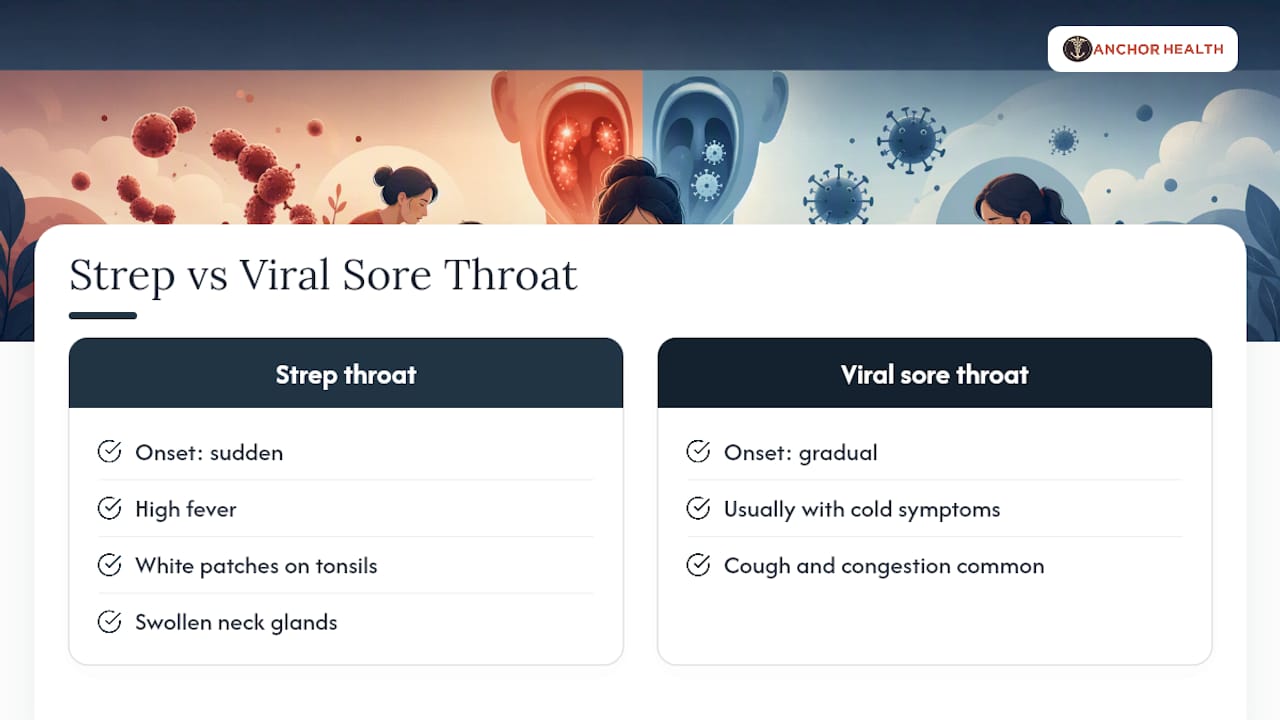
Symptoms overlap enough to trip people up, but a few signs are genuinely useful. Strep throat tends to show up fast and hits hard: sudden pain, fever climbing quickly, and a throat that looks angry with white patches or streaks of pus on the tonsils. Some people also develop tiny red spots on the roof of the mouth, called palatal petechiae, and swollen, tender lymph nodes at the front of the neck.
Viral sore throats build more gradually and almost always travel with company: cough, runny nose, sneezing, hoarseness, sometimes pink or watery eyes. The CDC notes that strep typically lacks these classic cold symptoms entirely, which is the fastest mental shortcut for telling the two apart.
How to check yourself at home:
- Take your temperature. A fever over 100.4°F (38°C) that came on suddenly leans toward strep.
- Look at the back of the throat with a flashlight. White or yellow spots on the tonsils are a strep signal, not a viral one.
- Press gently along the front of the neck, under the jaw. Tender, swollen lumps suggest strep.
- Ask whether you have a cough or runny nose. Their presence makes strep less likely; their absence makes it more likely.
- Think about exposure. A sick classmate, sibling, or coworker with confirmed strep raises your own odds.
| Feature | Strep throat | Viral sore throat |
|---|---|---|
| Onset | Sudden | Gradual |
| Fever | Often high, comes on fast | Mild to moderate, or absent |
| Cough/runny nose | Usually absent | Usually present |
| Tonsils | White patches, pus | Red, sometimes mildly swollen |
| Neck glands | Swollen, tender | Mildly swollen or normal |
| Other clues | Petechiae on roof of mouth | Hoarseness, conjunctivitis |
Pro Tip: A red throat by itself tells you almost nothing. Plenty of viral infections turn the throat bright red without any bacteria involved. And a cough doesn’t rule strep out completely. It just makes it less likely. The pattern matters more than any single symptom.
How Do Doctors Decide Who Needs a Strep Test?
Clinicians don’t test everyone who walks in with a sore throat, and that’s deliberate. Testing every case would mean unnecessary swabs for people who almost certainly have a virus. Instead, most providers use a scoring system, commonly the Centor score or its pediatric adjustment, the McIsaac score, to estimate how likely strep actually is before ordering anything.
The score adds up points for:
- Fever over 100.4°F
- Absence of cough
- Swollen, tender front neck glands
- Tonsillar swelling or white patches
- Age adjustment (McIsaac adds a point for children and subtracts one for adults over 45)
| Score | What it usually means |
|---|---|
| 0 to 1 | Strep unlikely; testing often skipped |
| 2 to 3 | Intermediate risk; rapid test recommended |
| 3 or higher | High risk; test and consider treatment while awaiting results |
Combining these scores with a rapid test measurably cuts unnecessary antibiotic prescriptions compared with treating based on symptoms alone. For telehealth visits, a score of 0 to 1 can often safely skip in-person testing altogether, though household strep exposure or a patient with a history of rheumatic fever changes that calculus and usually warrants an in-person look regardless of score.
Is My Sore Throat Strep? What Testing Actually Shows
Two main tests answer that question, and knowing what each one does helps you understand your results.
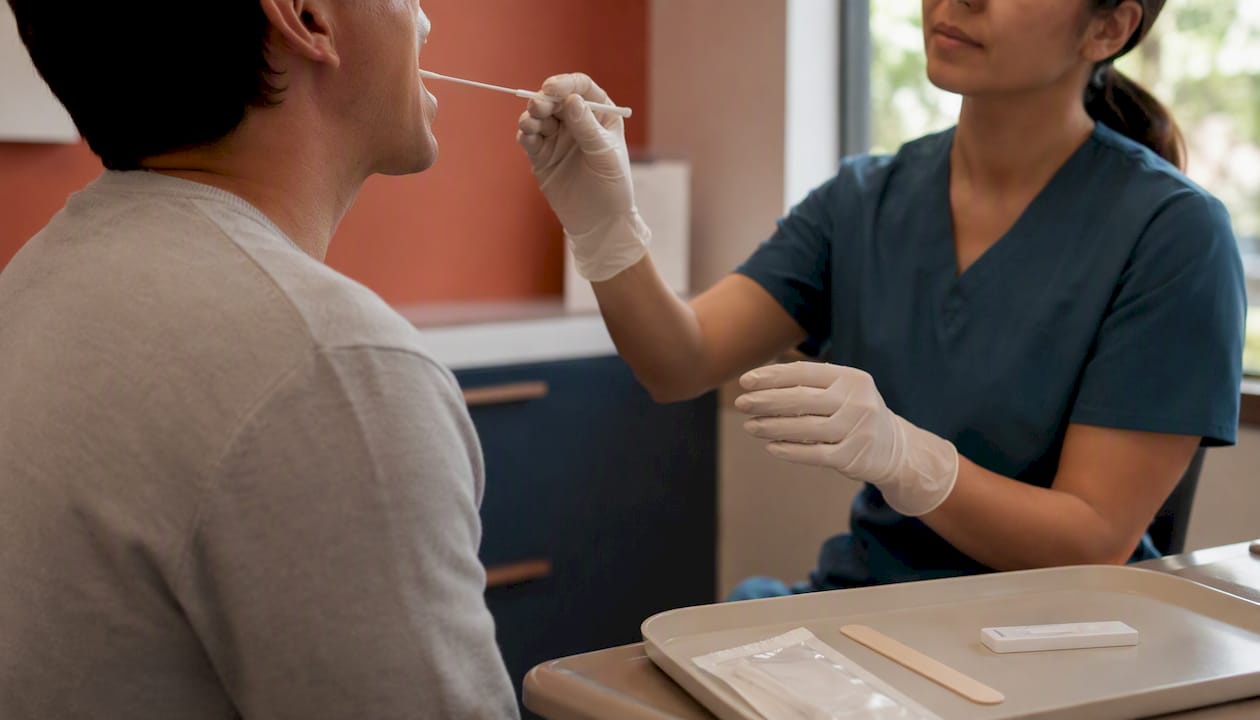
The rapid antigen detection test (RADT) uses a throat swab and gives results in minutes, right in the exam room or at an urgent care visit. It’s highly specific, meaning a positive result is very trustworthy, but its sensitivity varies by brand and technique, so a negative result doesn’t always settle the question.
The throat culture is the gold standard. A swab goes to a lab, and results take 24 to 48 hours. Because RADT sensitivity isn’t perfect, guidance recommends following up a negative rapid test with a culture in symptomatic children age 3 and older, catching cases the quick test might miss.
Some labs now offer molecular tests (PCR or NAAT), which read genetic material from the bacteria directly. These often reach sensitivity and specificity in the 93 to 98% range, rivaling or beating culture accuracy while still delivering same-day results in many settings.
What to expect:
- RADT: results in about 5 to 10 minutes
- Molecular/PCR: often same-day, depending on the lab
- Throat culture: 1 to 2 days
Before your test, mention any recent sick contacts, how long symptoms have lasted, and whether you’ve already tried antibiotics for anything else. That context helps a clinician interpret borderline results.
Pro Tip: If your child is 3 or older and tests negative on a rapid antigen test but still has classic strep symptoms, ask about a backup throat culture. It’s the extra step that catches the cases a fast test occasionally misses.
How to Treat Strep Throat and Manage Symptoms at Home
Confirmed strep gets antibiotics. Unconfirmed, symptom-only sore throats generally don’t need them at all, because antibiotics do nothing against viruses and only add side-effect risk without benefit.

For confirmed group A strep, penicillin or amoxicillin are the first-line choices, and resistance to these remains low, which keeps them effective decades after their introduction. If you’re allergic to penicillin but it’s not a severe (anaphylactic) reaction, cephalexin is a common alternative. For true anaphylactic allergies, a macrolide or clindamycin is typically used instead.
The standard course runs 10 days, and finishing every dose matters even after you feel fine. Shorter high-dose regimens have been studied, but the 10-day course remains the practice standard specifically because it more reliably prevents the rare inflammatory complications that come from stopping early.
For viral sore throats, the approach is entirely different:
- Drink warm fluids and stay hydrated
- Gargle with warm salt water
- Use acetaminophen or ibuprofen for pain, following age-appropriate dosing
- Rest, since your body needs time to clear the virus
Supportive care like this is the actual mainstay of treatment for the vast majority of sore throats, since most never involve bacteria at all.
Never give aspirin to children or teenagers with a viral illness. It’s linked to Reye’s syndrome, a rare but serious condition. Stick to acetaminophen or ibuprofen instead, and check the label for weight-based pediatric dosing.
Pro Tip: Once someone starts antibiotics for confirmed strep, they typically stop being contagious after about 24 hours, provided their fever has also resolved. That’s the practical marker for returning to school or work, not how they feel.
How Long Is Strep Throat Contagious?
Strep spreads through respiratory droplets, coughing, sneezing, or sharing food and drinks with someone who’s infected. People are contagious while symptomatic, and briefly even without obvious symptoms, which is part of why it moves so efficiently through classrooms and households.
Symptoms typically start 2 to 5 days after exposure. Without antibiotics, illness usually runs its course over about a week. With antibiotics, most people start feeling noticeably better within 24 to 48 hours.
- Contagious period: until 24 hours after starting effective antibiotics and being fever-free
- Return to school or work: generally safe once both conditions above are met
- At home: avoid sharing utensils, cups, and towels until the contagious window passes
If fever or throat pain hasn’t budged by 48 to 72 hours into antibiotic treatment, that’s worth a follow-up call rather than waiting it out.
Strep Throat Complications and When to Seek Urgent Care
Untreated strep rarely causes serious problems, but “rare” isn’t “never,” which is exactly why confirmed cases get treated rather than left alone. Possible complications include a peritonsillar abscess (a pocket of infection near the tonsil), rheumatic fever (which can affect the heart), and post-streptococcal glomerulonephritis (a kidney complication).
Seek emergency care immediately if you or your child has:
- Difficulty breathing or swallowing
- Drooling that wasn’t there before, or can’t swallow saliva
- Neck stiffness or severe neck pain
- A high fever that won’t come down
- Signs of severe dehydration (no urination, extreme lethargy, dizziness)
If symptoms aren’t improving after 48 to 72 hours on antibiotics, or they get noticeably worse after an initial improvement, contact your clinician. That pattern can signal an abscess or a resistant infection rather than a normal recovery curve, and it’s worth a same-day evaluation rather than watching and waiting.
What clinicians want you to know before you self-diagnose
Symptoms alone can’t reliably tell you strep from a virus. That’s not a failure of attention, it’s a real limitation, which is exactly why testing exists and why decision rules like Centor and McIsaac guide who actually needs a swab. A telehealth visit is often the right first move for sorting this out quickly. High-risk patients, or anyone with red-flag symptoms like breathing trouble, should skip triage altogether and get seen in person right away.
Telehealth Makes Strep Triage Faster, Not Just More Convenient
You don’t need to guess whether your symptoms warrant a same-day office visit or a “wait and see” approach. Myanchorhealthpc’s telehealth primary care lets you get evaluated from home for both adults and kids, walk through your symptoms and Centor-style risk factors with a clinician, and get a same-visit plan, whether that means coordinating in-person testing nearby or starting treatment based on your presentation.
Anchor Health accepts insurance, self-pay, and offers membership options if you want more consistent follow-up for recurring throat issues or a child prone to frequent infections. If you’re weighing your options, this guide on how to choose telehealth primary care for your family walks through what to look for. Telehealth is not a substitute for emergency care. If you or your child has trouble breathing, swallowing, or shows any red-flag symptom above, go to urgent care or call emergency services first. For everything short of that, book a visit and get a clear answer instead of a guessing game.
Frequently Asked Questions
Do I need a strep test if I have a cough?
A cough doesn’t rule out strep completely, but it makes it less likely. Most testing protocols weigh the absence of cough as a stronger signal toward strep, not the presence of one.
How is strep throat different from a regular sore throat?
Strep tends to come on suddenly with a high fever, white patches on the tonsils, and swollen neck glands, with no cough or congestion. A typical viral sore throat builds gradually and usually comes with cold symptoms.
Can I get a strep test through telehealth?
A telehealth visit can assess your symptoms using clinical decision rules and determine whether you need an in-person rapid test or throat culture, or whether your presentation looks viral enough to skip testing altogether.
How soon after starting antibiotics am I not contagious anymore?
Most people stop being contagious about 24 hours after starting effective antibiotics, provided their fever has also resolved by that point.
What happens if strep goes untreated?
Most cases resolve on their own, but untreated strep can rarely lead to complications like rheumatic fever, a peritonsillar abscess, or kidney inflammation, which is why confirmed cases get antibiotics.
Sources
- About Strep Throat | Group A Strep | CDC
- Streptococcal Pharyngitis – StatPearls – NCBI Bookshelf
- Streptococcal pharyngitis: Rapid evidence review | AAFP
- Strep throat symptoms & causes | Mayo Clinic
- Strep throat symptoms, causes, and treatment | Harvard Health
Recommended
- How Telehealth Handles Sick Child Visits for Families
- How to Request Lab Work Through Telehealth
- Support Stick Archives – My Anchor Health PC – Maryland
Blog & Information Disclaimer
Last Updated: May 23, 2026
The information provided on the Anchor Health website (https://myanchorhealthpc.com/), including but not limited to blog posts, articles, newsletters, graphics, and other materials (collectively, the "Content"), is for general informational and educational purposes only.
By accessing and using this website, you acknowledge and agree to the following terms and conditions:
The Content on this website is not intended to be a substitute for professional medical advice, diagnosis, or treatment. Always seek the advice of your physician, nurse practitioner, or other qualified health provider with any questions you may have regarding a medical condition. Never disregard professional medical advice or delay in seeking it because of something you have read on this website.
Reading, interacting with, or sharing the Content on this website does not establish a patient-provider relationship between you and Anchor Health or any of its clinicians, including Paule Valery Joseph, PhD, MBA, CRNP, FAAN. A formal patient-provider relationship is only established after you have completed the formal intake process, signed our clinical consent forms, and participated in a secure clinical consultation.
If you are experiencing a medical emergency, call 911 or seek emergency medical services immediately.
Anchor Health is a primary care practice and does not provide emergency or crisis intervention services through its website or blog.
While Anchor Health strives to provide thoughtful, evidence-based information grounded in our Anchored Care℠ model, healthcare is a rapidly evolving field. We make no representations or warranties, express or implied, about the completeness, accuracy, reliability, or suitability of the information contained in the Content. Any reliance you place on such information is strictly at your own risk.
Anchor Health is a telehealth practice providing services to patients physically located within the state of Maryland. The information provided on this blog is intended for residents of Maryland and is governed by the laws and regulations of that state. Accessing this information from outside of Maryland does not imply that our clinicians are licensed to practice medicine or provide consultations in your jurisdiction.
Content related to Weight & Metabolic Health, including discussions of GLP-1 medications or other medical therapies, is provided for educational context regarding our clinical approach. Prescriptions and specific medical recommendations are only made following a comprehensive clinical evaluation, diagnostic testing, and shared decision-making within a formal patient-provider relationship.
This website may contain links to external websites that are not provided or maintained by or in any way affiliated with Anchor Health. Please note that Anchor Health does not guarantee the accuracy, relevance, timeliness, or completeness of any information on these external websites.
To the fullest extent permitted by law, Anchor Health, its owners, and its employees shall not be liable for any direct, indirect, incidental, consequential, or punitive damag
Related posts