The Role of Family Doctor in Preventive Care

A family doctor’s role in preventive care is to maintain your health before illness takes hold, through continuous screenings, immunizations, and personalized guidance grounded in evidence-based guidelines. This is not a passive service. Primary care physicians, the standard clinical term for family doctors in this context, actively track your health over years, not just during sick visits. The U.S. Preventive Services Task Force (USPSTF) sets the guidelines that shape what your doctor recommends and when. Yet only about 5% of adults access all recommended preventive services appropriate for their age, sex, and health status. That gap represents real, preventable harm to families across every income level.
What is the role of family doctor in preventive care?
The family doctor’s preventive care role centers on three responsibilities: identifying risk before symptoms appear, delivering guideline-based interventions, and maintaining a continuous relationship that makes both possible. This is what separates primary care from urgent care or specialist visits. A specialist treats a condition. A family doctor works to prevent one from developing in the first place.

Preventive care relies on longitudinal tracking. Episodic care, the kind you get at a walk-in clinic, lacks the continuity needed to detect subtle health shifts over time. A consistent family doctor knows your baseline blood pressure, your family history of colon cancer, and the fact that your cholesterol crept up six points last year. That context is what makes prevention precise.
The USPSTF grades preventive services from A to D based on evidence strength. Grade A and B services carry the strongest recommendations and, under the Affordable Care Act, must be covered by most insurance plans without cost-sharing. Your family doctor uses these grades to build your personal screening schedule, adjusting for age, sex, and individual risk factors.
What specific preventive services do family doctors provide?
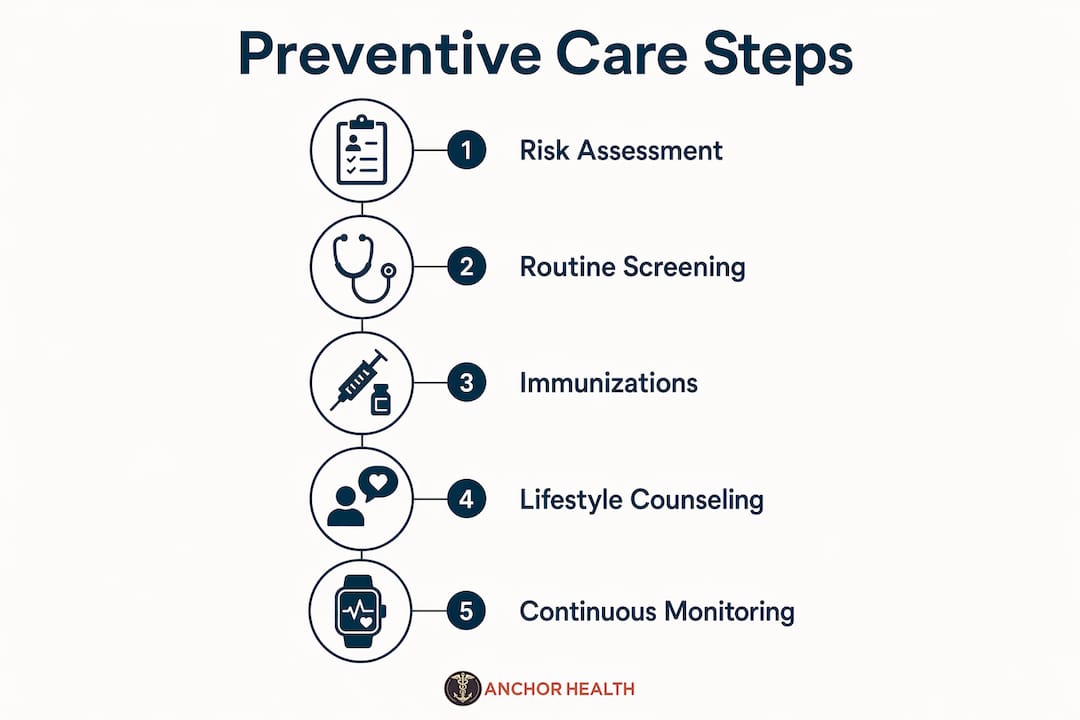
Family doctors deliver a wide range of preventive care services across four main categories.
-
Routine screenings: Colonoscopies, mammograms, HbA1c tests for diabetes, blood pressure checks, cholesterol panels, and cervical cancer screenings via Pap smears. Guideline-concordant screenings such as colonoscopies and HbA1c testing reduce disease-specific mortality by 40–60%. That reduction is not theoretical. It reflects real patients whose cancers were caught early or whose diabetes was identified before organ damage occurred.
-
Immunizations: Your family doctor maintains your vaccination schedule across your lifetime, not just in childhood. Adult vaccines for shingles, pneumonia, influenza, and COVID-19 fall within this scope. Consistent immunization through a trusted provider also supports community-level protection.
-
Lifestyle counseling: Smoking cessation, weight management, physical activity guidance, and dietary advice are all part of the family physician health advice framework. These conversations are most effective when they happen within an ongoing relationship, where your doctor already knows your habits and barriers.
-
Personalized risk assessment: Effective preventive care is a collaborative process where doctors tailor advice based on family history and lifestyle. If your parent had early-onset heart disease, your doctor adjusts your cholesterol screening schedule accordingly.
Pro Tip: Bring a written list of your family’s medical history to your first preventive health appointment. Conditions like diabetes, heart disease, and certain cancers in first-degree relatives directly change which screenings your doctor will prioritize and how soon.
Women have particular reason to engage with preventive screenings early and consistently, given the range of age-specific recommendations for breast, cervical, and bone health. For families with children, preventive care for kids follows its own developmental schedule that a family doctor tracks from birth through adolescence.
How does preventive care reduce chronic disease and hospitalizations?
Primary care is uniquely positioned to provide systemic chronic disease prevention. That is not a marketing claim. It reflects a structural reality: family doctors see patients across years and across conditions, which gives them the data and the relationship to intervene early.
Patients with a primary care relationship have higher rates of preventive service receipt and reduced emergency care or hospitalization. The mechanism is straightforward. When your doctor catches pre-diabetes through a routine HbA1c test, you get a lifestyle intervention before insulin resistance becomes type 2 diabetes. When hypertension is identified at a wellness visit, medication and dietary changes prevent a stroke.
“A consistent family doctor knows the patient’s history for more effective prevention. Longitudinal patient-provider relationships are essential for preventive care success by tracking subtle health changes that no single visit could reveal.”
Integration of electronic health records and team-based care enhances adherence to preventive screening guidelines. When a care team, including nurses, medical assistants, and the physician, shares a patient’s health record, screening reminders become systematic rather than accidental. A patient who misses a mammogram reminder gets a follow-up call. A diabetic patient’s A1C trend is visible to every provider involved in their care.
The result is a system that catches problems earlier, manages chronic conditions more consistently, and keeps patients out of emergency rooms. Telehealth tools have extended this capacity further, allowing family doctors to monitor patients between in-person visits and address concerns before they escalate.
What insurance coverage affects preventive care access?
Understanding your coverage removes one of the most common barriers to preventive care. Under the ACA, private health plans and Medicaid expansions cover USPSTF Grade A and B preventive services without cost-sharing. That means no copay, no deductible, and no coinsurance for covered screenings and immunizations when delivered as preventive services.
The critical distinction is between a preventive visit and a diagnostic one. This is where many patients get surprised by a bill.
| Service type | Billing classification | Patient cost |
|---|---|---|
| Annual wellness visit | Preventive | $0 with ACA-compliant plan |
| Blood pressure screening | Preventive | $0 with ACA-compliant plan |
| Colonoscopy (routine) | Preventive | $0 with ACA-compliant plan |
| Polyp removal during colonoscopy | Diagnostic | Standard cost-sharing applies |
| Follow-up after abnormal mammogram | Diagnostic | Standard cost-sharing applies |
If routine screening leads to finding and treating abnormalities, the service may shift from preventive to diagnostic for billing purposes. Patients may then incur standard costs for the diagnostic portion. This is not a billing error. It is how insurance classification works, and knowing it in advance prevents confusion.
Pro Tip: Before any screening, call your insurance company and ask two questions: “Is this covered as a preventive service?” and “If the doctor finds something and acts on it during the same visit, how will that portion be billed?” Two minutes of preparation can prevent a surprise bill.
Rural and socioeconomically deprived populations experience significantly lower utilization of preventive services, with adherence rates running 30–35% lower than the national average. Telehealth has begun to close that gap by removing transportation and scheduling barriers for patients who cannot easily reach a clinic.
How can patients maximize preventive care from their family doctor?
Getting the most from your family doctor’s preventive care requires active participation, not passive attendance. These steps make a measurable difference.
-
Establish a continuous relationship. Choose one primary care physician and stay with them across years. The value of preventive care compounds over time. A doctor who has seen you for five years reads your labs differently than one meeting you for the first time.
-
Share your full health history. Communicate family history, current medications, supplements, and lifestyle habits openly. Preventive care requires collaboration. Doctors help patients understand risks and co-create plans, but only when they have complete information.
-
Schedule annual wellness visits. These visits are distinct from sick visits. They exist specifically to review your screening schedule, update immunizations, and assess risk factors. Do not skip them because you feel well. Feeling well is exactly when prevention works best.
-
Follow through on referrals. When your family doctor orders a colonoscopy or refers you to a cardiologist, that referral is part of your preventive plan. Completing it closes the loop on your care.
-
Use telehealth between visits. Digital tools extend your access to your care team without requiring an office visit. Family primary care best practices across every age group increasingly include telehealth as a standard component of ongoing prevention.
Pro Tip: There is no missed window for starting preventive care. Providers welcome patients at any point to build tailored plans. If you have skipped years of wellness visits, your next appointment is the right time to catch up, not a reason to delay further.
Young adults navigating care independently for the first time benefit from understanding preventive care for ages 18–25, which includes specific screening timelines and immunization updates that differ from childhood schedules.
Key Takeaways
The family doctor’s preventive care role is the single most effective tool families have for reducing chronic disease, catching illness early, and keeping healthcare costs manageable over a lifetime.
| Point | Details |
|---|---|
| Preventive care is proactive, not reactive | Family doctors use USPSTF guidelines to screen and intervene before symptoms appear. |
| Continuity drives better outcomes | Patients with a consistent primary care relationship have lower hospitalization rates and higher screening completion. |
| ACA covers most preventive services at $0 | Grade A and B USPSTF services require no cost-sharing under ACA-compliant plans. |
| Billing can shift from preventive to diagnostic | If a screening leads to treatment in the same visit, standard cost-sharing may apply to the diagnostic portion. |
| Starting preventive care is never too late | Patients can catch up on missed screenings at any point without penalty. |
What I’ve learned from watching preventive care work and fail
I have spent years reading the evidence on preventive medicine, and the pattern that stands out most is not about screenings or guidelines. It is about relationships. The patients who benefit most from preventive care are not the ones with the best insurance or the most time. They are the ones with a doctor who knows them well enough to notice when something is slightly off.
That is harder to quantify than a colonoscopy schedule, but it is real. A doctor who has seen you annually for a decade notices that your energy has dropped, that your weight has shifted, or that your answers to routine questions sound different this year. No algorithm catches that. No urgent care visit produces it.
The challenge I see most often is that people treat preventive care as optional, something to do when convenient. The data says otherwise. The gap between the 5% of adults who complete all recommended preventive services and everyone else is not a gap in information. Most people know they should get screened. The gap is in access, continuity, and the kind of trusted relationship that makes follow-through feel worth the effort.
Telehealth has genuinely changed this equation for the better. It removes the friction that causes people to skip appointments, and it keeps the relationship alive between annual visits. That continuity is what preventive care has always needed and rarely had.
— Paule
Preventive care, made more accessible with Myanchorhealthpc
Myanchorhealthpc brings relationship-based preventive care to Maryland families through secure video visits, so distance and scheduling conflicts no longer stand between you and your annual wellness visit.
Through the Anchored Care℠ᴵᴾ model, Myanchorhealthpc builds the kind of longitudinal patient-provider relationship that makes preventive care actually work. Whether you need telehealth for your family’s preventive visits, support for women’s health screenings, or pediatric and adolescent care, the practice covers the full spectrum of primary care services. Myanchorhealthpc accepts insurance and offers membership options for patients who want enhanced access and more time with their care team.
FAQ
What does a family doctor do in preventive care?
A family doctor delivers routine screenings, immunizations, lifestyle counseling, and personalized risk assessments to prevent illness before it develops. They follow USPSTF guidelines to build a screening schedule tailored to your age, sex, and health history.
Are preventive care visits covered by insurance?
Under the ACA, USPSTF Grade A and B preventive services are covered without cost-sharing by most private health plans and Medicaid expansions. Coverage includes blood pressure checks, cancer screenings, cholesterol panels, and routine immunizations.
What is the difference between a preventive and a diagnostic visit?
A preventive visit focuses on screening and risk assessment in the absence of symptoms. A diagnostic visit addresses a specific complaint or follows up on an abnormal finding, and standard cost-sharing typically applies to the diagnostic portion.
How often should I see my family doctor for preventive care?
Most adults benefit from at least one annual wellness visit, with additional screenings scheduled based on age and risk factors. Your family doctor determines the right frequency based on USPSTF recommendations and your personal health profile.
Is it too late to start preventive care if I have missed years of visits?
No. Providers welcome patients at any point to build a tailored preventive plan. Missed screenings can be caught up without penalty, and starting now still reduces your long-term risk of chronic disease and serious illness.
Recommended
- Family Primary Care Best Practices for Every Age
- Examples of Preventive Care for Kids: Parent’s Guide
- How to Choose Telehealth Primary Care for Your Family
- Preventive Care for Ages 18–25: Your 2026 Guide
Blog & Information Disclaimer
Last Updated: May 23, 2026
The information provided on the Anchor Health website (https://myanchorhealthpc.com/), including but not limited to blog posts, articles, newsletters, graphics, and other materials (collectively, the "Content"), is for general informational and educational purposes only.
By accessing and using this website, you acknowledge and agree to the following terms and conditions:
The Content on this website is not intended to be a substitute for professional medical advice, diagnosis, or treatment. Always seek the advice of your physician, nurse practitioner, or other qualified health provider with any questions you may have regarding a medical condition. Never disregard professional medical advice or delay in seeking it because of something you have read on this website.
Reading, interacting with, or sharing the Content on this website does not establish a patient-provider relationship between you and Anchor Health or any of its clinicians, including Paule Valery Joseph, PhD, MBA, CRNP, FAAN. A formal patient-provider relationship is only established after you have completed the formal intake process, signed our clinical consent forms, and participated in a secure clinical consultation.
If you are experiencing a medical emergency, call 911 or seek emergency medical services immediately.
Anchor Health is a primary care practice and does not provide emergency or crisis intervention services through its website or blog.
While Anchor Health strives to provide thoughtful, evidence-based information grounded in our Anchored Care℠ model, healthcare is a rapidly evolving field. We make no representations or warranties, express or implied, about the completeness, accuracy, reliability, or suitability of the information contained in the Content. Any reliance you place on such information is strictly at your own risk.
Anchor Health is a telehealth practice providing services to patients physically located within the state of Maryland. The information provided on this blog is intended for residents of Maryland and is governed by the laws and regulations of that state. Accessing this information from outside of Maryland does not imply that our clinicians are licensed to practice medicine or provide consultations in your jurisdiction.
Content related to Weight & Metabolic Health, including discussions of GLP-1 medications or other medical therapies, is provided for educational context regarding our clinical approach. Prescriptions and specific medical recommendations are only made following a comprehensive clinical evaluation, diagnostic testing, and shared decision-making within a formal patient-provider relationship.
This website may contain links to external websites that are not provided or maintained by or in any way affiliated with Anchor Health. Please note that Anchor Health does not guarantee the accuracy, relevance, timeliness, or completeness of any information on these external websites.
To the fullest extent permitted by law, Anchor Health, its owners, and its employees shall not be liable for any direct, indirect, incidental, consequential, or punitive damag
Related posts