Get a Firm Telehealth Primary Care Price in 10 Minutes (Maryland)

Most Maryland residents pay a standard copay for an insured telehealth primary care visit, with the rest covered under state payment-parity rules. Self-pay visits typically run within a moderate range, with many common visits landing at a moderate flat fee. Some practices offer both models, plus membership options for families who want more frequent access.
TL;DR:
- Maryland law mandates insurance reimbursement for telehealth primary care at the same rate as in-person visits, with few exceptions related to billing and facility fees.
- Self-pay telehealth visits generally cost between $40 and $150, with typical rates around $79 to $99, excluding lab tests or imaging.
- Out-of-pocket costs depend on plan features like copays, coinsurance, deductible, and whether the provider is in-network or out-of-network.
- Membership-based telehealth plans can be cost-effective for frequent users, especially families or chronic condition patients, if the monthly fee exceeds the per-visit cost.
- Before booking, patients should verify coverage specifics and ask insurers for a firm price estimate using exact visit codes to avoid unexpected bills.
Table of Contents
- How Maryland Insurance Treats Telehealth Primary Care Cost
- What a Telehealth Visit Actually Costs Without Insurance
- Copays, Coinsurance, and Deductibles: Why Your Price Isn’t the List Price
- Are Membership-Based Telehealth Plans Worth It?
- Using HSA/FSA Funds and Avoiding Surprise Telehealth Bills
- Anchor Health’s Approach to Telehealth Primary Care in Maryland
- How to Get a Firm Price Before Your Visit
- What Maryland Residents Get Wrong About Telehealth Pricing
- Book a Telehealth Primary Care Visit With Anchor Health
- Sources
How Maryland Insurance Treats Telehealth Primary Care Cost
Maryland law settles the biggest question before you even call your insurer: telehealth has to be paid the same as an in-person visit. Under 2025 Regular Session Senate Bill 372, insurers must reimburse telehealth services on the same basis and at the same rate as comparable in-person care, with a short list of exceptions, mostly around facility fees and billing rules for providers who aren’t authorized to bill separately. A companion measure, House Bill 869, reinforces that language and spells out which delivery formats and exceptions apply.
This is what health policy people call payment parity, and it’s worth understanding because it answers a question a lot of patients ask us directly: does my telehealth visit cost more just because it’s virtual? Under Maryland’s framework, it shouldn’t. Parity applies to what the insurer pays the provider, not directly to what you owe at checkout.
Your actual out-of-pocket cost is a separate matter; it still depends entirely on your plan’s copay, coinsurance, and deductible structure. The Maryland Health Care Commission has studied telehealth reimbursement for years, using Milliman analyses to track utilization and recommend that the state preserve parity rather than let it lapse. That ongoing monitoring matters, because some provisions in Maryland telehealth law have historically been time-limited and subject to renewal, so coverage terms can shift from year to year.
Maryland Health Connection confirms that telehealth is commonly covered for:
- Primary care visits, including checkups and chronic condition management
- Behavioral health and mental health counseling
- Urgent care for non-emergency issues
- Some specialist consultations, depending on the plan
Coverage categories are broad, but the fine print in your specific plan still decides your bill. That’s the next thing to check.
What a Telehealth Visit Actually Costs Without Insurance
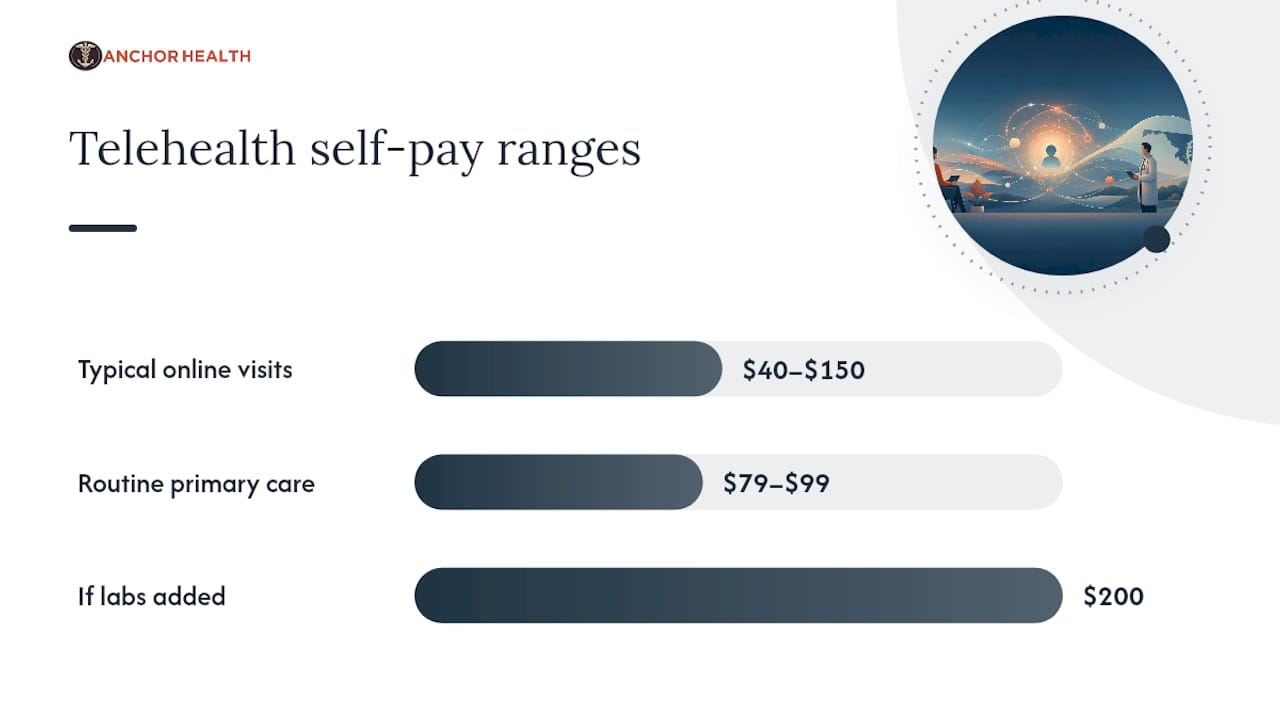
Self-pay pricing in Maryland tends to cluster in a predictable band. Aggregated consumer data from GoodRx shows online telehealth visits commonly cost between $40 and $150, with many routine primary care visits priced around $79 to $99.
Pro Tip: Ask upfront whether the quoted self-pay price includes a follow-up message thread or just the single video call. Some services bill a second fee for any back-and-forth after the visit.
A published flat rate usually covers:
- The clinician’s time during the video visit
- A basic diagnosis and treatment plan
- An electronic prescription, if one is medically appropriate
It usually does not cover:
- Lab work or bloodwork ordered during the visit
- Imaging, such as an X-ray referral
- Facility fees, when the visit is billed through a hospital-affiliated telehealth platform
That last exclusion catches people off guard. A $79 sticker price can turn into a $200 bill once a lab order gets added, so ask what’s included before you book, not after.
Copays, Coinsurance, and Deductibles: Why Your Price Isn’t the List Price
Three plan features decide what you actually pay, and they work differently from each other.
- Copay: a fixed dollar amount, often $0 to $40 for primary care, due at time of service regardless of the visit’s total cost.
- Coinsurance: a percentage of the allowed cost you owe after meeting your deductible, commonly 10% to 30% depending on the plan.
- Deductible: the amount you pay out of pocket before insurance starts covering costs, which can range from a few hundred dollars to several thousand on high-deductible plans.
Network status changes the math too. An in-network telehealth provider bills at a negotiated rate; an out-of-network one can leave you paying the full list price or a much higher coinsurance share, even if the visit itself looked identical on your screen.
Here’s how a typical flat-rate visit might land under three common plan types:
- HMO with a $25 primary care copay: you pay $25, insurer covers the rest.
- PPO with a $500 deductible not yet met: you pay close to the full $79, since it applies toward your deductible.
- High-deductible health plan paired with an HSA: you pay the negotiated rate out of your HSA funds until you hit your deductible, then coinsurance kicks in.
Before you book, log into your member portal or pull your plan’s summary of benefits and search for “telehealth” or “virtual visit” cost-sharing terms. That single search saves most people from a surprise bill.
Are Membership-Based Telehealth Plans Worth It?
Flat-fee membership models work differently from per-visit billing. Instead of paying separately for each appointment, you pay a recurring monthly fee that typically includes unlimited or discounted visits, secure messaging with your care team, and longer appointment times than a typical rushed office visit allows.
Pro Tip: Do quick break-even math before committing. If a membership costs $50 a month and a self-pay visit runs $79, you only need about eight visits a year to come out ahead, which is realistic for a family managing an ongoing condition.
Memberships tend to make the most financial sense for:
- Families with young children who need frequent sick visits
- Adults managing chronic conditions like hypertension or diabetes
- Anyone who values same-week access over per-visit savings
They don’t cover everything. Specialist referrals, lab processing fees, and imaging almost always bill separately, even under a membership. Compare your expected visit frequency against membership pricing structures before assuming a subscription beats paying per visit.
Using HSA/FSA Funds and Avoiding Surprise Telehealth Bills
Telehealth primary care visits generally qualify as eligible expenses under both HSA and FSA accounts, since they’re medical care delivered by a licensed provider. Keep your visit receipt and any itemized statement in case your plan administrator requests documentation later.
Before your appointment, ask the provider directly:
- Is there a separate facility fee for this visit?
- Will a follow-up message or callback trigger an additional charge?
- Are labs billed through your office or through a third-party lab, and at what rate?
If a bill arrives that doesn’t match what you were quoted, request an itemized statement first, then file a written appeal with your insurer if the charge still looks wrong. Maryland residents can also reach out to the state insurance administration’s consumer help line for billing disputes that a provider won’t resolve directly.
Anchor Health’s Approach to Telehealth Primary Care in Maryland
Anchor Health provides telehealth primary care across Maryland for patients of all ages, along with women’s health, pediatric and adolescent care, and metabolic health management that includes GLP-1 medications when clinically appropriate. Every visit runs through secure video, and appointments are built to run longer than the rushed slots many patients are used to elsewhere.
We accept insurance, self-pay, and HSA/FSA funds, and we offer an optional membership for families who want expanded access and closer follow-up between visits. Because we’re grounded in what we call Anchored Care℠, our model is built around continuity: the same clinician getting to know your history, rather than a rotating cast of providers each starting from scratch. That consistency is part of why families managing chronic conditions or ongoing metabolic care tend to stay with one trusted provider instead of bouncing between whichever telehealth service is cheapest that week.
How to Get a Firm Price Before Your Visit
Getting an exact number takes about ten minutes if you follow these steps in order.
- Find the visit type on your insurer’s coverage summary, usually listed as “primary care” or “office visit, established patient.”
- Call your insurer’s member services line and ask specifically about telehealth cost-sharing for that visit type.
- Confirm the provider is in-network before booking, since out-of-network telehealth visits can bill at a much higher rate.
- Ask the provider’s office for a self-pay estimate in writing if you’re uninsured or choosing not to use insurance.
- Ask separately about prescription costs, since medication pricing isn’t included in the visit fee.
Pro Tip: When you call your insurer, use this exact phrasing: “What is my cost-sharing for a telehealth primary care visit, CPT code 99213 or equivalent?” Naming a visit code gets you a faster, more accurate answer than asking generally about “virtual visits.”
If you’re uninsured, ask directly whether the practice offers a sliding scale or a published flat self-pay rate. Many Maryland telehealth practices, including ours, will quote a firm number before you ever book the appointment.
What Maryland Residents Get Wrong About Telehealth Pricing
The conventional advice treats telehealth pricing like a simple lookup: find a number, compare it to another number, book the cheaper one. That undersells how much your specific plan design changes the real cost, and it ignores what happens after the visit ends. A $79 flat rate looks great until a lab order or a second message thread adds $40 you didn’t budget for.
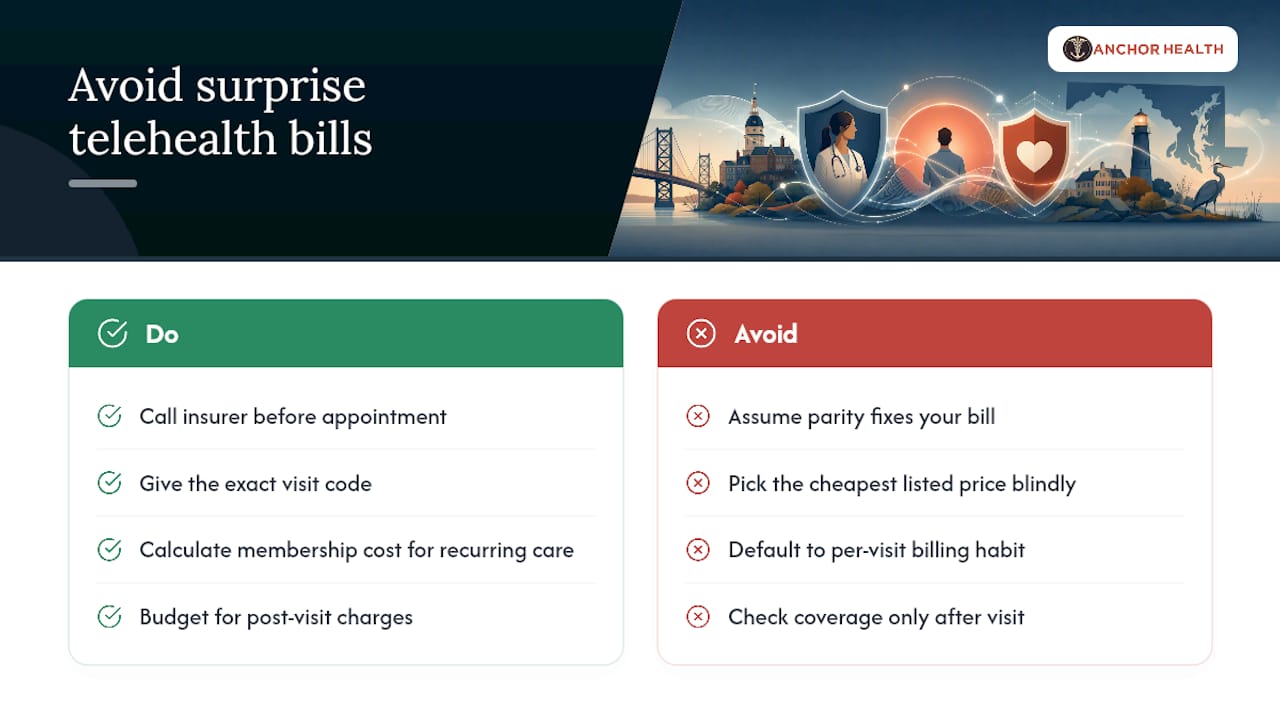
The bigger blind spot is Maryland’s own parity law. Patients assume “the insurer has to cover telehealth the same way” means their personal bill is fixed too. It isn’t. Parity governs what your insurer pays the clinician, not your copay or deductible, and that gap trips up more people than any pricing chart does.
If you take one action from this, make it the phone call to your insurer before the appointment, not after. Ten minutes with your plan’s member services line, using the exact visit code, beats any amount of guessing from a pricing page. For families with recurring needs, chronic conditions or a child who gets sick often, run the membership math honestly rather than defaulting to per-visit billing out of habit.
— Paule
Book a Telehealth Primary Care Visit With Anchor Health
Some telehealth providers offer clear cost information before booking to avoid guessing between competing rate sheets. Many accept insurance, self-pay, and HSA/FSA payments, and some use care models that keep you with the same provider visit after visit, so your history does not reset every time you log in.

Booking starts with a short intake, and you can review how membership and per-visit pricing work for your family before you commit to either path. Before your first visit, have your insurance card, a list of current medications, and a brief health history ready so your clinician can spend the appointment time on care instead of paperwork.
This article is general information, not a substitute for advice from a qualified doctor. Consult a qualified healthcare professional about your own circumstances before acting on anything here.
Sources
- 2025 Regular Session – Senate Bill 372 Chapter
- Use your coverage – Maryland Health Connection
- How Much Does a Telehealth Visit Cost?
Recommended
- Telehealth’s Role in Rural Maryland Healthcare Access
- Set Up Your First Telehealth Account: Maryland Guide
- How telehealth expands healthcare access for Maryland families
- How to Set Up Telehealth for an Elderly Parent
Blog & Information Disclaimer
Last Updated: May 23, 2026
The information provided on the Anchor Health website (https://myanchorhealthpc.com/), including but not limited to blog posts, articles, newsletters, graphics, and other materials (collectively, the "Content"), is for general informational and educational purposes only.
By accessing and using this website, you acknowledge and agree to the following terms and conditions:
The Content on this website is not intended to be a substitute for professional medical advice, diagnosis, or treatment. Always seek the advice of your physician, nurse practitioner, or other qualified health provider with any questions you may have regarding a medical condition. Never disregard professional medical advice or delay in seeking it because of something you have read on this website.
Reading, interacting with, or sharing the Content on this website does not establish a patient-provider relationship between you and Anchor Health or any of its clinicians, including Paule Valery Joseph, PhD, MBA, CRNP, FAAN. A formal patient-provider relationship is only established after you have completed the formal intake process, signed our clinical consent forms, and participated in a secure clinical consultation.
If you are experiencing a medical emergency, call 911 or seek emergency medical services immediately.
Anchor Health is a primary care practice and does not provide emergency or crisis intervention services through its website or blog.
While Anchor Health strives to provide thoughtful, evidence-based information grounded in our Anchored Care℠ model, healthcare is a rapidly evolving field. We make no representations or warranties, express or implied, about the completeness, accuracy, reliability, or suitability of the information contained in the Content. Any reliance you place on such information is strictly at your own risk.
Anchor Health is a telehealth practice providing services to patients physically located within the state of Maryland. The information provided on this blog is intended for residents of Maryland and is governed by the laws and regulations of that state. Accessing this information from outside of Maryland does not imply that our clinicians are licensed to practice medicine or provide consultations in your jurisdiction.
Content related to Weight & Metabolic Health, including discussions of GLP-1 medications or other medical therapies, is provided for educational context regarding our clinical approach. Prescriptions and specific medical recommendations are only made following a comprehensive clinical evaluation, diagnostic testing, and shared decision-making within a formal patient-provider relationship.
This website may contain links to external websites that are not provided or maintained by or in any way affiliated with Anchor Health. Please note that Anchor Health does not guarantee the accuracy, relevance, timeliness, or completeness of any information on these external websites.
To the fullest extent permitted by law, Anchor Health, its owners, and its employees shall not be liable for any direct, indirect, incidental, consequential, or punitive damag
Related posts