Why Convenience Drives Telehealth Adoption for Families

Convenience in telehealth is defined as the ability to access medical care from home, without travel, long waits, or scheduling conflicts. That single factor explains why convenience drives telehealth adoption more than any other force in modern healthcare. A 2024 J.D. Power study found that 65% of patients choose telehealth primarily for convenience, while 46% cite speed as their main motivator. For busy families juggling school pickups, work schedules, and chronic condition management, that data reflects a real shift in how people expect care to work.
Why convenience drives telehealth adoption: the time savings are real
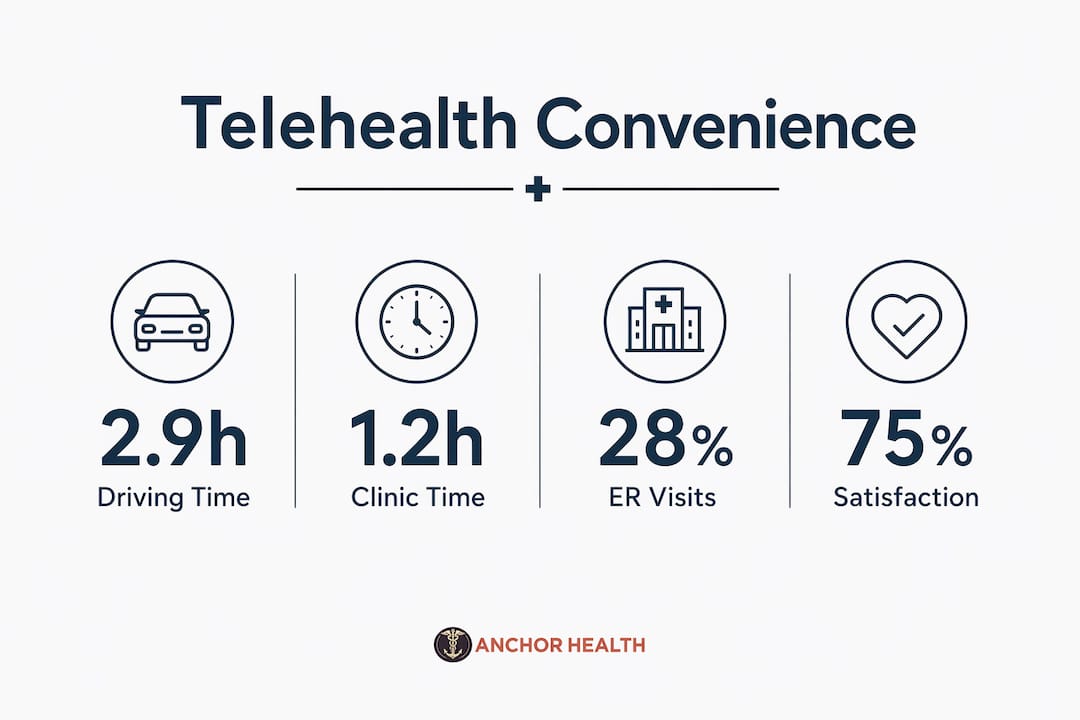
Telehealth saves patients an average of 2.9 hours in driving time and 1.2 hours of in-clinic time per visit. That is more than four hours returned to your day for a single appointment. For a parent managing a child’s asthma follow-up or an adult tracking blood pressure medication, those hours are not abstract. They are the difference between taking a half-day off work and stepping away from your desk for 30 minutes.

The time savings extend beyond the visit itself. Telehealth reduces the burden of transportation, child care arrangements, and time off work for both patients and caregivers. A parent no longer needs to arrange coverage for a second child while taking the first to a pediatric appointment. A working adult with diabetes does not need to use paid leave for a routine check-in with their primary care provider.
The concrete benefits of telehealth for busy schedules include:
- No commute. Appointments happen from your home, office, or anywhere with a stable connection.
- Shorter wait times. Video visits typically start on time, unlike in-person waiting rooms.
- Flexible scheduling. Many telehealth providers offer early morning, evening, and weekend slots that traditional clinics do not.
- Fewer missed appointments. When attendance requires only a phone or laptop, cancellation rates drop.
Pro Tip: Before your first telehealth visit, test your device’s camera and microphone at least 15 minutes early. A quick tech check prevents the most common disruption to a smooth appointment.
Research also shows a 28% reduction in emergency department visits among telehealth users. That figure reflects something important: when care is easy to access, people use it earlier and more consistently, which prevents conditions from escalating to emergency-level severity.
How does telehealth user experience affect convenience?
A convenient appointment means nothing if the platform fails mid-visit. Technical reliability is the foundation of a good telehealth user experience. Platforms that display real-time connection strength indicators reduce patient anxiety and help maintain the sense of human connection during video visits. Without that feedback, patients feel uncertain and distracted, which undermines the quality of the consultation.
Interface design matters just as much as connection quality. Research confirms that UI usability correlates strongly with the quality of informed consent in remote consultations. When a platform is confusing, patients miss critical steps, including privacy decisions. Nearly half of surveyed telehealth users could not recall making privacy decisions, pointing directly to poor interface design as the cause.
Post-visit processes also shape how convenient telehealth feels over time. Clear visit summaries, prescription follow-through, and timely lab result communication distinguish a high-quality telehealth provider from a one-off urgent care app. Patients who receive organized follow-up notes feel more confident in their care and more likely to return to the same provider.
The elements that most affect telehealth user experience include:
- Connection stability. Dropped calls mid-consultation damage trust and waste time.
- Simple login and access. Patients should reach their provider in three steps or fewer.
- Clear post-visit communication. Summaries, prescriptions, and next steps delivered promptly.
- Continuity with a known provider. Seeing the same clinician builds familiarity and reduces the time spent re-explaining health history.
Pro Tip: Choose a telehealth provider that sends a written visit summary after every appointment. That document becomes your personal health record and makes follow-up care far easier to manage.
Trust and continuity with a known provider result in significantly higher patient satisfaction than episodic visits with whoever is available. This is the difference between a telehealth platform and a telehealth practice. Platforms connect you to any available clinician. A practice builds a relationship.
What barriers limit the convenience benefits of telehealth?
Convenience is the leading reason for telehealth growth, but it does not reach everyone equally. For some populations, digital literacy gaps and unreliable internet access offset the benefits entirely. Older adults, rural residents, and individuals with disabilities face real obstacles that a well-designed interface alone cannot solve. Designing telehealth solutions with intuitive, accessible interfaces is the standard required to serve diverse populations, including the elderly and those with physical limitations.
Four barriers consistently limit how broadly convenience in healthcare translates into actual telehealth adoption:
- Digital access gaps. Patients without reliable broadband or a capable device cannot use video visits, regardless of how convenient the platform is.
- Low digital literacy. Older adults and first-time telehealth users often need guided onboarding to feel confident using the technology.
- Privacy and consent confusion. Poor interface design leads to patients skipping or misunderstanding consent steps, which creates legal and trust problems for providers.
- Reimbursement uncertainty. Insurance coverage for telehealth visits varies by state and plan, and unclear billing creates hesitation among patients who fear unexpected costs.
Trust ranks above convenience as the most important factor in sustained patient satisfaction. That finding reframes the conversation. Convenience gets patients to try telehealth. Trust is what keeps them coming back. Providers who treat convenience as the finish line miss the deeper requirement: a reliable, ongoing relationship with a clinician who knows your history.
Telehealth’s role in rural Maryland healthcare access illustrates this tension clearly. Distance makes telehealth attractive, but without broadband infrastructure and provider continuity, the convenience promise remains incomplete.
How can families get the most from telehealth convenience?
Busy families and adults managing chronic conditions get the most from telehealth when they treat it as a primary care channel, not just an urgent care backup. Positive telehealth experiences increase patient engagement and adherence to care plans, especially for chronic conditions like hypertension, diabetes, and asthma. Consistent access to a known provider through video visits keeps care plans on track without requiring repeated in-person visits.
Practical steps for maximizing telehealth convenience include:
- Select a provider with continuity. Avoid platforms that assign a random clinician each visit. Consistent care from one provider improves outcomes and saves time re-explaining your history.
- Use telehealth for both urgent and routine care. Prescription refills, chronic condition check-ins, mental health support, and pediatric follow-ups all work well via video.
- Prepare a brief health update before each visit. Note any new symptoms, medication changes, or questions. A prepared patient gets more from a 20-minute video visit than an unprepared one gets from a 45-minute in-person appointment.
- Confirm insurance coverage before your first visit. Most major insurers cover telehealth primary care, but verifying in advance prevents billing surprises.
The benefits of telehealth for busy caregivers extend beyond individual appointments. When a parent can attend a child’s follow-up visit during a lunch break, the entire family’s health management becomes more consistent.
| Scenario | In-person visit | Telehealth visit |
|---|---|---|
| Chronic condition check-in | Half-day off work, travel required | 20-minute video call from home |
| Child’s follow-up appointment | Childcare needed for siblings | Parent attends from any location |
| Mental health support | Stigma of clinic visit, travel time | Private, comfortable home setting |
| Prescription refill review | Scheduled appointment, waiting room | Quick video consult, e-prescription sent |
54% of Americans used telehealth in the past year, with satisfaction rates above 75%. That combination of broad adoption and high satisfaction confirms that telehealth convenience is not a niche preference. It is a mainstream expectation.
Pro Tip: When managing a chronic condition via telehealth, schedule your next appointment before ending the current one. Consistent scheduling prevents the gaps in care that lead to preventable complications.
Key Takeaways
Convenience drives telehealth adoption because it removes the time, travel, and scheduling barriers that prevent consistent care, but trust and continuity with a known provider determine whether patients stay.
| Point | Details |
|---|---|
| Time savings are measurable | Telehealth saves over 4 hours per visit by eliminating driving and waiting room time. |
| UX quality shapes convenience | Reliable platforms with clear interfaces and post-visit summaries make telehealth genuinely useful. |
| Barriers exist for some populations | Digital access gaps and low literacy offset convenience benefits for older adults and rural patients. |
| Trust outranks convenience long-term | Patients stay with telehealth providers who offer continuity, not just quick access. |
| Chronic care benefits most | Consistent telehealth check-ins improve adherence and reduce emergency department visits by 28%. |
Why convenience alone is not enough: a clinician’s perspective
Convenience is what gets patients to try telehealth. I have seen that pattern play out repeatedly. A parent books a first video visit because it fits between school drop-off and a work meeting. An adult with high blood pressure tries it because the alternative is a two-week wait for an in-person slot. The entry point is always convenience.
What I find more telling is what happens next. Patients who see the same provider consistently, who receive clear follow-up notes, and who feel genuinely heard during a 20-minute video visit, those patients do not go back to skipping appointments. They engage with their care in a way that episodic, app-based urgent care never produces. The American Medical Association’s research on care improvement through telehealth confirms what I observe directly: engagement and adherence improve when the experience is positive and consistent.
The risk I see is providers treating convenience as the product. Speed and ease are features. The product is care. When a platform prioritizes quick access over relationship continuity, it produces satisfied first-time users and disengaged long-term patients. That is not a healthcare model. It is a transaction model wearing a stethoscope.
My honest recommendation: choose a telehealth provider the way you would choose any primary care practice. Ask whether you will see the same clinician. Ask how they handle prescription management and follow-up. Ask what happens when your condition changes. Convenience should be the door, not the destination.
— Paule
Find the right telehealth primary care for your family
Choosing a telehealth provider is one of the most practical health decisions a busy family can make in 2026. The right practice offers same-day access, consistent care from a provider who knows your history, and the flexibility to manage everything from pediatric check-ins to chronic condition monitoring through secure video visits.
Myanchorhealthpc operates on exactly that model. As a Maryland-based telehealth primary care practice, Myanchorhealthpc delivers relationship-based care through its Anchored Care℠ᴵᴾ framework, covering primary care for all ages, women’s health, mental health support, and metabolic health management. If you are ready to make care fit your schedule rather than the other way around, start with a clear framework for choosing telehealth primary care for your family. You can also explore managing family health remotely to understand how a consistent telehealth practice supports your whole household.
FAQ
Why do most patients choose telehealth over in-person care?
65% of patients choose telehealth primarily for convenience, and 46% cite speed as their main reason. Eliminating travel and waiting room time makes telehealth the practical choice for busy adults and families.
How much time does telehealth actually save per visit?
Telehealth saves an average of 2.9 hours in driving time and 1.2 hours of in-clinic time per visit. That adds up to more than four hours returned to your schedule for a single appointment.
Is telehealth effective for managing chronic conditions?
Positive telehealth experiences increase patient engagement and adherence to care plans, especially for chronic conditions. Consistent video check-ins with a known provider keep treatment on track without requiring repeated in-person visits.
What makes a telehealth platform genuinely convenient to use?
Technical reliability, simple login, real-time connection indicators, and clear post-visit summaries are the core features that make a platform feel convenient. Poor interface design leads to confusion and missed consent steps, which undermines both trust and usability.
Does telehealth work for the whole family, including children?
Telehealth covers pediatric and adolescent care, women’s health, mental health support, and chronic condition management for adults. Providers like Myanchorhealthpc offer care for all ages through secure video visits, making it practical for families to manage multiple members’ health from one practice.
Recommended
- How to Choose Telehealth Primary Care for Your Family
- How telehealth expands healthcare access for Maryland families
- How to Attend a Telehealth Visit as a Caregiver
- How to Establish Pediatric Care Telehealth for Your Family
Blog & Information Disclaimer
Last Updated: May 23, 2026
The information provided on the Anchor Health website (https://myanchorhealthpc.com/), including but not limited to blog posts, articles, newsletters, graphics, and other materials (collectively, the "Content"), is for general informational and educational purposes only.
By accessing and using this website, you acknowledge and agree to the following terms and conditions:
The Content on this website is not intended to be a substitute for professional medical advice, diagnosis, or treatment. Always seek the advice of your physician, nurse practitioner, or other qualified health provider with any questions you may have regarding a medical condition. Never disregard professional medical advice or delay in seeking it because of something you have read on this website.
Reading, interacting with, or sharing the Content on this website does not establish a patient-provider relationship between you and Anchor Health or any of its clinicians, including Paule Valery Joseph, PhD, MBA, CRNP, FAAN. A formal patient-provider relationship is only established after you have completed the formal intake process, signed our clinical consent forms, and participated in a secure clinical consultation.
If you are experiencing a medical emergency, call 911 or seek emergency medical services immediately.
Anchor Health is a primary care practice and does not provide emergency or crisis intervention services through its website or blog.
While Anchor Health strives to provide thoughtful, evidence-based information grounded in our Anchored Care℠ model, healthcare is a rapidly evolving field. We make no representations or warranties, express or implied, about the completeness, accuracy, reliability, or suitability of the information contained in the Content. Any reliance you place on such information is strictly at your own risk.
Anchor Health is a telehealth practice providing services to patients physically located within the state of Maryland. The information provided on this blog is intended for residents of Maryland and is governed by the laws and regulations of that state. Accessing this information from outside of Maryland does not imply that our clinicians are licensed to practice medicine or provide consultations in your jurisdiction.
Content related to Weight & Metabolic Health, including discussions of GLP-1 medications or other medical therapies, is provided for educational context regarding our clinical approach. Prescriptions and specific medical recommendations are only made following a comprehensive clinical evaluation, diagnostic testing, and shared decision-making within a formal patient-provider relationship.
This website may contain links to external websites that are not provided or maintained by or in any way affiliated with Anchor Health. Please note that Anchor Health does not guarantee the accuracy, relevance, timeliness, or completeness of any information on these external websites.
To the fullest extent permitted by law, Anchor Health, its owners, and its employees shall not be liable for any direct, indirect, incidental, consequential, or punitive damag
Related posts