Primary Care’s Role in Women’s Reproductive Health

Primary care is defined as the first, continuous, and comprehensive point of contact for women’s reproductive health across every life stage. From adolescence through menopause, your primary care provider coordinates prevention, screenings, counseling, and specialist referrals under one trusted relationship. The WHO identifies primary health care as the front door of the health system, improving equity, access, and outcomes. Understanding the role of primary care in women’s reproductive health means recognizing it not as a single visit, but as an ongoing framework that protects your health before problems develop. ACOG, HRSA, and JAMA all point to primary care as the foundation for evidence-based reproductive health management.
How does primary care support reproductive health prevention and screenings?
Preventive care for women is one of the highest-yield functions a primary care provider delivers. Catching problems early, before symptoms appear, changes outcomes in ways that reactive treatment simply cannot match.
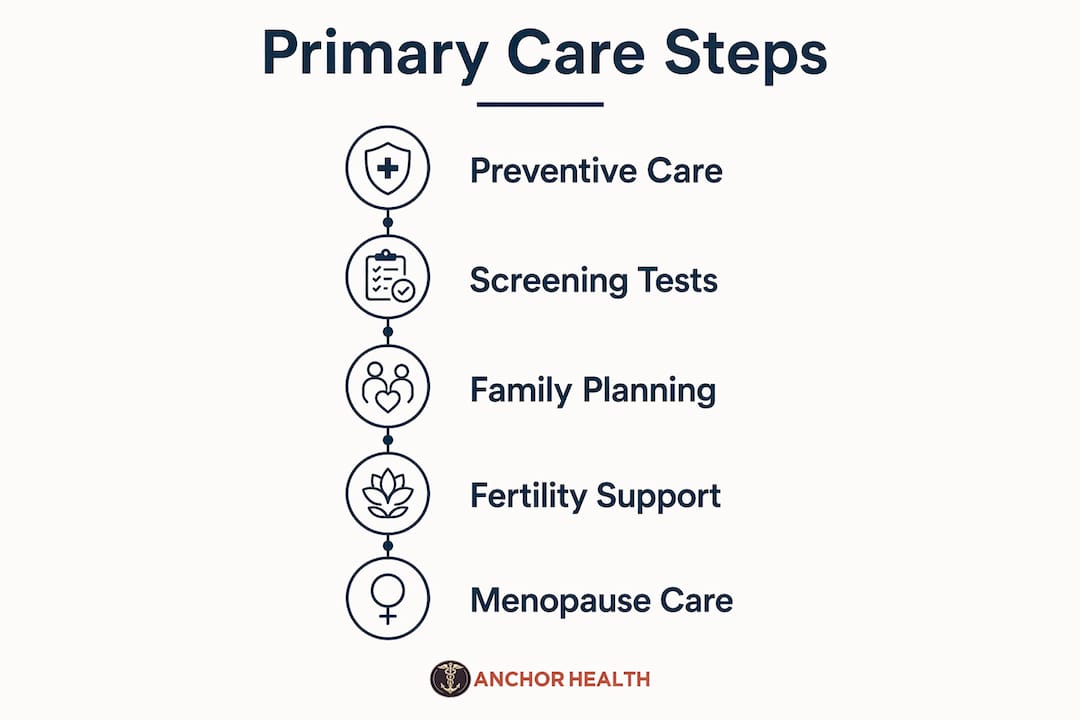
Cervical cancer screening is one of the clearest examples. HRSA’s 2025 updated guidelines recommend a Pap smear every three years for women ages 21 to 29, and primary high-risk HPV testing every five years as the preferred approach for women ages 30 to 65. These intervals are not arbitrary. They reflect decades of evidence on cancer progression rates and the sensitivity of each test. Your primary care provider tracks where you are in that schedule and makes sure you do not fall through the gaps.
Beyond cervical cancer, primary care delivers:
- HPV vaccination for adolescents and young adults, which reduces cervical, vaginal, and vulvar cancer risk
- Breast cancer screening discussions and referrals based on age, family history, and individual risk
- STI screening including chlamydia, gonorrhea, and HIV at intervals appropriate to your risk profile
- Folate supplementation counseling for women of reproductive age to reduce neural tube defect risk
- Tobacco and alcohol cessation support, which directly reduces adverse pregnancy and cancer outcomes
ACOG supports no cost-sharing for follow-up testing after an abnormal cervical cancer screening result. This matters because the screening itself is only the beginning. Completing the full diagnostic pathway, including colposcopy or biopsy when needed, is where lives are actually saved. Primary care coordinates that entire process.
Pro Tip: If you receive an abnormal Pap or HPV result, contact your primary care provider within two weeks. Delays in follow-up are the most common reason abnormal results do not lead to timely diagnosis. Your provider can track the referral and make sure nothing is missed.
You can learn more about how preventive screenings work across different life stages through the Myanchorhealthpc resource library.
What role does primary care play in family planning and preconception care?
Primary care providers are trained to support reproductive goal-setting, contraceptive counseling, and preconception health optimization as routine functions, not specialty referrals. This is where the importance of primary care becomes especially concrete for women in their 20s and 30s.

Research published in JAMA found that 66.4% of U.S. reproductive-aged women have at least one modifiable risk factor for adverse pregnancy outcomes. That figure means the majority of women planning a pregnancy have something a primary care provider can address before conception, whether it is blood pressure, weight, thyroid function, or medication safety. Addressing these factors before pregnancy is far more effective than managing complications during it.
A structured preconception visit with your primary care provider typically covers:
- Reproductive goal review to understand your timeline and preferences
- Immunization update including rubella, varicella, and COVID-19 status
- Chronic condition review to assess medication safety in pregnancy
- Substance use screening for tobacco, alcohol, and other substances that affect fetal development
- Mental health assessment because untreated depression and anxiety carry real risks during pregnancy
- Genetic counseling referral when family history warrants it
For contraception, primary care providers counsel on the full range of options, from oral contraceptives and IUDs to implants and barrier methods. This is not a one-time conversation. As your life circumstances change, your contraceptive needs change too, and a consistent provider who knows your history gives you better guidance than a one-off clinic visit.
Pro Tip: Schedule a dedicated preconception visit at least three to six months before you plan to conceive. This gives time to address any identified risks, update vaccinations, and start folate supplementation at the recommended dose before pregnancy begins.
Primary care also manages low-to-average risk pregnancies in coordination with obstetrics, and serves as the medical home for women who need referrals to maternal-fetal medicine or other specialists for complex cases.
How does primary care address fertility awareness and emotional support?
Fertility conversations belong in primary care, not just in fertility clinics. Dr. Esther H. Chung, MD, FACOG, has noted that proactive fertility discussions are inconsistently offered in primary care settings, leaving many women without guidance until they have already struggled to conceive. That gap is preventable.
Primary care providers can open these conversations at routine visits, regardless of whether a patient has raised fertility as a concern. This includes:
- Discussing how age affects fertility and what timelines to consider for family planning
- Explaining when to seek a fertility evaluation, typically after 12 months of trying for women under 35, or six months for women 35 and older
- Identifying conditions like polycystic ovary syndrome (PCOS), thyroid disorders, or uterine abnormalities that affect fertility and can be managed or referred from primary care
- Providing referrals to reproductive endocrinologists when workup is indicated
Mental health integration is another area where primary care adds real value. Fertility challenges, pregnancy loss, and postpartum adjustment all carry significant psychological weight. Mental health screening integration remains inconsistent in reproductive care settings, which means many women do not receive support until they are in crisis. Routine depression and anxiety screening at primary care visits creates an earlier safety net.
Your primary care provider is also positioned to coordinate care between your OB-GYN, reproductive endocrinologist, and mental health counselor, making sure each specialist has the full picture of your health.
In what ways does primary care support women during menopause and beyond?
Menopause is not a single event. It is a multi-year transition that primary care is uniquely equipped to manage because it requires continuity, not a one-time intervention. The perimenopause phase can begin years before the final menstrual period, and symptoms like irregular cycles, hot flashes, sleep disruption, and mood changes often appear before most women think to seek care.
Primary care providers manage menopausal symptoms through lifestyle counseling, non-hormonal options like cognitive behavioral therapy for sleep and mood, and hormone therapy when appropriate. For women who need hormone therapy, primary care coordinates with gynecology or endocrinology for complex cases while managing the ongoing monitoring that long-term treatment requires.
Screenings do not stop at menopause. Primary care continues to deliver:
- Bone density testing (DEXA scan) starting at age 65, or earlier for women with risk factors for osteoporosis
- Cardiovascular risk assessment, since estrogen loss accelerates heart disease risk after menopause
- Continued breast and colorectal cancer screenings on age-appropriate schedules
- Cognitive health monitoring as part of routine annual care
Having a usual primary care source is associated with longer median life expectancy and better mortality outcomes. For women navigating the chronic disease risks that accumulate after menopause, that continuity is not a convenience. It is a clinical advantage.
Pro Tip: Do not wait for symptoms to become severe before discussing menopause with your provider. Starting the conversation during perimenopause gives you more options and more time to make informed decisions about symptom management and long-term health protection.
What challenges and disparities affect reproductive health access in primary care?
Primary care is the most common first contact for women’s healthcare, but access is not equal. A mixed methods evaluation of Community Women’s Health Hub models in England found that inequities in reproductive health access exist across ethnicity, geographic location, socioeconomic status, age, sexuality, and gender identity. These findings reflect patterns seen in the U.S. as well.
| Barrier | Impact on reproductive health access |
|---|---|
| Geographic isolation | Fewer primary care providers per capita in rural areas, limiting screening and counseling access |
| Socioeconomic status | Cost barriers reduce follow-up after abnormal screenings, interrupting care pathways |
| Ethnicity and language | Communication gaps and cultural mismatches reduce screening uptake and patient trust |
| Gender identity | Transgender and nonbinary patients face inconsistent reproductive health screening protocols |
Workforce shortages compound these challenges. Primary care providers often lack dedicated training in reproductive health topics beyond basic obstetrics, and fragmented electronic health records make coordination between primary care and specialists harder than it should be. The result is that women with the most complex needs are often the least well-served by the current system.
Telehealth and team-based primary care models are two of the most promising responses to these gaps. Telehealth removes geographic and transportation barriers. Team-based care, where physicians, nurse practitioners, and behavioral health specialists work together, allows more comprehensive reproductive health support within a single care relationship. Both approaches improve access, quality, and health outcomes, particularly for underserved populations.
Explicit referral pathways, better training, and workforce planning are not optional improvements. They are the structural changes that determine whether primary care can fulfill its potential as the foundation of women’s reproductive health services.
Key takeaways
Primary care is the most effective framework for protecting women’s reproductive health across every life stage, from prevention and family planning through menopause and chronic disease management.
| Point | Details |
|---|---|
| Prevention starts in primary care | HPV vaccination, cervical screening, and folate counseling are all delivered at routine primary care visits. |
| Preconception care reduces risk | Addressing modifiable risk factors before pregnancy improves maternal and neonatal outcomes significantly. |
| Fertility conversations need to start earlier | Primary care providers should initiate fertility timeline discussions proactively, not only when patients ask. |
| Menopause requires ongoing management | Bone density, cardiovascular risk, and cancer screenings continue after menopause and belong in primary care. |
| Disparities require structural solutions | Telehealth and team-based care models reduce access barriers for underserved women. |
Why continuity in reproductive care matters more than most women realize
I have spent years working with women who came to us after years of fragmented care. A Pap smear here, a contraceptive prescription there, a specialist referral that never got followed up. The pattern is remarkably consistent, and the consequences are real. Abnormal screening results that sat unaddressed for months. Preconception risks that were never identified because no one asked about reproductive goals at a routine visit.
The most underrated aspect of primary care in reproductive health is not any single service. It is the relationship. When your provider knows your full history, your values, your anxiety about a family history of ovarian cancer, your ambivalence about starting a family, they give you better care. Not because they are smarter, but because context changes clinical decisions.
I also want to be direct about something the standard advice often glosses over: incomplete follow-up after abnormal screenings is one of the most preventable failures in women’s healthcare. Completing the full screening pathway beyond the initial test is where primary care earns its value. A provider who tracks your results, follows up on referrals, and calls you when something needs attention is not a luxury. That is what good primary care looks like.
Telehealth has changed what is possible here. Women in Maryland who previously had to choose between a long commute and skipping a visit now have no reason to delay. The technology is not the point. The relationship it enables is.
If you are not currently in a primary care relationship that includes proactive reproductive health conversations, that is the gap worth closing first. Everything else follows from there.
— Paule
How Myanchorhealthpc supports your reproductive health
Myanchorhealthpc offers telehealth primary care designed around continuity and whole-person health, including dedicated women’s health services covering preventive screenings, family planning, preconception counseling, and menopause management. All visits happen through secure video, which means you get consistent, relationship-based care without the scheduling friction that causes so many women to delay important appointments.
If you are ready to establish care with a provider who will track your screenings, discuss your reproductive goals, and coordinate with specialists when needed, start by reviewing how to choose telehealth primary care that fits your life. You can also explore what a primary care medical home means for your long-term reproductive health. Myanchorhealthpc currently serves patients across Maryland.
FAQ
What does primary care do for women’s reproductive health?
Primary care provides preventive screenings, contraceptive counseling, preconception care, fertility referrals, and menopause management as part of continuous, relationship-based care. It serves as the coordination point between specialists and the patient across all reproductive life stages.
How often should women get cervical cancer screenings?
HRSA’s 2025 updated guidelines recommend a Pap smear every three years for women ages 21 to 29, and primary high-risk HPV testing every five years for women ages 30 to 65. Your primary care provider tracks your schedule and manages any follow-up needed after abnormal results.
Can primary care help with fertility concerns?
Yes. Primary care providers can identify conditions affecting fertility such as PCOS or thyroid disorders, counsel on reproductive timelines, and refer to reproductive endocrinologists when a full fertility workup is needed. Proactive fertility conversations at routine visits close gaps that often delay diagnosis.
Why is continuity of care important in women’s reproductive health?
A consistent primary care provider tracks your full health history, follows up on abnormal results, and integrates reproductive decisions with chronic disease management over time. Research shows that having a usual primary care source is associated with better long-term health outcomes and longer life expectancy.
Does telehealth primary care cover reproductive health services?
Telehealth primary care covers most reproductive health services including screenings, counseling, prescriptions, and specialist referrals through secure video visits. Providers like Myanchorhealthpc offer family primary care that includes women’s health as a core service area.
Recommended
- Family Primary Care Best Practices for Every Age
- Examples of Preventive Care for Kids: Parent’s Guide
- How to Choose Telehealth Primary Care for Your Family
- Top 4 familyclinic.clinic Alternatives Providers 2026
Blog & Information Disclaimer
Last Updated: May 23, 2026
The information provided on the Anchor Health website (https://myanchorhealthpc.com/), including but not limited to blog posts, articles, newsletters, graphics, and other materials (collectively, the "Content"), is for general informational and educational purposes only.
By accessing and using this website, you acknowledge and agree to the following terms and conditions:
The Content on this website is not intended to be a substitute for professional medical advice, diagnosis, or treatment. Always seek the advice of your physician, nurse practitioner, or other qualified health provider with any questions you may have regarding a medical condition. Never disregard professional medical advice or delay in seeking it because of something you have read on this website.
Reading, interacting with, or sharing the Content on this website does not establish a patient-provider relationship between you and Anchor Health or any of its clinicians, including Paule Valery Joseph, PhD, MBA, CRNP, FAAN. A formal patient-provider relationship is only established after you have completed the formal intake process, signed our clinical consent forms, and participated in a secure clinical consultation.
If you are experiencing a medical emergency, call 911 or seek emergency medical services immediately.
Anchor Health is a primary care practice and does not provide emergency or crisis intervention services through its website or blog.
While Anchor Health strives to provide thoughtful, evidence-based information grounded in our Anchored Care℠ model, healthcare is a rapidly evolving field. We make no representations or warranties, express or implied, about the completeness, accuracy, reliability, or suitability of the information contained in the Content. Any reliance you place on such information is strictly at your own risk.
Anchor Health is a telehealth practice providing services to patients physically located within the state of Maryland. The information provided on this blog is intended for residents of Maryland and is governed by the laws and regulations of that state. Accessing this information from outside of Maryland does not imply that our clinicians are licensed to practice medicine or provide consultations in your jurisdiction.
Content related to Weight & Metabolic Health, including discussions of GLP-1 medications or other medical therapies, is provided for educational context regarding our clinical approach. Prescriptions and specific medical recommendations are only made following a comprehensive clinical evaluation, diagnostic testing, and shared decision-making within a formal patient-provider relationship.
This website may contain links to external websites that are not provided or maintained by or in any way affiliated with Anchor Health. Please note that Anchor Health does not guarantee the accuracy, relevance, timeliness, or completeness of any information on these external websites.
To the fullest extent permitted by law, Anchor Health, its owners, and its employees shall not be liable for any direct, indirect, incidental, consequential, or punitive damag
Related posts