Whole Person Care: What Families Need to Know in 2026

Whole person care is defined as an integrated approach to health that addresses physical, mental, emotional, social, and environmental factors together rather than treating each in isolation. The term is widely used in primary care and family medicine, though the clinical field also calls this the biopsychosocial model or integrated care model. Research from the American Academy of Family Physicians confirms that whole-person primary care improves health outcomes and reduces costs by focusing on prevention, continuity, and whole-life engagement. For families managing chronic conditions, caregivers coordinating complex care, and individuals who feel their health concerns are not fully heard, this model offers a fundamentally different experience. It treats you as a partner in your own care, not a list of symptoms to be processed.
What is whole person care and why does it matter?
Whole person care rests on the biopsychosocial model, a framework developed in medicine to recognize that biological, psychological, and social factors all shape health outcomes. The National Wellness Institute describes six dimensions of wellness that align directly with this model: emotional, occupational, physical, social, intellectual, and spiritual. No single dimension operates independently. A patient managing type 2 diabetes, for example, may face barriers rooted in work stress, food access, or social isolation that a standard 15-minute appointment never surfaces.
The patient-centered care model requires treating patients as partners engaged in decision-making and recognizes social determinants as clinically relevant as medical data. This shifts the entire dynamic of a clinical visit. Instead of a provider delivering instructions to a passive recipient, both parties work together to understand what is actually happening in the patient’s life and what care plan is realistic given that context.

A concept called salutogenesis sits at the heart of preventive whole person care. Rather than focusing solely on disease management, salutogenesis asks: what creates and sustains health? Many patients wait for disease progression before engaging with this model, yet early engagement in wellness practices produces the strongest long-term results. The goal is health creation, not just disease treatment.
| Dimension | What it includes |
|---|---|
| Physical | Exercise, nutrition, sleep, chronic disease management |
| Emotional | Stress management, mental health, resilience |
| Social | Relationships, community connection, support systems |
| Intellectual | Lifelong learning, cognitive engagement |
| Occupational | Work satisfaction, purpose, financial stability |
| Spiritual | Values, meaning, sense of purpose |
Pro Tip: When evaluating a new provider, ask directly whether they screen for social determinants of health. A provider who asks about your housing, food access, and stress levels at your first visit is practicing the integrated care model in a meaningful way.
How is whole person care implemented in healthcare systems?
Translating the philosophy of whole health solutions into actual clinical practice requires structured frameworks and organizational commitment. The Institute for Healthcare Improvement describes a 4-step framework for contextualizing care: detecting red flags in a patient’s situation, probing for relevant details, identifying the contextual factors shaping health, and adapting the care plan accordingly. A clinician who notices a patient has missed three appointments in a row, for instance, uses that behavioral clue to explore what is happening in the patient’s life rather than simply sending a reminder.
Implementation across larger systems follows four key steps:
- Workforce training. 65% of Veterans Affairs primary care teams were trained via virtual courses for whole person care implementation in 2026. This demonstrates that large-scale adoption is achievable without requiring every clinician to attend in-person programs.
- Payment reform. The federal government set a goal for 30% of Medicare payments to come from Accountable Care Organization models emphasizing integrated whole person care by end of 2026. Payment structure is one of the most powerful levers for changing clinical behavior.
- Technology-enabled coordination. Shared electronic health records, telehealth platforms, and care management software allow multidisciplinary teams to coordinate across physical, behavioral, and social care.
- Organizational culture. Successful implementation depends on organizational commitment, workforce training, and technology-enabled care coordination working together. No single element is sufficient alone.
A comparison of traditional care versus the integrated care model makes the difference concrete:
| Feature | Traditional care | Integrated care model |
|---|---|---|
| Visit focus | Presenting complaint | Full life context |
| Patient role | Passive recipient | Active partner |
| Care coordination | Siloed specialists | Collaborative team |
| Payment model | Fee-for-service | Value-based, ACO-aligned |
| Prevention emphasis | Reactive | Proactive and salutogenic |
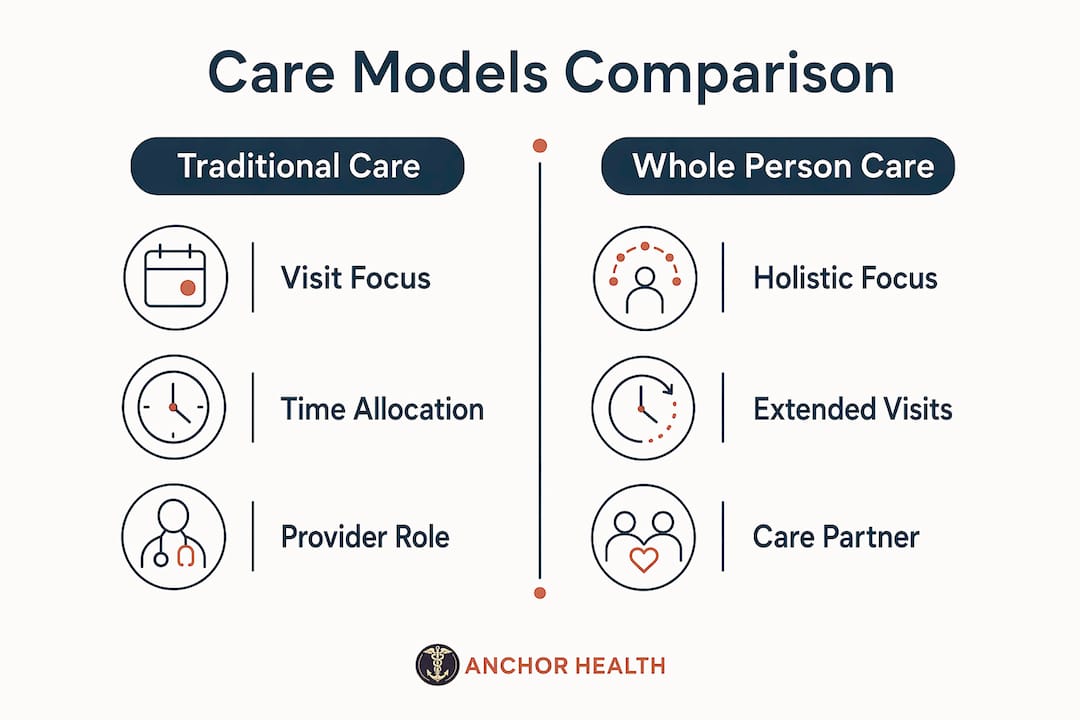
Pro Tip: When choosing a primary care provider, ask whether they use time-based billing codes or membership models. These structures give clinicians the time needed to practice family primary care the way whole person care requires.
What benefits does whole person care offer patients and caregivers?
The evidence for the patient-centered approach is clear and growing. Contextual errors occur in about 15% of medical encounters, and addressing patient life context lowers those errors while improving care efficiency without adding visit time. That means fewer misdiagnoses, fewer unnecessary prescriptions, and fewer return visits for problems that were never properly understood in the first place.
For families managing chronic conditions, the benefits are especially significant:
- Chronic disease management improves when care accounts for the social and emotional factors that drive behavior. A patient with hypertension whose stress is rooted in financial instability needs a different care plan than one whose hypertension is purely physiological.
- Healthcare costs decrease because prevention and early intervention reduce expensive emergency and specialist care. The AAFP notes that whole-person primary care reduces the chronic disease burden across populations.
- Patient satisfaction increases when people feel genuinely heard and involved in their care decisions. Shared decision-making produces stronger adherence to treatment plans.
- Clinician burnout decreases in practices that adopt this model. Providers who feel they are delivering meaningful, relationship-based care report higher job satisfaction and lower rates of burnout.
“True whole-person care shifts the patient from passive recipient to active partner, integrating social realities as medically relevant factors.” — National Patient Services Authority
It is also worth noting that integrative whole person care merges conventional medicine with complementary therapies like meditation and acupuncture through collaborative care teams. This does not mean abandoning evidence-based medicine. It means expanding the toolkit to include approaches that address the mind-body connection alongside standard clinical treatment.
How can you engage with and advocate for whole person care?
You do not have to wait for the healthcare system to change before you start experiencing the benefits of this model. There are concrete steps you can take right now to get more from your care visits and advocate for the approach you deserve.
Before your appointment:
- Write down not just your symptoms but the context around them. When did they start? What was happening in your life at that time? What makes them better or worse?
- Note any social or environmental factors that feel relevant, including work stress, sleep patterns, relationship changes, or financial pressures.
- Review your family history and bring it to the conversation. Whole health solutions depend on understanding your full picture, not just today’s complaint.
During your visit:
- Share your life context openly. Clinicians trained in the patient-centered approach use this information to build a more accurate and useful care plan.
- Ask your provider directly: “How does this treatment fit with the rest of my health and life situation?” That question signals that you expect contextualized care.
- Ask whether your provider uses a personal health inventory or wellness screening tool. These structured assessments help surface dimensions of health that a standard intake form misses.
For caregivers specifically:
Caregivers often carry significant health burdens of their own while managing care for others. Learning how to attend a telehealth visit as a caregiver gives you practical tools for participating effectively in care coordination. Telehealth removes geographic and scheduling barriers, making it far easier to access a consistent provider who knows your family’s full context over time.
Pro Tip: Ask your provider whether they screen for caregiver stress at annual visits. Caregiver burnout is a documented health risk, and a provider practicing whole person care will treat your wellbeing as clinically relevant, not secondary.
Key takeaways
Whole person care delivers better outcomes because it treats physical, emotional, social, and environmental health as equally relevant clinical factors rather than separating them into disconnected specialties.
| Point | Details |
|---|---|
| Core framework | The biopsychosocial model integrates physical, mental, and social factors into every care decision. |
| Patient role | Patients are active partners in care, sharing life context that shapes accurate, personalized treatment plans. |
| System adoption | Veterans Affairs and ACO payment reforms show large-scale whole person care implementation is already underway in 2026. |
| Clinical accuracy | Contextualizing care reduces errors in 15% of encounters and improves outcomes without extending visit time. |
| Practical access | Telehealth and membership-based primary care models give families consistent, relationship-based access to integrated care. |
Why whole person care is the most important shift in medicine right now
I have spent years watching patients leave appointments with prescriptions that addressed their diagnosis but not their life. A woman managing lupus who is also a single parent working two jobs does not need a medication adjustment. She needs a care team that understands her full situation and builds a plan she can actually follow. That is the gap whole person care is designed to close.
The honest challenge is that most healthcare systems are still structured around the opposite model. Fee-for-service payment rewards volume, not depth. Fifteen-minute appointments cannot surface the social and emotional factors that drive most chronic disease. The structural barriers favoring fragmented care are real, and they will not disappear quickly.
What gives me genuine confidence is the pace of change in 2026. The Veterans Affairs system training nearly two-thirds of its primary care teams in whole person care principles through virtual education is not a small experiment. It is a signal that the infrastructure for this model is being built at scale. Accountable Care Organizations are restructuring payment to reward exactly the kind of continuity and coordination this approach requires.
For individuals and families, the most powerful thing you can do is choose providers who already practice this way. Look for primary care medical homes that emphasize continuity, telehealth options that give you access to the same provider over time, and practices that ask about your life, not just your symptoms. The system is changing. You do not have to wait for it to catch up.
— Paule
Experience whole person care through Myanchorhealthpc
At Myanchorhealthpc, the Anchored Care℠ model is built around exactly the principles described in this article. Every visit through our secure telehealth platform is designed to give your provider the time and context needed to understand your full health picture, not just today’s concern. We serve Maryland families, working adults, and individuals managing chronic conditions with primary care that prioritizes relationship, continuity, and prevention.
Whether you are exploring telehealth primary care for the first time or looking for a practice that takes your whole health seriously, we are here. You can also explore the benefits of membership-based care for families who want enhanced access and a consistent provider relationship built over time.
FAQ
What is whole person care in simple terms?
Whole person care is a healthcare approach that treats physical, emotional, social, and environmental health together rather than addressing each separately. It positions the patient as an active partner in care decisions rather than a passive recipient of treatment.
How does whole person care differ from standard primary care?
Standard primary care often focuses on the presenting complaint within a short visit. Whole person care uses a structured framework to understand the patient’s full life context, including social determinants and mental health, and adapts the care plan accordingly.
Is holistic health care the same as alternative medicine?
No. Integrative care combines conventional evidence-based medicine with complementary therapies like meditation or acupuncture where appropriate. Whole person care does not replace standard medical treatment. It expands it.
How can telehealth support whole person care?
Telehealth removes scheduling and geographic barriers, making it easier to maintain a consistent provider relationship over time. Continuity with the same provider is one of the strongest enablers of the patient-centered approach because context builds with every visit.
What questions should I ask to find a whole person care provider?
Ask whether the practice screens for social determinants of health, uses shared decision-making, and offers time-based or membership billing models. Providers who answer yes to all three are practicing the integrated care model in a meaningful, structured way.
Recommended
- Family Primary Care Best Practices for Every Age
- How to Attend a Telehealth Visit as a Caregiver
- How telehealth expands healthcare access for Maryland families
- How to Choose Telehealth Primary Care for Your Family
Blog & Information Disclaimer
Last Updated: May 23, 2026
The information provided on the Anchor Health website (https://myanchorhealthpc.com/), including but not limited to blog posts, articles, newsletters, graphics, and other materials (collectively, the "Content"), is for general informational and educational purposes only.
By accessing and using this website, you acknowledge and agree to the following terms and conditions:
The Content on this website is not intended to be a substitute for professional medical advice, diagnosis, or treatment. Always seek the advice of your physician, nurse practitioner, or other qualified health provider with any questions you may have regarding a medical condition. Never disregard professional medical advice or delay in seeking it because of something you have read on this website.
Reading, interacting with, or sharing the Content on this website does not establish a patient-provider relationship between you and Anchor Health or any of its clinicians, including Paule Valery Joseph, PhD, MBA, CRNP, FAAN. A formal patient-provider relationship is only established after you have completed the formal intake process, signed our clinical consent forms, and participated in a secure clinical consultation.
If you are experiencing a medical emergency, call 911 or seek emergency medical services immediately.
Anchor Health is a primary care practice and does not provide emergency or crisis intervention services through its website or blog.
While Anchor Health strives to provide thoughtful, evidence-based information grounded in our Anchored Care℠ model, healthcare is a rapidly evolving field. We make no representations or warranties, express or implied, about the completeness, accuracy, reliability, or suitability of the information contained in the Content. Any reliance you place on such information is strictly at your own risk.
Anchor Health is a telehealth practice providing services to patients physically located within the state of Maryland. The information provided on this blog is intended for residents of Maryland and is governed by the laws and regulations of that state. Accessing this information from outside of Maryland does not imply that our clinicians are licensed to practice medicine or provide consultations in your jurisdiction.
Content related to Weight & Metabolic Health, including discussions of GLP-1 medications or other medical therapies, is provided for educational context regarding our clinical approach. Prescriptions and specific medical recommendations are only made following a comprehensive clinical evaluation, diagnostic testing, and shared decision-making within a formal patient-provider relationship.
This website may contain links to external websites that are not provided or maintained by or in any way affiliated with Anchor Health. Please note that Anchor Health does not guarantee the accuracy, relevance, timeliness, or completeness of any information on these external websites.
To the fullest extent permitted by law, Anchor Health, its owners, and its employees shall not be liable for any direct, indirect, incidental, consequential, or punitive damag
Related posts