How to Navigate Your First Primary Care Visit Alone

Your first solo primary care visit is defined by one thing: your ability to advocate for yourself before, during, and after the appointment. Over 40% of adults aged 18 to 29 do not have a primary care physician and rely on urgent care instead, risking missed diagnoses and no continuity of care. That pattern is worth breaking. When you prepare to navigate your first primary care visit alone, you are not just filling out forms. You are starting a long-term health relationship that pays dividends for years. This guide walks you through every step, from what to bring to how to speak up in the room.
How to navigate your first primary care visit alone: what to prepare

Preparation is the single most powerful tool a solo patient has. When you attend going to primary care alone without a family member to fill in gaps, every piece of information you bring must come from you. Organizing that information before you arrive is what separates a productive visit from a frustrating one.
Here is what to gather and organize before your appointment:
- Medication list: Write down every prescription, over-the-counter drug, vitamin, and supplement you take, including the exact dosage and how often you take it. Nurses will ask for this at intake, and an accurate list prevents dangerous prescribing errors.
- Personal medical history: Include past diagnoses, surgeries, hospitalizations, and any known allergies. If you have had prior imaging or lab work, request copies from previous providers through their patient portal or by calling the records department.
- Family medical history: Note conditions like heart disease, diabetes, cancer, or mental health disorders in your immediate family. This context directly shapes your doctor’s screening and prevention recommendations.
- Prioritized symptom and question list: Write down every concern you want to raise, then rank them by urgency. Physicians advise preparing a prioritized question list so the most critical health issues get addressed first, not whatever comes to mind in the moment.
- Insurance card and photo ID: Bring both physical copies. Many practices also ask you to complete intake paperwork online before the visit through a patient portal like MyChart or Healow.
| What to bring | Why it matters |
|---|---|
| Full medication list with dosages | Prevents prescribing errors and saves intake time |
| Personal and surgical history | Gives your doctor an accurate clinical baseline |
| Family health history highlights | Shapes screening and prevention decisions |
| Prioritized symptom and question list | Keeps your most urgent concerns front and center |
| Prior lab results or imaging reports | Avoids duplicate testing and informs diagnosis |
Pro Tip: Arriving 15 minutes early allows nursing staff to update your history and medications before the physician enters the room, which directly extends your face-to-face doctor time. Use that buffer, not your appointment time, to complete any remaining paperwork.
You can also use a telehealth visit checklist to organize your documents if your first appointment is conducted via video, which is increasingly common with providers like Myanchorhealthpc.
What to expect at your first primary care visit, step by step
Understanding the flow of the appointment removes most of the anxiety around going to primary care alone. A standard first visit follows a predictable structure, and knowing each phase helps you stay calm and focused.
- Check-in and intake. You will present your insurance card, ID, and any completed paperwork. The front desk may ask you to verify your contact and emergency information. If you have no emergency contact, that is acceptable. You are not required to list one.
- Nursing assessment. A medical assistant or nurse will take your vital signs, including blood pressure, heart rate, temperature, and weight. They will also review your medication list and ask about your reason for the visit. Hand over your prepared documents here.
- History review with the physician. Your doctor will ask about your medical history, current symptoms, and lifestyle factors like sleep, diet, exercise, and stress. Answer honestly and completely. Failing to communicate a full health background contributes to care coordination failures in a significant share of cases. Your doctor cannot help you with information they do not have.
- Physical examination. Most first visits include a general physical exam: listening to your heart and lungs, checking your abdomen, and reviewing any areas of concern you mentioned. This is routine and not a sign that something is wrong.
- Discussion of concerns and care plan. This is your window to raise your prioritized questions. Lead with your most urgent or sensitive concern, not your most comfortable one. Patients routinely save sensitive topics like mental health or sexual health for the end of the visit, which leaves insufficient time for real discussion. Flip that habit.
- Orders and referrals. Your doctor may order labs, imaging, or specialist referrals. Ask what each order is for and when you should expect results. Write it down or ask for a printed visit summary before you leave.
- Scheduling follow-up. Before you walk out, confirm whether a follow-up appointment is needed and when. If labs are ordered, ask how you will receive results, whether through a portal message, a phone call, or a follow-up visit.
Pro Tip: Ask the front desk or your nurse for a printed or digital visit summary before you leave. When you attend your first doctor’s visit without a second set of ears in the room, written notes are your safety net for remembering care instructions accurately.
How to advocate for yourself when attending primary care alone
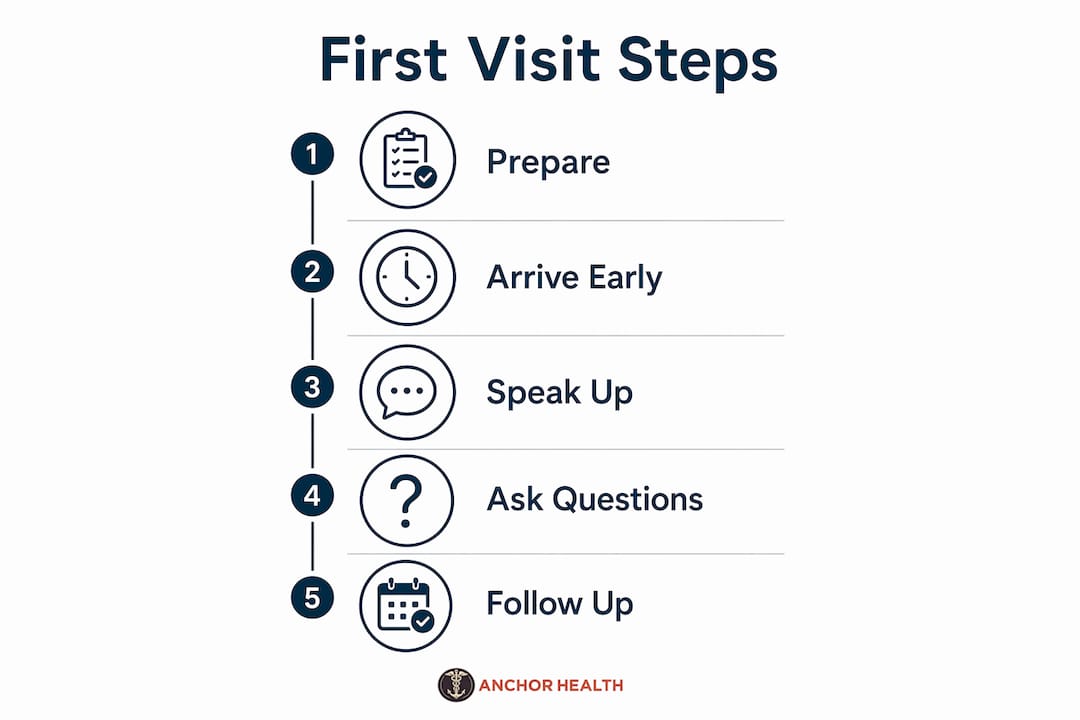
Self-advocacy in a medical setting is a skill, and it is one you can build deliberately. The primary care medical home model is built on the premise that your provider is a long-term partner, not a one-time service. That partnership only works when you communicate honestly.
Here is how to advocate effectively:
- Be honest about what you will actually do. Honesty about your realistic capacity to follow through on treatments or referrals builds trust and leads to better care outcomes. If you cannot afford a specialist or will not take a medication due to side effects, say so. Your doctor can only adjust the plan if they know the real constraints.
- Ask for clarification without apology. If your doctor uses a term you do not recognize, ask them to explain it in plain language. Phrases like “Can you walk me through what that means for me?” or “What should I watch for at home?” are direct and appropriate.
- Name sensitive topics early. Mental health, sexual health, substance use, and financial stress all affect your physical health. Raising these topics in the first half of the visit gives your doctor time to respond thoughtfully rather than rushing.
- Confirm the plan before you leave. Repeat back what you understood: “So I’m getting blood work done this week, and we’ll review results in two weeks. Is that right?” This closes the loop and catches any miscommunication.
- Know when to seek a different provider. If you consistently feel dismissed, rushed, or unheard, that is meaningful clinical information about the fit. Finding a provider who respects your needs is not disloyal. It is responsible.
The first primary care visit is the beginning of a long game. Focus on honest communication rather than trying to solve everything in one appointment. A trusted, consistent provider relationship is what reduces risk over time, not a single perfect visit.
Common challenges solo patients face and how to overcome them
Medical systems often assume patients have family support, which creates real friction for solo patients who must manage logistics and advocacy entirely on their own. Recognizing these structural gaps in advance helps you prepare for them rather than be blindsided.
The most common challenges include:
- Paperwork that assumes a support person. Emergency contact fields, consent forms, and discharge instructions are often written with a caregiver in mind. Fill in what applies to you and leave the rest blank or note “not applicable.” You are not obligated to manufacture a support network on paper.
- Care coordination gaps. Long waits, isolation, and lack of care coordination are documented challenges for patients without support persons. Bring a comprehensive health summary to every visit so no provider has to start from scratch.
- Managing anxiety in the room. It is normal to feel overwhelmed or forget what you wanted to say. Your written question list is the antidote. Keep it visible and refer to it openly. No physician will judge you for being organized.
- Transportation and follow-up logistics. If you are managing labs, referrals, and follow-up appointments without help, use a calendar app or a simple notes app to track every next step immediately after the visit. Do not rely on memory.
Pro Tip: Consider a membership-based primary care model if you are managing your health independently. These programs typically offer direct messaging with your provider, longer appointments, and care coordination support that is especially valuable when you have no secondary advocate.
Building even a minimal support network matters. This could mean one trusted friend who knows your health history, a patient advocate service, or a telehealth provider with strong care coordination built into the model.
After the visit: how to maintain continuity and build your care relationship
The work does not end when you leave the office. Post-visit follow-through is where solo patients either build real continuity or let care fall through the cracks. Continuity of care with a trusted primary care provider directly reduces the risk of missed diagnoses that come with relying on urgent care alone.
Here is how to stay on track after your first visit:
- Review your visit notes within 24 hours. Read through the summary while the conversation is fresh. Flag anything that is unclear and send a message through the patient portal, tools like MyChart or Healow make this straightforward.
- Set calendar reminders for every next step. Labs, screenings, referral appointments, and follow-up visits should all go into your calendar the same day you schedule them.
- Update your personal health record. Add any new diagnoses, medications, or care plan changes to your personal health file. A simple document or an app like Apple Health works well for this.
- Prepare for your next visit now. Start a running list of questions and symptom changes as they occur between appointments. This is far more accurate than trying to reconstruct three months of health history from memory.
Pro Tip: Keep a personal health journal, either a physical notebook or a notes app, where you log symptoms, medication changes, and questions as they arise. When you attend primary care alone, this record becomes your most reliable clinical tool.
Key takeaways
Preparing thoroughly before your first solo primary care visit is the most direct way to get the care you need and build a lasting health relationship.
| Point | Details |
|---|---|
| Prepare documents in advance | Bring a medication list, medical history, family history, and a prioritized question list. |
| Arrive 15 minutes early | Early arrival maximizes face-to-face physician time by completing intake before the appointment starts. |
| Lead with your most urgent concerns | Raise sensitive or complex topics early so they receive adequate time and attention. |
| Be honest about your real capacity | Telling your doctor what you will actually do leads to a care plan you can follow. |
| Follow through after the visit | Set reminders for labs and referrals, review your notes, and update your personal health record promptly. |
What I’ve learned from watching solo patients walk in unprepared
The patients who get the most out of their first primary care visit are not the ones who know the most about medicine. They are the ones who show up with a list, speak first about what matters most, and tell the truth about what they will and will not do. That combination is more powerful than any amount of medical knowledge.
What I find most telling is how often the medical system’s default assumptions catch solo patients off guard. Forms designed for families, discharge instructions written for caregivers, and appointment flows that assume someone else is taking notes. These are not personal failures. They are structural gaps. Knowing they exist means you can work around them rather than absorb the consequences.
The first visit is not about perfection. It is about starting a relationship with a provider who will come to know your history, your patterns, and your goals over time. That relationship is what makes the difference between reactive care and real health management. Seek out providers who treat you as a capable adult managing your own health, because that is exactly what you are.
If you do not feel heard after a first visit, that is data. A provider who respects your time, answers your questions directly, and builds a care plan around your actual life is not a luxury. It is the standard you deserve.
— Paule
How Myanchorhealthpc supports solo patients navigating primary care
Myanchorhealthpc is a Maryland-based telehealth primary care provider built around the Anchored Care℠ model, which prioritizes long-term, relationship-based care over episodic treatment. For solo patients, that model matters. You get consistent access to the same provider, longer appointment times, and direct messaging between visits so care coordination does not fall apart when you are managing everything yourself. Myanchorhealthpc accepts insurance and offers membership options that give you the kind of attentive, continuous care that solo patients need most. If you are ready to build a real primary care relationship on your own terms, explore telehealth primary care options that fit your life and your schedule.
FAQ
What should I bring to my first primary care visit alone?
Bring a complete medication list with dosages, your personal and family medical history, prior lab results or imaging if available, your insurance card, and a prioritized list of symptoms and questions. Organized documents replace the second set of ears you do not have in the room.
How do I make sure my concerns get addressed in a short appointment?
Put your most urgent or sensitive concerns at the top of your written question list and raise them within the first few minutes of the physician portion of your visit. Patients who save sensitive topics for the end consistently run out of time before those issues get proper attention.
Is it normal to feel anxious going to primary care alone?
Yes, and it is manageable. Bring a written list of questions and refer to it openly during the visit. Anxiety tends to decrease significantly once you have a clear structure to follow and a provider who takes time to listen.
What if I do not understand what my doctor is telling me?
Ask for clarification directly and without hesitation. Phrases like “Can you explain what that means in plain terms?” or “What should I watch for at home?” are appropriate and expected. Confirming your understanding before you leave prevents care errors.
How do I stay on top of follow-up care without a support person?
Set calendar reminders for every lab, referral, and follow-up appointment immediately after your visit. Use a patient portal like MyChart to message your provider with questions and track results. A personal health journal, physical or digital, keeps your care history organized between appointments.
Recommended
- Family Primary Care Best Practices for Every Age
- How to Choose Telehealth Primary Care for Your Family
- What Is a Primary Care Medical Home: Family Guide
Blog & Information Disclaimer
Last Updated: May 23, 2026
The information provided on the Anchor Health website (https://myanchorhealthpc.com/), including but not limited to blog posts, articles, newsletters, graphics, and other materials (collectively, the "Content"), is for general informational and educational purposes only.
By accessing and using this website, you acknowledge and agree to the following terms and conditions:
The Content on this website is not intended to be a substitute for professional medical advice, diagnosis, or treatment. Always seek the advice of your physician, nurse practitioner, or other qualified health provider with any questions you may have regarding a medical condition. Never disregard professional medical advice or delay in seeking it because of something you have read on this website.
Reading, interacting with, or sharing the Content on this website does not establish a patient-provider relationship between you and Anchor Health or any of its clinicians, including Paule Valery Joseph, PhD, MBA, CRNP, FAAN. A formal patient-provider relationship is only established after you have completed the formal intake process, signed our clinical consent forms, and participated in a secure clinical consultation.
If you are experiencing a medical emergency, call 911 or seek emergency medical services immediately.
Anchor Health is a primary care practice and does not provide emergency or crisis intervention services through its website or blog.
While Anchor Health strives to provide thoughtful, evidence-based information grounded in our Anchored Care℠ model, healthcare is a rapidly evolving field. We make no representations or warranties, express or implied, about the completeness, accuracy, reliability, or suitability of the information contained in the Content. Any reliance you place on such information is strictly at your own risk.
Anchor Health is a telehealth practice providing services to patients physically located within the state of Maryland. The information provided on this blog is intended for residents of Maryland and is governed by the laws and regulations of that state. Accessing this information from outside of Maryland does not imply that our clinicians are licensed to practice medicine or provide consultations in your jurisdiction.
Content related to Weight & Metabolic Health, including discussions of GLP-1 medications or other medical therapies, is provided for educational context regarding our clinical approach. Prescriptions and specific medical recommendations are only made following a comprehensive clinical evaluation, diagnostic testing, and shared decision-making within a formal patient-provider relationship.
This website may contain links to external websites that are not provided or maintained by or in any way affiliated with Anchor Health. Please note that Anchor Health does not guarantee the accuracy, relevance, timeliness, or completeness of any information on these external websites.
To the fullest extent permitted by law, Anchor Health, its owners, and its employees shall not be liable for any direct, indirect, incidental, consequential, or punitive damag
Related posts