How Telehealth Reduces Emergency Room Dependence

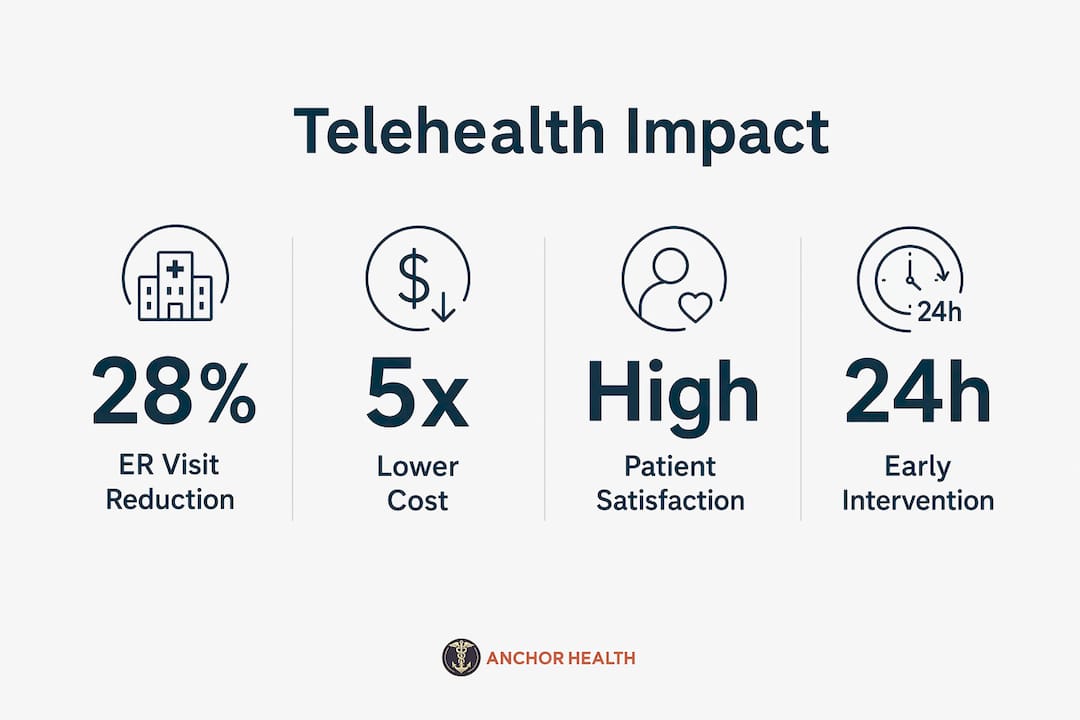
Telehealth is defined as the delivery of medical care through secure video visits, remote monitoring, and digital triage, and it directly reduces emergency room dependence by managing health issues before they escalate. Patients who connect with a virtual provider at the first sign of symptoms are far less likely to end up in an ER waiting room hours later. A VA evaluation published in JAMA Network Open found that tele-emergency care users had 28–29% fewer ER visits within 7 days of symptom onset compared to patients who did not use telehealth. That number represents real people who avoided a stressful, expensive, and often unnecessary trip to the emergency department. If you have found yourself cycling through the ER for conditions that never quite get resolved, virtual primary care offers a more consistent path forward.
How does telehealth reduce emergency room visits through early intervention?
Telehealth functions as a first-line triage system. When you notice a new symptom, a virtual provider can assess it in real time, determine its severity, and guide your next step. That assessment alone prevents the default response of driving to the ER because you are not sure what else to do.
The core components of telehealth include:
- Virtual visits: Secure video appointments with licensed providers who can diagnose, prescribe, and refer
- Remote patient monitoring: Wearable devices and connected tools that track vitals like blood pressure, blood glucose, and heart rate between visits
- Digital triage: Structured symptom assessment tools that help providers prioritize care urgency
- EHR integration: Access to your full medical history during every visit, so your provider is never starting from scratch
That last point matters more than most patients realize. EHR-integrated telehealth enables providers to access your complete medical history during a virtual encounter, which improves care quality and reduces the chance of a missed diagnosis that sends you to the ER later. A provider who knows your medication list, your allergies, and your recent lab results makes better decisions than one who sees you cold.
Common conditions managed effectively through telehealth include urinary tract infections, respiratory infections, skin rashes, ear pain, mild asthma flares, and anxiety episodes. These are among the most frequent reasons people visit ERs unnecessarily.

Pro Tip: Schedule a telehealth visit within the first 24 hours of a new symptom. Early contact with your provider is the single most effective way to avoid an escalation that lands you in the emergency department.
What evidence supports telehealth’s effectiveness in reducing ER dependence?
The research on virtual care’s impact on ER use is consistent and compelling. Three separate bodies of evidence point to the same conclusion: telehealth keeps patients out of the emergency department.
| Study or Program | Key Finding |
|---|---|
| VA Tele-Emergency Evaluation (JAMA Network Open) | 28–29% fewer ER visits within 7 days of symptom onset |
| UChicago Medicine Patient Advocacy Program | 45% reduction in non-urgent ER visits over nine years using telehealth-connected advocates |
| University of Pennsylvania Cost Study | Telemedicine visits average $96 versus $509 for in-person office visits |
The UChicago Medicine result is particularly striking. A 45% reduction in non-urgent ER visits over nine years is not a short-term effect. It reflects a fundamental shift in how patients seek care when they have consistent virtual access and support.
“Telehealth should be viewed as an essential care model, not a temporary fix. Positive virtual experiences improve patient adherence, reduce hospitalizations, and lower emergency department utilization.” — American Medical Association
The AMA’s position on telehealth reinforces what the data shows: virtual care is not a workaround. It is a complete clinical model that changes patient behavior over time. When patients trust their virtual provider and know help is accessible, they stop waiting until a situation becomes an emergency.
How does telehealth compare to traditional emergency and urgent care?
Cost is the most immediate difference. A telemedicine visit averages $96, while an in-person office visit for the same condition averages $509. That is a fivefold difference for care that, for lower-acuity conditions, matches or exceeds in-person quality. An ER visit for a non-emergent issue adds copays, facility fees, and hours of waiting on top of that.
Beyond cost, the differences include:
- Wait time: A telehealth appointment often connects you with a provider within minutes. An ER visit for a non-emergent issue can mean 3–6 hours of waiting.
- Continuity: Your telehealth provider knows your history. An ER physician typically does not.
- ER capacity: Every non-urgent visit to an emergency department takes resources away from patients with true emergencies. Telehealth preserves that capacity.
- Transportation: For patients without reliable transportation, or those managing young children, getting to an ER is a real barrier. A video visit removes it entirely.
Patient satisfaction with virtual care is consistently high for appropriate conditions. The virtual care impact on lower-acuity emergency cases shows that patients receive faster answers, experience less disruption to their day, and are more likely to follow through on treatment plans when care is convenient. Adherence improves when the friction of getting care goes down.
What role does telehealth play in managing chronic conditions and preventing ER visits?
Chronic disease management is where telehealth delivers its largest reduction in ER dependence. Conditions like diabetes, hypertension, heart failure, and asthma do not cause emergencies overnight. They escalate gradually, and that gradual escalation is exactly where virtual care intervenes.
Here is how a proactive telehealth model works for chronic conditions:
- Establish a consistent virtual provider. A provider who sees you regularly knows your baseline. They notice when something is off before you do.
- Use remote patient monitoring. Devices that track blood pressure, blood glucose, or oxygen saturation send data to your provider between visits. Abnormal readings trigger early outreach rather than a 911 call.
- Attend scheduled virtual check-ins. Regular appointments, even when you feel fine, catch medication issues, lifestyle changes, and early symptom shifts before they become crises.
- Track your symptoms between visits. Many telehealth platforms include symptom logs and messaging tools. Use them. A documented pattern helps your provider adjust your care plan before an exacerbation occurs.
- Get educated on your condition. The HHS telehealth guidance on chronic disease management emphasizes patient education as a core function of virtual care. Patients who understand their condition make better decisions at home.
The shift this creates is significant. Instead of managing diabetes reactively, with ER visits for blood sugar crises, you manage it proactively through virtual diabetes care and continuous monitoring. The ER becomes a last resort rather than a first response.
Pro Tip: If you manage a chronic condition, ask your telehealth provider about remote monitoring options at your next visit. Even basic blood pressure tracking at home, shared with your provider, can prevent the kind of undetected escalation that ends in an emergency.
How can you use telehealth to reduce your own ER dependence?
The most effective change you can make is behavioral. Early telehealth use correlates directly with fewer ER escalations. Patients who contact their virtual provider at symptom onset manage conditions at home far more successfully than those who wait until symptoms are severe.
Practical steps to reduce your ER dependence through virtual care:
- Use telehealth as your first call, not your last. When a symptom appears, contact your virtual provider before deciding whether to go to the ER. Most non-emergent issues can be assessed and managed remotely.
- Choose a telehealth provider with EHR access. A provider who can see your full medical history during a virtual visit gives you safer, more accurate care. This matters most when you are managing multiple conditions or medications.
- Schedule regular virtual check-ins even when you feel well. Preventive visits catch problems early. They also build the provider relationship that makes urgent visits more effective.
- Know what telehealth cannot handle. Chest pain with shortness of breath, signs of stroke, severe allergic reactions, and major trauma require in-person emergency care. Telehealth is not a replacement for true emergencies. It is a replacement for the many visits that were never true emergencies to begin with.
- Consider telehealth primary care for ongoing coordination. A telehealth primary care model gives you a consistent provider, integrated records, and the kind of continuity that prevents the fragmented care that drives unnecessary ER use.
Families managing multiple members’ health needs benefit especially from this model. The telehealth benefits for caregivers extend beyond convenience. Consistent virtual access changes the entire pattern of how a family seeks care.
Key takeaways
Telehealth reduces emergency room dependence by replacing reactive ER visits with proactive virtual care that catches problems early, manages chronic conditions continuously, and costs a fraction of emergency department care.
| Point | Details |
|---|---|
| Early intervention is the key mechanism | Contacting a virtual provider at symptom onset prevents the escalation that leads to ER visits. |
| Evidence is strong and consistent | VA research shows 28–29% fewer ER visits; UChicago Medicine achieved a 45% reduction over nine years. |
| Cost savings are significant | Telemedicine visits average $96 versus $509 for in-person office visits for comparable conditions. |
| Chronic disease management drives the biggest gains | Remote monitoring and regular virtual check-ins prevent the exacerbations that cause most non-emergent ER visits. |
| Behavioral change is required | Telehealth only reduces ER dependence when patients use it early and consistently, not as a last resort. |
What I have seen change when patients commit to virtual primary care
The pattern I see most often is this: a patient has been to the ER three or four times in a year for the same underlying issue. Each visit is treated in isolation. No one connects the dots. The patient leaves with a prescription but no plan, and the cycle repeats.
Telehealth breaks that cycle, but only when patients treat it as a primary care relationship rather than a convenience tool. The difference between a patient who reduces their ER visits and one who does not is almost never about access. It is about timing and consistency. Patients who reach out at the first sign of trouble, who show up for their scheduled check-ins, and who use remote monitoring between visits are the ones who stop going to the ER.
The barrier I encounter most is the belief that a video visit is somehow less real than an in-person one. That belief costs people money, time, and health. For the conditions that drive most non-urgent ER visits, a virtual provider with your full medical history is more equipped to help you than an ER physician who has never met you.
The uncomfortable truth about ER overuse is that it is often a symptom of a broken primary care relationship, not a medical necessity. Telehealth, done well, repairs that relationship. It gives you a consistent provider who knows you, monitors you, and responds before things get serious. That is what keeps you out of the emergency department.
— Paule
Telehealth primary care that keeps you out of the ER
If you are tired of the ER cycle, the most direct solution is establishing a consistent telehealth primary care relationship before your next health issue arises.

Myanchorhealthpc is a Maryland-based telehealth primary care provider built around the Anchored Care℠ᴵᴾ model, which prioritizes long-term, relationship-based care over episodic treatment. Myanchorhealthpc offers virtual visits for general primary care, chronic condition management, women’s health, and pediatric care, all through secure video appointments that fit your schedule. Patients with a consistent virtual provider and integrated medical records get faster, safer care at a fraction of ER costs. If you are ready to shift from reactive emergency visits to proactive care, start by learning how to choose telehealth primary care that fits your family’s needs.
FAQ
What conditions can telehealth treat instead of the ER?
Telehealth effectively manages urinary tract infections, respiratory infections, skin conditions, ear pain, mild asthma flares, and anxiety episodes. These are among the most common reasons patients visit emergency departments unnecessarily.
How much does a telehealth visit cost compared to an ER visit?
Telemedicine visits average $96, which is five times less than the $509 average for in-person office visits, and significantly less than most emergency department facility fees.
When should I use telehealth versus going to the ER?
Use telehealth for non-emergent symptoms at their onset. Go to the ER for chest pain, signs of stroke, severe allergic reactions, major trauma, or any condition where you believe your life is at risk.
Does telehealth actually reduce ER visits, or is that just a claim?
VA research shows tele-emergency users had 28–29% fewer ER visits within 7 days of symptom onset. UChicago Medicine’s program achieved a 45% reduction in non-urgent ER visits over nine years.
How do I get started with telehealth primary care?
Choose a provider with EHR integration, schedule an initial visit to establish your medical history, and commit to regular virtual check-ins. Early and consistent use is what produces the largest reduction in ER dependence.
Recommended
- Postpartum Care Telehealth Benefits for New Mothers
- Telehealth’s Role in Rural Maryland Healthcare Access
- How Telehealth Handles After-Hours Family Concerns
- How Telehealth Works for College Students in 2026
Blog & Information Disclaimer
Last Updated: May 23, 2026
The information provided on the Anchor Health website (https://myanchorhealthpc.com/), including but not limited to blog posts, articles, newsletters, graphics, and other materials (collectively, the "Content"), is for general informational and educational purposes only.
By accessing and using this website, you acknowledge and agree to the following terms and conditions:
The Content on this website is not intended to be a substitute for professional medical advice, diagnosis, or treatment. Always seek the advice of your physician, nurse practitioner, or other qualified health provider with any questions you may have regarding a medical condition. Never disregard professional medical advice or delay in seeking it because of something you have read on this website.
Reading, interacting with, or sharing the Content on this website does not establish a patient-provider relationship between you and Anchor Health or any of its clinicians, including Paule Valery Joseph, PhD, MBA, CRNP, FAAN. A formal patient-provider relationship is only established after you have completed the formal intake process, signed our clinical consent forms, and participated in a secure clinical consultation.
If you are experiencing a medical emergency, call 911 or seek emergency medical services immediately.
Anchor Health is a primary care practice and does not provide emergency or crisis intervention services through its website or blog.
While Anchor Health strives to provide thoughtful, evidence-based information grounded in our Anchored Care℠ model, healthcare is a rapidly evolving field. We make no representations or warranties, express or implied, about the completeness, accuracy, reliability, or suitability of the information contained in the Content. Any reliance you place on such information is strictly at your own risk.
Anchor Health is a telehealth practice providing services to patients physically located within the state of Maryland. The information provided on this blog is intended for residents of Maryland and is governed by the laws and regulations of that state. Accessing this information from outside of Maryland does not imply that our clinicians are licensed to practice medicine or provide consultations in your jurisdiction.
Content related to Weight & Metabolic Health, including discussions of GLP-1 medications or other medical therapies, is provided for educational context regarding our clinical approach. Prescriptions and specific medical recommendations are only made following a comprehensive clinical evaluation, diagnostic testing, and shared decision-making within a formal patient-provider relationship.
This website may contain links to external websites that are not provided or maintained by or in any way affiliated with Anchor Health. Please note that Anchor Health does not guarantee the accuracy, relevance, timeliness, or completeness of any information on these external websites.
To the fullest extent permitted by law, Anchor Health, its owners, and its employees shall not be liable for any direct, indirect, incidental, consequential, or punitive damag
Related posts