How Telehealth Works for College Students in 2026

Telehealth for college students is the delivery of healthcare services remotely through digital tools like video calls, secure messaging apps, and mobile platforms, giving you direct access to medical and mental health care without leaving campus or waiting weeks for an appointment. Understanding how telehealth works for college students matters now more than ever: digital-first mental health interventions achieve a 74% engagement rate among college students compared to just 30% for traditional campus referrals. That gap tells you something important. Virtual care is not a backup option. For millions of students, it is the primary path to consistent, reliable support.
How telehealth works for college students: services and modalities
Virtual care for students operates across four main delivery formats. Each one serves a different need, and knowing which to use makes a real difference in how quickly you get help.
Video consultations connect you with a licensed physician, nurse practitioner, or counselor through a secure platform like TimelyCare or Zoom Health. You schedule a visit or join on demand, share your symptoms or concerns, and receive a diagnosis, prescription, or referral in real time. Therapy apps combine CBT with coach messaging to guide students through modules on negative thinking patterns, with personalized feedback to track progress.

Text-based messaging platforms let you communicate with a provider asynchronously. You send a message describing your concern, and a clinician responds within a defined window. This format works well for follow-up questions, prescription refills, and low-urgency concerns.
On-demand emotional support through platforms like TimelyCare’s TalkNow feature connects you with a counselor in minutes, not days. Average wait times for on-demand support can be as low as 5 minutes. That speed is significant when you are in crisis at 11 p.m. on a Tuesday.
Common telehealth services available to college students include:
- Urgent care visits for illness, infections, and minor injuries
- Mental health counseling and therapy sessions
- Psychiatric evaluation and medication management
- Health coaching for sleep, nutrition, and stress
- Reproductive and sexual health consultations
- Prescription renewals and referrals
- Basic needs navigation and wellness check-ins
Pro Tip: Before your first visit, check whether your university has a contract with a platform like TimelyCare. Many schools offer these services at no cost to enrolled students, and you may already have access without knowing it.
Does telehealth actually fill campus healthcare gaps?
The short answer is yes, and the data is specific. 44% of student telehealth visits occur after standard campus clinic hours. Nearly 30% of students who used virtual care said they would have skipped treatment entirely without it. Those two numbers together reveal a real structural problem that telehealth directly solves.
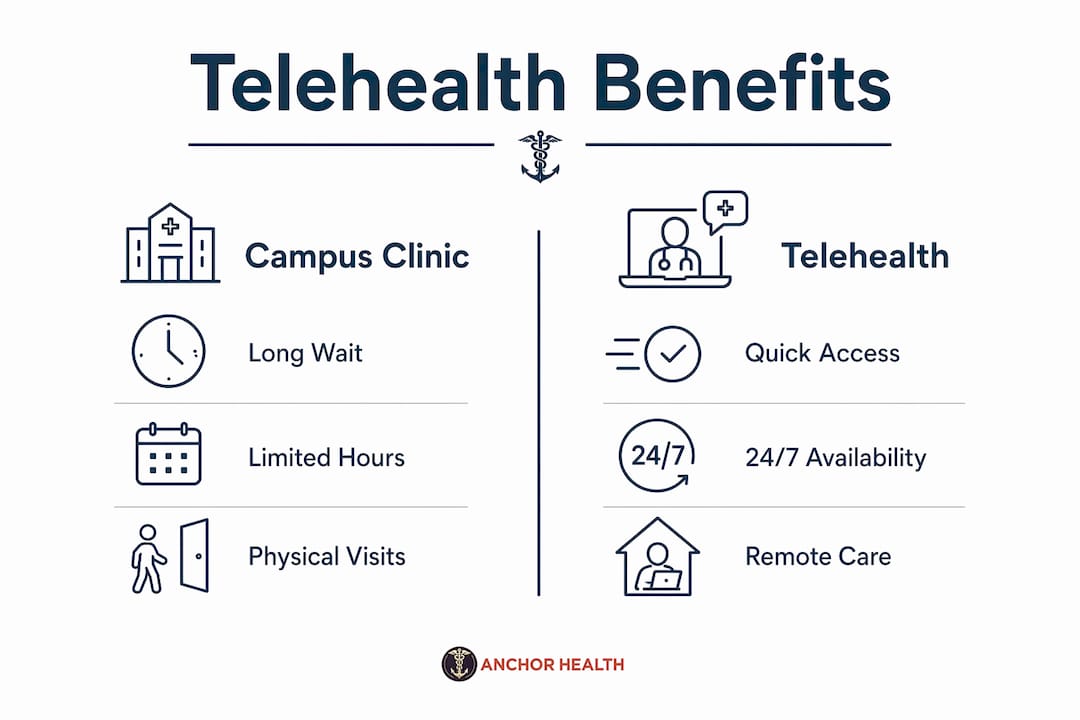
Campus counseling centers are under serious strain. 96% of institutions refer students to off-campus counseling because they cannot meet demand internally. Average wait times to see a campus counselor can stretch from days to weeks. Telehealth does not eliminate that problem, but it creates a parallel path that students can access immediately.
The table below compares key metrics between traditional campus clinic care and telehealth services:
| Metric | Campus Clinic | Telehealth |
|---|---|---|
| Average wait time | Days to weeks | As low as 5 minutes |
| After-hours availability | Limited or none | 24/7 on most platforms |
| Mental health engagement rate | 30% | 74% |
| Institutions supplementing with virtual care | N/A | 9 out of 10 |
| Students who would skip care without virtual option | N/A | Nearly 30% |
Nine out of ten institutions report that virtual care complements on-campus counseling rather than replacing it. University leaders view telehealth as a capacity tool, not a substitute for human connection. UCLA professor Daniel Eisenberg notes that digital therapy uses a public health approach to both treatment and prevention, specifically reaching students who are unlikely to seek in-person help. That population is large and historically underserved.
Pro Tip: If your campus clinic has a long wait, ask your student health office whether they partner with a telehealth platform. Many schools have contracts that give you free or low-cost access to virtual counseling and medical care within 24 hours.
What are the real challenges of telehealth for students?
Telehealth is not without friction. Three challenges come up consistently for college students, and each one has a practical workaround.
Privacy in shared living spaces is the most common barrier. Video calls in a dorm room with thin walls or a roommate present are not always realistic. Students in crowded dorms benefit from secure text-based messaging platforms that allow discreet access without requiring a private space. If a video call is necessary, use headphones, face a wall, and schedule during times your roommate is in class.
The digital divide affects students without reliable devices or internet. Most telehealth platforms are mobile-friendly, which helps. But students without smartphones or consistent Wi-Fi still face real access gaps. Campus libraries and student centers often provide both, and some platforms offer phone-based audio visits as an alternative to video.
Continuity of care is a subtler problem. Navigating telehealth quality off-campus complicates student access, particularly when students use multiple disconnected services. A student might see a campus counselor, use a telehealth app for urgent care, and consult a home-state provider during breaks. Without a consistent provider who knows your history, care becomes fragmented. Understanding how to establish telehealth care with a single trusted provider reduces that fragmentation significantly.
| Factor | Telehealth | In-Person Campus Care |
|---|---|---|
| Availability after hours | Yes, 24/7 | No |
| Privacy in shared spaces | Requires planning | Provided in clinic |
| Wait time | Minutes | Days to weeks |
| Continuity of care | Varies by platform | Consistent within clinic |
| Cost to student | Often free via university | Often free via student fees |
| Prescription capability | Yes, via licensed provider | Yes |
How to get the most out of your telehealth visits
Preparation determines the quality of your telehealth experience. A five-minute video visit with a prepared student produces better outcomes than a 20-minute call with no context. Follow these steps to make every virtual visit count.
- Write down your symptoms before the visit. Note when they started, how severe they are, and what makes them better or worse. Providers work faster when you give them a clear picture upfront.
- Check your technology in advance. Test your camera, microphone, and internet connection at least 10 minutes before your appointment. A dropped call wastes your time and the provider’s.
- Choose a quiet, private location. A library study room, your car, or an empty classroom works well. Headphones add an extra layer of privacy.
- Have your insurance card or student ID ready. Many university telehealth platforms are free with enrollment, but some require verification. Know which category your service falls into before you log on.
- Ask for a follow-up plan. Before the visit ends, confirm next steps. Do you need a prescription? A referral? A follow-up in two weeks? A good provider gives you this automatically, but it is worth asking directly.
- Keep a record of your visits. Save any notes, diagnoses, or prescriptions in a folder on your phone or email. This becomes your personal health record, especially useful when you transition between providers during school breaks.
Reviewing a telehealth visit checklist before your first appointment helps you walk in prepared and confident.
Pro Tip: Set up your telehealth account and complete your health history profile before you need care. Students who register during orientation, not during a health crisis, get faster service and better continuity.
Key takeaways
Telehealth works for college students because it delivers medical and mental health care on demand, after hours, and without the wait times that make traditional campus clinics inaccessible for many students.
| Point | Details |
|---|---|
| Engagement rates favor telehealth | Digital-first care achieves 74% engagement versus 30% for campus referrals. |
| After-hours access is critical | 44% of student telehealth visits happen outside standard campus clinic hours. |
| Telehealth complements campus care | Nine out of ten institutions use virtual care to supplement, not replace, counselors. |
| Privacy requires planning | Text-based platforms offer discreet access for students in shared living spaces. |
| Preparation improves outcomes | Preparing symptoms, testing technology, and requesting a follow-up plan maximizes each visit. |
Telehealth in college healthcare: what i’ve seen change
The conversation around student healthcare used to center on whether telehealth was “good enough.” That question is settled. The real conversation now is about integration and continuity.
What I find most telling is the engagement data. A 74% engagement rate for digital therapy versus 30% for campus referrals is not a marginal difference. It reflects something fundamental about how students actually want to access care. They want it on their terms, at their pace, and without the social friction of walking into a counseling center on a small campus where everyone knows everyone.
The challenge I see most often is fragmentation. Students use one app for anxiety, a different platform for urgent care, and their hometown doctor for anything serious. None of these providers talk to each other. That is where the model breaks down. The students who benefit most from telehealth are the ones who find a consistent provider and stick with them, someone who knows their history and can see patterns over time rather than treating each visit as a standalone event.
My honest recommendation: push your institution to invest in platforms that offer both medical and mental health services under one roof. And if your university’s options are limited, find a telehealth primary care provider you can use year-round, regardless of where you are living. Continuity of care is not a luxury. For students managing chronic conditions, mental health, or reproductive health, it is the difference between managed care and reactive care.
— Paule
Start your telehealth care with a provider you can trust
Finding the right telehealth provider as a college student means looking for more than convenience. You need a provider who offers continuity, accepts your insurance, and treats you as a whole person rather than a single complaint.
Myanchorhealthpc offers relationship-based primary care through secure video visits, with services covering general health, mental and emotional support, and women’s health. The Anchored Care℠ model prioritizes long-term care over episodic treatment, which matters when you are managing your health across semesters, breaks, and transitions. If you are ready to find a provider who stays consistent with you, start by reviewing how to choose telehealth primary care to understand what to look for before you commit. Myanchorhealthpc currently serves patients in Maryland and accepts insurance alongside membership options for enhanced access.
FAQ
What is telehealth and how does it work for students?
Telehealth is the delivery of healthcare services through digital platforms including video calls, secure messaging, and mobile apps. College students access medical and mental health care remotely, often through university-contracted platforms like TimelyCare, without scheduling in-person appointments.
Is telehealth free for college students?
Many universities cover telehealth costs through student fees, giving enrolled students free access to platforms like TimelyCare. Check with your student health office to confirm which services are included in your enrollment.
Can telehealth replace my campus counselor?
Telehealth complements campus counseling rather than replacing it. Nine out of ten institutions use virtual care to expand capacity, not eliminate staff. Both options work best when used together.
How do i keep my telehealth visits private in a dorm?
Use headphones, schedule visits when your roommate is out, and consider text-based platforms for sensitive conversations. Secure messaging platforms are specifically designed for students without access to private spaces.
Can a telehealth provider prescribe medication?
Yes. Licensed telehealth providers can prescribe medications, including mental health medications, after a proper evaluation. Review how the prescription process works through telehealth to understand what to expect before your visit.
Recommended
- Telehealth for Kids Explained: What Parents Need to Know
- How Telehealth Handles Sick Child Visits for Families
- How the Telehealth Prescription Process Works
Blog & Information Disclaimer
Last Updated: May 23, 2026
The information provided on the Anchor Health website (https://myanchorhealthpc.com/), including but not limited to blog posts, articles, newsletters, graphics, and other materials (collectively, the "Content"), is for general informational and educational purposes only.
By accessing and using this website, you acknowledge and agree to the following terms and conditions:
The Content on this website is not intended to be a substitute for professional medical advice, diagnosis, or treatment. Always seek the advice of your physician, nurse practitioner, or other qualified health provider with any questions you may have regarding a medical condition. Never disregard professional medical advice or delay in seeking it because of something you have read on this website.
Reading, interacting with, or sharing the Content on this website does not establish a patient-provider relationship between you and Anchor Health or any of its clinicians, including Paule Valery Joseph, PhD, MBA, CRNP, FAAN. A formal patient-provider relationship is only established after you have completed the formal intake process, signed our clinical consent forms, and participated in a secure clinical consultation.
If you are experiencing a medical emergency, call 911 or seek emergency medical services immediately.
Anchor Health is a primary care practice and does not provide emergency or crisis intervention services through its website or blog.
While Anchor Health strives to provide thoughtful, evidence-based information grounded in our Anchored Care℠ model, healthcare is a rapidly evolving field. We make no representations or warranties, express or implied, about the completeness, accuracy, reliability, or suitability of the information contained in the Content. Any reliance you place on such information is strictly at your own risk.
Anchor Health is a telehealth practice providing services to patients physically located within the state of Maryland. The information provided on this blog is intended for residents of Maryland and is governed by the laws and regulations of that state. Accessing this information from outside of Maryland does not imply that our clinicians are licensed to practice medicine or provide consultations in your jurisdiction.
Content related to Weight & Metabolic Health, including discussions of GLP-1 medications or other medical therapies, is provided for educational context regarding our clinical approach. Prescriptions and specific medical recommendations are only made following a comprehensive clinical evaluation, diagnostic testing, and shared decision-making within a formal patient-provider relationship.
This website may contain links to external websites that are not provided or maintained by or in any way affiliated with Anchor Health. Please note that Anchor Health does not guarantee the accuracy, relevance, timeliness, or completeness of any information on these external websites.
To the fullest extent permitted by law, Anchor Health, its owners, and its employees shall not be liable for any direct, indirect, incidental, consequential, or punitive damag
Related posts