How to Book a Telehealth Appointment as a Young Adult

Telehealth is defined as the delivery of healthcare services through secure video or audio technology, and it gives young adults a private, convenient way to see a doctor without leaving home. When you book a telehealth appointment as a young adult, you gain access to primary care, mental health support, and urgent consultations on your own schedule. HIPAA regulations protect every virtual visit the same way they protect in-person care. Providers like Myanchorhealthpc have built their entire practice around this model, offering relationship-based care through secure video visits for patients across Maryland.
What do you need before booking a telehealth appointment?
Getting set up correctly before your first virtual visit saves time and prevents last-minute stress. The technical requirements are simple, but skipping any one of them can disrupt your appointment.
Hardware and internet requirements
You need a smartphone, tablet, or computer with a working camera and microphone. A stable internet connection is the single most critical technical requirement. Providers may end calls if your connection drops or your environment lacks privacy. A wired connection or strong Wi-Fi signal is far more reliable than mobile data for a video visit.

Account setup and insurance checks
Most telehealth platforms require you to create a patient portal account before scheduling. You will enter basic personal information, upload a photo ID, and complete a health history form. Insurance coverage varies widely among providers, so confirming your plan covers virtual visits before you book prevents surprise costs. Call your insurer directly or check your plan’s online portal to verify telehealth eligibility.
Here is a quick checklist of what to have ready before you book:
- A device with a working camera and microphone
- Stable Wi-Fi or a wired internet connection
- Your insurance card and member ID number
- A government-issued photo ID
- A list of current medications and dosages
- Your pharmacy’s name and address
| Requirement | Why it matters |
|---|---|
| Stable internet | Prevents dropped calls and provider disconnection |
| Insurance verification | Avoids unexpected out-of-pocket charges |
| Patient portal account | Required to schedule and receive visit reminders |
| Private, quiet space | Protects your confidentiality and meets care standards |
| Medication list | Helps your provider give accurate, safe recommendations |
Pro Tip: Set up your patient portal account at least 24 hours before your appointment. Many platforms send a test link so you can confirm your camera and microphone work before the visit day.
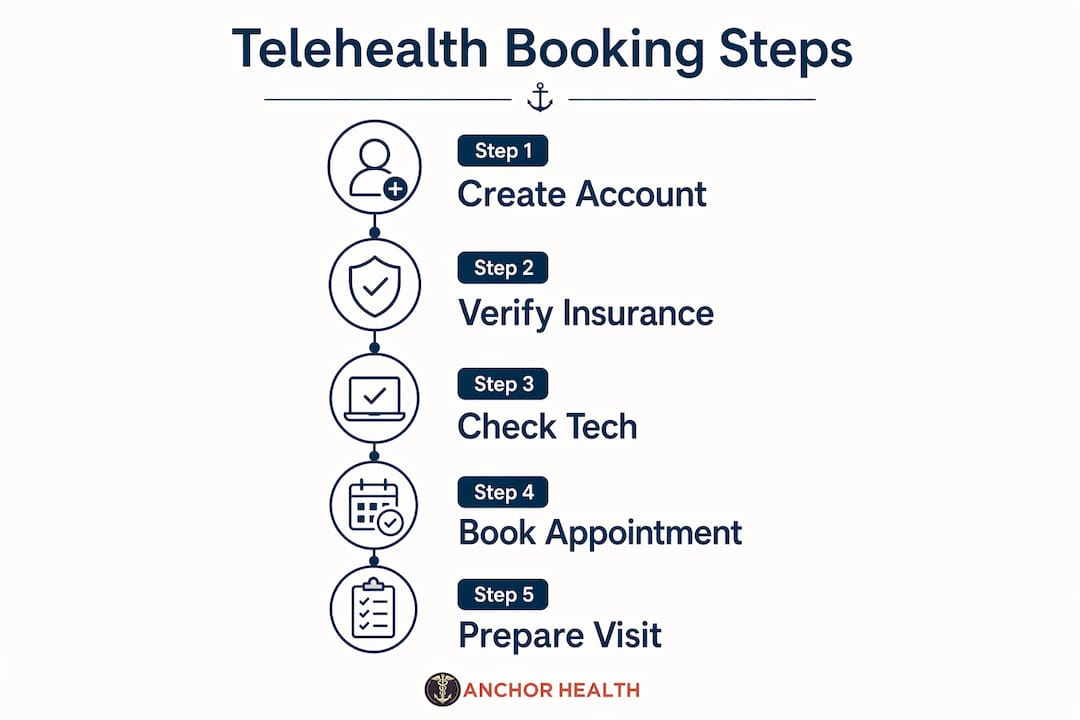
How do you book a telehealth appointment step by step?
The process of scheduling a virtual doctor visit follows a clear sequence. Following each step in order prevents common booking errors.
- Choose a provider that fits your needs. Look for a practice that accepts your insurance, serves your state, and offers the type of care you need. Myanchorhealthpc, for example, provides primary care, women’s health, and mental health support through telehealth for Maryland residents. If you are a college student, the telehealth options for students page outlines what to expect from a virtual primary care relationship.
- Create your account and complete intake forms. Most platforms walk you through this during registration. Fill out your health history, list your current medications, and note any allergies. Completing these forms before your appointment gives your provider time to review your background.
- Select your appointment type. Telehealth covers a wide range of visit types. Urgent care visits for a sore throat, rash, or minor infection are typically available same-day. Telepsychiatry evaluations usually require booking at least a week in advance to secure a consistent provider, and initial psychiatric evaluations typically last around 60 minutes compared to 10–15 minutes for urgent care. Knowing which type you need helps you pick the right slot.
- Pick a date and time. Use the platform’s scheduling tool to browse available slots. Morning appointments tend to have shorter wait times. If you need a recurring appointment for therapy or chronic care management, look for a provider who can hold a consistent weekly or biweekly slot.
- Confirm your appointment and save the details. After booking, you will receive a confirmation email or text with a link to join the visit. Save that link and add the appointment to your calendar. Most platforms also send a reminder 24 hours before.
- Complete any pre-visit requirements. Some providers ask you to upload photos of a rash or skin concern, complete a mood questionnaire, or review a consent form before the visit. Completing these steps in advance keeps the appointment focused on your care.
Young adults who schedule virtual visits for mental health concerns see higher session adherence compared to in-person therapy, largely because attending from home removes the stigma and travel barriers that often cause cancellations. That pattern holds especially true for anxiety and depression management.
How should you prepare for your telehealth visit?
Preparation directly affects the quality of care you receive. A few focused steps before the appointment make the visit more productive for both you and your provider.
Joining your visit 15 minutes early gives you time to test your camera, microphone, and internet connection before the appointment starts. Technical problems discovered at the last minute create stress and eat into your consultation time.
Here is how to set up your space and prepare your information:
- Sit in a well-lit room where your face is clearly visible on camera
- Use headphones to improve audio quality and protect your privacy
- Close other browser tabs and apps to free up bandwidth
- Write down your top three questions or concerns before the visit
- Have your medication bottles nearby so you can read dosages accurately
- Keep a notepad ready to write down your provider’s recommendations
Pro Tip: If you live with roommates or family, let them know you have a medical appointment and ask for 30 minutes of uninterrupted quiet. A “Do Not Disturb” sign on your door is a simple, effective solution.
Telepsychiatry works best when patients are motivated, disciplined, and engaged. For mental health visits specifically, writing down your mood patterns, sleep quality, and stress triggers from the past week gives your provider concrete information to work with. That preparation turns a 30-minute check-in into a genuinely useful clinical conversation.
Young adults managing ongoing conditions can also review preventive care guidelines for ages 18–25 before their appointment to understand which screenings and health checks are recommended at their age.
What are the common challenges with young adult telehealth?
Telehealth works well for most visits, but knowing its limits helps you use it wisely.
Know when to go in person. Telehealth cannot replace a physical exam. Conditions like respiratory distress, suspected fractures, or injuries that need hands-on assessment require an in-person visit. If your symptoms are severe or worsening rapidly, go to an urgent care center or emergency room.
The most common challenges young adults face with virtual visits include:
- Connectivity problems. A dropped call mid-appointment is frustrating. If your connection fails, most providers will call you back on your phone number on file. Always have your phone nearby as a backup.
- Privacy in shared spaces. Dorm rooms, shared apartments, and family homes make private conversations difficult. Using headphones and sitting close to your screen lowers the volume your neighbors can hear. A white noise machine outside your door adds another layer of privacy.
- Limited physical assessment. Telehealth cannot replace physical exams for acute conditions. Lab work, imaging, and hands-on assessments still require in-person visits. Your telehealth provider can order labs and refer you to a local facility when needed.
- Navigating insurance gaps. Not every insurer covers every type of telehealth visit. Mental health visits, for example, may have different coverage rules than primary care. Confirming coverage for each visit type separately prevents billing surprises.
Privacy and ease of access through telehealth reduce mental health care barriers for young adults and increase therapy engagement. That benefit is real, but it depends on having a genuinely private setup at home.
Key Takeaways
Booking a telehealth appointment as a young adult requires the right device, a verified insurance plan, a private space, and a clear understanding of which visit types suit virtual care versus in-person assessment.
| Point | Details |
|---|---|
| Verify insurance first | Confirm telehealth coverage before booking to avoid unexpected costs. |
| Match visit type to need | Use same-day slots for urgent care; book a week ahead for telepsychiatry. |
| Prepare your space | A quiet, private, well-lit room improves care quality and protects confidentiality. |
| Log in 15 minutes early | Early login lets you fix technical issues before your appointment time. |
| Know telehealth’s limits | Physical exams, lab work, and acute injuries still require in-person care. |
Telehealth and young adult care: my honest perspective
Young adults are often the most capable telehealth patients in the room. They are comfortable with video technology, quick to navigate patient portals, and generally motivated to handle their own healthcare. What I have seen, though, is that capability with technology does not automatically translate into getting the most out of a virtual visit.
The patients who benefit most from telehealth are the ones who treat it like a real appointment. They prepare questions, show up on time, and follow through on their provider’s recommendations. The ones who struggle tend to book impulsively, join from a noisy coffee shop, and expect the provider to do all the work. Telehealth shifts some responsibility onto the patient, and that is actually a good thing for young adults who are learning to manage their own health.
I also think the mental health application of telehealth is genuinely underused by this age group. Teletherapy reduces stigma and removes the logistical friction that stops many young adults from seeking help. Attending a therapy session from your own room, on your own schedule, is a real clinical advantage, not just a convenience. The evidence supports it, and the results speak for themselves when patients stay engaged.
The one caution I would offer is this: telehealth works best as part of an ongoing care relationship, not as a series of one-off visits. A provider who knows your history, your medications, and your health goals gives you far better care than a rotating roster of strangers. Find a consistent provider and stick with them.
— Paule
Myanchorhealthpc makes virtual care straightforward for young adults
Young adults in Maryland have a direct path to relationship-based telehealth care through Myanchorhealthpc. The practice operates on its Anchored Care℠ᴵᴾ model, which prioritizes continuity and personalized attention over quick, episodic visits. Whether you need primary care, mental health support, or women’s health services, appointments are conducted through secure video visits that meet HIPAA standards.
Myanchorhealthpc accepts insurance and offers membership options for patients who want more direct access to their provider. If you are a student or young adult figuring out how telehealth works for your stage of life, that page walks through the full process in practical terms. Scheduling is straightforward, and your provider stays consistent visit after visit.
FAQ
What do I need to book a telehealth appointment?
You need a device with a camera and microphone, a stable internet connection, a patient portal account, and your insurance information. Confirming your plan covers telehealth before booking prevents unexpected charges.
How far in advance should I schedule a virtual mental health visit?
Telepsychiatry and therapy appointments typically require booking at least a week in advance to secure a consistent provider. Initial psychiatric evaluations generally last around 60 minutes, so plan your schedule accordingly.
Can telehealth replace all in-person doctor visits?
Telehealth cannot replace physical exams or hands-on assessments. Conditions like injuries, respiratory distress, or anything requiring lab work or imaging still require in-person care.
Is my telehealth visit private and secure?
Yes. HIPAA regulations apply to telehealth visits the same way they apply to in-person appointments. Using headphones and a private room adds an additional layer of personal confidentiality during your visit.
What happens if my internet drops during a telehealth appointment?
Most providers will attempt to reach you by phone if your video connection fails. Keep your phone nearby and make sure your contact number is current in your patient portal before every appointment.
Recommended
- How Telehealth Works for College Students in 2026
- How Telehealth Handles Sick Child Visits for Families
- Preventive Care for Ages 18–25: Your 2026 Guide
- How to Establish Pediatric Care Telehealth for Your Family
Blog & Information Disclaimer
Last Updated: May 23, 2026
The information provided on the Anchor Health website (https://myanchorhealthpc.com/), including but not limited to blog posts, articles, newsletters, graphics, and other materials (collectively, the "Content"), is for general informational and educational purposes only.
By accessing and using this website, you acknowledge and agree to the following terms and conditions:
The Content on this website is not intended to be a substitute for professional medical advice, diagnosis, or treatment. Always seek the advice of your physician, nurse practitioner, or other qualified health provider with any questions you may have regarding a medical condition. Never disregard professional medical advice or delay in seeking it because of something you have read on this website.
Reading, interacting with, or sharing the Content on this website does not establish a patient-provider relationship between you and Anchor Health or any of its clinicians, including Paule Valery Joseph, PhD, MBA, CRNP, FAAN. A formal patient-provider relationship is only established after you have completed the formal intake process, signed our clinical consent forms, and participated in a secure clinical consultation.
If you are experiencing a medical emergency, call 911 or seek emergency medical services immediately.
Anchor Health is a primary care practice and does not provide emergency or crisis intervention services through its website or blog.
While Anchor Health strives to provide thoughtful, evidence-based information grounded in our Anchored Care℠ model, healthcare is a rapidly evolving field. We make no representations or warranties, express or implied, about the completeness, accuracy, reliability, or suitability of the information contained in the Content. Any reliance you place on such information is strictly at your own risk.
Anchor Health is a telehealth practice providing services to patients physically located within the state of Maryland. The information provided on this blog is intended for residents of Maryland and is governed by the laws and regulations of that state. Accessing this information from outside of Maryland does not imply that our clinicians are licensed to practice medicine or provide consultations in your jurisdiction.
Content related to Weight & Metabolic Health, including discussions of GLP-1 medications or other medical therapies, is provided for educational context regarding our clinical approach. Prescriptions and specific medical recommendations are only made following a comprehensive clinical evaluation, diagnostic testing, and shared decision-making within a formal patient-provider relationship.
This website may contain links to external websites that are not provided or maintained by or in any way affiliated with Anchor Health. Please note that Anchor Health does not guarantee the accuracy, relevance, timeliness, or completeness of any information on these external websites.
To the fullest extent permitted by law, Anchor Health, its owners, and its employees shall not be liable for any direct, indirect, incidental, consequential, or punitive damag
Related posts