How to Request Lab Work Through Telehealth

Requesting lab work through telehealth is the process of obtaining medical lab test orders from a licensed provider during a virtual visit, then completing the draw at a nearby diagnostic center or through an at-home option. The entire process moves faster than traditional care because telehealth eliminates referral delays and bypasses the insurance roadblocks common in episodic primary care. Providers issue electronic orders directly to your email or patient portal. You then walk into a lab like Quest Diagnostics or Labcorp, with no appointment required at most locations, and results return within days.
What you need before requesting lab work through telehealth
Preparation before your virtual visit determines how smoothly the lab order process goes. Patients who arrive unprepared often need a second visit or face delays at the lab.
Devices and connection
A smartphone, tablet, or computer with a working camera and microphone covers the technical requirements for most telehealth platforms. A stable internet connection matters more than device type. A dropped call mid-consultation can interrupt the clinical discussion and delay your order.

Health information to have ready
Gather the following before your appointment:
- Current symptoms and how long you have had them
- Prior lab results, especially if you are monitoring a chronic condition like diabetes or thyroid disease
- A list of current medications, including supplements and dosages
- Your insurance card and a valid photo ID
- The name and address of a local lab you plan to visit for the draw
Knowing your local lab options in advance saves time after the visit. Telehealth lab orders go to you directly, so you choose where to complete the draw.
Fasting and preparation requirements
Many patients assume fasting is automatic or that the platform will remind them. It is not and it will not. Fasting of 8–12 hours is required for common panels like glucose and lipid tests. Confirm fasting requirements with your provider during the visit, and write them down before you leave the call.
Pro Tip: Ask your provider at the end of the visit to confirm in writing whether you need to fast, and for how long. Most portals allow providers to attach instructions directly to the lab order.
| Tool or Information | Why You Need It |
|---|---|
| Camera-enabled device | Required to complete the video consultation |
| Stable internet connection | Prevents call drops during clinical discussion |
| Prior lab results | Helps provider compare trends and order the right panels |
| Local lab name and address | Needed to verify order acceptance before your visit |
| Fasting status | Determines whether you can eat before the draw |
How to request lab tests step-by-step during a telehealth visit
The virtual visit itself is where the lab order originates. Following a clear sequence makes the process efficient and reduces the chance of missing a test you need.
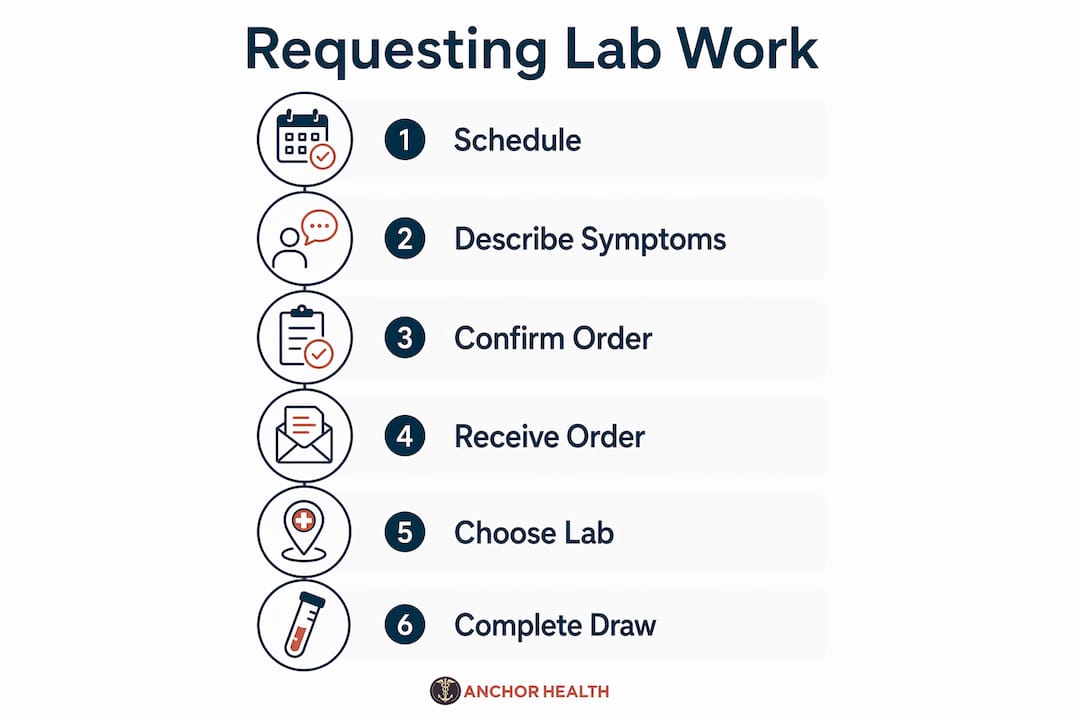
Step 1: Schedule your telehealth consultation.
Book a primary care visit with a licensed provider through your telehealth platform. At Myanchorhealthpc, this happens through a secure video visit. Use the first visit checklist to prepare your health history before the appointment.
Step 2: Describe your symptoms and health goals clearly.
Tell your provider exactly what you are experiencing and what you want to monitor. Providers use this information to select the appropriate lab panels. If you want a specific test, such as a thyroid panel or HbA1c, say so directly. Providers can order panels you request as long as they are clinically appropriate.
Step 3: Confirm the lab order before ending the call.
Ask your provider to confirm which tests are being ordered and why. Review the order name, the fasting requirement, and the expected turnaround time. This is the moment to ask every question you have about the process.
Step 4: Receive your electronic lab order.
After the visit, providers send electronic orders directly to your email or patient portal account. Most orders arrive within minutes to a few hours of the consultation. Check your spam folder if you do not see it within two hours.
Step 5: Choose your testing location.
Select a lab from the order instructions or from your own research. Quest Diagnostics and Labcorp operate 2,000 to 4,500 centers nationwide, and most accept walk-in patients. Confirm that your chosen location accepts orders from your specific telehealth provider before you go.
Step 6: Complete the draw and follow post-draw instructions.
Arrive at the lab with your order (printed or on your phone), your photo ID, and your insurance card. Most blood draws take less than 10 minutes. Follow any post-draw instructions your provider included with the order.
Pro Tip: Call the lab location ahead of your visit to confirm they accept telehealth orders from your provider. Some branches prioritize institutional orders over independent digital ones, and a quick call saves you a wasted trip.
How and where to complete your lab work after receiving your telehealth order
Receiving the electronic order is only the midpoint. Completing the draw correctly determines whether your results are accurate and timely.
Lab location options
Most patients use a national diagnostic center for their draw. Walk-in availability at 2,000 or more labs nationwide means you rarely need a scheduled appointment. Independent regional labs are also an option, though they may have more limited hours or fewer accepted insurance plans.
Patients who cannot visit a physical lab have two alternatives:
- Mobile lab draw services: A phlebotomist comes to your home or office. This option typically costs more than a standard lab visit and requires advance scheduling.
- At-home collection kits: At-home lab options work for certain tests, such as hormone panels or some infectious disease screens. You collect the sample yourself and mail it to the processing lab.
Common issues and how to avoid them
Verifying that your chosen lab accepts orders from your telehealth provider is the single most important step patients skip. Some locations do not accept orders from independent digital providers due to contracting differences. Calling ahead takes two minutes and prevents a wasted visit.
Additional pitfalls to avoid:
- Arriving without fasting: For glucose or lipid panels, eating beforehand invalidates the result and requires a repeat draw.
- Forgetting your order: Labs cannot process a draw without the order on file. Bring a printed copy or have the digital version accessible on your phone.
- Skipping ID verification: Labs require a photo ID and insurance card at check-in. Missing either causes delays.
- Choosing a lab outside your insurance network: Confirm network status before your visit to avoid unexpected costs.
Understanding your lab results and follow-up after telehealth lab work
Lab results after a telehealth order arrive through the same secure channels used for the order itself. HIPAA-compliant portals and encrypted email protect your data throughout the process.
Turnaround times
Standard panels like a complete blood count or basic metabolic panel typically return within 48–72 hours. Complex tests, including genetic panels or certain infectious disease screens, may take 5–7 business days when they require manual review by a licensed provider before patient notification. Do not assume a delay means a problem. It often means your provider is reviewing the results before releasing them.
How to read and act on your results
When results arrive, focus on these key areas:
- Reference ranges: Labs include normal ranges next to each value. A result outside the range does not always indicate disease. Context matters.
- Flagged values: Results marked “H” (high) or “L” (low) warrant a conversation with your provider, not self-diagnosis.
- Trending over time: A single result tells you less than a pattern. Patients managing chronic conditions through telehealth benefit most from comparing results across multiple draws.
- Provider commentary: Some platforms attach provider notes to results. Read these before drawing conclusions from raw numbers.
Schedule a follow-up telehealth visit if any result is flagged or if you have questions. Providers use results to adjust medications, recommend lifestyle changes, or order additional testing. Proactive follow-up is the difference between a lab result and a health decision.
Key Takeaways
Patients who prepare before their virtual visit, verify lab acceptance, and follow up on results get the most value from telehealth lab ordering.
| Point | Details |
|---|---|
| Prepare before the visit | Gather prior labs, medications, and local lab information before your telehealth appointment. |
| Confirm fasting requirements | Ask your provider directly; fasting of 8–12 hours is required for glucose and lipid panels. |
| Verify lab acceptance | Call your chosen lab to confirm they accept orders from your specific telehealth provider. |
| Expect 48–72 hours for results | Complex panels may take 5–7 business days if provider review is required before release. |
| Schedule follow-up care | Use a follow-up telehealth visit to interpret flagged results and adjust your care plan. |
What I’ve learned from watching patients navigate telehealth lab orders
The patients who struggle most with telehealth lab work are not the ones with complex conditions. They are the ones who assume the process is fully automatic. They expect the platform to remind them to fast, to call the lab for them, and to explain every result without a follow-up visit. That expectation sets them up for frustration.
The patients who get the most out of virtual lab work treat the telehealth visit the way they would treat a visit with a trusted specialist. They come prepared, they ask specific questions, and they follow up. One thing I have seen repeatedly: patients managing metabolic conditions like diabetes or thyroid disease benefit enormously from the speed of telehealth lab ordering. Removing the referral step and the scheduling delay means they get results and medication adjustments weeks faster than they would through a traditional system.
The one step I would make mandatory for every patient is calling the lab before going. It takes two minutes. It prevents the single most common complaint I hear, which is arriving at a lab that cannot process the order. Telehealth lab ordering is genuinely convenient, but it still requires you to be an active participant in your own care.
— Paule
How Myanchorhealthpc makes lab ordering part of your care
Myanchorhealthpc provides telehealth primary care through secure video visits, and lab ordering is built into that process. After your virtual visit with a licensed provider, your electronic lab order goes directly to your email or patient portal. You take that order to any participating diagnostic center, with no appointment needed at most locations.
What sets Myanchorhealthpc apart is the follow-up. Providers review your results and schedule a return visit to discuss findings, adjust medications, or recommend next steps. That continuity is what the Anchored Care℠ᴵᴾ model is built on. If you are ready to choose a telehealth primary care provider who coordinates your lab work from order to result, Myanchorhealthpc is accepting new patients in Maryland now.
FAQ
Can I request lab work through telehealth without an in-person visit?
Yes. A licensed telehealth provider can evaluate your symptoms and issue an electronic lab order entirely through a video visit, with no in-person appointment required.
How do I receive my lab order after a telehealth visit?
Your provider sends the order directly to your email or patient portal account, usually within minutes to a few hours of the consultation.
Do all labs accept telehealth lab orders?
Most major diagnostic centers like Quest Diagnostics and Labcorp accept telehealth orders, but some locations may not depending on their contracting. Always call ahead to confirm.
How long does it take to get telehealth lab results?
Standard results arrive within 48–72 hours. Complex panels that require provider review may take 5–7 business days before you receive notification.
Does insurance cover lab work ordered through telehealth?
Most major insurance plans cover lab work regardless of whether the order came from a telehealth or in-person visit. Confirm your specific plan’s network coverage before choosing a lab location.
Recommended
- How Telehealth Handles Sick Child Visits for Families
- How Telehealth Works for College Students in 2026
- How to Book a Telehealth Appointment as a Young Adult
Blog & Information Disclaimer
Last Updated: May 23, 2026
The information provided on the Anchor Health website (https://myanchorhealthpc.com/), including but not limited to blog posts, articles, newsletters, graphics, and other materials (collectively, the "Content"), is for general informational and educational purposes only.
By accessing and using this website, you acknowledge and agree to the following terms and conditions:
The Content on this website is not intended to be a substitute for professional medical advice, diagnosis, or treatment. Always seek the advice of your physician, nurse practitioner, or other qualified health provider with any questions you may have regarding a medical condition. Never disregard professional medical advice or delay in seeking it because of something you have read on this website.
Reading, interacting with, or sharing the Content on this website does not establish a patient-provider relationship between you and Anchor Health or any of its clinicians, including Paule Valery Joseph, PhD, MBA, CRNP, FAAN. A formal patient-provider relationship is only established after you have completed the formal intake process, signed our clinical consent forms, and participated in a secure clinical consultation.
If you are experiencing a medical emergency, call 911 or seek emergency medical services immediately.
Anchor Health is a primary care practice and does not provide emergency or crisis intervention services through its website or blog.
While Anchor Health strives to provide thoughtful, evidence-based information grounded in our Anchored Care℠ model, healthcare is a rapidly evolving field. We make no representations or warranties, express or implied, about the completeness, accuracy, reliability, or suitability of the information contained in the Content. Any reliance you place on such information is strictly at your own risk.
Anchor Health is a telehealth practice providing services to patients physically located within the state of Maryland. The information provided on this blog is intended for residents of Maryland and is governed by the laws and regulations of that state. Accessing this information from outside of Maryland does not imply that our clinicians are licensed to practice medicine or provide consultations in your jurisdiction.
Content related to Weight & Metabolic Health, including discussions of GLP-1 medications or other medical therapies, is provided for educational context regarding our clinical approach. Prescriptions and specific medical recommendations are only made following a comprehensive clinical evaluation, diagnostic testing, and shared decision-making within a formal patient-provider relationship.
This website may contain links to external websites that are not provided or maintained by or in any way affiliated with Anchor Health. Please note that Anchor Health does not guarantee the accuracy, relevance, timeliness, or completeness of any information on these external websites.
To the fullest extent permitted by law, Anchor Health, its owners, and its employees shall not be liable for any direct, indirect, incidental, consequential, or punitive damag
Related posts