What Does a Health Maintenance Visit Include?

A health maintenance visit is defined as a scheduled preventive care appointment designed to assess your overall health, catch problems early, and build a personalized plan to keep you well. Understanding what does a health maintenance visit include helps you walk in prepared and walk out with real answers. A standard annual physical exam typically lasts 30–60 minutes and covers physical assessment, vital signs, and age-appropriate screenings. Most commercial insurance plans cover one preventive visit per year with a $0 copay under the ACA. That means skipping this visit is leaving covered, potentially life-saving care on the table.
What does a health maintenance visit include?
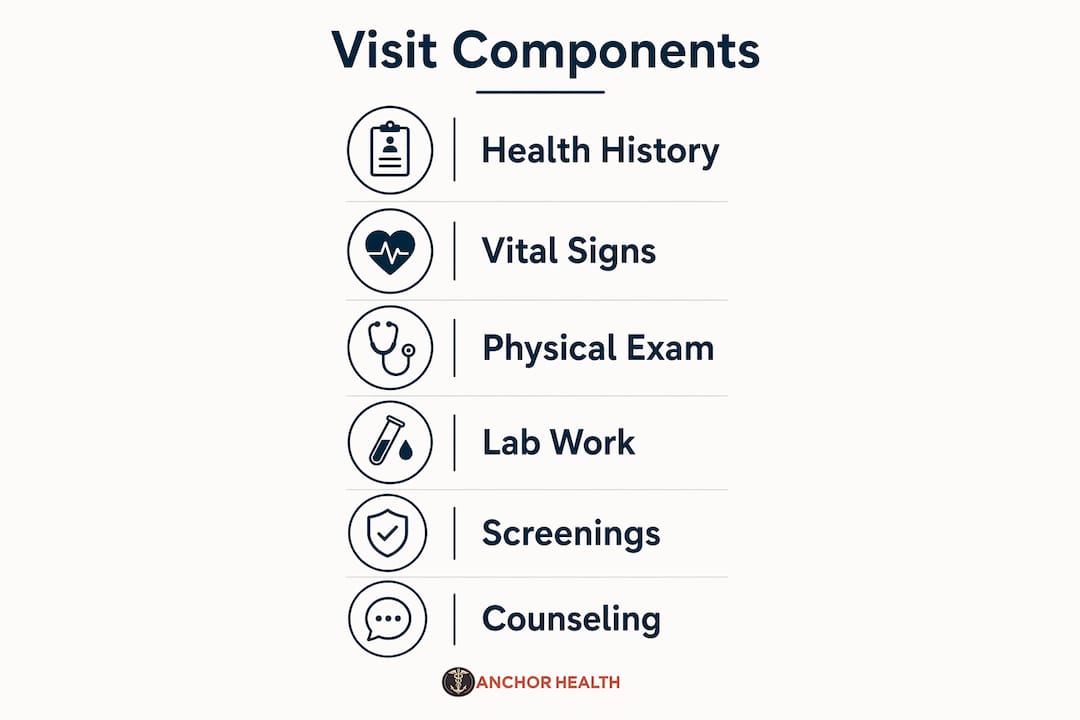
A health maintenance visit covers six core areas: health history review, vital signs, physical examination, lab work, immunizations, and health counseling. Each component builds on the others to give your provider a complete picture of where you stand.
Health history review is where the visit begins. Your provider will ask about current medications, recent symptoms, family medical history, and lifestyle habits like sleep, diet, and exercise. This conversation shapes every other decision made during the appointment.

Vital signs and measurements come next. Routine preventive visits include blood pressure, BMI assessment, depression and anxiety screening, and immunization status reviews. Blood pressure is checked at every visit; BMI is assessed annually. These numbers give your provider a baseline to track over time.
Physical examination follows a head-to-toe format. Your provider checks your heart, lungs, abdomen, skin, and reflexes. Sex-specific exams, such as a breast exam or testicular check, are included based on your needs. For women, a pelvic exam may also be part of the visit, and gynecological primary care often overlaps with these components.
Lab work is ordered based on your age, risk factors, and history. Common panels include a complete blood count, metabolic panel, lipid panel, and urinalysis. Results from these tests often reveal conditions like prediabetes or high cholesterol before symptoms appear.
Immunization review confirms you are current on recommended vaccines. Standard vaccines reviewed include flu, COVID-19, Tdap, and shingles. Your provider will update your record and administer any overdue shots during the visit.
Common components covered during a health maintenance visit:
- Medical and family history update
- Blood pressure, heart rate, and weight measurements
- BMI calculation
- Head-to-toe physical examination
- Depression and anxiety screening
- Blood panels and urinalysis
- Vaccine status review and updates
- Personalized health counseling
Pro Tip: Before your appointment, write down every medication and supplement you take, including dosages. Bring a short list of your top three health concerns. Providers make better decisions when they have this information upfront rather than trying to reconstruct it from memory.
How does age and risk affect screenings during your visit?
Screening recommendations change significantly based on your age, sex, and personal risk profile. The U.S. Preventive Services Task Force (USPSTF) publishes evidence-based guidelines that most providers follow when deciding which tests to order.
Age-specific preventive screenings follow clear benchmarks: cervical cancer screening starts at age 21 and repeats every 3–5 years, colorectal cancer screening begins at age 45, and bone density testing is recommended for women starting at age 65. These intervals are not arbitrary. They reflect the age ranges where early detection produces the greatest reduction in disease and death.
Risk factors shift the timeline. A patient with a strong family history of colon cancer may start colorectal screening before age 45. A patient with obesity or a sedentary lifestyle may receive earlier diabetes screening. Your provider uses your personal profile to adjust the standard schedule.
Mental health screening is also built into the visit. Depression and anxiety assessments are standard components, not optional add-ons. Addressing mental health at a routine checkup removes the barrier of scheduling a separate appointment.
| Screening type | Recommended start age | Typical interval |
|---|---|---|
| Blood pressure check | All adults | Every visit |
| Cervical cancer (Pap smear) | Age 21 | Every 3–5 years |
| Colorectal cancer | Age 45 | Every 1–10 years (method-dependent) |
| Diabetes screening | Age 35 (or earlier with risk factors) | Every 3 years |
| Bone density (DEXA) | Age 65 for women | Every 2 years |
| Cholesterol panel | Age 20 | Every 4–6 years (more often with risk) |
| Depression screening | All adults | Annually |
The young adult preventive health checklist for 2026 reflects these USPSTF-aligned intervals and is a useful reference for patients in their 20s and 30s who assume they are too young to need screenings.
What is the difference between a health maintenance visit and a wellness visit?
These two visit types are often used interchangeably, but they are billed and structured differently. Knowing the distinction protects you from unexpected charges.
A health maintenance visit (also called an annual physical) includes a hands-on physical exam, lab orders, and a full clinical assessment. Your provider examines you, interprets findings, and may diagnose or manage conditions during the same appointment.
A wellness visit is more structured around prevention planning. Wellness visits include structured Health Risk Assessments covering medical history, medications, lifestyle, mental health screening, and preventive planning. There is typically no mandatory physical exam and no automatic lab orders.
The Medicare Annual Wellness Visit (AWV) is a specific type of wellness visit. Medicare AWVs do not include a hands-on physical exam. They focus on prevention planning, cognitive assessment, and fall risk evaluation. Many patients arrive expecting a physical and leave confused. Labs ordered during an AWV are billed separately.
Insurance covers preventive wellness exams at no cost, but new medical problems addressed during the visit may trigger separate billing and copays. If you mention a new symptom like knee pain or a rash, your provider may need to document it as a problem-focused visit. That portion of the visit can generate a separate charge.
Pro Tip: If you have a new concern to discuss, ask your provider at the start of the visit whether addressing it will change the billing. Some providers can handle minor concerns within the preventive visit; others will need to schedule a follow-up. Knowing this upfront prevents billing surprises.
| Visit type | Physical exam included | Labs included | Insurance coverage |
|---|---|---|---|
| Health maintenance visit (annual physical) | Yes | Yes, based on clinical need | Covered under ACA preventive benefit |
| Wellness visit | No (or limited) | No (billed separately) | Covered under ACA preventive benefit |
| Medicare Annual Wellness Visit | No | No (billed separately) | Covered under Medicare Part B |
| Problem-focused (sick) visit | Yes | Yes, as needed | Subject to copay and deductible |
How to prepare for your health maintenance visit
Preparation directly improves the quality of your visit. Providers recommend patients prepare a written Health Action Plan that includes a medication list, family history summary, and top health questions. Patients who arrive prepared cover more ground and leave with clearer next steps.
Preparation with written medication lists, symptom logs, and health questions helps patients avoid missing critical topics during typical short 30–60 minute visits. Many patients regret not using their time well. A written list removes that risk entirely.
Here is what to bring and do before your appointment:
- Write down all current medications, supplements, and vitamins with dosages
- Update your family medical history, especially any new diagnoses among close relatives
- Log any symptoms you have noticed, even if they seem minor
- Record home health measurements like blood pressure readings or blood glucose levels if you track them
- Write down your top three health goals or concerns to discuss
- Bring your insurance card and a photo ID
- Know the date of your last physical, last labs, and any recent specialist visits
Setting health goals before the visit shifts the conversation from reactive to proactive. Instead of waiting for your provider to ask questions, you arrive with an agenda. That changes the dynamic and the outcome.
Pro Tip: Track your blood pressure at home for two weeks before your visit using a validated home monitor. Bring the log to your appointment. White-coat hypertension (elevated readings only in a clinical setting) is common, and home readings give your provider a more accurate picture.
The role of a family doctor in preventive care extends well beyond the visit itself. A consistent provider who knows your history can spot changes that a new provider would miss entirely.
Key Takeaways
A health maintenance visit delivers the most value when you understand its components, prepare thoroughly, and treat it as an annual investment in long-term health rather than a one-time obligation.
| Point | Details |
|---|---|
| Core visit components | Every health maintenance visit covers history, vitals, physical exam, labs, vaccines, and counseling. |
| Age-based screenings | USPSTF guidelines set specific start ages and intervals for cervical, colorectal, bone density, and diabetes screening. |
| Visit type distinctions | Annual physicals include a physical exam; Medicare Annual Wellness Visits do not, and labs are billed separately. |
| Billing awareness | Addressing new symptoms during a preventive visit can trigger separate charges; ask your provider upfront. |
| Preparation improves outcomes | A written medication list, symptom log, and health questions help you cover more ground in a 30–60 minute visit. |
Why I think most people underuse their annual visit
Most patients treat the annual visit as a box to check. They show up, answer questions, and leave without a clear plan. That is a missed opportunity every single year.
What I have seen consistently is that the patients who get the most from these visits are the ones who treat them like a business meeting. They come with an agenda. They ask about their numbers. They push for specifics on what to do before the next visit. That mindset shift changes everything.
The confusion between a physical exam and a wellness visit is also more damaging than people realize. Patients who expect a physical during a Medicare Annual Wellness Visit leave feeling shortchanged. Patients who do not know that discussing a new symptom can change their bill feel blindsided. These are not obscure billing technicalities. They are things every patient deserves to know before they walk in.
The preventive care framework that works for children applies to adults too: show up consistently, prepare deliberately, and build a relationship with a provider who knows your history. One visit a year with a trusted, continuous provider is worth more than five rushed appointments with someone who has never seen your chart.
— Paule
Myanchorhealthpc makes preventive care work for your life
Scheduling and preparing for a health maintenance visit should not feel like a logistical challenge. Myanchorhealthpc delivers comprehensive primary care through secure video visits, so you get a thorough, relationship-based appointment without rearranging your day.

Myanchorhealthpc’s Anchored Care℠ model means your provider knows your history, tracks your screenings over time, and personalizes your preventive plan at every visit. Whether you are managing a chronic condition, navigating a health transition, or simply due for your annual checkup, Myanchorhealthpc offers the continuity that makes preventive care actually work. Learn how to choose telehealth primary care for your family and schedule your next health maintenance visit with a provider who stays with you long-term.
FAQ
What does a health maintenance visit include?
A health maintenance visit includes a health history review, vital signs, head-to-toe physical exam, age-appropriate lab work, immunization updates, and personalized health counseling. Most visits last 30–60 minutes and are covered at no cost under the ACA preventive care benefit.
How often should you schedule a health maintenance visit?
Most adults benefit from one health maintenance visit per year. Patients with chronic conditions or elevated risk factors may need more frequent check-ins based on their provider’s recommendation.
Is a wellness visit the same as an annual physical?
No. A wellness visit focuses on prevention planning and health risk assessment without a mandatory physical exam. An annual physical includes a hands-on clinical examination and may include lab orders based on findings.
Does insurance cover the full cost of a health maintenance visit?
Most commercial insurance plans cover one preventive visit per year with a $0 copay under the ACA. However, if you address a new medical problem during the visit, that portion may be billed separately and subject to your copay or deductible.
What should I bring to my health maintenance visit?
Bring a written list of all current medications and supplements, a summary of your family medical history, any home health measurements you track, and your top three health concerns or questions. A prepared Health Action Plan helps you and your provider cover more ground in the time available.
Recommended
- Examples of Preventive Care for Kids: Parent’s Guide
- Young Adult Preventive Health Checklist: 2026 Guide
- What Does Preventive Care Mean for Teens: A Parent’s Guide
Blog & Information Disclaimer
Last Updated: May 23, 2026
The information provided on the Anchor Health website (https://myanchorhealthpc.com/), including but not limited to blog posts, articles, newsletters, graphics, and other materials (collectively, the "Content"), is for general informational and educational purposes only.
By accessing and using this website, you acknowledge and agree to the following terms and conditions:
The Content on this website is not intended to be a substitute for professional medical advice, diagnosis, or treatment. Always seek the advice of your physician, nurse practitioner, or other qualified health provider with any questions you may have regarding a medical condition. Never disregard professional medical advice or delay in seeking it because of something you have read on this website.
Reading, interacting with, or sharing the Content on this website does not establish a patient-provider relationship between you and Anchor Health or any of its clinicians, including Paule Valery Joseph, PhD, MBA, CRNP, FAAN. A formal patient-provider relationship is only established after you have completed the formal intake process, signed our clinical consent forms, and participated in a secure clinical consultation.
If you are experiencing a medical emergency, call 911 or seek emergency medical services immediately.
Anchor Health is a primary care practice and does not provide emergency or crisis intervention services through its website or blog.
While Anchor Health strives to provide thoughtful, evidence-based information grounded in our Anchored Care℠ model, healthcare is a rapidly evolving field. We make no representations or warranties, express or implied, about the completeness, accuracy, reliability, or suitability of the information contained in the Content. Any reliance you place on such information is strictly at your own risk.
Anchor Health is a telehealth practice providing services to patients physically located within the state of Maryland. The information provided on this blog is intended for residents of Maryland and is governed by the laws and regulations of that state. Accessing this information from outside of Maryland does not imply that our clinicians are licensed to practice medicine or provide consultations in your jurisdiction.
Content related to Weight & Metabolic Health, including discussions of GLP-1 medications or other medical therapies, is provided for educational context regarding our clinical approach. Prescriptions and specific medical recommendations are only made following a comprehensive clinical evaluation, diagnostic testing, and shared decision-making within a formal patient-provider relationship.
This website may contain links to external websites that are not provided or maintained by or in any way affiliated with Anchor Health. Please note that Anchor Health does not guarantee the accuracy, relevance, timeliness, or completeness of any information on these external websites.
To the fullest extent permitted by law, Anchor Health, its owners, and its employees shall not be liable for any direct, indirect, incidental, consequential, or punitive damag
Related posts