Primary Care’s Role in Young Adult Chronic Prevention

Why primary care is your frontline defense against chronic disease
The role of primary care in young adult chronic prevention is more decisive than most people in their 20s realize. Adults with a usual source of primary care received preventive services at a rate of 95.5%, compared to just 67.6% among those without one. That same group had 11% fewer emergency department visits and 20% fewer hospitalizations. The financial difference is equally striking: total healthcare costs were nearly 54% lower for those with consistent primary care.
Young adults often see primary care only as a place to go when sick. In reality, it serves as a centralized medical home that coordinates records, prevents harmful drug interactions, and catches risk factors before they become diagnoses. The conditions most likely to shorten your life, including heart disease, type 2 diabetes, and certain cancers, are largely preventable when addressed early.
Preventive services commonly delivered through primary care for young adults include:
- Blood pressure and cholesterol screening
- Blood glucose testing for diabetes risk
- Mental health and depression screening
- Alcohol, tobacco, and substance use counseling
- Body mass index assessment and weight counseling
- Sexually transmitted infection screening
- Immunizations and vaccine updates
- Lifestyle and physical activity counseling
1. Proactive primary care models that actually change outcomes
Standard primary care, where you show up only when something hurts, leaves too many prevention opportunities on the table. Proactive models close that gap by reaching patients between visits, not just during them.

The patient-centered medical home model organizes care around the patient rather than the appointment. It uses outreach, education, and team-based support to keep prevention on track across the full year. Research confirms this approach improves population health, enhances the patient experience, and reduces costs.
The BETTER approach (Building on Existing Tools To Improve Chronic Disease Prevention and Screening in Primary Care) takes this further for younger adults. A dedicated Prevention Practitioner meets individually with patients to set personalized prevention goals using motivational interviewing. In a pragmatic cluster randomized controlled trial, the BETTER approach improved uptake of chronic disease prevention and screening actions by 32.5% in urban primary care settings. The BETTER LIFE adaptation now targets adults aged 18–39, including those living with lower income who face earlier onset of preventable chronic disease.
Shared decision-making is the engine behind BETTER’s results. When a Prevention Practitioner uses motivational interviewing to help a 24-year-old set a specific, written goal around alcohol use or physical activity, that person is far more likely to follow through than if they received a generic handout. The personalized prevention prescription makes the goal concrete and trackable.
Mental health screening belongs in this conversation too. Primary care is often the first place a young adult discloses anxiety or depression, and clinical personalization in mental health within primary care visits significantly improves engagement and follow-through on both mental and physical health goals.
Social determinants of health, including housing instability, food access, and insurance gaps, shape chronic disease risk just as powerfully as genetics. The American Heart Association’s scientific statement on cardiovascular health in emerging adults identifies these factors as central to understanding why some young adults develop risk factors earlier than others.
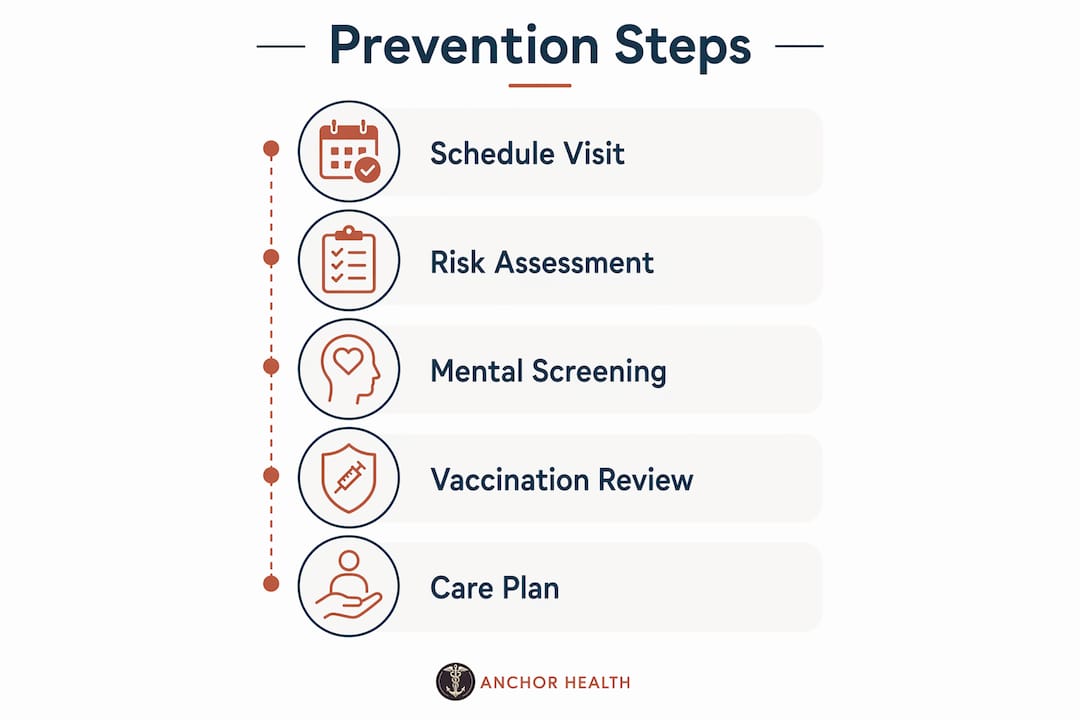
Pro Tip: Ask your primary care provider to complete a written prevention plan at your next visit. A documented goal, even a simple one like “30 minutes of walking five days a week,” is measurably more effective than a verbal reminder.
2. How the transition from pediatric to adult care shapes your long-term health
Turning 18 is not just a legal milestone. It is a healthcare inflection point that most young adults are not prepared for. The shift from pediatric to adult primary care requires more than finding a new doctor; it demands learning to manage insurance, interpret your own health records, and advocate for yourself in appointments.
The data on what happens during this transition is sobering. Young adults who visited their adult primary care provider within 18 months of leaving pediatrics were significantly more likely to complete every major preventive screening. Mental health screening rates doubled. Completion rates for alcohol, exercise, and tobacco screenings all reached into the 90th percentile. Yet only 46% of newly adult patients actually met with their assigned provider during that window.
Certain groups face steeper barriers. Males were 16% less likely to visit a primary care provider during the transition period. Young adults living in more deprived neighborhoods were 15% less likely. Those requiring an interpreter were 55% less likely. These disparities translate directly into missed screenings and delayed detection of conditions that are far easier to address early.
Key screenings and counseling topics for young adults navigating this transition include:
- Alcohol and substance use assessment using validated tools like the NIDA Quick Screen
- Mental health and depression screening
- Tobacco cessation counseling
- Physical activity and nutrition guidance
- Reproductive and sexual health screening
- Chronic condition self-management education
- Insurance navigation and healthcare literacy support
The transition from pediatric to adult care is also a critical window for cardiovascular health, as the American Heart Association emphasizes. Collaborative practices jointly staffed by pediatric and adult clinicians ease this handoff and reduce the gap in preventive care that so often opens up between ages 18 and 22.
3. How primary care quality directly affects your chronic disease outcomes
Not all primary care is equal. The quality of the practice, and the continuity of your relationship with a specific clinician, measurably changes your health trajectory if you develop a chronic condition.
Higher continuity in primary care is associated with fewer avoidable hospitalizations and lower costs. For every 10% increase in continuity scores, patients with chronic disease had a 3–4% lower likelihood of hospitalization. Costs decreased by nearly 15% for every 10% improvement in continuity. These are not marginal gains; they represent real reductions in suffering and financial burden.
High-quality chronic care in primary care settings depends on several interconnected components:
- Medication management and regular review for appropriateness and interactions
- Patient education on self-monitoring and symptom recognition
- Care coordination across specialists and labs
- Proactive outreach between visits, not just reactive appointments
- Integration of care guides and health coaches for behavioral support
- Telehealth access for routine follow-ups, medication management, and counseling
Primary care physicians increasingly lead team-based care for complex patients, using group visits, care guides, and telehealth to extend their reach. Group visits, in particular, show clinically meaningful improvements in medical, psychological, and behavioral outcomes for patients managing chronic conditions.
4. The Anchored Care℠ᴵᴾ model: relationship-based prevention for young adults
Myanchorhealthpc operates on a model called Anchored Care℠ᴵᴾ, built around the principle that a continuous, trusted relationship between patient and provider is the most effective chronic disease prevention tool available. Rather than treating each visit as a standalone encounter, Anchored Care℠ᴵᴾ treats every interaction as part of a longer conversation about your health.
For young adults, this means your provider knows your baseline. They notice when your blood pressure trends upward over two years, not just when it crosses a threshold at a single visit. They remember that you mentioned stress at work last spring, and they connect that to the sleep issues you raise today.
Myanchorhealthpc’s services relevant to young adult chronic prevention include:
- Comprehensive primary care via secure video visits, available throughout Maryland
- Mental and emotional health support integrated into primary care
- Weight and metabolic health management, including GLP-1 medication support
- Personalized prevention planning aligned with evidence-based guidelines
- Insurance-accepted visits plus membership options for enhanced access
- Ongoing patient education and self-management support between appointments
Pro Tip: If you are between 18 and 25 and have not established care with an adult primary care provider, the preventive care guide for ages 18–25 from Myanchorhealthpc outlines exactly which screenings and visits to prioritize in your first year of adult care.
The Anchored Care℠ᴵᴾ approach also addresses social determinants of health directly. Providers ask about housing, food security, and insurance status because these factors shape whether prevention recommendations are actually achievable for each patient.
5. Vaccinations your primary care provider should be tracking for you
Immunizations do not stop at childhood. Primary care is the right place to keep your vaccine schedule current through your 20s and beyond, and many young adults have gaps they are not aware of.
Vaccines recommended for young adults through primary care include:
- Influenza: annually for all adults
- Tdap/Td: one Tdap dose if not received as an adolescent, then Td booster every 10 years
- HPV: recommended through age 26 for all adults not previously vaccinated; shared decision-making for ages 27–45
- COVID-19: updated formulations per current CDC guidance
- Meningococcal (MenACWY and MenB): particularly for college students and those in communal living
- Hepatitis B: for adults not previously vaccinated or without documented immunity
- Varicella: two doses for adults without evidence of immunity
Your primary care provider reviews your immunization history at wellness visits and flags any gaps. This is one of the clearest examples of preventive care for young adults that requires a consistent provider relationship to execute reliably.
6. Supporting medication adherence in young adults with chronic conditions
Young adults with chronic conditions, whether that is asthma, type 1 diabetes, hypertension, or a mental health diagnosis, face a specific challenge: they are newly responsible for managing treatment that was previously supervised by parents and pediatric teams. Adherence tends to drop sharply during this transition.
Primary care addresses this through several practical strategies:
- Simplified regimens: providers review medication lists and reduce complexity where possible, since fewer daily steps mean fewer missed doses
- Motivational interviewing: the same technique used in BETTER visits helps patients connect their medication routine to goals they actually care about
- Digital reminders and mHealth tools: eHealth and mHealth interventions improve self-management in young adults with chronic disease by delivering reminders, education, and peer connection through platforms they already use
- Regular medication reviews: primary care catches interactions, outdated doses, and side effects that drive people to quietly stop taking a medication
- Care coordination: when a specialist prescribes something new, your primary care provider reconciles it against your full medication list
- Patient education: understanding why a medication matters, not just that it was prescribed, is one of the strongest predictors of long-term adherence
The patient-centered medical home model supports adherence by keeping all of this coordination in one place, with one trusted provider who knows your full picture.
Myanchorhealthpc’s Anchored Care℠ᴵᴾ model is designed for exactly this kind of ongoing, relationship-based support. If you are a young adult in Maryland ready to establish consistent primary care, telehealth primary care through Myanchorhealthpc makes it possible to get comprehensive, preventive-focused care from home, without the barriers of long wait times or fragmented appointments.

Key Takeaways
Primary care is a highly effective tool young adults have for preventing chronic disease, with those who maintain a consistent provider receiving significantly more preventive services compared to those without one.
| Point | Details |
|---|---|
| Preventive service gap | Adults with primary care received preventive services at 95.5% vs. 67.6% for those without a usual source. |
| Hospitalization reduction | Having a usual source of primary care lowered hospitalization odds by 20% and emergency visits by 11%. |
| Continuity and cost | Every 10% increase in continuity scores reduced healthcare costs by nearly 15% for patients with chronic disease. |
| Transition window matters | Young adults who visited their adult PCP after leaving pediatrics doubled their mental health screening rates, while completion rates for alcohol, exercise, and tobacco screenings exceeded 90%. |
| BETTER approach results | The BETTER model improved chronic disease prevention and screening uptake by 32.5% in urban primary care settings. |
Recommended
- Young Adult Preventive Health Checklist: 2026 Guide
- Preventive Care for Ages 18–25: Your 2026 Guide
- The Role of Family Doctor in Preventive Care
- Primary Care’s Role in Chronic Disease Management
Blog & Information Disclaimer
Last Updated: May 23, 2026
The information provided on the Anchor Health website (https://myanchorhealthpc.com/), including but not limited to blog posts, articles, newsletters, graphics, and other materials (collectively, the "Content"), is for general informational and educational purposes only.
By accessing and using this website, you acknowledge and agree to the following terms and conditions:
The Content on this website is not intended to be a substitute for professional medical advice, diagnosis, or treatment. Always seek the advice of your physician, nurse practitioner, or other qualified health provider with any questions you may have regarding a medical condition. Never disregard professional medical advice or delay in seeking it because of something you have read on this website.
Reading, interacting with, or sharing the Content on this website does not establish a patient-provider relationship between you and Anchor Health or any of its clinicians, including Paule Valery Joseph, PhD, MBA, CRNP, FAAN. A formal patient-provider relationship is only established after you have completed the formal intake process, signed our clinical consent forms, and participated in a secure clinical consultation.
If you are experiencing a medical emergency, call 911 or seek emergency medical services immediately.
Anchor Health is a primary care practice and does not provide emergency or crisis intervention services through its website or blog.
While Anchor Health strives to provide thoughtful, evidence-based information grounded in our Anchored Care℠ model, healthcare is a rapidly evolving field. We make no representations or warranties, express or implied, about the completeness, accuracy, reliability, or suitability of the information contained in the Content. Any reliance you place on such information is strictly at your own risk.
Anchor Health is a telehealth practice providing services to patients physically located within the state of Maryland. The information provided on this blog is intended for residents of Maryland and is governed by the laws and regulations of that state. Accessing this information from outside of Maryland does not imply that our clinicians are licensed to practice medicine or provide consultations in your jurisdiction.
Content related to Weight & Metabolic Health, including discussions of GLP-1 medications or other medical therapies, is provided for educational context regarding our clinical approach. Prescriptions and specific medical recommendations are only made following a comprehensive clinical evaluation, diagnostic testing, and shared decision-making within a formal patient-provider relationship.
This website may contain links to external websites that are not provided or maintained by or in any way affiliated with Anchor Health. Please note that Anchor Health does not guarantee the accuracy, relevance, timeliness, or completeness of any information on these external websites.
To the fullest extent permitted by law, Anchor Health, its owners, and its employees shall not be liable for any direct, indirect, incidental, consequential, or punitive damag
Related posts