UTI Telehealth Treatment: What to Expect and When It Works

Yes, telehealth can safely diagnose and treat most uncomplicated urinary tract infections, provided a clinician screens out the cases that need hands-on care first. If your symptoms are classic (burning, urgency, frequent trips to the bathroom) and you’re otherwise healthy, a same-day video visit can get you an accurate assessment and, often, a prescription within the hour.
That said, telehealth isn’t the right path for everyone. Your visit should be redirected to in-person care if you’re:
- Pregnant
- Running a fever or feeling chills
- Experiencing flank or back pain (a possible sign of kidney involvement)
- Living with a catheter
- Immunosuppressed or managing a condition that weakens your immune response
If any of those apply, skip the video visit and seek urgent or in-person evaluation right away. If they don’t, booking a same-day telehealth visit with a primary care provider like Myanchorhealthpc is a reasonable, well-supported first move.
Key Takeaways
Telehealth safely treats most uncomplicated UTIs when clinicians apply structured triage to rule out fever, pregnancy, and other red flags first.
| Point | Details |
|---|---|
| Telehealth works for uncomplicated cases | Classic cystitis symptoms in nonpregnant, otherwise healthy adults are well suited to virtual care. |
| Red flags require in-person care | Fever, flank pain, pregnancy, or catheter use mean you should seek urgent or in-person evaluation. |
| Relief typically starts in 24 to 48 hours | Most patients feel improvement within two days of starting the correct antibiotic. |
| Costs stay predictable | Insurance co-pays and low-cost generic antibiotics generally keep expenses below an urgent care visit. |
| Myanchorhealthpc offers continuity | Same-day video visits paired with an ongoing clinician relationship help manage recurrent UTIs, not just single episodes. |
Table of Contents
- Who Is a Good Candidate for UTI Telehealth Treatment?
- What Happens During an Online UTI Consultation?
- What Antibiotics Treat UTIs, and How Fast Do Symptoms Improve?
- When Should You Skip Telehealth and Seek In-Person Care?
- How Much Does UTI Telehealth Treatment Cost?
- How to Prepare for a Telehealth UTI Visit With Anchor Health
- Why Continuity Beats a One-Off Prescription
- Book Same-Day UTI Care With Myanchorhealthpc
- Authoritative Clinical and Patient Resources
- Sources
Who Is a Good Candidate for UTI Telehealth Treatment?
Telehealth works best for adults with textbook cystitis symptoms: burning with urination, frequent urges, cloudy or strong-smelling urine, and pelvic pressure, without fever or back pain. If you’re nonpregnant, generally healthy, and this isn’t your first rodeo with a UTI, you’re likely a strong candidate for remote care.
Some groups typically need an in-person look instead:
- Pregnant patients, since untreated or under-treated UTIs carry higher risk during pregnancy, and the American College of Obstetricians and Gynecologists recommends in-person evaluation for this group
- Men experiencing a first-time UTI, which is less common and warrants a closer look at underlying causes
- Anyone with a recent urologic procedure or catheter
- Patients with significant comorbidities, like poorly controlled diabetes or kidney disease
Clinicians lean on structured decision tools, including the Ann Arbor Guide developed with RAND and UCLA researchers, to sort candidates quickly and consistently rather than relying on gut instinct alone.
What Happens During an Online UTI Consultation?
A telehealth UTI visit moves fast, but it follows a consistent sequence:
- You fill out an intake form covering symptom onset, prior UTIs, allergies, current medications, and pregnancy status before the call even starts.
- A clinician reviews your history live, asking follow-up questions about pain location, fever, and anything that might point to a complication.
- You get a decision, which usually lands in one of three places: an empiric prescription based on your symptoms, a request for urine testing at a local lab, or a referral to in-person care if something doesn’t fit the uncomplicated pattern.
- If a prescription is appropriate, it’s sent electronically to your pharmacy, often within the same visit.
Most patients pick up medication within an hour or two of finishing the call, sometimes sooner if the pharmacy is nearby. The entire visit, from intake to e-prescription, frequently wraps up in under 30 minutes for straightforward cases, which is part of why virtual UTI care has become such a popular alternative to a same-day urgent care trip.
What Antibiotics Treat UTIs, and How Fast Do Symptoms Improve?
Telehealth clinicians typically follow the same first-line antibiotic guidance used in any outpatient setting. The most commonly prescribed options for uncomplicated cystitis include:
- Nitrofurantoin, taken for five days, a go-to choice with low resistance rates in most regions
- Trimethoprim-sulfamethoxazole (TMP-SMX), a short three-day course where local resistance patterns allow it
- Fosfomycin, a single-dose option that’s convenient but slightly less effective against some bacteria
- Cephalexin, sometimes used for patients with sulfa allergies or specific resistance concerns
Beyond antibiotics, over-the-counter phenazopyridine (sold as AZO) can ease burning and urgency while the antibiotic takes effect, and steady fluid intake helps flush the urinary tract. Culture-based testing usually comes into play for recurrent infections or when you’ve taken antibiotics recently, since resistance is more likely in those cases.
Symptom relief typically starts within 24 to 48 hours of starting the right antibiotic. If you’re not noticing improvement by day three, that’s your cue to follow up rather than wait it out.
When Should You Skip Telehealth and Seek In-Person Care?
Some symptoms mean a video visit isn’t enough, and waiting on one could delay care you need right away. Seek urgent or in-person evaluation if you notice:
- Fever, chills, or night sweats
- Flank or lower back pain, which can signal the infection has reached your kidneys
- Nausea or vomiting that keeps you from staying hydrated or keeping medication down
- Lightheadedness, rapid heartbeat, or confusion, which can point to a more serious systemic infection
- Inability to urinate at all
Pregnancy, an indwelling catheter, a recent urologic surgery, or an immune system weakened by medication or illness are all reasons your clinician will likely steer you toward in-person testing rather than an empiric prescription, as explained in urinary incontinence treatment in Dallas, TX, since a study on telehealth outcomes by age found that adults 65 and older face a somewhat higher rate of treatment failure and benefit from closer follow-up regardless of symptom severity.
Pro Tip: If you’re not sure whether your symptoms cross into red-flag territory, describe them in as much detail as possible when you request your visit. A clinician can often tell within a few questions whether telehealth is appropriate or whether you need to head to urgent care instead.

How Much Does UTI Telehealth Treatment Cost?
Pricing depends heavily on whether you’re using insurance or paying out of pocket. Insured patients typically pay a standard co-pay for a telehealth visit, similar to what they’d pay for an in-person primary care appointment. Self-pay visits generally run in a modest, predictable range that’s usually lower than an urgent care or emergency room bill for the same complaint.
- Generic antibiotics like nitrofurantoin or TMP-SMX are inexpensive at most pharmacies, and coupon tools or HSA/FSA funds can bring the cost down further.
- E-prescriptions usually reach your pharmacy within minutes of your visit ending, though pickup timing depends on your pharmacy’s own queue.
- Some states have specific rules about whether a live video visit is required versus asynchronous forms, so what your visit looks like can vary slightly depending on where you live.
How to Prepare for a Telehealth UTI Visit With Anchor Health
A little prep work speeds up your visit and helps your clinician make a confident, safe call. Before you log on, gather:
- When your symptoms started and how they’ve changed
- Whether you’ve had UTIs before and how they were treated
- Any drug allergies, especially to sulfa drugs or penicillin
- Your pregnancy status, if relevant
- Current medications and supplements
- Results from any recent urine tests, if you have them
Describing your symptoms clearly, burning versus pressure, constant versus intermittent, with or without back pain, helps your clinician apply triage frameworks efficiently instead of guessing.
Continuity matters here. At Myanchorhealthpc, care doesn’t end when your prescription is sent. Our Anchored Care℠ᴵᴾ model means the same clinician who treats your UTI today can also track patterns if infections keep coming back, something an episodic urgent-care visit simply isn’t built to do.
Same-day scheduling with a board-certified MD or NP is standard here, and we can walk you through what to gather before your first visit so nothing slows down your appointment.
Why Continuity Beats a One-Off Prescription
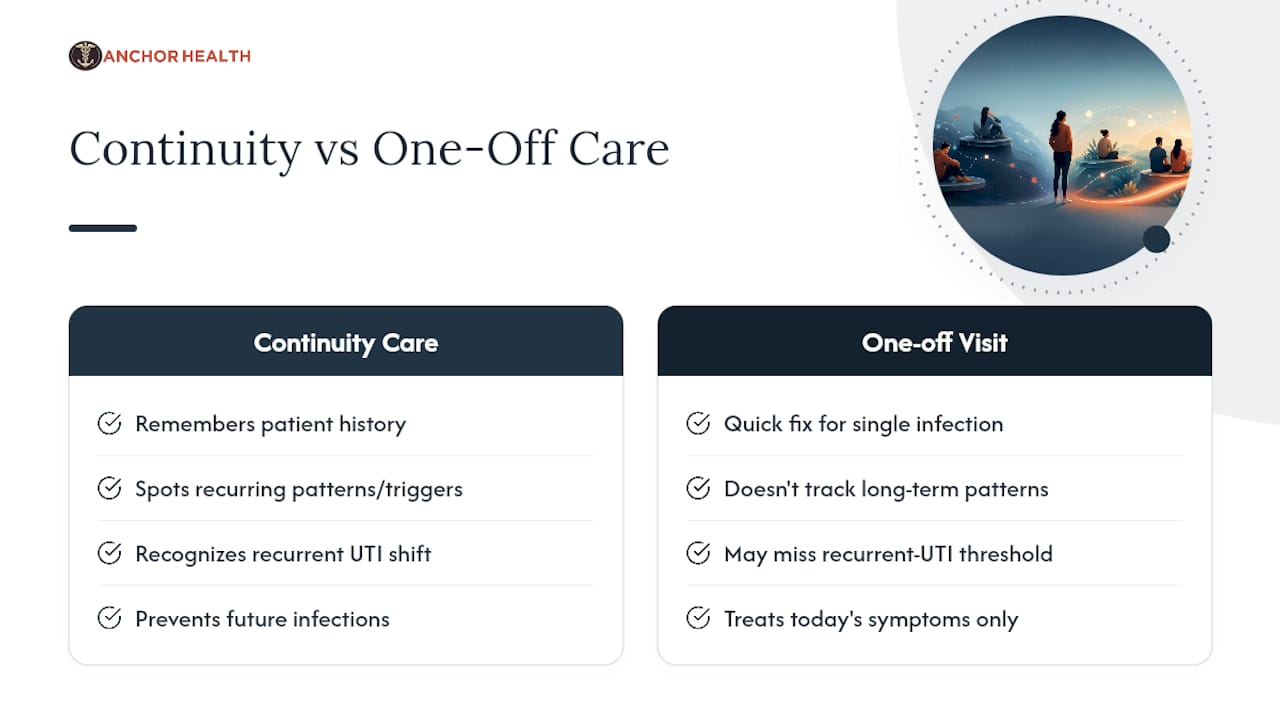
Most people book a UTI visit hoping for a quick fix, and often that’s exactly what they get. But UTIs that keep coming back deserve a provider who remembers your history instead of starting from zero each time.
Episodic urgent-care telehealth is fine for a single, uncomplicated infection. It’s less useful for spotting patterns, recurring triggers, or the point where “occasional UTI” becomes “recurrent UTI requiring a different approach.” Relationship-based primary care catches that shift. It’s also, frankly, the more interesting clinical work: fixing today’s infection is easy, preventing next month’s is where the real value sits.
— Paule
Book Same-Day UTI Care With Myanchorhealthpc
Myanchorhealthpc is the option for readers who want more than a one-time prescription. We combine same-day video visits with an ongoing primary care relationship, so the clinician who treats your UTI today already knows your history if symptoms return next season.

Booking is straightforward: request an appointment, complete a short intake covering your symptoms and history, and connect with a board-certified MD or NP the same day in most cases. We accept insurance, self-pay, and HSA/FSA funds, and our optional membership tier adds longer visits and structured follow-up for anyone managing recurrent infections or broader health needs. If you want to see how continuity-first telehealth fits into everyday primary care, start with our guide to choosing telehealth primary care for your family and book your visit when you’re ready.
Authoritative Clinical and Patient Resources
- Ann Arbor Guide to Triaging Adults With Suspected UTI — JAMA Network Open
- Bladder infection (UTI) in adults — NIDDK
- Urinary tract infection — Mayo Clinic
- Urinary tract infections — ACOG FAQs
This article is general information, not a substitute for advice from a qualified doctor. Consult a qualified healthcare professional about your own circumstances before acting on anything here.
Sources
- Ann Arbor Guide to Triaging Adults With Suspected Urinary Tract Infection for In-Person and Telehealth Settings | JAMA Network Open
- Bladder infection (urinary tract infection) in adults — NIDDK
- Urinary tract infection (UTI) — Mayo Clinic
- ACOG: Urinary tract infections — FAQs
Recommended
- How to Communicate Care Needs to Your Telehealth Provider
- Same-Day Telehealth Availability: What It Means for You
Blog & Information Disclaimer
Last Updated: May 23, 2026
The information provided on the Anchor Health website (https://myanchorhealthpc.com/), including but not limited to blog posts, articles, newsletters, graphics, and other materials (collectively, the "Content"), is for general informational and educational purposes only.
By accessing and using this website, you acknowledge and agree to the following terms and conditions:
The Content on this website is not intended to be a substitute for professional medical advice, diagnosis, or treatment. Always seek the advice of your physician, nurse practitioner, or other qualified health provider with any questions you may have regarding a medical condition. Never disregard professional medical advice or delay in seeking it because of something you have read on this website.
Reading, interacting with, or sharing the Content on this website does not establish a patient-provider relationship between you and Anchor Health or any of its clinicians, including Paule Valery Joseph, PhD, MBA, CRNP, FAAN. A formal patient-provider relationship is only established after you have completed the formal intake process, signed our clinical consent forms, and participated in a secure clinical consultation.
If you are experiencing a medical emergency, call 911 or seek emergency medical services immediately.
Anchor Health is a primary care practice and does not provide emergency or crisis intervention services through its website or blog.
While Anchor Health strives to provide thoughtful, evidence-based information grounded in our Anchored Care℠ model, healthcare is a rapidly evolving field. We make no representations or warranties, express or implied, about the completeness, accuracy, reliability, or suitability of the information contained in the Content. Any reliance you place on such information is strictly at your own risk.
Anchor Health is a telehealth practice providing services to patients physically located within the state of Maryland. The information provided on this blog is intended for residents of Maryland and is governed by the laws and regulations of that state. Accessing this information from outside of Maryland does not imply that our clinicians are licensed to practice medicine or provide consultations in your jurisdiction.
Content related to Weight & Metabolic Health, including discussions of GLP-1 medications or other medical therapies, is provided for educational context regarding our clinical approach. Prescriptions and specific medical recommendations are only made following a comprehensive clinical evaluation, diagnostic testing, and shared decision-making within a formal patient-provider relationship.
This website may contain links to external websites that are not provided or maintained by or in any way affiliated with Anchor Health. Please note that Anchor Health does not guarantee the accuracy, relevance, timeliness, or completeness of any information on these external websites.
To the fullest extent permitted by law, Anchor Health, its owners, and its employees shall not be liable for any direct, indirect, incidental, consequential, or punitive damag
Related posts