Two Visit ADHD Evaluation in Primary Care: Clinic Ready Workflow

Primary care clinicians can evaluate, and often diagnose, ADHD using DSM-5 criteria, validated screening tools, and a structured, multi-visit approach. Start with a pre-visit symptom questionnaire and line up an informant, a parent, partner, or former teacher, before the first appointment. Reserve specialist referral for cases involving severe impairment, suspected psychosis, or treatment resistance.
TL;DR:
- Accurate ADHD diagnosis in primary care requires a multi-visit approach with structured history, validated rating scales, and collateral reports from trusted informants.
- Use pre-visit questionnaires like the ASRS or Vanderbilt scales and collect detailed symptom timelines before seeing the patient to ensure quality data.
- Confirmed impairment must be documented across at least two settings, with childhood onset symptoms before age 12 as a key diagnostic criterion.
- Screen for common conditions like anxiety, depression, sleep disorders, and substance use, prioritizing treatment of comorbidities before or alongside ADHD management.
- Reserve specialist referral for severe impairment, treatment resistance, or complex psychiatric or substance use issues, while primary care manages most cases with support and structured protocols.
Table of Contents
- What Does an ADHD Evaluation in Primary Care Involve?
- How Do You Evaluate ADHD Across Two Visits?
- Which Screening Tools Work Best in Primary Care?
- What Conditions Mimic or Coexist With ADHD?
- What Physical Exam and Labs Are Actually Necessary?
- What Should You Document, and How Do You Prescribe Safely?
- When Should You Refer to Specialty Care?
- How Does Telehealth Fit Into the Evaluation Process?
- How Anchor Health Applies This Workflow
- Primary Care’s Real Role in ADHD Diagnosis
- Ready to Start Your ADHD Evaluation With Anchor Health?
- Where to Read More
- Sources
What Does an ADHD Evaluation in Primary Care Involve?
An ADHD evaluation in primary care is not a single conversation. It is a planned sequence of visits built around structured history, validated rating scales, and outside confirmation of symptoms. That structure matters because ADHD has no blood test, no imaging marker, and no biological signature a clinician can point to on a screen. The AAFP’s adult ADHD toolkit confirms that family physicians are well positioned to manage most cases, reserving specialty referral for the presentations that need more than a primary care visit can offer.
Getting this right starts with the paperwork patients fill out before they ever sit down with you.
Pre-visit packet: what to send patients
Send these documents at scheduling, not at check-in. A patient who fills out forms in the waiting room five minutes before their appointment gives you rushed, low-quality data.
- The Adult ADHD Self-Report Scale (ASRS v1.1) for adult patients, or the Vanderbilt Assessment Scale (parent and teacher versions) for children and adolescents.
- A one-page symptom timeline template asking when attention or hyperactivity problems first appeared, in what settings, and how they changed over time.
- A brief substance and medication use questionnaire, including caffeine, nicotine, cannabis, and any stimulant medications obtained outside your practice.
- A short sleep inventory covering typical bedtime, wake time, snoring, and daytime fatigue.
Who to invite, what records to pull
Tell the patient directly: bring someone who knew you as a child, or knows you well now. For a child evaluation, that means asking the school for report cards or a teacher rating form. For an adult, it often means a parent, an older sibling, or a spouse who can speak to patterns going back years. Workplace performance reviews can substitute when parents are unavailable or family history is fraught.
Red flags that change the visit
A handful of findings mean you pause the standard ADHD workup and address safety first:
- Suicidal ideation or a recent self-harm episode.
- Any sign of psychosis, hallucinations, disorganized speech, paranoia.
- Active substance withdrawal or evidence of ongoing misuse severe enough to explain the attention symptoms alone.
- Sudden, severe functional decline that looks more like an acute psychiatric crisis than a longstanding attention problem.
Pro Tip: Ask the patient to rate their top three impairments in their own words before you hand them a screening tool. Patients who say “I can’t finish anything at work” give you more diagnostic texture than a checklist score alone ever will.
How Do You Evaluate ADHD Across Two Visits?
A single 20-minute appointment cannot reliably establish an ADHD diagnosis. The AAFP notes that diagnostic accuracy improves when clinicians build in a planned, multi-visit sequence instead of trying to reach a determination in one sitting. Splitting the work across two visits also spreads the documentation burden and gives you time to collect collateral reports that patients cannot produce on demand.
Visit one: history, screening, baseline
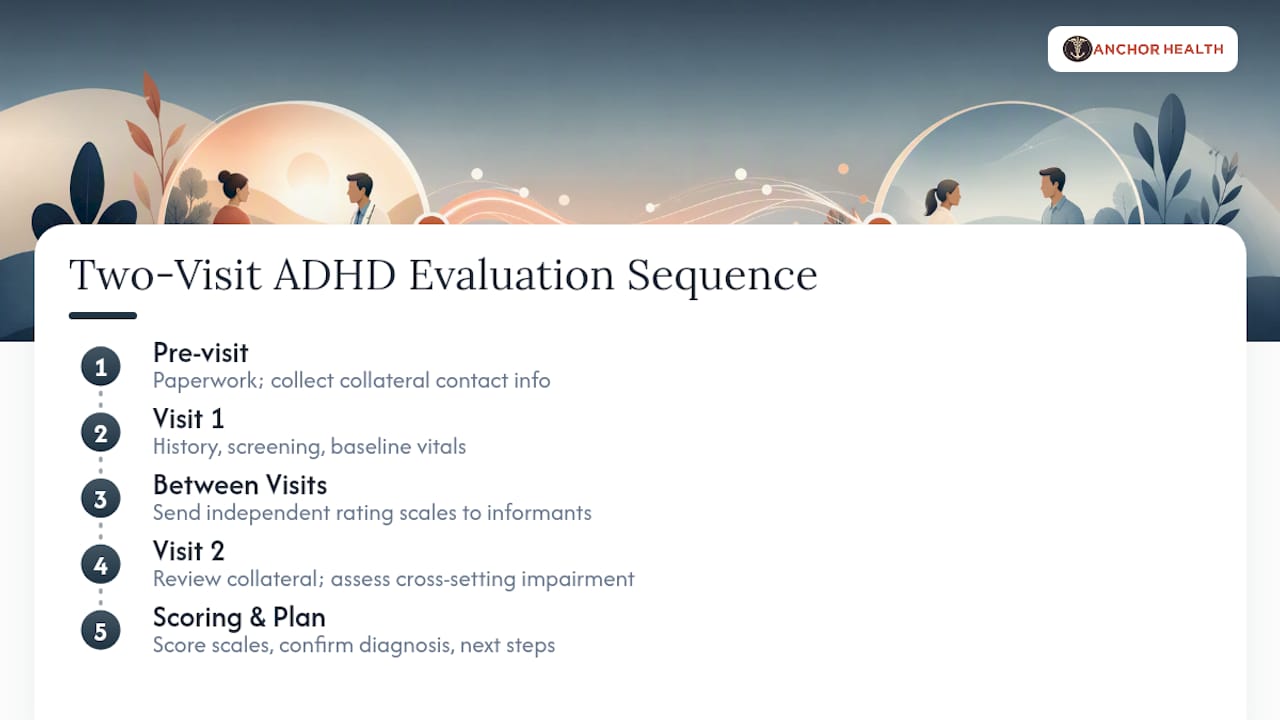
The first visit is about gathering raw material, not reaching a verdict. Take a targeted history: when did attention or hyperactivity symptoms start, how do they show up at work, school, and home, and what has the patient already tried. Screen for medical causes and medication effects, review caffeine and substance use, and check whether any current prescriptions (like certain antihistamines or asthma medications) could be contributing to the picture. Get baseline vitals, blood pressure and heart rate, before you get anywhere near a stimulant conversation.
Send the patient home with the standardized rating scale if it was not completed beforehand, plus a version for the informant to fill out independently.
Visit two: collateral, cross-setting impairment, scoring
The second visit is where the diagnosis actually takes shape. Review the collateral report side by side with the patient’s own self-report. Discrepancies are common and informative. A patient may rate their own inattention as mild while a spouse describes years of missed bills and forgotten appointments.
DSM-5 requires impairment in more than one setting, work and home, or school and home, not just a single context. The AAP guideline directs pediatricians to initiate evaluation in children ages 4 to 18 presenting with academic or behavioral concerns, and to explicitly document symptoms appearing in more than one setting before diagnosing. Adults face the same cross-setting requirement, along with a threshold of five inattentive or hyperactive-impulsive symptoms (versus six for children under 17).
The trickiest documentation task is establishing childhood onset. DSM-5 requires several symptoms present before age 12, and most adults are terrible at recalling their own grade-school behavior with any precision.
Adults often cannot reliably recall childhood symptoms with accuracy. Pragmatic workarounds include pulling old school records, interviewing parents directly, or using early job performance reviews as a proxy for undiagnosed attention problems that surfaced once academic support structures disappeared, according to the AAFP toolkit.
Some adults compensated so well through school and early adulthood that impairment only became visible once external structure, a controlling parent, a rigid class schedule, dropped away. High-functioning patients can mask symptoms through elaborate personal systems, which means a normal-looking resume does not rule out ADHD. A targeted collateral interview and a specific functional-impairment conversation, not just a checklist score, are what catch these cases.
A realistic primary care ADHD workup, done properly across both visits, can consume a significant amount of clinician time. That is worth planning into your schedule and coding deliberately, rather than trying to squeeze into a standard follow-up slot.
Which Screening Tools Work Best in Primary Care?
Four instruments cover nearly every primary care scenario, and each serves a different purpose.
- ASRS v1.1 is a six-item screener for adults, quick enough to hand out in the waiting room. A positive screen does not confirm ADHD; it tells you the diagnosis deserves a full workup.
- Vanderbilt Assessment Scales cover children, with separate parent and teacher forms. Send the teacher form directly to school through the parent or a release form rather than relying on the family to relay it, which improves the return rate.
- DIVA (Diagnostic Interview for ADHD in Adults) is a structured clinical interview useful when the self-report and collateral report conflict, or when the diagnosis is genuinely uncertain after the standard two-visit process.
- CAARS (Conners’ Adult ADHD Rating Scales) offers a more detailed symptom and functional profile than the ASRS, useful for tracking treatment response over time as well as initial diagnosis.
Licensing costs and time burden vary. The ASRS and Vanderbilt forms are free and take under ten minutes to complete. DIVA and CAARS require more clinician or staff time to administer and score, and CAARS in particular carries a per-use licensing fee through its publisher. Many electronic health record systems now support direct upload of ASRS and Vanderbilt results into structured fields, which saves you from transcribing scores by hand and keeps the documentation audit-ready if a payer later requests it.
What Conditions Mimic or Coexist With ADHD?
Anxiety, depression, sleep disorders, thyroid disease, and substance use all overlap heavily with ADHD symptoms, and distinguishing them changes your treatment plan entirely. A PMC review on primary care’s role in ADHD found that comorbid psychiatric conditions are common enough that screening for anxiety, depression, learning disorders, and substance use belongs in every evaluation, not just the ambiguous ones.
- Anxiety can produce restlessness and poor concentration that looks like hyperactivity or inattention on a surface read.
- Depression frequently causes concentration problems and low motivation that mimic inattentive-type ADHD, particularly in adults presenting for the first time in their thirties or forties.
- Untreated sleep apnea or chronic sleep deprivation produces daytime inattention and irritability nearly indistinguishable from ADHD on a symptom checklist alone.
- Thyroid dysfunction, especially hypothyroidism, can slow processing speed and attention in ways patients describe using the same language as ADHD.
- Substance use, particularly cannabis and stimulant misuse, both mimics and masks ADHD symptoms depending on timing and dose.
The sequencing question matters: treat comorbidity first, treat ADHD first, or treat both concurrently? As a general approach, address active substance use and significant untreated depression or anxiety before or alongside ADHD treatment, since stimulant medication can worsen anxiety symptoms or interact poorly with substance use patterns. A brief add-on screener, the GAD-7 for anxiety or the PHQ-9 for depression, takes under two minutes and catches most of what would otherwise slip through.
Pro Tip: When a patient’s history includes both new-onset anxiety and new-onset attention complaints, ask which came first. ADHD symptoms with a clear childhood pattern that anxiety later compounded point toward one treatment path; anxiety that predates any attention complaint points toward another.
What Physical Exam and Labs Are Actually Necessary?
ADHD is a clinical diagnosis. The CDC’s clinical care guidance states plainly that validated rating scales assist the process, but no routine lab test, EEG, or neuroimaging study is required to make the diagnosis. Overtesting wastes the patient’s time and money without adding diagnostic value.
A focused exam still matters:
- Blood pressure and heart rate at baseline, especially before any stimulant conversation.
- Growth parameters (height and weight, plotted on a growth chart) for children, since stimulants can affect appetite and growth trajectory over time.
- A brief neurologic screen to rule out tics, tremor, or other findings that might suggest an alternate diagnosis.
- Visible signs of substance use or withdrawal.
Check thyroid function tests when the history suggests fatigue, weight change, or cognitive slowing beyond what typical ADHD symptoms would explain. Refer for a sleep study when snoring, witnessed apneas, or unexplained daytime sleepiness raises concern for obstructive sleep apnea. An AHRQ evidence review found insufficient evidence to support routine EEG or neuroimaging for ADHD diagnosis. Adjunct tools built around EEG data exist commercially, but they function as complements to clinical judgment in select, specialist-led evaluations, not as stand-alone diagnostic tests for a primary care visit.
What Should You Document, and How Do You Prescribe Safely?
Payers and malpractice reviewers both want to see the same thing: a clear paper trail showing how you reached the diagnosis, not just the diagnosis itself.
Chart these elements at minimum:
- Specific symptom count with concrete examples, not just “meets criteria for ADHD.”
- The settings where impairment appears, work, home, school, and evidence it occurs in more than one.
- The corroborating source used (parent, partner, teacher) and what that source reported.
- A functional impact statement describing how symptoms affect daily life, job performance, or academic standing.
Before prescribing a stimulant, run through a baseline safety check: current weight, blood pressure, heart rate, personal or family cardiac history, and a substance use screen. Document that you discussed risks and benefits, including diversion risk, with the patient directly.
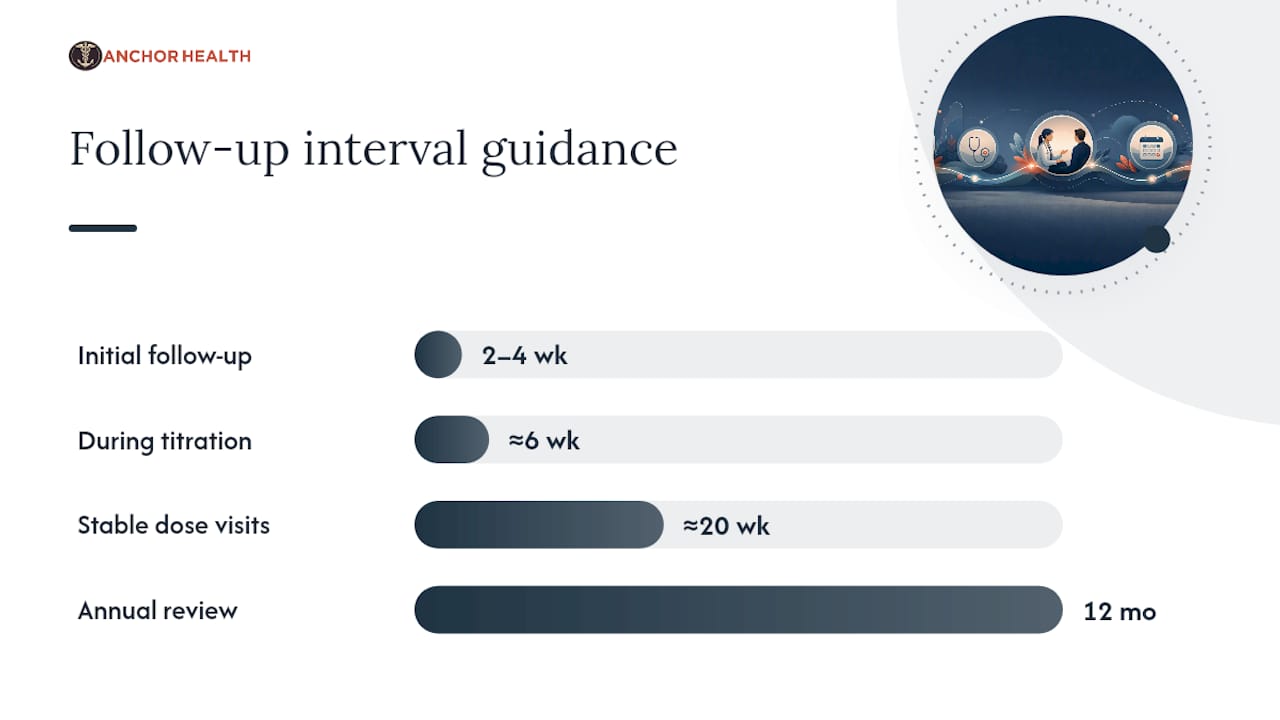
- Schedule a follow-up visit within two to four weeks of any dose change to assess response and side effects.
- Continue monthly or bimonthly visits during active titration.
- Move to quarterly or twice-yearly visits once the dose is stable and working.
- Complete an annual review covering growth (in children), cardiovascular status, and continued medical necessity.
Diversion risk mitigation is a real part of safe prescribing, not an afterthought. Use your state’s prescription drug monitoring program before initiating a controlled substance, write for the smallest reasonable supply during titration, and document your rationale when a patient requests early refills.
When Should You Refer to Specialty Care?
Refer when the picture goes beyond what a structured primary care evaluation can safely manage. Clear triggers include:
- Severe functional impairment that has not responded to a reasonable initial treatment trial.
- Suicidality or any indication of psychosis.
- Treatment resistance after adequate trials of first-line medications.
- Complex psychiatric comorbidity, particularly bipolar disorder or a personality disorder that complicates the diagnostic picture.
- Suspected substance use disorder requiring specialized treatment beyond a brief office intervention.
Send along the completed rating scales, a summary of treatments already tried and their outcomes, a full medication list, and relevant medical history. This spares the specialist from repeating your groundwork and gets the patient a faster, more focused specialist visit. A PMC review on shared-care models recommends primary care and mental health specialists build explicit protocols distinguishing who handles initiation and titration versus who manages routine long-term monitoring, which keeps capacity from bottlenecking at the specialist level. In many shared-care arrangements, a psychiatrist or psychologist initiates treatment for a complex case, then hands routine prescribing and monitoring back to primary care once the patient stabilizes. If you’re unsure whether a case needs a psychologist or a psychiatrist, this comparison of the two roles breaks down what each one actually does.
How Does Telehealth Fit Into the Evaluation Process?
A workable pathway looks like this: pre-visit screening forms go out first, then an extended history-taking visit (telehealth or in-person), followed by collateral collection, and finally medication initiation with a structured follow-up calendar.
- Send pre-visit forms electronically at scheduling.
- Conduct the extended history visit, telehealth works well here since it removes travel time that often shortens in-person slots.
- Collect collateral reports, teacher forms via secure upload, partner or parent interviews by phone or video.
- Review all data together, confirm the diagnosis, and start treatment with a clear follow-up schedule.
Telehealth actually simplifies collateral gathering in some respects. A working parent who could never leave the office for an in-person teacher conference can join a scheduled video call for ten minutes. Document the interview date, participant, and key points just as you would an in-person collateral conversation.
Longer ADHD evaluation visits typically warrant time-based billing codes rather than a standard problem-focused visit code. Check your payer’s specific requirements, since documentation standards for time-based coding differ from complexity-based coding.
Pro Tip: Block telehealth ADHD evaluation slots as 40 to 50 minute appointments in your scheduling system from the start. Trying to force this workup into a standard 20-minute slot is the single most common reason these evaluations drag across too many visits.
How Anchor Health Applies This Workflow
Myanchorhealthpc built its Anchored Care℠ᴵᴾ model around the kind of unhurried, continuity-focused visit that an ADHD evaluation actually requires. Longer telehealth appointments give clinicians room to run a full structured history in one sitting and coordinate collateral interviews without rushing a patient out the door for the next appointment.
- Extended visit times built for multi-step evaluations.
- Offers optional membership for patients who want enhanced access and closer follow-up during titration.
- Telehealth convenience for ongoing monitoring visits once a diagnosis and treatment plan are in place.
Author Paule works with Anchor Health’s clinical team and encourages patients in Maryland managing attention concerns to book a consult and start the evaluation process.
Primary Care’s Real Role in ADHD Diagnosis
Primary care is not a lesser substitute for specialty mental health care when it comes to ADHD. It is often the more practical front door, particularly for patients who would otherwise wait months for a psychiatric intake appointment. The evidence backs this: family physicians and pediatricians using a structured, multi-visit process reach accurate diagnoses without needing a subspecialist for every case.
That said, primary care cannot do this work well without support. Clinics need protected time for these longer visits, training on the rating instruments, and a working relationship with local behavioral health specialists for the cases that genuinely need more. Where those supports exist, primary care expands access. Where they don’t, patients fall through the gap between “too complex for a rushed visit” and “not complex enough for a six-month specialist waitlist.” The system needs both pieces working together, not primary care and psychiatry treated as competing options.
— Paule
Ready to Start Your ADHD Evaluation With Anchor Health?
If you’ve been putting off an ADHD evaluation because the alternative looks like a crowded psychiatric waitlist or a rushed fifteen-minute slot at a walk-in clinic, Myanchorhealthpc offers a different starting point: longer telehealth visits built specifically for the kind of structured history-taking and collateral gathering this evaluation actually needs.

Anchor Health accepts insurance, self-pay, and HSA/FSA funds, and offers an optional membership for patients who want extended follow-up access during medication titration. Before your visit, gather any old school records, a list of current medications and supplements, and contact information for a parent, partner, or close friend willing to complete a brief collateral questionnaire. If your evaluation points toward a complex comorbidity or a presentation that needs specialist-level care, Anchor Health will refer you honestly rather than trying to manage something outside its scope. Ready to get started? Learn how telehealth primary care works for your family and book your first visit.
Where to Read More
For deeper clinical detail beyond what fits in a single office visit, a handful of sources are worth bookmarking. The AAFP’s adult ADHD toolkit is the best starting point for adult evaluations, with downloadable forms and workflow guidance built for family medicine settings. The AAP clinical practice guideline is essential for pediatric and adolescent cases, laying out exact diagnostic recommendations. The CDC’s clinical care page offers a concise summary of diagnostic standards. For a fuller evidence synthesis on testing and treatment strategies, the AHRQ comparative effectiveness review is the most thorough resource available, though it’s denser reading suited to clinicians researching a specific evidence question rather than a quick office reference.
This article is general information, not a substitute for advice from a qualified doctor. Consult a qualified healthcare professional about your own circumstances before acting on anything here.
Sources
- Adult ADHD toolkit for family physicians | AAFP
- Diagnosing ADHD | Attention-Deficit / Hyperactivity Disorder (ADHD) | CDC
- Clinical Practice Guideline for the Diagnosis, Evaluation, and Treatment of Attention-Deficit/Hyperactivity Disorder in Children and Adolescents | AAP
- Comparative effectiveness review: diagnosis and treatment evidence for ADHD | AHRQ (NCBI Bookshelf)
Recommended
- Pediatric Annual Checkup Checklist for Parents
- Get Your Child Ready for a Telehealth Well-Child Checkup
- Family Primary Care Best Practices for Every Age
Blog & Information Disclaimer
Last Updated: May 23, 2026
The information provided on the Anchor Health website (https://myanchorhealthpc.com/), including but not limited to blog posts, articles, newsletters, graphics, and other materials (collectively, the "Content"), is for general informational and educational purposes only.
By accessing and using this website, you acknowledge and agree to the following terms and conditions:
The Content on this website is not intended to be a substitute for professional medical advice, diagnosis, or treatment. Always seek the advice of your physician, nurse practitioner, or other qualified health provider with any questions you may have regarding a medical condition. Never disregard professional medical advice or delay in seeking it because of something you have read on this website.
Reading, interacting with, or sharing the Content on this website does not establish a patient-provider relationship between you and Anchor Health or any of its clinicians, including Paule Valery Joseph, PhD, MBA, CRNP, FAAN. A formal patient-provider relationship is only established after you have completed the formal intake process, signed our clinical consent forms, and participated in a secure clinical consultation.
If you are experiencing a medical emergency, call 911 or seek emergency medical services immediately.
Anchor Health is a primary care practice and does not provide emergency or crisis intervention services through its website or blog.
While Anchor Health strives to provide thoughtful, evidence-based information grounded in our Anchored Care℠ model, healthcare is a rapidly evolving field. We make no representations or warranties, express or implied, about the completeness, accuracy, reliability, or suitability of the information contained in the Content. Any reliance you place on such information is strictly at your own risk.
Anchor Health is a telehealth practice providing services to patients physically located within the state of Maryland. The information provided on this blog is intended for residents of Maryland and is governed by the laws and regulations of that state. Accessing this information from outside of Maryland does not imply that our clinicians are licensed to practice medicine or provide consultations in your jurisdiction.
Content related to Weight & Metabolic Health, including discussions of GLP-1 medications or other medical therapies, is provided for educational context regarding our clinical approach. Prescriptions and specific medical recommendations are only made following a comprehensive clinical evaluation, diagnostic testing, and shared decision-making within a formal patient-provider relationship.
This website may contain links to external websites that are not provided or maintained by or in any way affiliated with Anchor Health. Please note that Anchor Health does not guarantee the accuracy, relevance, timeliness, or completeness of any information on these external websites.
To the fullest extent permitted by law, Anchor Health, its owners, and its employees shall not be liable for any direct, indirect, incidental, consequential, or punitive damag
Related posts