See the Same Clinician Every Visit With Virtual Primary Care

Virtual primary care gives you ongoing medical care from a dedicated clinician or care team through secure video visits, built around continuity rather than one-off problem-solving. It covers routine checkups, chronic-condition management, prescription refills, and integrated mental health support. If you want a consistent provider who knows your history without the hassle of frequent office visits, this model fits.
TL;DR:
- Virtual primary care is best suited for patients with stable chronic conditions who need regular check-ins and ongoing relationship continuity.
- Consistent care depends on seeing the same clinician over time, ideally within integrated teams that coordinate follow-ups and referrals.
- Costs vary, with some plans covered fully by insurance or employer programs, while others involve memberships with added features like longer visits or messaging.
- State licensing and HIPAA compliance are strict legal requirements, and only providers licensed in your state can treat you remotely.
- Video visits effectively manage most chronic issues and follow-ups but require in-person care for urgent or physical examination needs.
Table of Contents
- What Does Virtual Primary Care Actually Cover?
- Who Benefits Most From Online Primary Healthcare?
- How Does Anchored Care℠ᴵᴾ Deliver Continuity?
- What Does Virtual Primary Care Cost, and Does Insurance Cover It?
- How Do You Sign Up and What Happens at Your First Visit?
- Is Virtual Primary Care Private and Secure?
- When Should You Choose In-Person or Emergency Care Instead?
- Does Virtual Primary Care Match In-Person Care Quality?
- What Qualifications Do Virtual Primary Care Providers Need?
- What Do Patient Satisfaction and Outcomes Data Show?
- What Legal and Regulatory Rules Apply to Virtual Primary Care?
- Publisher Perspective: Why Continuity Should Be the Deciding Factor
- How to Get Started With Anchor Health
- Selected Sources and Further Reading
What Does Virtual Primary Care Actually Cover?
Virtual primary care handles most of what you’d expect from an in-person practice, just delivered through a screen instead of a waiting room. That distinction matters because it separates this model from virtual urgent care, which treats isolated problems like a sinus infection or a rash and then disappears from your life. Primary care telemedicine is different. It’s meant to be the medical relationship you keep coming back to, year after year.
A typical practice offering virtual primary care covers:
- Annual wellness visits, including screenings and preventive counseling
- Chronic disease management for conditions like diabetes, hypertension, and metabolic issues, with medication adjustments (including GLP-1 medications when clinically appropriate)
- Prescription management and refills, coordinated with your pharmacy
- Behavioral health integration, with referrals for more intensive mental health needs
- Pediatric and adolescent routine care, within the limits of what a video exam allows
Major insurers describe virtual primary care in similar terms: routine checkups, chronic-condition follow-up, refills, and coordinated referrals when a problem needs more than a video visit can offer.
Who Benefits Most From Online Primary Healthcare?
Not everyone needs the same thing from a doctor. Some people want a fast answer to one question. Others want a clinician who remembers their blood pressure trend from six months ago. Virtual primary care tends to serve the second group best, and a few patterns show up again and again:
- Busy professionals who can’t take a half-day off work for a fifteen-minute appointment but still want consistent preventive care.
- Caregivers managing appointments for aging parents or children, where scheduling flexibility determines whether care happens at all.
- Patients with stable chronic conditions (well-controlled diabetes, hypertension, thyroid issues) who need regular check-ins more than hands-on exams.
- Families who want routine pediatric visits without hauling a toddler to a clinic for a growth check or vaccine schedule review.
An annual checkup, a medication refill, or a follow-up after a specialist visit are all reasonable telehealth primary care use cases. A hybrid approach, mixing virtual visits with occasional local in-person care, works best when a patient has a complex condition requiring periodic physical exams or lab draws that can’t be done from home.
How Does Anchored Care℠ᴵᴾ Deliver Continuity?
Most virtual visits succeed or fail on one variable: whether you see the same provider twice. A rotating cast of clinicians who’ve never read your chart isn’t primary care. It’s a series of disconnected transactions.
A virtual primary care model called Anchored Care℠ᴵᴾ is built around the opposite premise. The team structure typically includes a primary care provider working alongside nurse practitioners or physician assistants, with mental health support integrated directly into the same visit flow rather than routed through a separate system. Continuity, in this context, means the person reviewing your labs next quarter is the same person who ordered them.
Long-term, evidence-based relationships between patient and clinician produce better follow-through on chronic disease management than episodic, transaction-based care.
Follow-up appointments, lab orders, and referrals to local specialists get coordinated by the same care team, so a referral doesn’t just vanish into a void. Anchor Health’s model treats each visit as part of a continuing record, not a fresh start.
Pro Tip: Ask any virtual primary care provider directly whether you’ll see the same clinician at your next visit. If the answer is vague, that’s a signal the practice is built for volume, not continuity.
What Does Virtual Primary Care Cost, and Does Insurance Cover It?
Payment models vary more than most patients expect. Some virtual primary care visits run through standard insurance billing with a normal telehealth copay. Others operate on a self-pay basis, and a growing number of practices layer an optional membership on top for patients who want more than the basics.
Before enrolling anywhere, check:
- Whether the provider is in-network with your specific plan
- Your telehealth copay amount, which can differ from an in-person copay
- State licensing limits (a provider licensed in your state is a requirement, not a formality)
- Whether your employer-sponsored plan includes virtual visits at reduced or no cost
Some employer and insurer-sponsored programs offer $0 virtual visits in select markets, though coverage depends heavily on your specific plan and state. Membership tiers, where offered, typically add longer visit times, direct messaging with your care team, and proactive outreach between appointments. The trade-off is a recurring fee on top of, or instead of, standard insurance billing.
How Do You Sign Up and What Happens at Your First Visit?
Getting started with a digital health clinic follows a fairly predictable sequence, and knowing it in advance removes most of the friction:
- Create an account and enter your insurance information, or confirm your self-pay/membership option.
- Complete intake forms covering your medical history, current medications, and reason for the visit.
- Test your camera, microphone, and internet connection beforehand, and find a private space for the call.
- Gather your medication list, any home vitals you track (blood pressure, glucose readings), and a written list of questions.
- Have prior medical records or specialist notes on hand if the visit concerns an existing condition.
After the visit, expect next steps like lab orders sent to a local facility, referrals to specialists, or follow-up instructions delivered through a secure messaging portal. A caregiver attending on someone else’s behalf should prepare the same materials, plus a clear sense of what decisions they’re authorized to make during the call. First-time patients often find a pre-visit checklist helps the first appointment run faster.
Is Virtual Primary Care Private and Secure?
Security concerns are one of the most common hesitations patients raise, and they deserve a straight answer. Legitimate virtual primary care runs on HIPAA-compliant platforms with encrypted video and messaging, meaning your visit and records aren’t exposed the way a regular video call might be.
Quality indicators worth checking before you commit:
- Clinicians who are licensed and board-certified, not just “available”
- A documented care plan you can review after each visit, not just verbal instructions
- A clear referral pathway when a problem needs in-person follow-up
- Prescriptions routed electronically to your chosen pharmacy, with your records stored in a secure patient portal
If a provider can’t explain how your data is protected in plain language, that’s worth treating as a red flag on its own.
When Should You Choose In-Person or Emergency Care Instead?
Virtual primary care has real limits, and a relationship-based provider should be upfront about them rather than trying to stretch video visits past what they can safely handle.
Go to an emergency room or call 911 for chest pain, severe shortness of breath, sudden confusion, slurred speech, or any acute neurologic symptom. These need immediate physical evaluation, not a video call. Problems requiring a hands-on exam or a procedure, like a suspected fracture, a deep laceration, or an abdominal exam for severe pain, also fall outside what telehealth can safely manage. A well-run virtual practice escalates these cases quickly and coordinates a local referral rather than trying to talk you through something that needs hands-on care.
Does Virtual Primary Care Match In-Person Care Quality?
For a large share of primary care needs, video visits perform comparably to office visits, particularly for chronic disease management, medication follow-up, and behavioral health check-ins. The exam itself is the real dividing line. A clinician can review your blood pressure log, ask targeted questions about your diabetes symptoms, and adjust a medication dose over video just as effectively as in an exam room. What video can’t replicate is a hands-on physical exam: listening to lungs, palpating an abdomen, or examining a joint.
That’s why the strongest virtual primary care practices don’t pretend to replace every function of an in-person clinic. They lean into what video does well, continuity and frequent access, while maintaining a clear path to in-person care or local labs for anything requiring physical presence. Health systems running established virtual programs frequently point to same-day scheduling and coordinated lab orders as evidence that video care isn’t a lesser substitute so much as a different delivery format for the same clinical standard.
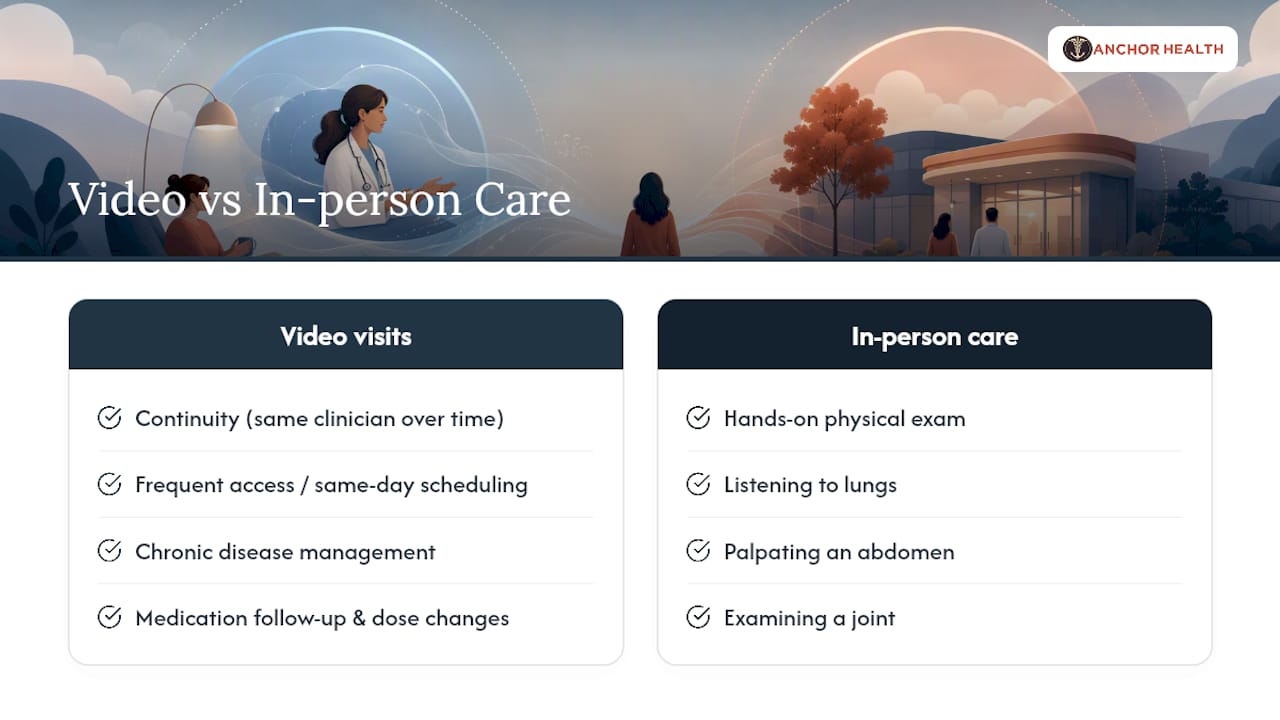
The honest framing: quality depends less on the medium and more on whether the same clinician follows your case over time. A rushed ten-minute in-person visit with an unfamiliar provider isn’t automatically better than a thorough video visit with someone who has managed your chronic condition for two years.
What Qualifications Do Virtual Primary Care Providers Need?
Licensing is the part patients skip past and shouldn’t. A provider delivering primary care telemedicine must hold an active medical license in the state where you, the patient, are physically located at the time of the visit, regardless of where the clinician sits. That’s a hard legal requirement, not a preference.
Beyond state licensing, legitimate providers carry board certification in family medicine, internal medicine, or pediatrics, the same credentialing standard you’d expect from any in-person primary care physician. Nurse practitioners and physician assistants working within a virtual care team operate under their own state licensure and scope-of-practice rules, which vary somewhat by state but generally allow them to manage routine visits and chronic-condition follow-up under physician collaboration.
Before booking with any virtual family doctor, it’s reasonable to ask directly about board certification and state licensure. A credible practice will answer without hesitation. Vague or evasive answers to a direct licensing question are one of the clearest signs to look elsewhere.
What Do Patient Satisfaction and Outcomes Data Show?
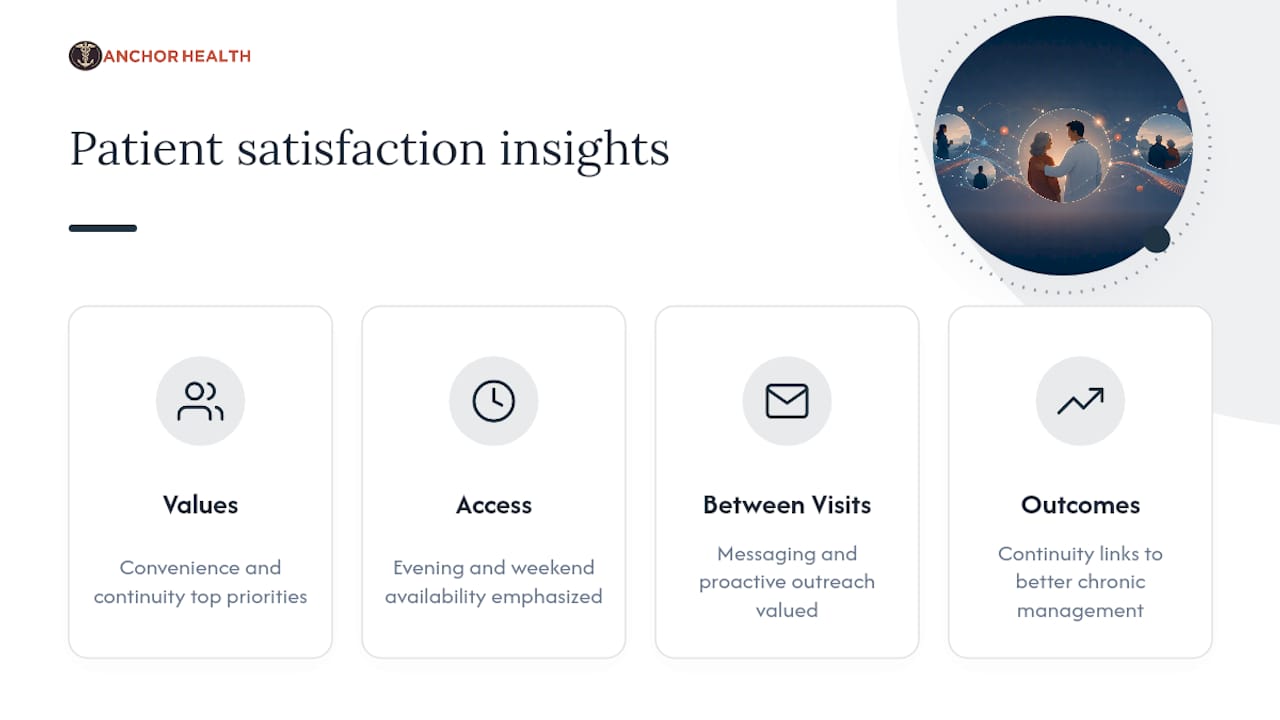
Patients consistently point to two things when asked what they value most in remote medical consultations: convenience and continuity with the same care team. Health systems running established telehealth primary care programs highlight extended evening and weekend availability alongside continuity of care as the primary differentiators that keep patients engaged over time.
Messaging access between visits and proactive outreach from a care team, rather than waiting for the patient to reach out first, show up repeatedly as features patients value most in membership-style virtual primary care models. That pattern makes sense: chronic disease management depends heavily on the small adjustments made between formal visits, not just what happens during a scheduled twenty-minute call.
Outcomes data specific to virtual-only primary care models is still an evolving area, and any provider claiming definitive superiority over in-person care on hard clinical outcomes should be viewed skeptically. What’s better established is that continuity itself, seeing a consistent provider over time, correlates with better chronic disease management regardless of whether the visits happen in an office or over video. Virtual primary care’s real advantage is making that continuity easier to sustain, since patients are far more likely to keep an appointment they can attend from their kitchen table than one requiring a commute and a waiting room.
What Legal and Regulatory Rules Apply to Virtual Primary Care?
State licensing sits at the center of virtual primary care regulation. A provider can only treat you legally in the state where you’re physically located during the visit, which is why practices typically ask for your address at sign-up and confirm it before every appointment. This isn’t bureaucratic friction. It’s a legal boundary that protects both you and the clinician.
Prescribing controlled substances via telehealth carries additional federal rules under the Ryan Haight Act, generally requiring at least one element of in-person evaluation for certain controlled medications, though exceptions and updates to these rules have shifted over recent years. Non-controlled prescriptions, including most chronic disease medications and GLP-1 treatments, don’t carry the same restriction.
HIPAA governs how your data is stored, transmitted, and shared, and any legitimate digital health clinic should be able to explain its compliance in plain terms. Insurance regulation adds another layer: some states mandate that insurers cover telehealth visits at parity with in-person visits, while others leave more room for insurers to set their own telehealth policies. That’s part of why confirming your specific plan’s telehealth coverage before your first visit matters more than assuming it works the same everywhere.
Publisher Perspective: Why Continuity Should Be the Deciding Factor
Most of the telehealth industry sells convenience as the whole pitch. Convenience matters, but it’s not what determines whether a chronic condition actually gets managed well over five years. Continuity does. We built Anchored Care℠ᴵᴾ around that belief: the clinician who ordered your last set of labs should be the one reviewing them, asking why your numbers moved, and adjusting the plan accordingly.
If you’re choosing a virtual primary care provider, ask fewer questions about app design and more about whether you’ll see the same person twice. That single question tells you more about long-term care quality than almost anything else on a features list.
— Paule
How to Get Started With Anchor Health
A relationship-based virtual primary care model delivers care covering general medicine, women’s health, mental and emotional health support, pediatric care, and weight and metabolic management, all through secure video visits with a consistent care team instead of a rotating roster of strangers.
Getting started takes three practical steps. Visit the Anchor Health overview to see the full service scope and confirm it matches what you need. Check whether your insurance plan is accepted, or review the self-pay and membership options if you’d rather skip the insurance question entirely. Then schedule your initial visit and complete the intake forms ahead of time so your first appointment focuses on your actual health, not paperwork.
Membership tiers, where you choose one, add longer visits and direct messaging access on top of standard insurance or self-pay billing. Either path gets you to the same place: a provider who’s still there for your next visit.
Selected Sources and Further Reading
- What Gynecological Primary Care Includes for Women
- How to Attend a Telehealth Visit as a Caregiver
- Virtual Primary Care | Corewell Health
This article is general information, not a substitute for advice from a qualified doctor. Consult a qualified healthcare professional about your own circumstances before acting on anything here.
Recommended
- How to Prepare for a Chronic Care Video Visit
- Same-Day Telehealth Availability: What It Means for You
- How to Attend a Telehealth Visit as a Caregiver
Blog & Information Disclaimer
Last Updated: May 23, 2026
The information provided on the Anchor Health website (https://myanchorhealthpc.com/), including but not limited to blog posts, articles, newsletters, graphics, and other materials (collectively, the "Content"), is for general informational and educational purposes only.
By accessing and using this website, you acknowledge and agree to the following terms and conditions:
The Content on this website is not intended to be a substitute for professional medical advice, diagnosis, or treatment. Always seek the advice of your physician, nurse practitioner, or other qualified health provider with any questions you may have regarding a medical condition. Never disregard professional medical advice or delay in seeking it because of something you have read on this website.
Reading, interacting with, or sharing the Content on this website does not establish a patient-provider relationship between you and Anchor Health or any of its clinicians, including Paule Valery Joseph, PhD, MBA, CRNP, FAAN. A formal patient-provider relationship is only established after you have completed the formal intake process, signed our clinical consent forms, and participated in a secure clinical consultation.
If you are experiencing a medical emergency, call 911 or seek emergency medical services immediately.
Anchor Health is a primary care practice and does not provide emergency or crisis intervention services through its website or blog.
While Anchor Health strives to provide thoughtful, evidence-based information grounded in our Anchored Care℠ model, healthcare is a rapidly evolving field. We make no representations or warranties, express or implied, about the completeness, accuracy, reliability, or suitability of the information contained in the Content. Any reliance you place on such information is strictly at your own risk.
Anchor Health is a telehealth practice providing services to patients physically located within the state of Maryland. The information provided on this blog is intended for residents of Maryland and is governed by the laws and regulations of that state. Accessing this information from outside of Maryland does not imply that our clinicians are licensed to practice medicine or provide consultations in your jurisdiction.
Content related to Weight & Metabolic Health, including discussions of GLP-1 medications or other medical therapies, is provided for educational context regarding our clinical approach. Prescriptions and specific medical recommendations are only made following a comprehensive clinical evaluation, diagnostic testing, and shared decision-making within a formal patient-provider relationship.
This website may contain links to external websites that are not provided or maintained by or in any way affiliated with Anchor Health. Please note that Anchor Health does not guarantee the accuracy, relevance, timeliness, or completeness of any information on these external websites.
To the fullest extent permitted by law, Anchor Health, its owners, and its employees shall not be liable for any direct, indirect, incidental, consequential, or punitive damag
Related posts