Family Health Membership Plans Compared for Maryland Families

For most Maryland families seeking ongoing telehealth primary care, a relationship-based Direct Primary Care (DPC) or concierge-style membership delivers the best combination of access, pediatric coverage, and insurance compatibility. We recommend evaluating Myanchorhealthpc’s Anchored Care℠ᴵᴾ model as your first stop. It accepts insurance, supports HSA/FSA use, and serves families across all ages through secure video visits. To check eligibility or book an introductory visit, visit myanchorhealthpc.com.
One foundational point before comparing: health-sharing programs are not insurance. They carry no state solvency guarantees and typically exclude pre-existing conditions for 12–36 months. That distinction shapes every cost and risk calculation below.
Table of Contents
- What do the different family health membership models actually mean?
- What do family memberships typically include, and what gets billed separately?
- How do costs and billing actually work for families?
- How should you choose the right membership for your family?
- What Maryland families need to know about telehealth portability
- How Myanchorhealthpc’s Anchored Care℠ᴵᴾ works for Maryland families
- Key Takeaways
- Why relationship-first telehealth usually wins for Maryland families
- Ready to get started with Myanchorhealthpc?
- Selected sources and further reading
What do the different family health membership models actually mean?
“Membership” covers four distinct models, and they work very differently for families.
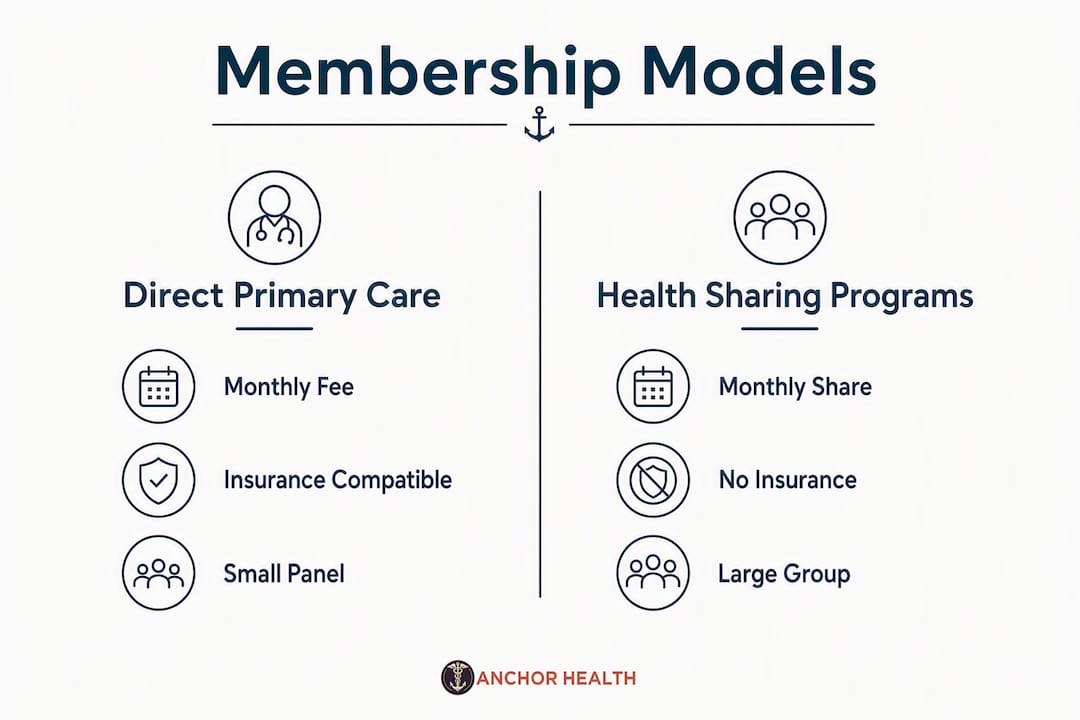
- Direct Primary Care (DPC): A flat monthly fee covers your clinical relationship with a primary care physician. DPC practices keep panels under roughly 300 patients, which is what makes same-day access and longer visits possible. A typical example: adult $65/month, child $35/month, family package $165/month, plus a small one-time registration fee, with unlimited telehealth included.
- Concierge medicine: Similar to DPC but usually priced higher, often with an annual retainer. Visits tend to be longer and more personalized. Learn more about what concierge memberships include before assuming they’re interchangeable with DPC.
- App-based convenience memberships: A low monthly subscription buys you app access and messaging. Clinical visits are still billed to your insurance separately, meaning members with high deductibles often pay twice: once for the subscription and again through cost-sharing.
- Health-sharing programs: Voluntary communities where members pool contributions to cover each other’s medical bills. Not insurance. No legal guarantee of payment. Pre-existing condition waiting periods of 12–36 months are standard.
| Model | What you’re paying for | Insurance billing | Panel size | Consumer protections |
|---|---|---|---|---|
| Direct Primary Care | Clinical time and continuity | Visits included in fee | Under ~300 patients | Membership contract |
| Concierge medicine | Clinical time, enhanced access | Varies; often bills insurance too | Small | Membership contract |
| App-based membership | Technology and convenience | Visits billed to insurance | Large | Standard insurance rules |
| Health-sharing | Community cost-pooling | Not insurance; no billing | N/A | None (voluntary) |
Pro Tip: The single most important question for families is whether the membership fee includes your doctor’s clinical time. DPC and concierge do. Most app-based memberships do not.
What do family memberships typically include, and what gets billed separately?
A well-structured family membership covers the services your household uses most often. For families across every age group, that typically means:
- Same-day sick visits and after-hours messaging
- Well-child checks and immunizations
- Chronic care follow-up (asthma, diabetes, hypertension)
- Telehealth and secure video visits
- Adolescent sports physicals and mental health support within primary care scope
- Adult preventive care and women’s health screenings
What memberships usually do not cover: specialist procedures, imaging, facility fees, and branded prescriptions. Those are billed to your insurance or paid out of pocket.
Age-specific examples matter here. Toddlers need frequent vaccine visits and developmental checks. Teenagers often need sports physicals, mental health check-ins, and confidential conversations with a trusted provider. Adults managing chronic conditions need consistent follow-up, not episodic care. A membership that covers all three age bands under one relationship is genuinely different from a plan that handles only acute illness.
Families should ask specifically about lab and imaging charges. Registration or initiation fees and per-service lab draws are frequently billed outside the monthly membership total.
Pro Tip: Watch for registration and initiation fees. Always calculate your true first-year cost by adding those one-time charges to twelve months of membership fees before comparing options.
How do costs and billing actually work for families?
Pricing varies significantly by model. For context, ACA Silver plan premiums for a family of four before subsidies in 2026 typically range from $950 to $1,800 per month, which can be relatively high. Health-sharing programs typically offer monthly costs for a family of four that range from $240 to $899 (as of June 2026), but without insurance-level guarantees.
DPC family packages usually charge a modest monthly fee—typically around $165 per family per month—designed to complement a high-deductible insurance plan, not replace it. Concierge practices charge more, sometimes significantly so. Understanding what insurance membership healthcare means for your specific situation is worth doing before you enroll.
Health-sharing programs are not insurance. They have no state solvency guarantees, no legal obligation to pay claims, and no appeals process if a bill is denied. Pre-existing conditions typically face a 12–36 month waiting period before sharing applies.
HSA and FSA compatibility: DPC membership fees are generally not HSA/FSA-eligible on their own, but clinical services billed through a DPC practice may qualify. Myanchorhealthpc accepts HSA/FSA funds for eligible services. Confirm the specific rules with your plan administrator before enrolling.
Insurance interaction: DPC and concierge memberships work alongside your insurance, not instead of it. You keep your insurance for specialist care, hospitalizations, and emergencies. App-based memberships still bill insurance for visits, so your deductible and copays apply on top of the subscription fee.

How should you choose the right membership for your family?
Run through this checklist before signing up for any plan:
- Does the membership include a consistent, named provider for your family?
- Are pediatric visits and well-child checks explicitly covered?
- What is the physician’s panel size, and how does that affect same-day access?
- How long are standard appointments?
- What services are included versus billed separately?
- Are there waiting periods for pre-existing conditions?
- Does coverage travel with your family out of state?
| Question to ask | Why it matters | Acceptable answer |
|---|---|---|
| Who is my family’s primary provider? | Continuity of care drives better outcomes | A named clinician, not a rotating pool |
| What is the panel size? | Smaller panels mean faster access | Under 300 patients for DPC |
| Are pediatric visits included? | Children need frequent preventive care | Yes, explicitly stated |
| How are labs and imaging handled? | Hidden costs inflate total spend | Clear per-service pricing disclosed |
| Does telehealth work out of state? | Portability matters for travel and college | Confirmed licensure in relevant states |
| Are there faith or lifestyle requirements? | Health-sharing programs often require these | None, or clearly disclosed |
Red flags: Vague coverage language, mandatory faith statements for sharing programs, and unclear billing for routine services are all signs to look elsewhere. The benefits of membership-based primary care are real, but only when the terms are transparent.
What Maryland families need to know about telehealth portability
Telehealth has a hard rule: the provider must be licensed in the state where the patient is physically located at the time of the visit. For most Maryland families, this is straightforward. But several common scenarios create gaps:
- College students: A freshman at a Virginia or Pennsylvania school cannot use a Maryland-only telehealth provider for care while on campus.
- Family travel: A video visit during a vacation in Florida requires a Florida-licensed provider.
- Seasonal residents: Families who split time between Maryland and another state need to confirm coverage in both.
For young patients navigating telehealth access, the practical fix is to pair a Maryland telehealth membership with a national network insurance plan (PPO) that covers urgent care visits out of state. That combination handles routine care at home and unexpected needs on the road.
For families with children who have special needs or require home-based care, pediatric home visit options may fill gaps that telehealth cannot.
How Myanchorhealthpc’s Anchored Care℠ᴵᴾ works for Maryland families
Myanchorhealthpc’s Anchored Care℠ᴵᴾ is a relationship-based telehealth primary care model built specifically to serve Maryland families. Here is what it includes:
- Secure video visits for all family members, including children and adolescents
- Longer appointments that allow time for thorough discussion, not rushed check-ins
- Chronic care management for conditions like hypertension, diabetes, and metabolic health
- Women’s health services across reproductive stages and menopause
- Mental and emotional health support within primary care scope
- Weight and metabolic health management, including GLP-1 medications where appropriate
- Messaging access between visits for follow-up questions
Enrollment is straightforward:
- Visit myanchorhealthpc.com and complete the online intake form
- Provide your insurance information (Myanchorhealthpc accepts most major plans)
- Add family members during enrollment, including children
- Book your first video visit, typically available within days
Myanchorhealthpc accepts insurance, supports HSA/FSA use for eligible services, and operates exclusively within Maryland via secure telehealth. The Anchored Care℠ᴵᴾ model prioritizes long-term, evidence-based relationships over episodic treatment.
Key Takeaways
For Maryland families, a relationship-based telehealth primary care membership that accepts insurance and covers all ages delivers better continuity and access than app-based or health-sharing alternatives.
| Point | Details |
|---|---|
| Health-sharing is not insurance | Programs carry no solvency guarantees and exclude pre-existing conditions for 12–36 months. |
| DPC keeps panels small | Panels under about 300 patients enable same-day access and longer visits for families. |
| App memberships can cost twice | Subscriptions plus insurance cost-sharing create double costs for families with high deductibles. |
| Calculate first-year total cost | Add registration fees to twelve months of membership fees before comparing plans. |
| Myanchorhealthpc’s Anchored Care℠ᴵᴾ | Maryland telehealth membership accepting insurance and HSA/FSA, covering all ages with continuity-focused care. |
Why relationship-first telehealth usually wins for Maryland families
Most families spend months comparing monthly prices and end up underweighting the factor that matters most: whether their family has a consistent, trusted provider who actually knows them. A DPC or concierge-style membership that keeps panels small and visits long will outperform a cheaper app subscription almost every time, because the value is in the relationship, not the technology.
Health-sharing programs deserve honest consideration for healthy families with no pre-existing conditions and no prescription needs. But for a family managing one chronic condition, one adolescent with mental health needs, or one parent navigating a health transition, the lack of guaranteed coverage is a real financial risk. The lower monthly cost can evaporate quickly when a claim is declined.
For Maryland families specifically, Myanchorhealthpc’s Anchored Care℠ᴵᴾ addresses the core need: a named provider, telehealth convenience, insurance compatibility, and care that spans pediatrics through adult medicine. That combination is harder to find than the membership market makes it look.
Ready to get started with Myanchorhealthpc?
Myanchorhealthpc offers Maryland families a clear alternative to fragmented, rushed primary care. With Anchored Care℠ᴵᴾ, your family gets longer video visits, a consistent provider who knows your history, and coverage that works with your existing insurance. There are no surprise billing structures and no faith requirements. HSA/FSA funds are accepted for eligible services.
Start by reviewing how to choose telehealth primary care for your family, then complete the online intake at myanchorhealthpc.com. Add your family members during enrollment, confirm your insurance, and book your first video visit. Most families are seen within days of completing intake.
This article provides general health information and is not a substitute for professional medical or insurance advice. Confirm current plan terms, licensure, and eligibility with Myanchorhealthpc or a qualified advisor for your specific situation.
Selected sources and further reading
| Source | What it covers |
|---|---|
| California DOI — Health Care Sharing Ministries | Regulatory notice on health-sharing consumer protections and solvency risks |
| AAFP — Direct Primary Care | Industry guidance on DPC panel size, pricing, and access benefits |
| WhichHealthShare — Plan Comparison | Family-of-four pricing ranges and plan feature breakdowns |
| NextMD — Membership Comparison | Analysis of what different membership types actually include clinically |
| Myanchorhealthpc — Anchored Care℠ᴵᴾ | Maryland telehealth primary care membership details and enrollment |
Recommended
- Benefits of Membership-Based Primary Care for Families
- How telehealth expands healthcare access for Maryland families
- Top 6 Affordable Employee Benefits Providers 2026
- What Does Concierge Medicine Membership Include?
Blog & Information Disclaimer
Last Updated: May 23, 2026
The information provided on the Anchor Health website (https://myanchorhealthpc.com/), including but not limited to blog posts, articles, newsletters, graphics, and other materials (collectively, the "Content"), is for general informational and educational purposes only.
By accessing and using this website, you acknowledge and agree to the following terms and conditions:
The Content on this website is not intended to be a substitute for professional medical advice, diagnosis, or treatment. Always seek the advice of your physician, nurse practitioner, or other qualified health provider with any questions you may have regarding a medical condition. Never disregard professional medical advice or delay in seeking it because of something you have read on this website.
Reading, interacting with, or sharing the Content on this website does not establish a patient-provider relationship between you and Anchor Health or any of its clinicians, including Paule Valery Joseph, PhD, MBA, CRNP, FAAN. A formal patient-provider relationship is only established after you have completed the formal intake process, signed our clinical consent forms, and participated in a secure clinical consultation.
If you are experiencing a medical emergency, call 911 or seek emergency medical services immediately.
Anchor Health is a primary care practice and does not provide emergency or crisis intervention services through its website or blog.
While Anchor Health strives to provide thoughtful, evidence-based information grounded in our Anchored Care℠ model, healthcare is a rapidly evolving field. We make no representations or warranties, express or implied, about the completeness, accuracy, reliability, or suitability of the information contained in the Content. Any reliance you place on such information is strictly at your own risk.
Anchor Health is a telehealth practice providing services to patients physically located within the state of Maryland. The information provided on this blog is intended for residents of Maryland and is governed by the laws and regulations of that state. Accessing this information from outside of Maryland does not imply that our clinicians are licensed to practice medicine or provide consultations in your jurisdiction.
Content related to Weight & Metabolic Health, including discussions of GLP-1 medications or other medical therapies, is provided for educational context regarding our clinical approach. Prescriptions and specific medical recommendations are only made following a comprehensive clinical evaluation, diagnostic testing, and shared decision-making within a formal patient-provider relationship.
This website may contain links to external websites that are not provided or maintained by or in any way affiliated with Anchor Health. Please note that Anchor Health does not guarantee the accuracy, relevance, timeliness, or completeness of any information on these external websites.
To the fullest extent permitted by law, Anchor Health, its owners, and its employees shall not be liable for any direct, indirect, incidental, consequential, or punitive damag
Related posts