How Primary Care Supports Fertility Awareness and Planning

Primary care can lead fertility awareness and early fertility optimization. Your primary care clinician can screen for pregnancy intention, teach fertility-awareness basics like the fertile window and fertility awareness based methods (FABMs), manage weight and chronic conditions that affect fertility, order initial tests, and refer you to a specialist when the evidence points that way. The American Society for Reproductive Medicine defines infertility as a lack of conception after 12 months of unprotected intercourse, and practices like Myanchorhealthpc build fertility conversations into ordinary primary care visits rather than waiting for a crisis.
Before your next appointment, you can:
- Ask your clinician directly whether you’re planning a pregnancy this year.
- Request basic fertility-awareness education, even if you’re not actively trying.
- Bring your menstrual cycle history and current medication list to the visit.
Key Takeaways
Primary care can lead fertility awareness through routine screening, focused education, initial testing, and timely referral, all within visits patients already attend.
| Point | Details |
|---|---|
| Start with the One Key Question | Ask about pregnancy intention at annual exams or chronic-care visits, not just at a fertility-specific appointment. |
| Know the 12-month threshold | Begin evaluation after 12 months of trying, or sooner for high-risk patients over 35 or with irregular cycles. |
| Charting has diagnostic value | Cervical mucus and BBT tracking can reveal anovulation or a short luteal phase, not just help time intercourse. |
| Training changes outcomes | Fertility awareness based methods used without instruction carry failure rates of 22 to 24 percent as contraception. |
| Choose continuity-based care | Myanchorhealthpc’s telehealth model builds fertility conversations into ongoing primary care rather than a one-off specialist visit. |
Table of Contents
- What Role Does Primary Care Play in Fertility Awareness?
- When Should You Start a Fertility Evaluation?
- Which Fertility Awareness Methods and Monitors Actually Work?
- How Do Lifestyle Habits and Mental Health Affect Fertility?
- What Do Cost, Access, and Referral Timing Look Like?
- What Should You Bring to Your Fertility Visit?
- Why Continuity of Care Matters for Fertility Conversations
- Get Started With a Fertility-Focused Primary Care Visit
- Frequently Asked Questions
- Sources
What Role Does Primary Care Play in Fertility Awareness?
Your primary care visit is one of the few places in the health system built for an ongoing conversation, not a single transaction. That structure matters here. Clinicians increasingly use a simple screening prompt called the One Key Question: “Would you like to become pregnant in the next year?” It takes a few seconds to ask during an annual exam, a medication review, or a chronic-care checkup, and it opens a door many patients never think to open themselves.
Once that door is open, your clinician can walk through fertility literacy with you. That means explaining the fertile window, describing what a normal cycle looks like, and helping you interpret basic fertility awareness based method signs like cervical mucus changes or basal body temperature shifts. Standardized, life-course fertility education delivered by trusted clinicians, rather than left to scattered internet searches, tends to stick better and gets revisited as your circumstances change.
Primary care can also order and interpret a solid first round of testing: a urine pregnancy test, thyroid-stimulating hormone, prolactin, a cycle-timed progesterone level to check for ovulation, and STI screening. Semen analysis and anti-Müllerian hormone testing usually route through a specialty referral, but your primary care clinician can order the initial conversation and paperwork that gets that process moving.
A typical fertility-focused visit includes:
- A cycle and symptom history, including cycle length and any irregular bleeding.
- A medication and supplement review, since some drugs affect ovulation or sperm quality.
- Baseline labs ordered based on your history and exam findings.
- A follow-up plan, usually within one to three cycles.
Pro Tip: Fill out a previsit fertility checklist before your appointment. Jotting down your last several cycle start dates and any medications you’re taking turns a rushed 15-minute visit into a genuinely useful one.
When Should You Start a Fertility Evaluation?
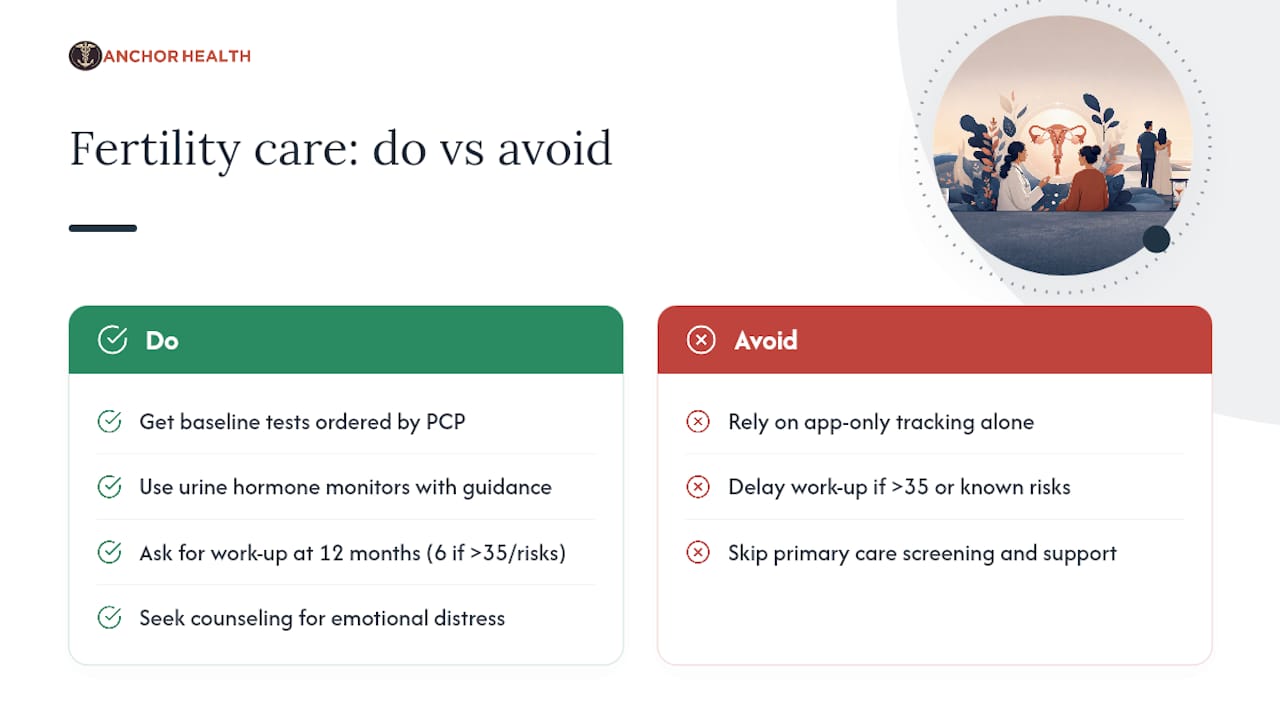
The standard threshold is 12 months of unprotected intercourse without pregnancy, per family medicine guidance on infertility. That timeline shortens to six months, or immediately, for certain patients: anyone over 35, anyone with irregular or absent periods, and anyone with a history of chemotherapy, radiation, or known reproductive risk factors. Waiting the full year in those cases can cost you months you don’t need to lose.
Certain findings should move you toward an earlier work-up rather than a “let’s wait and see” approach:
- Amenorrhea or signs of anovulation, such as wildly unpredictable cycle length.
- A history of severe endometriosis, pelvic infection, or pelvic surgery.
- A male partner with a known fertility risk factor, prior vasectomy, or abnormal semen history.
- Any known structural or hormonal condition affecting either partner.
A reasonable timeline looks like this: bring up your concerns at your very next primary care visit, complete baseline labs and a cycle history within the first cycle or two, and reassess progress every three to six months. If nothing has changed after six months of focused effort, or sooner given any red flag above, that’s the point to ask for a reproductive endocrinology referral rather than continuing to self-manage.
Which Fertility Awareness Methods and Monitors Actually Work?
Fertility awareness based methods fall into a few main categories: cervical mucus charting, basal body temperature tracking, urinary luteinizing hormone monitors, and multi-indicator devices that combine several signals into one reading. Each measures something different. Mucus charting tracks the body’s own fertility signal directly. BBT confirms that ovulation already happened, which makes it more useful for record-keeping than same-cycle timing. Urinary LH monitors detect the hormone surge that precedes ovulation by roughly a day or two, which is often the most actionable window for timing intercourse.

The evidence on objective hormone monitors is genuinely encouraging. Randomized trials have found higher short-term pregnancy rates among women using urinary hormone monitors compared with controls, though researchers still want larger trials to confirm the size of that effect. Charting also has real diagnostic value beyond timing intercourse. Cycle charting functions like a vital sign, letting your clinician spot anovulation or a short luteal phase that a single office visit would never catch.
The catch is training. FABMs used for contraception without formal instruction carry a failure rate of 22 to 24 percent, largely because people misread mucus or temperature patterns on their own. A consumer app can log data, but it can’t replace instruction from someone trained to teach the method.
- Cervical mucus charting: tracks your body’s own hormonal signal in real time.
- BBT: confirms ovulation after the fact, useful for pattern review.
- Urinary LH monitors: pinpoint the one to two days before ovulation.
- Multi-indicator monitors: combine signals for a fuller picture, at higher cost.
How Do Lifestyle Habits and Mental Health Affect Fertility?
Several modifiable factors move the needle on fertility more than most people expect, and your primary care clinician can address every one of them without a specialist referral, including connecting you to wellness programs that complement fertility support. Smoking cessation, cutting back on alcohol, working toward a healthier weight, and tightening glycemic control if you have prediabetes or diabetes all belong on that list. So does a straightforward medication review, since some common prescriptions interfere with ovulation or sperm production.
Primary care-based counseling on nutrition, alcohol, and tobacco has been shown to improve fertility literacy and outcomes, and it doesn’t require a fertility specialist to deliver. Your clinician can also make a structured referral to a nutritionist or weight-management program, adjust a medication that’s working against you, and keep your vaccinations and STI screening current, since some infections directly damage fertility if left untreated.
The emotional weight of fertility concerns deserves equal attention. A clinician who already knows your history is well positioned to notice distress early and normalize it before it becomes isolating.
Pro Tip: If a patient brings up fertility struggles, validate the difficulty out loud before jumping to the next test order. A simple “this is genuinely hard, and you’re not alone in feeling this way” opens the door to a referral for counseling that a rushed visit would otherwise skip.
What Do Cost, Access, and Referral Timing Look Like?
Fertility testing and treatment carry real financial and logistical barriers, and primary care can soften the first stretch of that road. An initial work-up through your primary care clinician, using standard labs and insurance-covered visits, costs far less than jumping straight to a specialist for basic screening.
Equity matters here too. Every patient, regardless of background or relationship status, deserves to be asked about fertility desires directly, not just those who fit a narrow assumption about who wants children.
Patients who present first to a generalist for fertility concerns are associated with a lower likelihood of proceeding to IVF, without worse time-to-pregnancy outcomes in some studies. That finding suggests conservative, primary-care-led management serves many patients well, both medically and financially, per a summary on generalist-led infertility management.
Refer out when age is over 35 with six months of effort, when semen analysis or hormone results come back abnormal, when history suggests a structural problem, or when ovulation issues persist despite reasonable primary-care measures.
What Should You Bring to Your Fertility Visit?
A little preparation turns a fertility conversation into a genuinely productive visit instead of a rushed exchange.
Bring these to your appointment:
- Your cycle calendar or period start dates for the last three to six months.
- Your current medication and supplement list.
- Your contraception history and any prior fertility test results.
- Relevant partner health history, if applicable.
Ask your clinician these three questions:
- “Based on my history, when should we start testing rather than waiting?”
- “What specific tests make sense for me right now?”
- “If something comes back abnormal, what’s our next step?”
Track cycle length, mucus changes, and BBT (if you’re charting it) between visits, and plan to check back in every one to three cycles.
Why Continuity of Care Matters for Fertility Conversations
A single 15-minute specialist visit rarely captures the full picture of someone’s reproductive health. It captures a snapshot. Longitudinal primary care captures the story, and fertility awareness benefits enormously from that difference.
When your clinician already manages your thyroid condition, your weight goals, or your anxiety, fertility conversations fold naturally into care you’re already receiving rather than requiring a separate appointment and a new relationship built from zero. Continuity of care has been linked to reduced emotional burden during fertility work-ups, which tracks with what makes sense intuitively: it’s easier to talk about something vulnerable with someone who already knows you.
Telehealth adds a layer of privacy that some patients find genuinely freeing. Discussing cycle irregularities or pregnancy intentions from home, without a waiting room, tends to lower the barrier to bringing it up at all. At Myanchorhealthpc, that continuity model, paired with a fertility health checkup checklist, aims to make fertility awareness a normal part of ongoing care rather than a separate, intimidating specialty visit.
Get Started With a Fertility-Focused Primary Care Visit
You don’t need a specialist referral to start understanding your fertility. Myanchorhealthpc’s Anchored Care model gives you a consistent clinician who already knows your cycle history, your medications, and your health goals, so fertility questions get answered in context instead of starting from scratch every time.
Through secure video visits, Myanchorhealthpc can screen your pregnancy intentions, walk you through fertile-window basics, order baseline labs like thyroid and hormone panels, and coordinate a referral if your history calls for one. Explore what a gynecological primary care visit covers, then use the fertility health checkup checklist to prepare. Ready to talk it through? Book a telehealth visit and bring your questions. That first conversation is where most fertility clarity actually begins.
Frequently Asked Questions
Can my primary care doctor really help with fertility, or do I need a specialist right away?
Your primary care clinician can handle the first stage of fertility support directly, including screening, education, and baseline testing. Specialist referral becomes necessary only when results are abnormal, your history includes specific risk factors, or six to twelve months of primary-care-led effort hasn’t led anywhere.
What tests can a primary care visit actually cover for fertility?
A primary care clinician can order a urine pregnancy test, thyroid function, prolactin, a cycle-timed progesterone level, and STI screening. Semen analysis and AMH testing typically require a referral, but your primary care visit can start that process.
Are fertility apps and monitors reliable enough to rely on?
Objective urinary hormone monitors have shown improved short-term pregnancy rates in randomized trials, which makes them a reasonable tool for timing intercourse. App-only tracking without hormone data is less reliable and works best paired with clinician guidance or formal method instruction.
When should I stop waiting and ask for a fertility work-up?
Standard guidance points to 12 months of unprotected intercourse without pregnancy. That drops to six months, or right away, if you’re over 35, have irregular cycles, or have a known risk factor like prior chemotherapy or pelvic surgery.
Does primary care address the emotional side of fertility struggles too?
Yes. Your primary care clinician can screen for distress, validate what you’re going through, and refer you to counseling or behavioral health support as part of the same ongoing relationship that manages your physical care.
This article is general information, not a substitute for advice from a qualified doctor. Consult a qualified healthcare professional about your own circumstances before acting on anything here.
Sources
- Infertility: The Family Physician’s Role (NCBI Bookshelf)
- Fertility education: recommendations for developing and implementing tools (PMC article)
Recommended
- Primary Care’s Role in Women’s Reproductive Health
- Family Primary Care Best Practices for Every Age
- Primary Care’s Role in Childhood Obesity Prevention
Blog & Information Disclaimer
Last Updated: May 23, 2026
The information provided on the Anchor Health website (https://myanchorhealthpc.com/), including but not limited to blog posts, articles, newsletters, graphics, and other materials (collectively, the "Content"), is for general informational and educational purposes only.
By accessing and using this website, you acknowledge and agree to the following terms and conditions:
The Content on this website is not intended to be a substitute for professional medical advice, diagnosis, or treatment. Always seek the advice of your physician, nurse practitioner, or other qualified health provider with any questions you may have regarding a medical condition. Never disregard professional medical advice or delay in seeking it because of something you have read on this website.
Reading, interacting with, or sharing the Content on this website does not establish a patient-provider relationship between you and Anchor Health or any of its clinicians, including Paule Valery Joseph, PhD, MBA, CRNP, FAAN. A formal patient-provider relationship is only established after you have completed the formal intake process, signed our clinical consent forms, and participated in a secure clinical consultation.
If you are experiencing a medical emergency, call 911 or seek emergency medical services immediately.
Anchor Health is a primary care practice and does not provide emergency or crisis intervention services through its website or blog.
While Anchor Health strives to provide thoughtful, evidence-based information grounded in our Anchored Care℠ model, healthcare is a rapidly evolving field. We make no representations or warranties, express or implied, about the completeness, accuracy, reliability, or suitability of the information contained in the Content. Any reliance you place on such information is strictly at your own risk.
Anchor Health is a telehealth practice providing services to patients physically located within the state of Maryland. The information provided on this blog is intended for residents of Maryland and is governed by the laws and regulations of that state. Accessing this information from outside of Maryland does not imply that our clinicians are licensed to practice medicine or provide consultations in your jurisdiction.
Content related to Weight & Metabolic Health, including discussions of GLP-1 medications or other medical therapies, is provided for educational context regarding our clinical approach. Prescriptions and specific medical recommendations are only made following a comprehensive clinical evaluation, diagnostic testing, and shared decision-making within a formal patient-provider relationship.
This website may contain links to external websites that are not provided or maintained by or in any way affiliated with Anchor Health. Please note that Anchor Health does not guarantee the accuracy, relevance, timeliness, or completeness of any information on these external websites.
To the fullest extent permitted by law, Anchor Health, its owners, and its employees shall not be liable for any direct, indirect, incidental, consequential, or punitive damag

Related posts