Navigate Insurance for Family Member Care: A Caregiver’s Guide

Start by checking your loved one’s Medicaid eligibility and asking every provider for billing codes in writing before care begins. Those two moves matter because Medicaid, not Medicare, is the fastest and most common route to paying a family caregiver: Medicaid paid two-thirds of home care spending in 2022, while Medicare rarely covers long-term custodial care at all. Nearly every state now allows some payment to family caregivers through Medicaid home care programs, but the rules differ enough that you need to call your state office directly rather than assume.
While you’re on the phone, gather your loved one’s power of attorney, diagnosis records, and insurance cards. You’ll need them for nearly every next step.
- Check Medicaid eligibility and ask specifically about consumer-directed programs.
- Request billing and benefit details in writing, every time.
- Pull together diagnosis paperwork, POA documents, and insurance cards now.
Pro Tip: Ask every representative for their name and a reference or case number. If a benefit gets denied later, that record is what lets you challenge it.
| Point | Details |
|---|---|
| Fastest payer route | Medicaid waivers and consumer-directed programs pay family caregivers more often than Medicare or private insurance. |
| Documentation wins appeals | Written confirmations of benefits and billing codes protect you if a claim is denied later. |
Key Takeaways
Medicaid waivers and consumer-directed programs remain the most reliable way to get a family caregiver paid, but written documentation is what makes any payer approve and keep paying.
| Point | Details |
|---|---|
| Medicaid pays fastest | Consumer-directed waivers let most states pay family caregivers, though rules and pay rates vary by state. |
| Medicare covers less | Medicare pays for skilled, short-term home health and hospice, not ongoing custodial care. |
| Get it in writing | Billing codes, price estimates, and coverage confirmations protect you if a claim is later denied. |
| Document care needs early | A functional ADL assessment and a caregiving log support both applications and appeals. |
| Telehealth speeds documentation | Myanchorhealthpc can provide medical necessity letters and training referrals through video visits. |
Table of Contents
- What Should You Do in the Next 7 to 14 Days?
- Who Actually Pays for Family Member Care?
- How Do You Get Paid Through Medicaid as a Family Caregiver?
- Does Long-Term Care Insurance Pay Family Caregivers?
- How Do You Confirm Coverage Before Care Starts?
- Where Can You Get Direct Help With Applications and Appeals?
- How Do You Document Care Needs for Insurance Eligibility?
- What Won’t Insurance Cover for Family Caregivers?
- How Does Coverage Differ for Respite Care Versus Emergency Care?
- How Telehealth Primary Care Fits Into Your Coverage Plan
- Where This Guidance Comes From
- Frequently Asked Questions
- Sources
What Should You Do in the Next 7 to 14 Days?
Before you make a single phone call, spend twenty minutes gathering paperwork. It saves you from calling back three times because you forgot the diagnosis code or the policy number.
- Collect Medicare and insurance cards, recent medical records, physician’s orders, and diagnosis notes.
- Pull bank statements if Medicaid is a possibility. Most states review financial history for a “look-back” period, and gaps slow everything down.
- Locate legal documents: power of attorney, guardianship papers, or a healthcare proxy.
- Call your state Medicaid office and ask directly whether family caregivers can be paid under any waiver program.
- Call the primary care physician or care manager to request medical necessity documentation.
- Call the provider’s billing office and ask for CPT or HCPCS codes tied to any planned service.
- Contact your local Area Agency on Aging for community-based options.
- If the care recipient is a veteran or a veteran’s spouse, call the VA benefits office about Aid and Attendance.
Pro Tip: Keep a single notebook or shared document with the date, name, and department of every call. When you call back in three weeks, you won’t be starting from zero.
Who Actually Pays for Family Member Care?
The honest answer is: it depends on what kind of care your loved one needs and how long they’ll need it. Four payer types cover almost every situation caregivers run into, and each one has a different appetite for paying a family member directly.
Medicaid is the workhorse for long-term services and supports. It often covers home and community-based services (HCBS) through waivers, and in most states, it can pay a family caregiver, though eligibility, pay rates, and restrictions on legally responsible relatives (like spouses) vary by state.
Medicare covers skilled, short-term home health care and hospice, not ongoing custodial help. If your parent needs someone to help with bathing, meals, and supervision indefinitely, Medicare generally will not cover that, though Medicare Advantage or Medigap plans sometimes narrow that gap.
VA benefits, including Aid and Attendance pension supplements, can help eligible veterans and surviving spouses pay for in-home care, sometimes including a family caregiver.
Private long-term care insurance and hybrid life/LTC products vary the most. Some explicitly allow payment to a non-spouse family caregiver once care-plan requirements are met; others don’t.
Nearly all states permit some form of payment to family or friend caregivers under a Medicaid program, but the rules about who qualifies, and how much they’re paid, differ so much from state to state that a neighbor’s experience tells you almost nothing about your own.
About 4.5 million people use Medicaid home care nationally, which tells you this is a well-worn path, not a loophole.
Pro Tip: Don’t assume your situation matches a friend’s just because you live in neighboring states. Medicaid waiver rules are set at the state level and can differ dramatically.
How Do You Get Paid Through Medicaid as a Family Caregiver?
Medicaid pays family caregivers most often through consumer-directed personal assistance programs and home and community-based services waivers, commonly authorized under Section 1115 or 1915© of the Social Security Act. These programs let the care recipient (or a representative) hire and direct their own caregiver, including, in most states, a relative.
- Call your state Medicaid office and ask specifically: “Does this state’s Medicaid program allow consumer-directed care, and can a family member serve as the paid caregiver?”
- Ask which waiver program applies to your loved one’s diagnosis and living situation. Rules and waitlists differ by waiver.
- Confirm which relatives are excluded. Most states won’t pay a spouse or a parent caring for a minor child, though exceptions exist.
- Ask what training or background checks the caregiver must complete before payment starts.
- Request the pay structure in writing: hourly wage versus a per-diem rate, and how many hours per week are authorized.
If someone with a disability already qualifies for Medicaid, becoming a paid family caregiver through a consumer-directed program is often just a matter of enrollment paperwork once the waiver slot opens. The catch is availability. Many state waivers carry waitlists, sometimes years long, so applying early matters more than almost anything else you’ll do.
Pro Tip: Ask specifically about “self-direction” or “participant-directed” programs. Those are the search terms Medicaid staff use internally, and they’ll get you a faster, more accurate answer than asking generally about “caregiver pay.”
Does Long-Term Care Insurance Pay Family Caregivers?
Private long-term care policies pay out once your loved one fails a set number of activities of daily living, like bathing, dressing, or transferring, typically after an elimination period of 30 to 90 days with no benefit paid. Daily or monthly benefit limits then cap what the policy will reimburse.
- Some policies allow care from a family member other than the insured’s spouse or domestic partner, usually through a formal care plan benefit.
- Hybrid life insurance and LTC products, which pay a death benefit if long-term care is never needed, appeal to families wary of “use it or lose it” LTC premiums.
- Certain federal LTC-style programs cap family-caregiver-paid days, sometimes up to 500 days under specific plan rules.
- VA Aid and Attendance is worth a separate call if the care recipient or their spouse served.
Pro Tip: Call the insurance agent and ask them to confirm in writing whether a family member can be the paid caregiver under this specific policy. “Family caregiver” coverage is never assumed; it’s always spelled out in the policy language.
How Do You Confirm Coverage Before Care Starts?
Surprise medical bills usually trace back to one missed step: nobody asked for the code and the price before the visit happened. Before scheduling home health, therapy, or any billed service, ask the provider’s office for the exact CPT or HCPCS code tied to that service, along with the provider’s network status under your loved one’s plan.
- Request a written price estimate, not a verbal ballpark, before care is delivered.
- Use a cost-lookup tool like FAIR Health Consumer to compare the quoted price against typical charges in your area.
- Save every written estimate as a screenshot or PDF. Verbal quotes disappear; documents don’t.
- Log the date, the representative’s name, and the exact wording they used when confirming coverage.
- Ask for email confirmation of any coverage decision, even a simple “yes, this is covered.”
If a claim gets denied anyway, most insurers give you 60 to 180 days to appeal, depending on the plan. Start with the provider’s billing office to check for a coding error, then call the insurer’s appeals line, and loop in your state’s State Health Insurance Assistance Program (SHIP) if it’s a Medicare-related denial. SHIP counselors are free and trained specifically to interpret Medicare paperwork.
Pro Tip: Appeal even when the denial letter sounds final. A large share of first-round Medicare and Medicaid appeals succeed simply because the original claim was missing a code or a signature, not because the care wasn’t covered.
Where Can You Get Direct Help With Applications and Appeals?
You don’t have to sort this out alone, and in most cases, you shouldn’t try to.
Start with your state Medicaid office for waiver and HCBS questions. Every state publishes a Medicaid contact line, though the name of the department varies. Your Area Agency on Aging offers free local guidance on everything from meal delivery to caregiver support groups, and it’s often the fastest way to find out what’s actually available in your county. SHIP counselors handle Medicare questions at no cost, and the VA benefits office handles Aid and Attendance and other veteran-specific claims.
- Elder law attorneys help with Medicaid planning and appeals, typically billing by the hour or a flat project fee.
- Geriatric care managers coordinate care logistics and can attend appointments with you.
- Certified Medicaid planners specialize narrowly in eligibility and asset rules.
For common coverage gaps and practical workarounds, it helps to know what other families have run into first. Many Medicaid waivers also fund caregiver training and respite care directly, so ask about both when you call.
How Do You Document Care Needs for Insurance Eligibility?
Insurers and Medicaid case workers don’t take your word for how much help your loved one needs. They want documentation, specifically a functional assessment showing which activities of daily living the person can no longer do safely alone.
Start with a physician’s written assessment covering mobility, bathing, dressing, toileting, eating, and cognitive status. Most Medicaid waivers and LTC policies use a version of the activities-of-daily-living (ADL) scale, so a clinician who understands that framework will produce documentation that matches what reviewers expect. A diagnosis alone, say, “moderate dementia,” rarely satisfies a reviewer. What convinces them is a specific functional description: “requires standby assistance for transfers, cannot prepare meals independently, needs reminders for medication three times daily.”
Keep a caregiving log for at least two to four weeks before applying. Note how much time you spend on specific tasks, how often your loved one needs supervision, and any safety incidents, like falls or missed medications. This log becomes evidence, not just for the initial application, but for renewals and appeals down the line.

Ask your loved one’s physician to update this assessment at least annually, since most programs require periodic recertification. A stale assessment is one of the most common reasons a renewal gets delayed.
What Won’t Insurance Cover for Family Caregivers?
Almost every payer excludes something caregivers assume is covered, and finding out after the fact is expensive and frustrating.
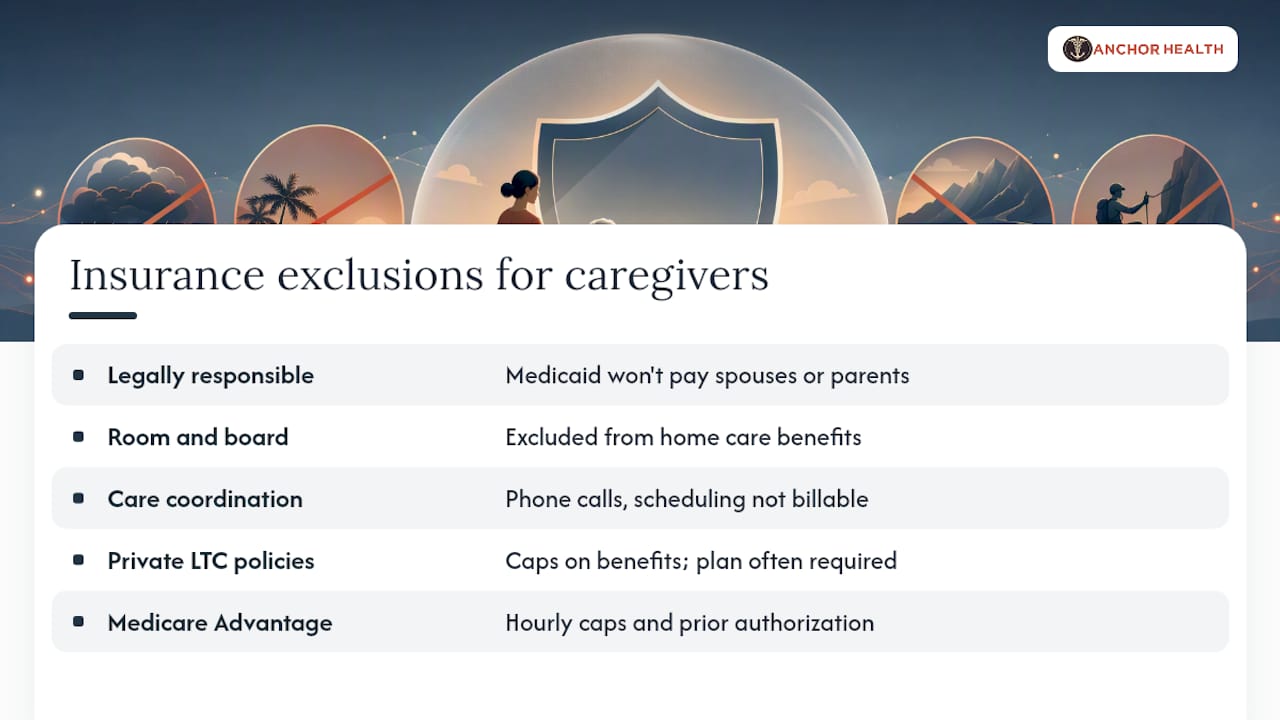
Legally responsible relatives face the tightest restrictions. Most state Medicaid programs won’t pay a spouse to care for their spouse, and won’t pay a parent to care for a minor child, on the theory that this care is already a legal obligation. Some states carve out exceptions for exceptionally high-need cases, but don’t assume yours qualifies without asking directly.
Room and board is almost universally excluded from home care and waiver benefits, even when a paid caregiver lives in the home. Medicaid waivers pay for the caregiving hours, not for housing the caregiver provides.
Care coordination and administrative time, the hours you spend on the phone with insurers, scheduling appointments, or managing medications, is rarely billable under any program, even though it’s often the most time-consuming part of caregiving.
Private long-term care policies frequently cap total benefit days or dollar amounts, and many require a formal, provider-approved care plan before family-caregiver payments start; informal arrangements typically don’t qualify.
Medicare Advantage supplemental benefits, which sometimes include limited in-home support, usually cap hours per year and require prior authorization, so check the specific plan’s evidence of coverage document rather than relying on the general marketing summary.
How Does Coverage Differ for Respite Care Versus Emergency Care?
Respite care and emergency care get treated very differently by nearly every payer, and confusing the two leads to denied claims.
Respite care, short-term relief care meant to give the primary caregiver a break, is typically funded through Medicaid HCBS waivers, VA programs for eligible veterans, or dedicated state and community grant programs, not through standard Medicare or most private insurance. It’s usually capped at a set number of days per year and often requires advance scheduling and prior authorization.
Emergency care works through a completely different set of rules. If your loved one has a medical crisis, an ambulance ride, an ER visit, or urgent hospitalization, that’s billed through standard medical insurance (Medicare, Medicaid, or private insurance) as acute care, not as caregiver support. Emergency coverage doesn’t require the waiver enrollment or waitlist process that respite care often does, since emergency services are federally required to be covered regardless of ability to pay upfront.
The practical gap: if you need a planned weekend off, you likely need to apply for respite benefits weeks in advance. If your loved one falls and needs the ER at 2 a.m., that’s covered under ordinary emergency medical benefits with no waiver application required. Many caregivers discover the difference only after being denied respite funding for what they assumed was an emergency situation, so it’s worth confirming in advance which category a given need falls under.
A Primary Care Perspective on Documentation
A primary care clinician can write the medical necessity letter, functional assessment, or training referral that most benefit applications require. Telehealth visits make this faster: you can often get a signed letter or documentation update within days, not weeks, without needing an in-person appointment your loved one may struggle to attend.
How Telehealth Primary Care Fits Into Your Coverage Plan
Verifying benefits and assembling documentation eats time you don’t have, and that’s exactly where a consistent primary care relationship pays off. Myanchorhealthpc works with families through secure video visits, which means getting a signed medical necessity letter, an updated functional assessment, or a caregiver training referral doesn’t require rearranging a workday around an in-person appointment your loved one may not be able to make anyway.

Because the same clinician sees your loved one visit after visit, documentation stays consistent instead of restarting from scratch with a new provider each time a Medicaid renewal or insurance appeal comes due. Myanchorhealthpc also handles medication management and can flag concerns before they become an ER visit, which matters given how differently emergency care and routine caregiver support get billed. If you’re weighing how a consistent telehealth provider could support your family’s caregiving situation, see how to choose telehealth primary care for your family and book a visit to get documentation moving before your next Medicaid or insurance deadline.
Where This Guidance Comes From
This guide draws on federal and policy-level sources, not general advice, so you can verify anything here directly.
- KFF’s analysis of Medicaid home care programs for caregiver payment scale and state variation.
- AARP’s Medicare caregiver resources for training reimbursement policy.
- FAIR Health Consumer’s navigation checklist for billing and pricing verification steps.
- Usa for state Medicaid enrollment pathways.
- LTCFEDS program details for private long-term care policy examples.
Call your state Medicaid office and your SHIP counselor before you call anyone else. They’re free, and they know the rules your specific state actually enforces, not the general version.
| Point | Details |
|---|---|
| Start with state Medicaid | Waiver rules and pay eligibility are set state by state, not federally. |
| Use SHIP for Medicare questions | Free, trained counselors interpret Medicare paperwork at no cost. |
Frequently Asked Questions
Can I get paid to take care of my elderly parent?
In most states, yes, through a Medicaid consumer-directed personal assistance program or waiver, though spouses and parents of minor children are usually excluded. Contact your state Medicaid office to confirm your specific eligibility.
Does Medicare pay for a family member to provide home care?
Medicare generally does not pay family caregivers directly. It covers skilled, short-term home health after a qualifying hospitalization and hospice care, not ongoing custodial support.
What documents do I need to apply for caregiver payment through Medicaid?
You’ll typically need proof of diagnosis, a physician’s functional assessment, proof of the care recipient’s Medicaid eligibility, and identifying documents like power of attorney if you’re applying on someone else’s behalf.
How long does a Medicaid caregiver payment appeal take?
Appeal windows vary by state and program, often 60 to 180 days from the denial notice. Contact the billing office first to rule out a coding error, then file with the state Medicaid appeals unit.
Will long-term care insurance pay my adult child to care for me?
It depends entirely on the policy. Some plans allow payment to a family member other than a spouse through a formal care plan benefit; others don’t. Call the insurer directly and get the answer in writing.
This article is general information, not a substitute for advice from a qualified doctor. Consult a qualified healthcare professional about your own circumstances before acting on anything here.
Sources
- How do Medicaid home care programs support family caregivers? (KFF)
- Medicare tips and resources for caregiver assistance (AARP)
- Healthcare Navigation Checklist for Family Caregivers and Care Partners (FAIR Health Consumer)
- Usa
- LTCFEDS program details
Recommended
- How to Attend a Telehealth Visit as a Caregiver
- How to Balance Caregiving Work with Telehealth
- Primary Care’s Role in Caregiver Preventive Screenings
Blog & Information Disclaimer
Last Updated: May 23, 2026
The information provided on the Anchor Health website (https://myanchorhealthpc.com/), including but not limited to blog posts, articles, newsletters, graphics, and other materials (collectively, the "Content"), is for general informational and educational purposes only.
By accessing and using this website, you acknowledge and agree to the following terms and conditions:
The Content on this website is not intended to be a substitute for professional medical advice, diagnosis, or treatment. Always seek the advice of your physician, nurse practitioner, or other qualified health provider with any questions you may have regarding a medical condition. Never disregard professional medical advice or delay in seeking it because of something you have read on this website.
Reading, interacting with, or sharing the Content on this website does not establish a patient-provider relationship between you and Anchor Health or any of its clinicians, including Paule Valery Joseph, PhD, MBA, CRNP, FAAN. A formal patient-provider relationship is only established after you have completed the formal intake process, signed our clinical consent forms, and participated in a secure clinical consultation.
If you are experiencing a medical emergency, call 911 or seek emergency medical services immediately.
Anchor Health is a primary care practice and does not provide emergency or crisis intervention services through its website or blog.
While Anchor Health strives to provide thoughtful, evidence-based information grounded in our Anchored Care℠ model, healthcare is a rapidly evolving field. We make no representations or warranties, express or implied, about the completeness, accuracy, reliability, or suitability of the information contained in the Content. Any reliance you place on such information is strictly at your own risk.
Anchor Health is a telehealth practice providing services to patients physically located within the state of Maryland. The information provided on this blog is intended for residents of Maryland and is governed by the laws and regulations of that state. Accessing this information from outside of Maryland does not imply that our clinicians are licensed to practice medicine or provide consultations in your jurisdiction.
Content related to Weight & Metabolic Health, including discussions of GLP-1 medications or other medical therapies, is provided for educational context regarding our clinical approach. Prescriptions and specific medical recommendations are only made following a comprehensive clinical evaluation, diagnostic testing, and shared decision-making within a formal patient-provider relationship.
This website may contain links to external websites that are not provided or maintained by or in any way affiliated with Anchor Health. Please note that Anchor Health does not guarantee the accuracy, relevance, timeliness, or completeness of any information on these external websites.
To the fullest extent permitted by law, Anchor Health, its owners, and its employees shall not be liable for any direct, indirect, incidental, consequential, or punitive damag
Related posts