Do Sinus Infections Need Antibiotics? What the Evidence Says

Most sinus infections are viral, and antibiotics won’t speed recovery or ease symptoms. We reserve them for three situations: severe symptoms (fever of 102°F or higher with thick discharge lasting several days), symptoms that persist past 10 days without improvement, or a pattern of “double worsening,” where you improve, then relapse. When one of those applies, amoxicillin-based treatment is usually the first choice.
TL;DR:
- Most sinus infections are viral, and antibiotics are only justified if symptoms are severe, persist past 10 days, or follow a double-worsening pattern.
- Antibiotics such as amoxicillin or amoxicillin-clavulanate are first-line treatments for bacterial sinusitis, with alternatives like doxycycline for penicillin allergies.
- Courses typically last 5 to 7 days, as longer durations do not significantly improve outcomes and increase risks like antimicrobial resistance.
- Supportive home care—including saline rinses, intranasal steroids, humidifiers, and pain relievers—provides effective relief for most cases without antibiotics.
- Telehealth visits use symptom timelines and visual checks to assess the need for treatment, favoring watchful waiting over unnecessary antibiotic prescriptions.
Table of Contents
- Who Needs Antibiotics for a Sinus Infection?
- Which Antibiotics Work Best for Sinusitis?
- Why Skipping Antibiotics Is Often the Right Call
- How to Treat Sinus Infection Symptoms at Home
- What Happens During a Telehealth Visit for Sinus Symptoms
- Why the Antibiotic Reflex Persists Even When the Evidence Says Otherwise
- Get Evaluated for Sinus Symptoms Without an Urgent Care Wait
- Where to Learn More About Sinus Infection Guidelines
- Sources
Who Needs Antibiotics for a Sinus Infection?
Guidelines from the CDC put the number in perspective: The vast majority of sinus infections are viral. Antibiotics do nothing for a virus, so the diagnostic question isn’t “does this feel bad?” It’s whether your case matches one of three specific patterns.
Severe symptoms mean a fever of 102°F (39°C) or higher paired with facial pain or thick nasal discharge lasting several days without letting up. Persistent symptoms means you’re still congested, pressured, and miserable after 10 full days, with no sign of turning the corner. Double worsening is the pattern clinicians watch closest: you start feeling better around day 5 or 6, then symptoms come roaring back, often with a new fever. That relapse is a stronger signal of bacterial involvement than color, thickness, or volume of mucus ever is.
None of those criteria require a lab test. They require an honest symptom timeline, which is exactly what we ask for in a video visit. Some situations move past “wait and see” entirely and need same-day evaluation:
- Vision changes, eye swelling, or redness around the eye
- Swelling that spreads across the face or forehead
- Severe headache with neck stiffness or confusion
- A fever that spikes rather than gradually resolves
Any of those point toward a complication that can’t wait for a follow-up call, and they warrant urgent or emergency care, not a telehealth visit.
Which Antibiotics Work Best for Sinusitis?
When your symptoms actually meet the bacterial criteria, the CDC’s outpatient guidance names amoxicillin or amoxicillin-clavulanate as first-line therapy for adults. Both are inexpensive, well-studied, and effective against the bacteria most commonly responsible for sinus infections.

Pro Tip: If you’ve been told you’re “allergic to penicillin” but never had a reaction confirmed, mention that during your visit. Many labeled allergies aren’t true reactions, and ruling that out keeps you eligible for first-line treatment instead of a broader-spectrum drug you may not need.
If you have a genuine penicillin allergy, doxycycline or a respiratory fluoroquinolone are the standard alternatives. One class gets specifically ruled out for most patients:
- Macrolides (like azithromycin) are generally discouraged, because Streptococcus pneumoniae resistance to this class runs around 40%, meaning nearly half the time the drug simply won’t work against the bacteria causing the infection.
- Amoxicillin-clavulanate over plain amoxicillin is favored when there’s recent antibiotic use, a nearby resistant organism, or a more severe presentation.
- High-dose or extended courses get considered for patients with underlying conditions, recent hospitalization, or infections that haven’t responded to a first round.
Duration matters more than people assume. Courses commonly run 5 to 10 days, and several guidelines note that 5 to 7 days works just as well as 10 for most uncomplicated adult cases. Longer isn’t automatically better; it’s often just longer.
Why Skipping Antibiotics Is Often the Right Call
Antibiotics carry real costs even when they seem harmless. Nausea, diarrhea, and allergic reactions are the common ones, but the serious risks matter more at a population level. Clostridioides difficile colitis, a severe gut infection triggered by disrupted bacterial balance, is a known consequence of antibiotic overuse, and every unnecessary prescription adds to antimicrobial resistance that makes future infections harder to treat.
The evidence on benefit is thinner than most patients expect. A meta-analysis published in PMC found that antibiotics offer limited benefit for many uncomplicated acute sinusitis cases while increasing adverse effects like diarrhea compared to placebo. That tradeoff is why watchful waiting and delayed prescribing have become standard tools:
- Watchful waiting means observing symptoms for 2 to 3 days before deciding on treatment.
- Delayed prescribing means you receive a prescription but are advised to hold off filling it unless symptoms worsen.
Both approaches give you a safety net without exposing you to antibiotics you likely don’t need.
How to Treat Sinus Infection Symptoms at Home
Supportive care is the actual first-line treatment for the overwhelming majority of sinus infections, not a placeholder while you wait for antibiotics. Here’s what actually helps:
- Rinse with saline irrigation once or twice daily to loosen mucus and calm irritated tissue.
- Use an intranasal corticosteroid spray, which Cleveland Clinic lists among the most effective options for reducing inflammation.
- Run a humidifier to keep nasal passages from drying out further, especially overnight.
- Take acetaminophen or ibuprofen for pain and fever control.
- Consider a short course of an OTC decongestant for immediate relief, but stop after 3 days. Longer use can cause rebound congestion that’s worse than the original problem.
Mucus color is a red herring. Yellow or green discharge feels alarming, but it doesn’t reliably indicate a bacterial infection; it’s simply a normal part of your immune response. Viral sinusitis typically clears in 7 to 10 days, and some cases stretch to 4 weeks before fully resolving. If you’re past day 10 with no improvement, or you hit a double-worsening pattern, that’s your cue to contact your clinician instead of waiting it out further.
What Happens During a Telehealth Visit for Sinus Symptoms
A video visit for sinus symptoms follows the same logic as an in-person exam, built around the timeline that actually drives the decision. We ask when symptoms started, whether you had a brief improvement before relapsing, and whether you’ve had recent fevers. We’ll often ask to see your face on camera or request a photo if swelling or visible symptoms are relevant, and we check your temperature history and any prior antibiotic use or drug allergies.
That conversation is what determines whether you fall into watchful waiting, a delayed prescription, or immediate treatment. Safety netting matters just as much as the initial decision:
- A clear follow-up window, often 48 to 72 hours, to confirm you’re improving
- Specific red-flag instructions on what would mean stop waiting and seek care now
- A direct path to in-person or emergency evaluation if symptoms escalate
This is where continuity earns its keep. Our Anchored Care℠ᴵᴾ model means the clinician following up on day 3 already knows your history from day 1, so nothing gets lost between visits.
Why the Antibiotic Reflex Persists Even When the Evidence Says Otherwise
Here’s the uncomfortable part: most of the pressure toward antibiotics doesn’t come from clinical uncertainty. It comes from the fact that “wait it out” feels like a non-answer when you’re on day 4 of facial pressure and missed work. The guidance is genuinely clear, backed by trials showing limited benefit and real downside risk, yet patients often leave visits feeling like watchful waiting means their provider didn’t take them seriously.
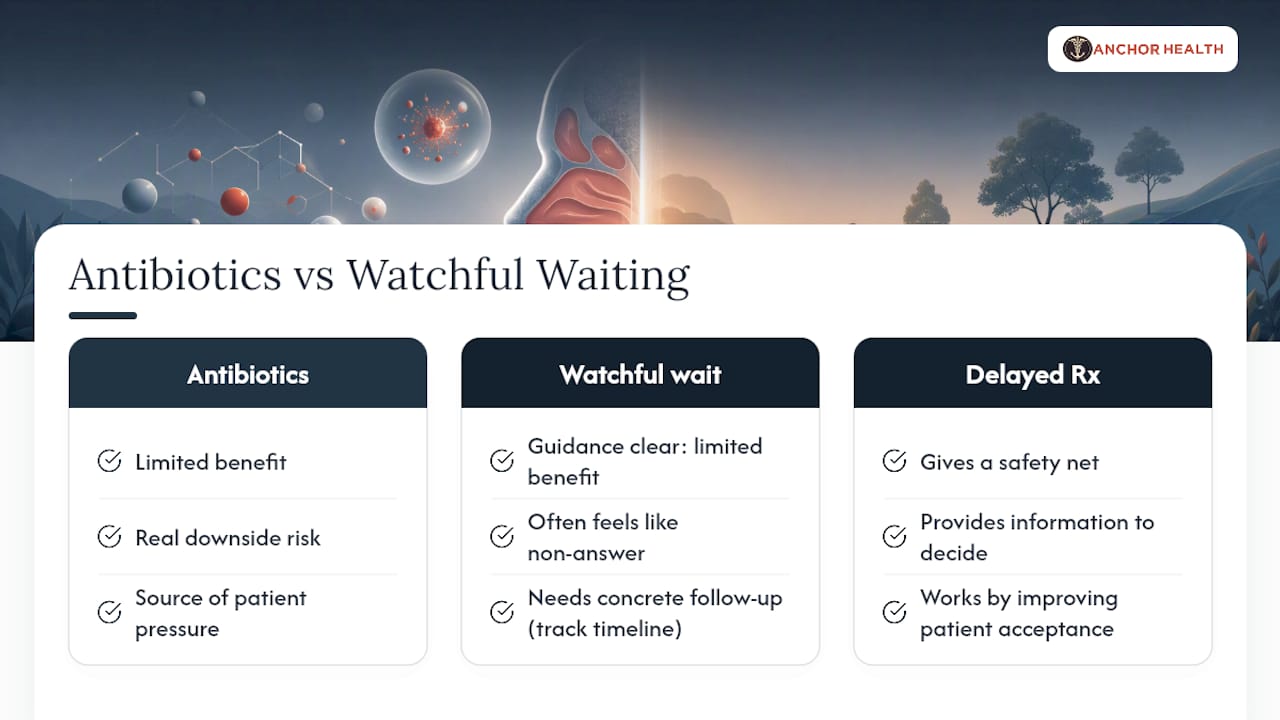
That’s a communication failure, not a clinical one. The fix isn’t stronger antibiotics; it’s a provider who explains the reasoning, sets a concrete follow-up window, and actually checks back in instead of leaving you to self-monitor blindly for ten days. Delayed prescribing works precisely because it gives patients a safety net and an information base to make their own call.
If there’s one thing worth prioritizing over the antibiotic question itself, it’s finding a primary care relationship where that follow-up actually happens. The criteria for treatment are only useful if someone is tracking your timeline with you.
— Paule
Get Evaluated for Sinus Symptoms Without an Urgent Care Wait
Myanchorhealthpc gives you a faster, more personal alternative to sitting in an urgent care waiting room for a sinus infection that may not even need antibiotics. Instead of a rushed five-minute exam with a provider you’ll never see again, you get a video visit with a clinician who reviews your symptom timeline, applies the same guideline-based criteria outlined above, and sets a real follow-up plan if watchful waiting is the right call.

Booking works the same way any primary care visit should: you describe your symptoms, share your history including allergies and prior antibiotics, and your clinician decides whether treatment, delayed prescribing, or a 48 to 72 hour check-in fits your case. We accept insurance and self-pay, and our membership option adds extended access for patients managing recurring or chronic sinus issues who want continuity built in from the start. If facial pressure has outlasted a week and a half, see how to choose telehealth primary care for your family and book a visit today.
Where to Learn More About Sinus Infection Guidelines
- CDC sinus infection guidance: official criteria for when antibiotics are warranted
- StatPearls clinical review: in-depth dosing and diagnostic detail for clinicians
- Cleveland Clinic patient guide: plain-language symptom and treatment overview
- Flu season primary care guidance: when overlapping viral illness changes the picture
This article is general information, not a substitute for advice from a qualified doctor. Consult a qualified healthcare professional about your own circumstances before acting on anything here.
Sources
- Sinus Infection Basics | Sinus Infection | CDC
- Acute sinusitis: Symptoms, causes & treatment | Cleveland Clinic
- Patients insist on antibiotics for sinusitis? Here is a good reason to say “no” | PMC
Recommended
- Sore Throat or Strep? How to Tell and What to Do Next
- Support Stick Archives – My Anchor Health PC – Maryland
- Primary Care’s Role in Childhood Obesity Prevention
Blog & Information Disclaimer
Last Updated: May 23, 2026
The information provided on the Anchor Health website (https://myanchorhealthpc.com/), including but not limited to blog posts, articles, newsletters, graphics, and other materials (collectively, the "Content"), is for general informational and educational purposes only.
By accessing and using this website, you acknowledge and agree to the following terms and conditions:
The Content on this website is not intended to be a substitute for professional medical advice, diagnosis, or treatment. Always seek the advice of your physician, nurse practitioner, or other qualified health provider with any questions you may have regarding a medical condition. Never disregard professional medical advice or delay in seeking it because of something you have read on this website.
Reading, interacting with, or sharing the Content on this website does not establish a patient-provider relationship between you and Anchor Health or any of its clinicians, including Paule Valery Joseph, PhD, MBA, CRNP, FAAN. A formal patient-provider relationship is only established after you have completed the formal intake process, signed our clinical consent forms, and participated in a secure clinical consultation.
If you are experiencing a medical emergency, call 911 or seek emergency medical services immediately.
Anchor Health is a primary care practice and does not provide emergency or crisis intervention services through its website or blog.
While Anchor Health strives to provide thoughtful, evidence-based information grounded in our Anchored Care℠ model, healthcare is a rapidly evolving field. We make no representations or warranties, express or implied, about the completeness, accuracy, reliability, or suitability of the information contained in the Content. Any reliance you place on such information is strictly at your own risk.
Anchor Health is a telehealth practice providing services to patients physically located within the state of Maryland. The information provided on this blog is intended for residents of Maryland and is governed by the laws and regulations of that state. Accessing this information from outside of Maryland does not imply that our clinicians are licensed to practice medicine or provide consultations in your jurisdiction.
Content related to Weight & Metabolic Health, including discussions of GLP-1 medications or other medical therapies, is provided for educational context regarding our clinical approach. Prescriptions and specific medical recommendations are only made following a comprehensive clinical evaluation, diagnostic testing, and shared decision-making within a formal patient-provider relationship.
This website may contain links to external websites that are not provided or maintained by or in any way affiliated with Anchor Health. Please note that Anchor Health does not guarantee the accuracy, relevance, timeliness, or completeness of any information on these external websites.
To the fullest extent permitted by law, Anchor Health, its owners, and its employees shall not be liable for any direct, indirect, incidental, consequential, or punitive damag

Related posts