What Does Insurance Membership Healthcare Mean for You

Insurance membership healthcare is a care delivery model where patients pay a flat, recurring fee for direct access to primary care services, bypassing traditional insurance billing for routine visits. Known formally as Direct Primary Care (DPC), this model is gaining traction among patients who want predictable costs, longer appointments, and a consistent provider relationship. Understanding what does insurance membership healthcare mean helps you make informed decisions about your coverage, your budget, and your health. Myanchorhealthpc offers this kind of relationship-centered care through its Anchored Care℠ᴵᴾ model, built around continuity and access rather than billing volume.
What does insurance membership healthcare mean and how does it work?
Insurance membership healthcare, or Direct Primary Care, is defined as a subscription-based arrangement between a patient and a primary care provider. You pay a flat monthly fee that covers a defined set of primary care services, with no copays or insurance claims for those visits. The Direct Primary Care Association and the Centers for Medicare and Medicaid Services (CMS) both recognize DPC as a distinct care delivery framework, separate from traditional insurance products.
Here is how the model works in practice:
- Enroll with a membership practice. You sign a membership agreement and set up automatic monthly payments, typically ranging from $50 to $150 per month for standard Direct Primary Care plans.
- Schedule visits without billing friction. Once enrolled, you book appointments directly. There are no insurance authorizations, no referral forms, and no surprise bills for covered primary care services.
- Access a defined service set. Most membership practices include unlimited office visits, telehealth consultations, preventive care, chronic disease management, and basic in-office procedures.
- Communicate directly with your doctor. Direct doctor access via text, email, or phone is a standard feature, replacing the front-desk or patient-portal model common in insurance-based settings.
- Renew monthly or annually. Membership agreements are typically month-to-month or annual, with automatic renewal unless you cancel.
Membership practices also keep their patient panels intentionally small. Patient panels in DPC typically range from 300 to 600 patients, compared to 2,000 or more in traditional insurance-based practices. That smaller panel is what makes longer, more personal visits possible.
Pro Tip: Ask any membership practice about same-day and next-day appointment availability before enrolling. Most DPC practices offer both as a standard feature, which is a meaningful difference from the weeks-long wait common in traditional settings.

How does membership healthcare differ from traditional health insurance?
The core difference is scope. Membership healthcare covers routine, relationship-based primary care. Traditional health insurance covers a much broader range of services, including hospitalizations, specialist visits, surgeries, and emergency care. The two models are built for different purposes, and understanding that distinction prevents costly coverage gaps.
Here is a side-by-side comparison of the key differences:
| Feature | Membership healthcare (DPC) | Traditional health insurance |
|---|---|---|
| Payment structure | Flat monthly fee, no copays | Premiums plus copays, deductibles, coinsurance |
| Visit length | 30–60 minutes | 7–15 minutes on average |
| Billing complexity | None for covered services | Multiple payers, codes, and claims |
| Specialist access | Referral required, not covered | Often covered after deductible |
| Emergency and hospital care | Not included | Covered based on plan type |
| Doctor communication | Direct text, email, or call | Front desk or patient portal |
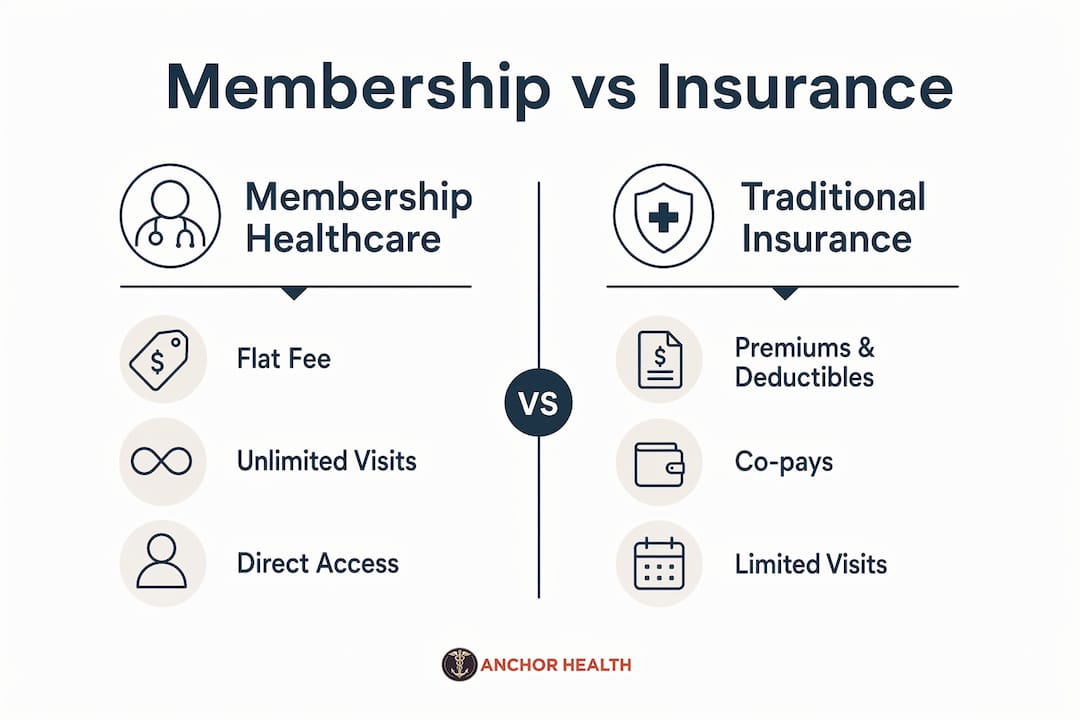
The patient experience gap is significant. Traditional insurance-based visits average 7 to 15 minutes. Membership visits run 30 to 60 minutes. That difference in time translates directly into more thorough evaluations, better chronic disease management, and stronger patient-doctor relationships.
The financial structure also differs in a meaningful way. Traditional insurance involves premiums, deductibles, copays, and coinsurance, all of which can make your actual out-of-pocket cost unpredictable. Membership healthcare eliminates that complexity for primary care. What you pay each month is what you pay, with no additional billing for covered visits.
Membership healthcare and traditional insurance are not competing products. They serve different needs. The most practical approach for most patients is to use membership care for routine and preventive services, and maintain a separate insurance plan for specialist care, hospitalizations, and emergencies.
What are the financial benefits and limits of membership healthcare?
Transparent, predictable pricing is the primary financial benefit of membership healthcare. You know your monthly cost before you schedule a single visit. That predictability matters most for patients managing chronic conditions who need frequent primary care contact throughout the year.
The financial advantages go beyond the flat fee:
- Discounted labs and imaging. Many membership practices negotiate wholesale prices on laboratory tests, imaging, and medications. Membership plan savings on ancillary services can reach 50–90% compared to standard insurance billing rates. That is a benefit rarely available in traditional insurance markets.
- No surprise bills for primary care. Because membership practices do not bill insurance for covered visits, there are no unexpected charges after the fact.
- Medication access. Some practices offer discounted generic medications directly to members, reducing pharmacy costs further.
The limits are equally clear and should not be overlooked:
- Membership plans exclude hospitalizations, emergency care, and specialist services. A membership plan alone does not protect you from a major medical event.
- Specialist referrals are your responsibility to coordinate and fund through separate insurance.
- Surgical procedures, imaging beyond what the practice negotiates, and inpatient care all fall outside the membership scope.
Pro Tip: Pair your membership plan with a high-deductible health plan (HDHP). This combination keeps your monthly insurance premium low while your membership covers the routine care you use most. Combining membership with an HDHP is a recognized strategy for cost-effective, comprehensive coverage.
It is also worth distinguishing DPC from concierge medicine. Concierge medicine often bills insurance in addition to charging a membership fee and typically carries significantly higher monthly costs. DPC is the more affordable, insurance-free version of membership primary care.
How to decide if membership healthcare is right for you
The right fit depends on how you actually use healthcare. Patients who visit their primary care provider frequently, manage one or more chronic conditions, or simply want more time with their doctor benefit most from membership models. Patients who rarely see a doctor and primarily need catastrophic coverage may find the monthly fee less worthwhile.
Work through these steps before enrolling:
- Audit your current healthcare use. Count how many primary care visits you had in the past year. If you had three or more, a flat monthly fee likely costs less than copays plus deductibles for those visits.
- Review what the membership includes. Ask the practice for a written list of covered services. Confirm whether telehealth, preventive screenings, chronic disease management, and basic labs are included.
- Check appointment availability. Ask about same-day and next-day scheduling, after-hours access, and how the practice handles urgent concerns between visits.
- Understand the contract terms. Most DPC agreements are month-to-month, but some require a minimum commitment. Know your cancellation terms before signing.
- Confirm your insurance coverage for non-primary care needs. Maintaining separate insurance for hospital and specialist care is not optional. A membership plan is a complement to insurance, not a replacement.
- Ask about tiered membership options. Some practices offer different tiers based on age, family size, or service level. Families with children may find a family membership more cost-effective than individual plans.
Myanchorhealthpc operates on exactly this kind of model through its Anchored Care℠ᴵᴾ framework, offering telehealth primary care with a focus on continuity, longer visits, and direct provider access for patients across Maryland.
Key Takeaways
Membership healthcare and traditional insurance serve different purposes, and combining them gives patients the most complete and cost-effective coverage available.
| Point | Details |
|---|---|
| Membership healthcare defined | Direct Primary Care is a flat-fee subscription for primary care, not a replacement for insurance. |
| Typical monthly cost | Standard DPC fees range from $50 to $150 per month, with no copays for covered visits. |
| Visit length advantage | Membership visits run 30–60 minutes, compared to 7–15 minutes in traditional insurance settings. |
| Coverage limits | Membership plans exclude hospitalizations, emergency care, and specialist services. |
| Best pairing strategy | Combine a membership plan with a high-deductible health plan for comprehensive, affordable coverage. |
Why membership healthcare changes the patient-doctor relationship
The most underappreciated benefit of membership healthcare is not the cost savings. It is the removal of the billing department as a third party in your care. Bypassing insurance billing for routine visits means your doctor’s decisions are driven by your health, not by what a payer will reimburse. That shift changes everything about how care is delivered.
I have seen patients who spent years cycling through rushed appointments, leaving with unanswered questions and generic advice. The 7-minute visit is not a failure of individual doctors. It is a structural outcome of a billing system that rewards volume over depth. Membership models break that structure by design.
The common misconception I hear most often is that membership healthcare is a luxury product for wealthy patients. That framing is wrong. A $75 monthly membership fee for a family managing a chronic condition can cost less annually than the copays and deductibles they would pay under a standard insurance plan for the same number of primary care visits. The math works for ordinary families, not just high earners.
My honest recommendation is this: do not enroll in a membership practice and cancel your insurance. That is the one mistake that turns a good financial decision into a serious risk. Membership care covers what you use most. Insurance covers what you hope you never need. You need both.
— Paule
Personalized primary care at Myanchorhealthpc
Myanchorhealthpc brings the membership care model to Maryland through secure telehealth visits, with a focus on longer appointments, direct provider communication, and care that follows you over time rather than treating each visit as a standalone event.
The Anchored Care℠ᴵᴾ framework covers general primary care, women’s health, pediatric and adolescent health, mental health support, and weight management, including GLP-1 medications. Enrollment is straightforward, with flat-rate pricing and no surprise billing for covered services. If you are weighing your options, the telehealth primary care guide on the Myanchorhealthpc website walks through exactly what to look for in a membership practice and how to evaluate fit for your family’s needs.
FAQ
What is the difference between DPC and concierge medicine?
Direct Primary Care charges a flat monthly fee and does not bill insurance for routine visits. Concierge medicine often bills insurance in addition to a membership fee and typically costs significantly more per month.
Does a membership healthcare plan count as health insurance?
No. Membership healthcare is a care delivery model, not insurance. Patients must maintain separate health insurance for hospital care, specialist visits, and emergencies to avoid coverage gaps.
What services does a typical membership plan include?
Most Direct Primary Care memberships include unlimited primary care visits, telehealth, preventive screenings, chronic disease management, and direct doctor communication via text or phone.
Can I use a membership plan with a high-deductible health plan?
Yes. Pairing a membership plan with a high-deductible health plan is a recognized strategy for keeping insurance premiums low while covering routine primary care through the membership fee.
How do I enroll in a membership healthcare practice?
Enrollment typically involves signing a membership agreement and setting up automatic monthly payments. Most practices offer month-to-month terms, and some offer family or tiered pricing options.
Recommended
- Benefits of Membership-Based Primary Care for Families
- Whole Person Care: What Families Need to Know in 2026
- What Does Preventive Care Mean for Teens: A Parent’s Guide
Blog & Information Disclaimer
Last Updated: May 23, 2026
The information provided on the Anchor Health website (https://myanchorhealthpc.com/), including but not limited to blog posts, articles, newsletters, graphics, and other materials (collectively, the "Content"), is for general informational and educational purposes only.
By accessing and using this website, you acknowledge and agree to the following terms and conditions:
The Content on this website is not intended to be a substitute for professional medical advice, diagnosis, or treatment. Always seek the advice of your physician, nurse practitioner, or other qualified health provider with any questions you may have regarding a medical condition. Never disregard professional medical advice or delay in seeking it because of something you have read on this website.
Reading, interacting with, or sharing the Content on this website does not establish a patient-provider relationship between you and Anchor Health or any of its clinicians, including Paule Valery Joseph, PhD, MBA, CRNP, FAAN. A formal patient-provider relationship is only established after you have completed the formal intake process, signed our clinical consent forms, and participated in a secure clinical consultation.
If you are experiencing a medical emergency, call 911 or seek emergency medical services immediately.
Anchor Health is a primary care practice and does not provide emergency or crisis intervention services through its website or blog.
While Anchor Health strives to provide thoughtful, evidence-based information grounded in our Anchored Care℠ model, healthcare is a rapidly evolving field. We make no representations or warranties, express or implied, about the completeness, accuracy, reliability, or suitability of the information contained in the Content. Any reliance you place on such information is strictly at your own risk.
Anchor Health is a telehealth practice providing services to patients physically located within the state of Maryland. The information provided on this blog is intended for residents of Maryland and is governed by the laws and regulations of that state. Accessing this information from outside of Maryland does not imply that our clinicians are licensed to practice medicine or provide consultations in your jurisdiction.
Content related to Weight & Metabolic Health, including discussions of GLP-1 medications or other medical therapies, is provided for educational context regarding our clinical approach. Prescriptions and specific medical recommendations are only made following a comprehensive clinical evaluation, diagnostic testing, and shared decision-making within a formal patient-provider relationship.
This website may contain links to external websites that are not provided or maintained by or in any way affiliated with Anchor Health. Please note that Anchor Health does not guarantee the accuracy, relevance, timeliness, or completeness of any information on these external websites.
To the fullest extent permitted by law, Anchor Health, its owners, and its employees shall not be liable for any direct, indirect, incidental, consequential, or punitive damag
Related posts