Why Primary Care Tracks Growth Milestones in Children

Primary care providers track growth milestones because early identification of developmental delays gives children the best chance at timely intervention during the windows when their brains and bodies are most responsive to support. This isn’t routine paperwork. It’s a structured, ongoing process that monitors five core developmental domains: gross motor skills, fine motor skills, language, cognition, and social-emotional development. The American Academy of Pediatrics recommends standardized developmental screenings at 9, 18, and 30 months, with autism-specific screening at 18 and 24 months. Tracking these benchmarks serves two purposes at once: it catches concerns before they become entrenched, and it gives you, as a parent or caregiver, a clear picture of where your child stands and what to expect next.
Key reasons primary care monitors developmental progress:
- Early detection of delays in motor, language, or social skills before they affect school readiness
- Anticipatory guidance so parents know what milestones to watch for between visits
- Longitudinal data that reveals patterns no single appointment can show
- Timely referrals to specialists or early intervention programs when concerns arise
- Parent education that builds confidence and active participation in a child’s development
Why consistent well-child visits are the foundation of growth tracking
Routine well-child visits are where growth monitoring actually happens, and missing them creates gaps that are hard to fill later. The American Academy of Pediatrics recommends developmental surveillance at every visit, alongside formal screening at designated ages. That consistency is what allows a provider to distinguish a temporary plateau from a genuine delay.
Keeping visits on schedule matters for several practical reasons:
- Growth patterns are only meaningful when measured repeatedly over time, not in isolation
- Behavioral or language concerns that parents normalize at home often become visible to a trained provider during a routine exam
- Screenings are timed to align with critical developmental windows throughout early childhood
- Screening frequency tends to drop after 18 months in many practices, making parental vigilance especially important from toddlerhood onward
- School readiness visits at ages 4–5 are a key checkpoint for catching late-emerging concerns
To get the most from each visit, bring a written list of any behaviors or changes you’ve noticed at home. Providers rely on your observations as much as their own clinical assessment.
Pro Tip: Before each well-child visit, spend five minutes writing down two or three specific things your child has started doing or stopped doing since the last appointment. That kind of concrete detail helps your provider make faster, more accurate assessments.
What developmental milestones actually are and why they matter
Developmental milestones are the skills and behaviors that most children can perform by a certain age. They aren’t pass-or-fail tests. They’re reference points that help providers assess whether a child’s development is progressing along a typical path or showing signs that warrant closer attention.
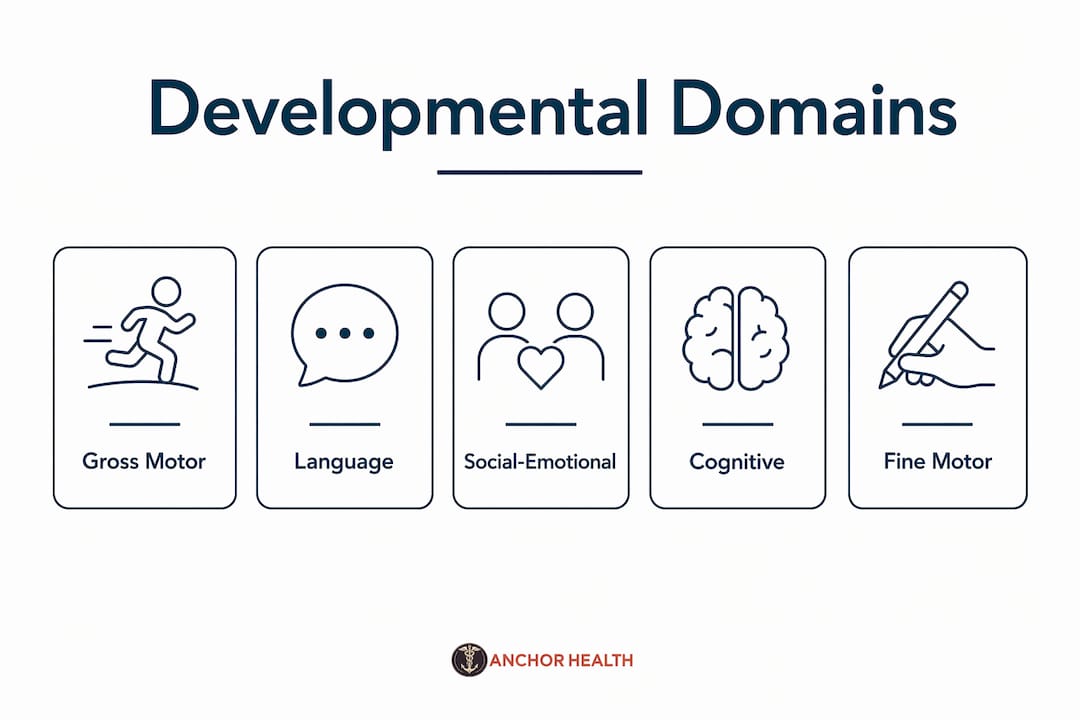
Milestones are organized into five domains, and delays in one area can signal issues across others, which is why providers assess all of them together rather than in isolation.
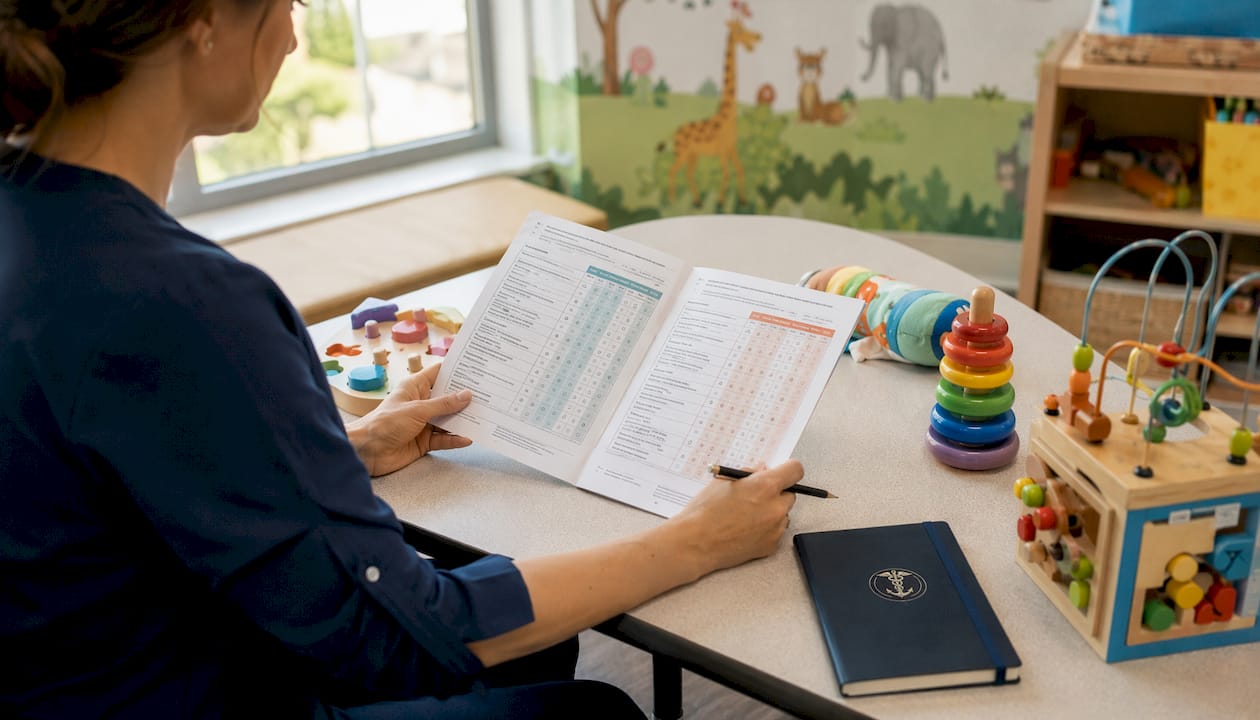
| Age | Gross Motor | Language | Social-Emotional | Cognitive |
|---|---|---|---|---|
| — | Rolls both ways | Responds to name | Recognizes familiar faces | Reaches for objects |
| 12 months | Pulls to stand | Says “mama” or “dada” | Shows stranger anxiety | Imitates gestures |
| 18 months | Walks independently | Uses 10+ words | Points to show interest | Sorts shapes |
| 24 months | Runs, kicks a ball | Two-word phrases | Parallel play with peers | Simple pretend play |
| 4–5 years | Hops on one foot | Tells simple stories | Cooperative play | Counts to 10+ |
Providers use validated tools alongside direct observation to assess these domains. The Ages and Stages Questionnaires and the Modified Checklist for Autism in Toddlers with Follow-Up (M-CHAT-R/F) are two widely used instruments in primary care settings. These tools give structure to what might otherwise be an informal conversation, and they help ensure that subtle delays aren’t overlooked during a busy appointment.
How primary care identifies developmental concerns early
There’s an important distinction between developmental monitoring and developmental screening, and understanding both helps you know what your provider is doing at each visit. Monitoring is the ongoing, informal observation that happens at every appointment. Screening uses formal, validated tools at specific ages to identify children who need further evaluation.
Red flags that providers watch for include:
- No babbling by 12 months or no single words by 16 months
- Loss of previously acquired language or social skills at any age
- No two-word phrases by 24 months
- Persistent toe-walking or significant asymmetry in motor skills
- Limited eye contact or difficulty responding to their name by 12 months
The earlier a concern is identified, the more responsive a child’s developing brain tends to be to intervention. Responsiveness to intervention is most prominent in early childhood; the later a developmental issue is caught, the greater the risk of emotional, social, and academic difficulties down the line. That’s the core reason why primary care doesn’t wait for a problem to become obvious before acting.
How growth tracking supports your child’s long-term health
Physical growth monitoring, which tracks weight, height, head circumference, and BMI over time, tells a different story than any single measurement can. Growth charts track trends, not just percentiles, and a child who consistently follows the 15th percentile curve is developing normally, while a child who crosses multiple percentile lines upward or downward may need further evaluation.
Growth trajectories, rather than absolute measurements, are what help providers identify critical windows where intervention can improve long-term outcomes. Upward crossing of percentile lines in the first six months of life, for example, has been shown to predict later obesity risk. Providers use this longitudinal data to adjust nutrition guidance, flag potential endocrine or metabolic concerns, and connect families to childhood obesity prevention resources before a problem becomes entrenched.
Supporting healthy growth at home reinforces what happens in the clinic:
- Prioritize consistent sleep schedules, which directly affect growth hormone release
- Offer varied, nutrient-dense foods and limit ultra-processed options from early toddlerhood
- Encourage active, unstructured play that supports both motor development and healthy weight
- Limit screen time in line with age-appropriate guidelines, particularly before age 2
- Talk, read, and sing to your child daily to build language and cognitive pathways
Building a real partnership with your child’s provider
The relationship between your family and your primary care provider is one of the most practical tools in your child’s developmental support system. Parents who understand why milestone screenings occur are more likely to follow through on recommended interventions, which leads to better outcomes. That engagement starts with open, honest communication at every visit.
A strong family-provider partnership looks like this:
- Sharing concerns without waiting to be asked, even if they seem minor
- Asking your provider to explain what a screening result means in plain terms
- Following up on referrals promptly rather than adopting a wait-and-see approach
- Keeping a simple log of new skills or behavioral changes between appointments
- Requesting written summaries or handouts when guidance feels hard to retain
Pro Tip: If something feels off with your child’s development, say it out loud at the appointment. Providers depend on your observations. A concern you mention in passing may be exactly the detail that changes the clinical picture.
Shared decision-making matters when a provider recommends a referral or early intervention. Ask what the referral is for, what the evaluation will involve, and what happens if you wait. Those questions don’t signal distrust. They signal that you’re an engaged partner in your child’s care, and a good provider will welcome them. You can also review a pediatric annual checkup checklist to prepare for each visit with confidence.
Telehealth and milestone tracking: what a continuous care model makes possible
Telehealth changes the practical calculus of developmental monitoring in ways that benefit families directly. When geography, work schedules, or transportation make in-person visits difficult, a secure video visit removes those barriers without sacrificing the clinical relationship. At Myanchorhealthpc, the Anchored Care℠ᴵᴾ model is built around exactly this kind of continuity. Your child sees the same provider across visits, which means that provider accumulates a real longitudinal picture of your child’s development rather than starting fresh each time.
Telehealth-specific advantages for milestone tracking include:
- Providers can observe a child in their natural home environment, which sometimes reveals behaviors that don’t appear in a clinical setting
- Parents can share video clips of concerning behaviors captured between appointments
- Follow-up visits after a screening concern are easier to schedule and keep
- Digital milestone checklists can be completed before the visit, making the appointment itself more focused
- Parental education and anticipatory guidance can be reinforced through secure messaging between visits
Pro Tip: Use your phone to record short clips of any behavior that concerns you, whether it’s an unusual gait, a speech pattern, or a social interaction. A 30-second video shown during a telehealth visit gives your provider far more information than a verbal description alone.
Telehealth enables continuous engagement and milestone tracking, allowing providers to reinforce parental education and maintain routine monitoring even when in-person visits are challenging. The evidence base for preventive care for kids supports this model: children who receive both developmental monitoring and formal screening together are more likely to receive early intervention when they need it.
Myanchorhealthpc brings consistent pediatric care to Maryland families
For Maryland families who want attentive, relationship-based pediatric care without the friction of traditional clinic visits, Myanchorhealthpc offers a different path. Through secure video visits and the Anchored Care℠ᴵᴾ model, your child’s provider builds a genuine longitudinal record of their growth and development across every appointment. There’s no rotating roster of unfamiliar faces, and no rushed 10-minute slot where your concerns get sidelined.
Myanchorhealthpc covers pediatric and adolescent health as part of its full-spectrum primary care offering, including developmental surveillance, growth chart review, and parent guidance at every stage. If a concern arises between scheduled visits, the practice’s telehealth model makes it straightforward to connect quickly rather than waiting weeks for an opening. For families managing sick child visits or ongoing developmental questions, that kind of access matters. Schedule your child’s first telehealth visit at myanchorhealthpc.com to get started with a provider who will know your child by name, not just by chart number.
Key Takeaways
Primary care tracks growth milestones because longitudinal monitoring across all five developmental domains is the most reliable way to catch delays early, when intervention has the greatest impact.
| Point | Details |
|---|---|
| Screening ages are specific | The American Academy of Pediatrics recommends standardized developmental screenings at 9, 18, and 30 months, with autism-specific screening at 18 and 24 months. |
| Trends matter more than numbers | Growth charts reveal meaningful patterns only when reviewed across multiple visits, not as a single data point. |
| Monitoring and screening are both needed | Informal surveillance at every visit and formal validated tools at key ages work together to catch concerns that either method alone might miss. |
| Parent engagement improves outcomes | Parents who understand why screenings occur are more likely to follow through on referrals and interventions, leading to better developmental results. |
| Myanchorhealthpc supports continuous tracking | Through the Anchored Care℠ᴵᴾ model, Myanchorhealthpc provides relationship-based telehealth pediatric care that builds a real longitudinal developmental record for your child. |
Recommended
- Family Primary Care Best Practices for Every Age
- Primary Care’s Role in Childhood Obesity Prevention
- Examples of Preventive Care for Kids: Parent’s Guide
- Pediatric Annual Checkup Checklist for Parents
Blog & Information Disclaimer
Last Updated: May 23, 2026
The information provided on the Anchor Health website (https://myanchorhealthpc.com/), including but not limited to blog posts, articles, newsletters, graphics, and other materials (collectively, the "Content"), is for general informational and educational purposes only.
By accessing and using this website, you acknowledge and agree to the following terms and conditions:
The Content on this website is not intended to be a substitute for professional medical advice, diagnosis, or treatment. Always seek the advice of your physician, nurse practitioner, or other qualified health provider with any questions you may have regarding a medical condition. Never disregard professional medical advice or delay in seeking it because of something you have read on this website.
Reading, interacting with, or sharing the Content on this website does not establish a patient-provider relationship between you and Anchor Health or any of its clinicians, including Paule Valery Joseph, PhD, MBA, CRNP, FAAN. A formal patient-provider relationship is only established after you have completed the formal intake process, signed our clinical consent forms, and participated in a secure clinical consultation.
If you are experiencing a medical emergency, call 911 or seek emergency medical services immediately.
Anchor Health is a primary care practice and does not provide emergency or crisis intervention services through its website or blog.
While Anchor Health strives to provide thoughtful, evidence-based information grounded in our Anchored Care℠ model, healthcare is a rapidly evolving field. We make no representations or warranties, express or implied, about the completeness, accuracy, reliability, or suitability of the information contained in the Content. Any reliance you place on such information is strictly at your own risk.
Anchor Health is a telehealth practice providing services to patients physically located within the state of Maryland. The information provided on this blog is intended for residents of Maryland and is governed by the laws and regulations of that state. Accessing this information from outside of Maryland does not imply that our clinicians are licensed to practice medicine or provide consultations in your jurisdiction.
Content related to Weight & Metabolic Health, including discussions of GLP-1 medications or other medical therapies, is provided for educational context regarding our clinical approach. Prescriptions and specific medical recommendations are only made following a comprehensive clinical evaluation, diagnostic testing, and shared decision-making within a formal patient-provider relationship.
This website may contain links to external websites that are not provided or maintained by or in any way affiliated with Anchor Health. Please note that Anchor Health does not guarantee the accuracy, relevance, timeliness, or completeness of any information on these external websites.
To the fullest extent permitted by law, Anchor Health, its owners, and its employees shall not be liable for any direct, indirect, incidental, consequential, or punitive damag
Related posts