Care Coordination in Family Medicine: A Practical Guide

What is care coordination in family medicine?
Care coordination in family medicine is the deliberate organization of patient care activities and the sharing of information among everyone involved in a patient’s care, with the goal of achieving safer and more effective outcomes. The Agency for Healthcare Research and Quality defines it as ensuring that a patient’s needs and preferences are known ahead of time, communicated to the right people at the right time, and used to guide every care decision. This is not incidental communication. It is a structured, intentional process built into how a family medicine practice operates.
At its core, family medicine coordination rests on several interconnected elements:
- Establishing accountability: Every team member knows their role and who owns each task.
- Sharing knowledge: Medical history, test results, and care plans move between providers without gaps.
- Proactive care planning: Needs are anticipated before a crisis, not addressed after one.
- Supporting transitions: Patients moving from hospital to home, or from specialist back to primary care, receive active follow-up.
- Linking to community resources: Social needs like housing, transportation, and food access are addressed alongside medical ones.
- Monitoring and follow-up: Changes in a patient’s condition trigger a response, not just a note in the chart.
The Institute of Medicine has identified care coordination as a key strategy with the potential to improve the effectiveness, safety, and efficiency of the American health care system.
Table of Contents
- How care coordination works within a family medicine team
- What are the real benefits of care coordination for patients?
- How do family medicine practices deliver care coordination?
- What does the evidence say about care coordination’s effectiveness?
- How the Anchored Care℠ᴵᴾ model puts coordination into practice
- What makes care coordination difficult in family medicine?
- Myanchorhealthpc brings coordinated primary care to Maryland families
- Key Takeaways
How care coordination works within a family medicine team
Team-based care is the engine behind effective coordination in family medicine. The American Academy of Family Physicians (AAFP) emphasizes that distributing tasks across a care team allows physicians to focus on complex clinical decisions while nurses, care coordinators, and behavioral health specialists handle the coordination work that keeps patients from falling through the cracks.
A typical family medicine care team includes:
- Family physicians: Lead clinical decision-making, manage complex diagnoses, and set the care plan.
- Nurses and medical assistants: Conduct assessments, manage medication reconciliation, and follow up on test results.
- Care coordinators: Track patients with chronic conditions, schedule referrals, and connect patients with community services.
- Behavioral health specialists: Address mental health needs that often complicate physical conditions.
- Social workers: Shift communication toward telephone and remote contacts when social determinants of health require attention, such as unstable housing or food insecurity.
Structured workflows hold this team together. The AAFP notes that short daily huddles and panel management meetings improve communication and support care management billing compliance. The SBAR framework (Situation, Background, Assessment, Recommendation) gives team members a consistent format for handoffs, reducing the chance that critical information gets lost.
Pro Tip: Delegate routine coordination tasks, such as appointment reminders and referral tracking, to care coordinators and nurses. This frees physicians to spend their time on the clinical complexity that genuinely requires their training.

What are the real benefits of care coordination for patients?
Coordinated care produces measurable improvements in patient safety, experience, and cost. The Centers for Medicare & Medicaid Services recognizes it as central to reducing patient frustration and improving health care affordability. For patients managing chronic conditions, the difference between coordinated and fragmented care can be the difference between stability and a preventable hospitalization.
Key benefits include:
- Fewer medical errors: When all providers share the same information, conflicting prescriptions and missed diagnoses become far less likely.
- Reduced duplicate testing: Accountable Care Organizations (ACOs) help eliminate redundant tests by enabling providers to access shared records.
- Lower out-of-pocket costs: Patients avoid repeated appointments and unnecessary procedures when their care team communicates well.
- Fewer emergency department visits: Coordinated care, especially for patients with chronic conditions, reduces hospitalizations and ED use.
- Better chronic disease management: Patients with diabetes, heart disease, or multiple coexisting conditions benefit most, since their care spans multiple providers and settings.
- Stronger patient-provider relationships: Knowing that someone on the team is actively tracking your care builds trust and encourages patients to stay engaged.
For families managing pediatric or adolescent health alongside adult chronic conditions, coordinated family primary care means fewer gaps and a more consistent experience across every stage of life.
How do family medicine practices deliver care coordination?
Delivery methods vary considerably depending on a practice’s resources, geography, and patient population. Research published in the Journal of the American Board of Family Medicine confirms that coordination models evolve organically, with no single best approach. Rural clinics often develop resource-rich models for complex patient needs, while urban practices tend to rely more heavily on specialist networks and referral systems.
Common delivery approaches include:
- Electronic health records (EHRs): Shared platforms let every provider see a patient’s medical history, active medications, and recent test results in real time.
- ACO participation: Joining an Accountable Care Organization facilitates communication between primary care physicians and specialists, and often connects patients with social services.
- Closed-loop communication: After a referral or test order, the team confirms receipt and follows up on results rather than assuming the patient will manage it independently.
- Teach-Back method: Providers confirm patient understanding by asking patients to explain instructions back in their own words, catching misunderstandings before they become problems.
- Telehealth platforms: Video visits extend coordination reach, particularly for patients in Maryland and other states where in-person access is limited.
- CMS Innovation Center models: Programs like the Medicare Shared Savings Program reward practices for successful coordination that improves patient health outcomes.
For families with children who have complex medical needs, coordinated pediatric care requires the same structured communication and proactive planning that adult chronic care demands.
What does the evidence say about care coordination’s effectiveness?
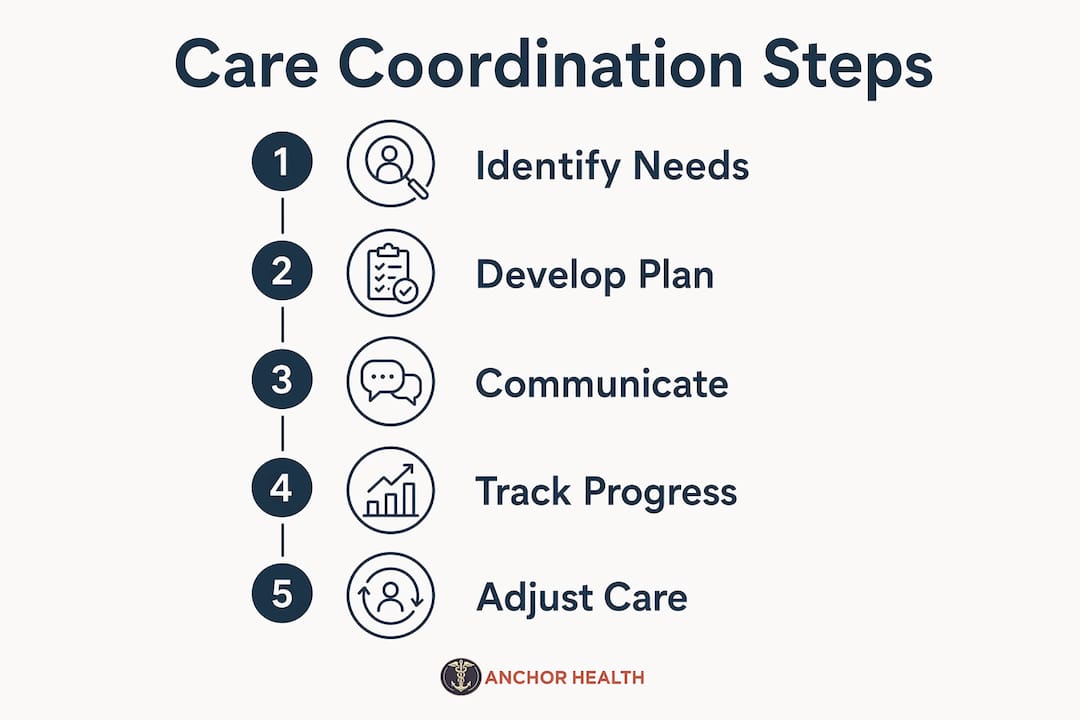
The research base supporting care coordination is consistent and spans multiple care settings. Nurse-led coordination models have demonstrated improved clinical and financial outcomes, with reductions in both emergency department visits and hospitalizations. The Patient-Centered Medical Home (PCMH) model, which places care coordination at its center, has shown similar results across primary care populations.
Key findings from the evidence base:
- Coordinated care reduces ED visits and hospitalizations, producing meaningful cost savings for patients and payers.
- Nurse-led coordination models improve both clinical outcomes and financial performance across populations.
- ACO participation supports shared health information and reduces duplicate testing, as documented by CMS.
- Integrated mental health within primary care teams improves outcomes for patients whose behavioral health needs complicate their physical conditions.
- Care coordinators report high job satisfaction despite role-related stress, supporting the sustainability of the model in primary care settings.
How the Anchored Care℠ᴵᴾ model puts coordination into practice
Myanchorhealthpc built its Anchored Care℠ᴵᴾ model around exactly what the evidence supports: long-term, relationship-based care that treats coordination as a continuous responsibility, not a one-time event. Where fragmented care leaves patients managing their own referrals and repeating their history to every new provider, Anchored Care℠ᴵᴾ keeps a consistent provider relationship at the center of every interaction.
The model prioritizes knowing each patient’s preferences and health goals before a visit, not during it. Care plans are proactive, updated as conditions change, and shared across the care team. For patients managing chronic conditions or navigating mental and metabolic health alongside primary care, this continuity prevents the gaps that lead to preventable complications. Myanchorhealthpc delivers this through secure video visits, making it accessible for busy families and working adults in Maryland without requiring time off or travel.
Pro Tip: When evaluating any primary care practice, ask whether your care plan is updated between visits and whether someone on the team proactively tracks your referrals and follow-up results. That follow-through is what separates coordinated care from episodic treatment.
What makes care coordination difficult in family medicine?
Even well-designed coordination systems face real barriers. Understanding them helps both patients and care teams set realistic expectations and advocate for better systems.
- Time constraints: Physicians in busy practices often lack the time to personally manage every coordination task, which is why team delegation is so critical.
- Interoperability gaps: Not all EHR systems communicate with each other, meaning patient records from outside a practice may not be visible to the care team.
- Workforce shortages: Rural and underserved areas often lack the care coordinators and behavioral health specialists needed to staff a full team-based model.
- Patient engagement: Coordination only works when patients follow up, attend referrals, and communicate changes in their condition. Low health literacy can make this harder.
- Billing complexity: Care coordination services are reimbursable under Medicare and Medicaid, but the documentation requirements can be burdensome for smaller practices.
- Fragmented social services: Connecting patients with housing, food, or transportation resources requires relationships with community organizations that many practices have not yet built.
Addressing these barriers takes both practice-level commitment and policy support. CMS programs and AAFP resources provide frameworks, but the day-to-day work of coordination still depends on teams that are staffed, trained, and given the time to do it well.
Myanchorhealthpc brings coordinated primary care to Maryland families
Fragmented care is frustrating, and it costs more than most patients realize. Myanchorhealthpc offers a different path: a telehealth primary care experience built on the Anchored Care℠ᴵᴾ model, where your care team knows your history, tracks your referrals, and follows up without you having to chase anyone down.
Whether you are managing a chronic condition, coordinating care for your family, or simply looking for a primary care provider who treats you as a whole person, Myanchorhealthpc is designed for exactly that. We accept insurance, offer membership options for enhanced access, and serve patients across Maryland through secure video visits. If you are ready for care that stays with you between appointments, schedule your first visit at myanchorhealthpc.com.
Key Takeaways
Care coordination in family medicine requires deliberate organization, shared information, and a team-based approach to prevent errors, reduce costs, and keep patients healthier over time.
| Point | Details |
|---|---|
| Core definition | Care coordination means organizing patient activities and sharing information so care is safe, effective, and aligned with patient goals. |
| Team-based delivery | Nurses, care coordinators, and behavioral health specialists handle coordination tasks so physicians can focus on complex decisions. |
| Patient benefits | Coordinated care reduces duplicate testing, lowers out-of-pocket costs, and decreases emergency department visits, especially for chronic conditions. |
| Evidence base | Nurse-led coordination models have demonstrated improved clinical and financial outcomes, supported by AAFP, AHRQ, and CMS research. |
| Myanchorhealthpc | The Anchored Care℠ᴵᴾ model delivers relationship-based, proactive coordination through telehealth for Maryland families and individuals. |
Recommended
- Family Primary Care Best Practices for Every Age
- The Role of Family Doctor in Preventive Care
- How to Choose Telehealth Primary Care for Your Family
- How to Balance Caregiving Work with Telehealth
Blog & Information Disclaimer
Last Updated: May 23, 2026
The information provided on the Anchor Health website (https://myanchorhealthpc.com/), including but not limited to blog posts, articles, newsletters, graphics, and other materials (collectively, the "Content"), is for general informational and educational purposes only.
By accessing and using this website, you acknowledge and agree to the following terms and conditions:
The Content on this website is not intended to be a substitute for professional medical advice, diagnosis, or treatment. Always seek the advice of your physician, nurse practitioner, or other qualified health provider with any questions you may have regarding a medical condition. Never disregard professional medical advice or delay in seeking it because of something you have read on this website.
Reading, interacting with, or sharing the Content on this website does not establish a patient-provider relationship between you and Anchor Health or any of its clinicians, including Paule Valery Joseph, PhD, MBA, CRNP, FAAN. A formal patient-provider relationship is only established after you have completed the formal intake process, signed our clinical consent forms, and participated in a secure clinical consultation.
If you are experiencing a medical emergency, call 911 or seek emergency medical services immediately.
Anchor Health is a primary care practice and does not provide emergency or crisis intervention services through its website or blog.
While Anchor Health strives to provide thoughtful, evidence-based information grounded in our Anchored Care℠ model, healthcare is a rapidly evolving field. We make no representations or warranties, express or implied, about the completeness, accuracy, reliability, or suitability of the information contained in the Content. Any reliance you place on such information is strictly at your own risk.
Anchor Health is a telehealth practice providing services to patients physically located within the state of Maryland. The information provided on this blog is intended for residents of Maryland and is governed by the laws and regulations of that state. Accessing this information from outside of Maryland does not imply that our clinicians are licensed to practice medicine or provide consultations in your jurisdiction.
Content related to Weight & Metabolic Health, including discussions of GLP-1 medications or other medical therapies, is provided for educational context regarding our clinical approach. Prescriptions and specific medical recommendations are only made following a comprehensive clinical evaluation, diagnostic testing, and shared decision-making within a formal patient-provider relationship.
This website may contain links to external websites that are not provided or maintained by or in any way affiliated with Anchor Health. Please note that Anchor Health does not guarantee the accuracy, relevance, timeliness, or completeness of any information on these external websites.
To the fullest extent permitted by law, Anchor Health, its owners, and its employees shall not be liable for any direct, indirect, incidental, consequential, or punitive damag
Related posts