The Role of Primary Care in Advanced Care Planning

Advanced care planning (ACP) is defined as an ongoing, voluntary process in which patients clarify their healthcare values, name a trusted decision-maker, and document their preferences before a medical crisis occurs. The role of primary care in advanced care planning is central to this process because no other clinical relationship combines the trust, continuity, and frequency of contact needed to make these conversations meaningful. Primary care providers who use standardized frameworks, Medicare Annual Wellness Visits, and electronic medical record (EMR) integration are best positioned to ensure your wishes guide your care across every setting. At Myanchorhealthpc, this kind of relationship-based, ongoing care is the foundation of everything we do.
How does primary care facilitate the advanced care planning process?
Primary care providers are the most effective facilitators of ACP because they already hold the trust patients need to discuss difficult topics. ACP is a voluntary, patient-led process typically involving multiple 30–60 minute consultations rather than a single appointment. That structure matters. It means your provider can revisit your preferences as your health or personal goals change over time.
The best outcomes come when patients lead these conversations and clinicians facilitate them. Clinicians provide prompts and clarify terminology rather than simply completing forms. This distinction is important because patients who feel guided rather than directed are more likely to complete ACP documents and update them when circumstances shift.
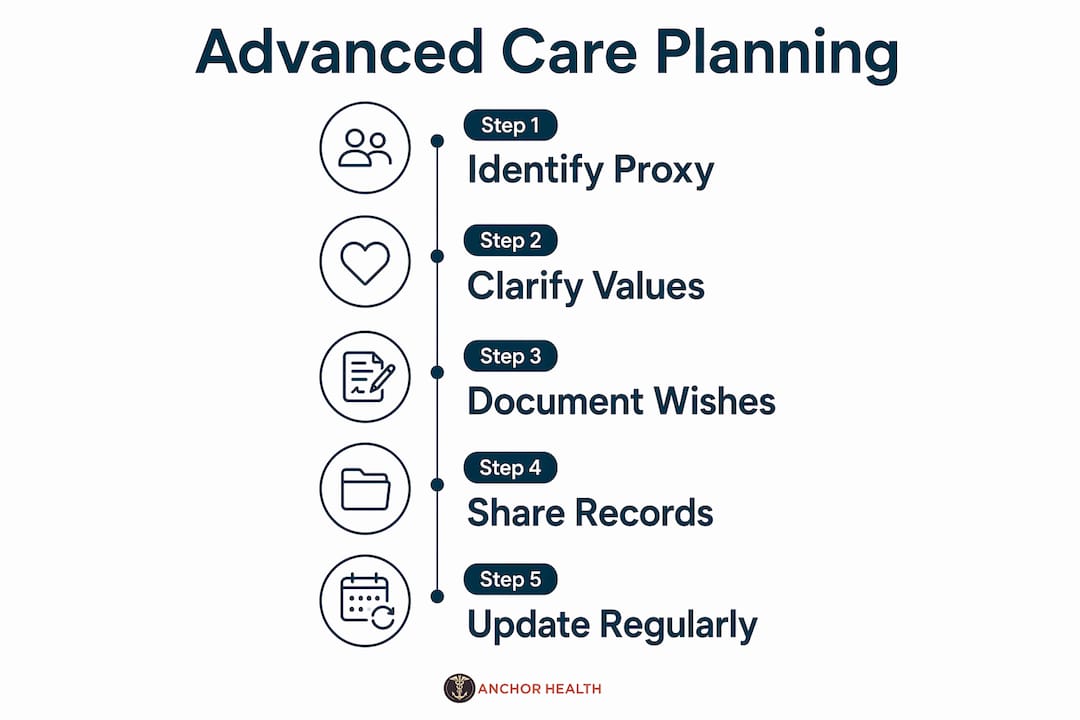
A structured approach helps families know what to expect. The ACP process in primary care generally follows this sequence:
- Identify a healthcare proxy. The first priority is naming a trusted person to make decisions if you cannot speak for yourself. This conversation often happens before any medical preferences are discussed.
- Clarify your values. Your provider helps you articulate what quality of life means to you, what conditions you would find unacceptable, and what matters most in your daily life.
- Review treatment preferences. Specific preferences around resuscitation, mechanical ventilation, and artificial nutrition are discussed in plain language.
- Address comfort and emotional needs. The Five Wishes framework covers healthcare proxy, treatment preferences, comfort goals, emotional needs, and personalized messages for family. It is one of the most patient-focused ACP tools available.
- Involve family and caregivers. Primary care visits offer a safe, private space to bring family members into the conversation, reducing the burden on loved ones during a future crisis.
Pro Tip: Ask your primary care provider to schedule a dedicated ACP appointment rather than attaching it to a sick visit. A focused conversation produces far more complete and accurate documentation.
Primary care’s strength here is the environment itself. Patients are far more willing to discuss end-of-life preferences with a provider they have seen for years than with a specialist or hospital team they just met. That trusted clinician relationship is not incidental to ACP. It is the condition that makes honest conversation possible.

Why does standardized documentation matter for ACP?
Standardized documentation is the mechanism that turns a conversation into a directive that actually shapes care. A quality improvement initiative found that ACP documentation rates rose from 0% to 39.7% after primary care practices introduced standardized EMR templates alongside provider and patient education. That shift shows how much workflow design influences whether preferences get recorded at all.
EMR integration gives care teams access to ACP records at any hour, from any location within the health system. This matters most in emergencies, when a patient cannot speak and family members are under enormous stress. Paper documents stored at home routinely fail in these moments. Digital interoperability ensures 24/7 access for hospital staff, reducing the risk that your preferences are ignored simply because no one could find them.
Platforms like MyDirectives integrate directly with health information exchanges (HIE), allowing ACP documents to travel with the patient across care settings. Your primary care provider can upload your completed directives so that specialists, emergency departments, and inpatient teams all see the same record.
Medicare Annual Wellness Visits are particularly effective windows for initiating ACP documentation. System-level training and clinician prompts during these visits increase same-day ACP uptake, especially among older adults and those with cognitive impairment. Scheduling your annual wellness visit with ACP in mind is one of the highest-value steps you can take.
| Documentation approach | Key benefit |
|---|---|
| Standardized EMR templates | Increases documentation rates and consistency across providers |
| Health information exchanges | Shares directives across hospitals, specialists, and emergency teams |
| Patient portals (e.g., MyDirectives) | Gives patients direct control over uploading and updating documents |
| Medicare Annual Wellness Visit | Creates a structured, reimbursable opportunity for ACP initiation |
Pro Tip: After completing your ACP documents, upload digital copies to your patient portal and confirm with your primary care office that the files are visible in your EMR. Do not rely on paper copies alone.
How does primary care connect patient preferences to the broader healthcare system?
Primary care occupies a unique position in the healthcare system because it provides what researchers call the 4Cs: first contact, comprehensive, coordinated care, and continuity. These four functions together create the only clinical relationship capable of bridging the values a patient holds at home with the interventions a hospital team might offer during a crisis.
Without that bridge, care becomes fragmented. A patient may have told their primary care provider they do not want aggressive resuscitation, but if that preference never reaches the hospital, the emergency team will default to full intervention. Primary care’s coordination role prevents exactly that outcome. Your provider ensures that ACP information reaches specialists and inpatient teams before a crisis, not during one.
Families benefit from this coordination in concrete ways:
- Reduced burden during emergencies. When preferences are documented and shared, family members do not have to make agonizing decisions without guidance.
- Fewer unwanted treatments. Aligning care with patient values reduces the likelihood of burdensome interventions that the patient would not have chosen.
- Consistent communication across providers. Specialists receive ACP context from the primary care record, so every clinician works from the same understanding of your goals.
- Support for caregivers. Primary care teams can explain how ACP fits into chronic disease management and long-term care planning, giving caregivers a clearer picture of what to expect.
The role of family doctors in preventive care extends naturally into ACP because both involve anticipating future health needs rather than reacting to crises. Primary care providers who treat ACP as a preventive measure, similar to cancer screening or vaccination, integrate it into routine care rather than reserving it for the final months of life.
What barriers exist, and how can families overcome them?
Variability in ACP workflow across primary care practices is the most significant barrier families face. Some practices have standardized templates, trained staff, and clear documentation protocols. Others handle ACP inconsistently, leaving patients uncertain about whether their preferences are recorded or shared. Families should not assume the process is uniform.
The good news is that families can take concrete steps to close these gaps:
- Ask directly about documentation. When you visit your primary care office, ask whether they use standardized ACP templates and whether those documents are shared with hospitals and specialists.
- Request a dedicated ACP appointment. Do not wait for a provider to bring it up. Schedule a wellness visit specifically for this conversation.
- Share documents with everyone involved. Give copies to your healthcare proxy, upload them to your patient portal, and confirm they are in your EMR.
- Treat ACP as a process, not a form. Your preferences will change as your health changes. Plan to revisit your directives after any significant diagnosis or life event.
- Address access barriers proactively. Families managing caregiver healthcare access challenges can use telehealth visits to complete ACP conversations without the logistical burden of in-person appointments.
Pro Tip: If your primary care practice does not use standardized ACP templates, ask whether they can refer you to a social worker or palliative care team who does. ACP is a team effort, and your primary care provider does not have to do it alone.
ACP conversations are dynamic. The initial focus should be identifying a trusted healthcare proxy before moving to detailed medical preferences. That sequence reduces the emotional weight of early conversations and gives patients time to think carefully before committing to specific directives.
Key Takeaways
Primary care is the most effective setting for advanced care planning because it combines trust, continuity, standardized documentation, and system-wide coordination to ensure patient preferences guide care across every clinical encounter.
| Point | Details |
|---|---|
| ACP is an ongoing process | Plan multiple dedicated appointments rather than a single form-signing event. |
| Standardized EMR templates work | Documentation rates rose from 0% to 39.7% after structured templates were introduced. |
| Digital records prevent emergencies | Upload directives to your patient portal so hospital teams can access them at any time. |
| Medicare Wellness Visits are key | Annual Wellness Visits are proven opportunities to initiate and update ACP documentation. |
| Primary care bridges all settings | The 4Cs model ensures your preferences reach specialists and inpatient teams before a crisis. |
Why primary care is the right anchor for these conversations
I have spent years watching families navigate end-of-life decisions under pressure, and the pattern is consistent. The families who fare best are not the ones who had the most medical information. They are the ones who had a primary care provider who knew them well enough to ask the right questions before a crisis forced the issue.
What surprises most people is that ACP is not primarily a legal or medical exercise. It is a relational one. The paperwork matters, but the conversation that produces it matters more. A provider who has seen you through a diabetes diagnosis, a mental health episode, or a difficult pregnancy already understands your values in ways that no intake form can capture. That context is what makes the conversation honest rather than clinical.
The shift toward digital records and health information exchanges has genuinely changed what is possible. A directive that once sat in a filing cabinet now travels with the patient. That change reduces family burden in ways that are hard to overstate. When a family member arrives at an emergency department at 2:00 AM, the difference between a documented preference and an undocumented one can determine the entire course of care.
My strongest advice to families is this: do not wait for your provider to bring it up. Schedule the conversation. Treat it the way you treat a mammogram or a colonoscopy, as a preventive measure that protects you and the people you love. Primary care is built for exactly this kind of ongoing, relationship-based planning. Use it.
— Paule
Myanchorhealthpc and your advanced care planning conversations
At Myanchorhealthpc, we built our Anchored Care℠ᴵᴾ model around the kind of continuity that makes ACP conversations possible. Our Maryland-based telehealth practice gives you access to a consistent primary care provider through secure video visits, so you can have these discussions from home, on your schedule, without the logistical barriers that often delay planning.
Families who want a primary care provider skilled in ACP facilitation can choose telehealth primary care that prioritizes time, trust, and documentation. Coordinated care through Myanchorhealthpc also helps reduce reliance on emergency services by ensuring your preferences are on record before a crisis occurs. If you are ready to start the conversation, we are ready to support you through every step of the process.
FAQ
What is the role of primary care in advanced care planning?
Primary care providers facilitate ACP by guiding patients through identifying a healthcare proxy, clarifying values, and documenting preferences across multiple visits. Their continuity and trusted relationship make honest, thorough conversations possible.
When should I start advanced care planning with my doctor?
ACP is most effective when treated as a preventive measure, ideally initiated during a Medicare Annual Wellness Visit or any routine primary care appointment, well before a health crisis occurs.
What is the Five Wishes framework?
The Five Wishes framework is a patient-focused ACP tool that covers healthcare proxy designation, treatment preferences, comfort goals, emotional needs, and personalized messages for family members.
Why are paper ACP documents not enough?
Paper documents are often inaccessible during emergencies. Digital records integrated into EMRs and health information exchanges give hospital staff 24/7 access to your directives when it matters most.
How can families improve ACP outcomes with their primary care provider?
Families should schedule a dedicated ACP appointment, ask whether standardized templates are used, upload documents to the patient portal, and confirm that records are shared with specialists and hospitals.
Recommended
- Primary Care’s Role in Caregiver Preventive Screenings
- Primary Care’s Role in Chronic Disease Management
- Functional Primary Care: What You Need to Know
- Family Primary Care Best Practices for Every Age
Blog & Information Disclaimer
Last Updated: May 23, 2026
The information provided on the Anchor Health website (https://myanchorhealthpc.com/), including but not limited to blog posts, articles, newsletters, graphics, and other materials (collectively, the "Content"), is for general informational and educational purposes only.
By accessing and using this website, you acknowledge and agree to the following terms and conditions:
The Content on this website is not intended to be a substitute for professional medical advice, diagnosis, or treatment. Always seek the advice of your physician, nurse practitioner, or other qualified health provider with any questions you may have regarding a medical condition. Never disregard professional medical advice or delay in seeking it because of something you have read on this website.
Reading, interacting with, or sharing the Content on this website does not establish a patient-provider relationship between you and Anchor Health or any of its clinicians, including Paule Valery Joseph, PhD, MBA, CRNP, FAAN. A formal patient-provider relationship is only established after you have completed the formal intake process, signed our clinical consent forms, and participated in a secure clinical consultation.
If you are experiencing a medical emergency, call 911 or seek emergency medical services immediately.
Anchor Health is a primary care practice and does not provide emergency or crisis intervention services through its website or blog.
While Anchor Health strives to provide thoughtful, evidence-based information grounded in our Anchored Care℠ model, healthcare is a rapidly evolving field. We make no representations or warranties, express or implied, about the completeness, accuracy, reliability, or suitability of the information contained in the Content. Any reliance you place on such information is strictly at your own risk.
Anchor Health is a telehealth practice providing services to patients physically located within the state of Maryland. The information provided on this blog is intended for residents of Maryland and is governed by the laws and regulations of that state. Accessing this information from outside of Maryland does not imply that our clinicians are licensed to practice medicine or provide consultations in your jurisdiction.
Content related to Weight & Metabolic Health, including discussions of GLP-1 medications or other medical therapies, is provided for educational context regarding our clinical approach. Prescriptions and specific medical recommendations are only made following a comprehensive clinical evaluation, diagnostic testing, and shared decision-making within a formal patient-provider relationship.
This website may contain links to external websites that are not provided or maintained by or in any way affiliated with Anchor Health. Please note that Anchor Health does not guarantee the accuracy, relevance, timeliness, or completeness of any information on these external websites.
To the fullest extent permitted by law, Anchor Health, its owners, and its employees shall not be liable for any direct, indirect, incidental, consequential, or punitive damag
Related posts