How Telehealth Manages Women’s Hormonal Health

Telehealth for women’s hormonal health is a physician-guided, lab-informed care model that supports ongoing management of hormone symptoms through remote consultations, structured follow-ups, and personalized treatment plans. Understanding how telehealth manages women’s hormonal health means recognizing it as more than a convenient appointment. It is a clinical framework that integrates symptom history, lab data, and longitudinal monitoring to guide safe, individualized care. Providers certified by The Menopause Society and trained in evidence-based hormone therapy bring the same clinical rigor to a video visit that you would expect in a specialist’s office. For women managing perimenopause, thyroid imbalances, or testosterone concerns, this model offers real medical oversight without the six-week wait.
How does telehealth manage women’s hormonal health step by step?
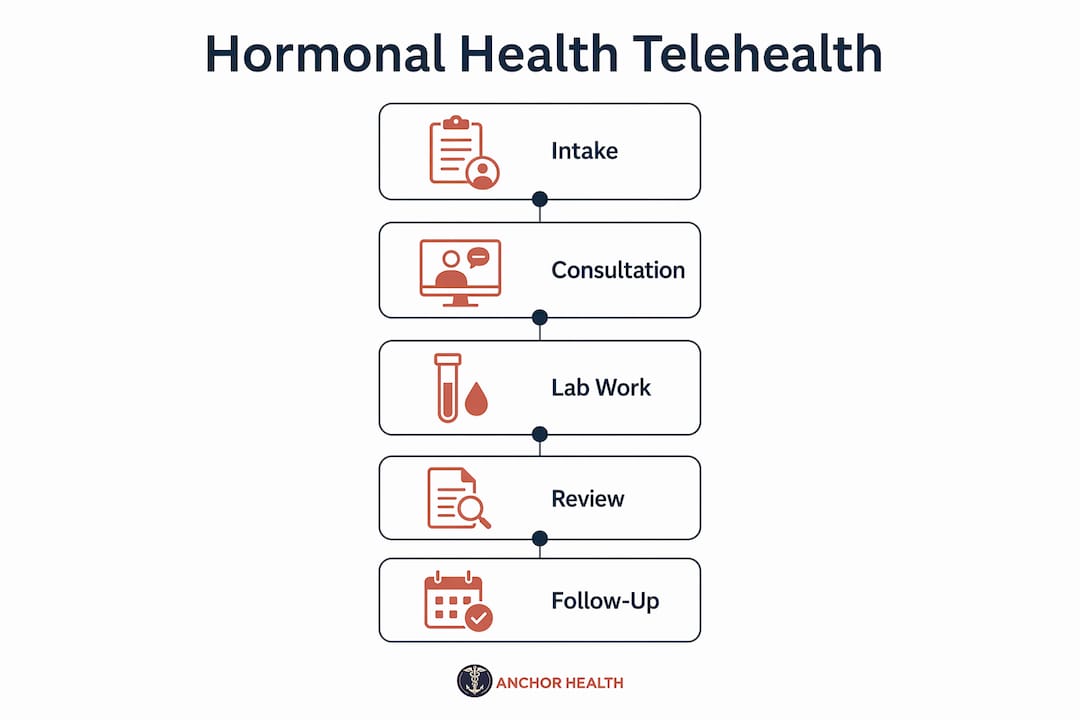
The telehealth process for hormonal health management follows a clear, structured path from first contact to ongoing care. Each step builds on the last, creating a clinical record that supports smarter decisions over time.
-
Complete an intake form. Most platforms begin with a 5–15 minute intake form covering your current symptoms, menstrual history, medications, and relevant health history. This form becomes the foundation of your care plan.
-
Schedule your consultation. Many telehealth providers offer access to a clinician within 12–48 hours, compared to traditional specialist wait times that can stretch up to six weeks. That speed matters when symptoms are affecting your daily life.
-
Meet your provider via secure video. Your physician reviews your intake data, asks follow-up questions, and discusses your goals. This is not a scripted chat. It is a clinical conversation.
-
Get lab work ordered remotely. Your provider sends lab orders electronically. You visit a local draw site, and results return digitally for your physician to review. Learning how to request lab work through telehealth before your first visit helps you prepare the right questions.
-
Receive your treatment plan. After reviewing labs and your symptom history, your provider creates a dosing schedule, identifies side effects to watch for, and sets a timeline for follow-up visits.
-
Continue with scheduled follow-ups. Hormonal care is not a one-time prescription. Dose adjustments, repeat labs, and symptom check-ins are built into the plan from the start.
Pro Tip: Ask your provider at the first visit how often labs will be repeated and what specific changes in your symptoms should prompt an earlier check-in. This sets clear expectations and keeps your care on track.
Continuity with the same physician removes the burden of re-explaining your history at every visit. Consistent physician involvement improves both the speed and quality of care adjustments over time.

How do labs and clinical judgment work together in hormonal care?
Lab results inform hormone care. They do not drive it alone. Physician-led telehealth programs treat labs as one input among many, combining them with symptom trends, health history, and lifestyle context to make safe, individualized decisions.
Common labs ordered in hormonal health management include:
- Estradiol and progesterone to assess reproductive hormone levels
- TSH, free T3, and free T4 for thyroid function
- Testosterone (total and free) for energy, libido, and mood concerns
- Fasting glucose and insulin to screen for insulin resistance
- Ferritin and iron panel to rule out deficiency as a symptom driver
- Vitamin D and B12 as cofactors that affect fatigue and mood
A single lab result rarely tells the full story. Timing matters. Estradiol drawn on day three of a cycle reads differently than one drawn mid-cycle. Medications, stress, and even the lab methodology used can shift results. Clinicians who understand these variables make better decisions than those who treat a number in isolation.
| Clinical factor | Why it matters |
|---|---|
| Symptom history | Identifies patterns labs may not capture |
| Lab timing in cycle | Affects hormone level interpretation |
| Repeat testing over time | Reveals trends rather than snapshots |
| Lifestyle factors | Sleep and stress alter hormone output |
| Medication interactions | Can suppress or elevate lab values |
Longitudinal symptom monitoring is the clinical standard for safe dose adjustments. A provider who only reacts to a single lab value, without context, is not practicing evidence-based hormonal care.
What are the benefits of telehealth for menopause and hormone therapy?
Telehealth delivers real advantages for women managing hormone therapy, particularly for conditions like perimenopause and menopause where symptoms evolve over months and years. The benefits extend beyond convenience.
Expanded access to specialists. Women in rural areas or states with limited gynecologic specialists can now connect with menopause-expert physicians within hours. Geography no longer determines the quality of your hormonal care.
Ongoing symptom monitoring. Telehealth platforms built for hormonal health include secure messaging, symptom tracking, and scheduled follow-ups. This structure catches side effects early and supports timely adjustments.
Integrated lifestyle evaluation. Effective hormone care accounts for sleep quality, stress load, exercise habits, and weight changes alongside lab data. A provider who asks about your sleep is doing their job correctly.
Key benefits for specific conditions include:
- Menopause: Remote support for hot flashes, sleep disruption, mood shifts, and vaginal symptoms without repeated in-person visits
- Testosterone therapy for women: Careful dosing with monitoring for side effects like acne, hair changes, and voice shifts
- Thyroid management: Regular TSH and symptom reviews that adjust medication without unnecessary office visits
- Perimenopause: Early intervention during irregular cycles when symptoms begin but labs may still appear “normal”
Pro Tip: A well-structured telehealth hormone plan includes a written list of side effects to report immediately. Ask your provider for this list at your first visit so you know exactly what to watch for.
Telehealth does have limits. Pelvic exams, physical assessments for breast tissue changes, and certain procedural evaluations require in-person care. A good telehealth provider will tell you clearly when an in-person referral is the right next step. Knowing what gynecological primary care includes helps you understand where telehealth fits within your broader care picture.
How much does telehealth hormonal health management cost?
Telehealth hormone care costs vary by platform model, insurance coverage, and the scope of services included. Understanding the pricing structure before you commit prevents surprises.
Online hormone therapy subscriptions typically range from $45 to $199 per month, with some platforms charging a separate consultation fee between $0 and $99. PPO insurance coverage can reduce out-of-pocket costs significantly, in some cases near zero.
| Pricing model | Typical cost range | What is usually included |
|---|---|---|
| Monthly subscription | $45–$199/month | Provider access, messaging, care plan |
| Consultation fee only | $0–$99 per visit | Single visit, prescription if appropriate |
| Insurance-covered visit | Varies by plan | Standard copay applies |
| HSA/FSA eligible | Accepted by many platforms | Reduces net cost |
Beyond the platform fee, factor in the cost of lab work, which may or may not be bundled. Medication costs depend on whether you use a compounding pharmacy or a standard retail option. The financial advantage of telehealth includes no travel costs, no time off work for a two-hour appointment, and faster access that prevents symptoms from worsening while you wait.
Women evaluating cost should also consider the value of continuity. A provider who knows your history does not repeat unnecessary labs or prescribe reactively. That clinical efficiency has real financial value over time.
Key Takeaways
Telehealth manages women’s hormonal health through physician-led, lab-informed care that prioritizes symptom continuity, personalized dosing, and ongoing follow-up over episodic treatment.
| Point | Details |
|---|---|
| Structured care process | Intake, consultation, labs, and follow-up form a repeating clinical cycle. |
| Labs support, not replace, judgment | Symptom history and lifestyle context are as important as lab numbers. |
| Continuity improves outcomes | Seeing the same provider avoids repeated history and supports smarter adjustments. |
| Cost varies by model | Subscriptions range $45–$199/month; PPO insurance can reduce costs near zero. |
| Telehealth has clear limits | Pelvic exams and physical assessments still require in-person evaluation. |
What I look for when evaluating telehealth hormone care providers
After years of watching women navigate hormone care, the single biggest mistake I see is choosing a platform based on speed alone. Fast access is valuable. Fast prescribing without clinical depth is a different thing entirely.
The providers I trust most are the ones who ask about sleep before they ask about estradiol levels. Hormonal health does not exist in a lab tube. It lives in how you feel at 2:00 AM, how your energy holds through the afternoon, and whether your mood tracks with your cycle or has gone completely unpredictable. A provider who skips those questions is missing the clinical picture.
Credential verification matters more than most women realize. Certification by The Menopause Society signals that a clinician has met a defined standard for evidence-based hormonal care. It is not a guarantee, but it is a meaningful filter. I would also look for clear follow-up protocols. Any provider who prescribes hormone therapy without a scheduled follow-up lab and visit within 8–12 weeks is not managing your care. They are filling a prescription.
The question I encourage every woman to ask at a first telehealth visit is this: “What will you monitor, how often, and what would prompt you to change my plan?” A confident, specific answer tells you everything about the quality of care you are about to receive. A vague answer tells you just as much.
— Paule
Myanchorhealthpc and women’s hormonal health telehealth
Women managing hormonal health deserve a provider who knows their history and stays involved between visits. Myanchorhealthpc offers physician-led telehealth primary care in Maryland through its Anchored Care℠ᴵᴾ model, built on continuity, evidence-based treatment, and secure video visits that fit your schedule.

Myanchorhealthpc integrates lab-informed care with ongoing provider relationships, so your hormone management evolves with you rather than restarting at every appointment. The practice accepts insurance and offers membership options for patients who want more direct access to their care team. If you are ready to find a provider who treats your full picture, start by reviewing how to choose telehealth primary care to understand what a strong care relationship looks like before your first visit.
FAQ
What does a telehealth hormone consultation include?
A telehealth hormone consultation includes a review of your symptom history, current medications, and health goals, followed by lab orders and a personalized treatment plan. Follow-up visits and dose adjustments are built into the care structure from the start.
Can telehealth manage menopause symptoms effectively?
Yes. Telehealth platforms staffed by menopause-certified clinicians manage hot flashes, sleep disruption, mood changes, and other menopause symptoms through remote consultations, lab monitoring, and ongoing messaging support.
How often will I need lab work for hormone management?
Lab frequency depends on your treatment stage, but most providers repeat hormone panels every 8–12 weeks during the first year of therapy. Stable patients may move to twice-yearly testing once dosing is established.
Is telehealth hormone care covered by insurance?
PPO insurance plans often cover telehealth hormone consultations, which can reduce out-of-pocket costs significantly. Many platforms also accept HSA and FSA payments, and some offer subscription models starting around $45 per month for patients without coverage.
When does telehealth hormone care require an in-person visit?
Telehealth is not appropriate for pelvic exams, physical breast assessments, or procedural evaluations. A qualified telehealth provider will refer you to in-person care when those assessments are clinically necessary.
Recommended
- What Gynecological Primary Care Includes for Women
- How Telehealth Works for College Students in 2026
- Primary Care’s Role in Women’s Reproductive Health
- How to Set Health Goals With a Telehealth Provider
Blog & Information Disclaimer
Last Updated: May 23, 2026
The information provided on the Anchor Health website (https://myanchorhealthpc.com/), including but not limited to blog posts, articles, newsletters, graphics, and other materials (collectively, the "Content"), is for general informational and educational purposes only.
By accessing and using this website, you acknowledge and agree to the following terms and conditions:
The Content on this website is not intended to be a substitute for professional medical advice, diagnosis, or treatment. Always seek the advice of your physician, nurse practitioner, or other qualified health provider with any questions you may have regarding a medical condition. Never disregard professional medical advice or delay in seeking it because of something you have read on this website.
Reading, interacting with, or sharing the Content on this website does not establish a patient-provider relationship between you and Anchor Health or any of its clinicians, including Paule Valery Joseph, PhD, MBA, CRNP, FAAN. A formal patient-provider relationship is only established after you have completed the formal intake process, signed our clinical consent forms, and participated in a secure clinical consultation.
If you are experiencing a medical emergency, call 911 or seek emergency medical services immediately.
Anchor Health is a primary care practice and does not provide emergency or crisis intervention services through its website or blog.
While Anchor Health strives to provide thoughtful, evidence-based information grounded in our Anchored Care℠ model, healthcare is a rapidly evolving field. We make no representations or warranties, express or implied, about the completeness, accuracy, reliability, or suitability of the information contained in the Content. Any reliance you place on such information is strictly at your own risk.
Anchor Health is a telehealth practice providing services to patients physically located within the state of Maryland. The information provided on this blog is intended for residents of Maryland and is governed by the laws and regulations of that state. Accessing this information from outside of Maryland does not imply that our clinicians are licensed to practice medicine or provide consultations in your jurisdiction.
Content related to Weight & Metabolic Health, including discussions of GLP-1 medications or other medical therapies, is provided for educational context regarding our clinical approach. Prescriptions and specific medical recommendations are only made following a comprehensive clinical evaluation, diagnostic testing, and shared decision-making within a formal patient-provider relationship.
This website may contain links to external websites that are not provided or maintained by or in any way affiliated with Anchor Health. Please note that Anchor Health does not guarantee the accuracy, relevance, timeliness, or completeness of any information on these external websites.
To the fullest extent permitted by law, Anchor Health, its owners, and its employees shall not be liable for any direct, indirect, incidental, consequential, or punitive damag
Related posts