Your Cholesterol Numbers Explained: What Each One Means

Your lipid panel tells a clear story: LDL is the main driver of artery-clogging plaque and lower is better, HDL is protective and higher is better, and triglycerides above 150 mg/dL signal rising metabolic risk. The American Heart Association is direct on this point: LDL lowering is the primary focus of cardiovascular risk reduction, and HDL should never be read in isolation. The CDC adds that the combination of high triglycerides and low HDL raises risk beyond what either number signals alone.
A standard lipid panel reports six values, all measured in milligrams per deciliter (mg/dL):
- Total cholesterol — the sum of all cholesterol in your blood
- LDL (low-density lipoprotein) — the primary target for treatment
- HDL (high-density lipoprotein) — the protective fraction
- Triglycerides — a separate fat that reflects diet, weight, and metabolic health
- Non-HDL cholesterol — total cholesterol minus HDL; a broader risk marker
- Total cholesterol/HDL ratio — a quick risk ratio some labs report
If your LDL is 160 mg/dL or above, or your triglycerides reach 500 mg/dL or higher, contact your clinician promptly. Triglycerides at that level carry a real risk of pancreatitis, not just heart disease. For most other results, the right next step is a scheduled conversation with your primary care provider to review your full risk picture before deciding on any treatment.
Key Takeaways
Understanding your cholesterol numbers is most useful when paired with a full risk assessment, because LDL, HDL, triglycerides, and non-HDL each tell a different part of the story and no single value determines your cardiovascular risk alone.
| Point | Details |
|---|---|
| LDL is the primary target | Lower LDL reduces plaque buildup; goals range from <100 mg/dL to <55 mg/dL depending on your ASCVD risk category. |
| Triglycerides ≥500 mg/dL need urgent attention | That threshold carries pancreatitis risk and typically requires prompt medical evaluation, not just a diet change. |
| Fasting matters for accuracy | Fasting 9–12 hours before a lipid panel produces the most reliable triglyceride and calculated LDL values. |
| Statins lower LDL and triglycerides | Statins are the primary LDL-lowering therapy and typically reduce triglycerides by 10%–30% as well. |
| Myanchorhealthpc offers telehealth lipid review | Maryland adults can book a secure video visit for a full risk assessment, lab ordering, and medication discussion. |
Table of Contents
- What does a lipid panel actually measure?
- What do the numbers on your lab report mean?
- Why your LDL goal depends on your personal risk level
- Fasting vs. nonfasting: how your cholesterol test is done
- How to lower high cholesterol: lifestyle first, then medication
- How often should you get your cholesterol tested?
- Questions to bring to your next cholesterol appointment
- How clinicians use your lipid numbers to make treatment decisions
- Does LDL particle size actually matter?
- Common myths about cholesterol numbers worth correcting
- A clinician’s perspective on treating the whole picture, not just the number
- Myanchorhealthpc can help you review and manage your cholesterol
- Sources
What does a lipid panel actually measure?
Cholesterol does not travel freely in your bloodstream. It moves inside protein-wrapped particles called lipoproteins, and the type of lipoprotein carrying it determines whether it harms or protects your arteries.
Total cholesterol is the combined count of all cholesterol-carrying particles. On its own it is a rough screen, not a treatment target. LDL particles deposit cholesterol into artery walls, which is why the CDC describes LDL as the main source of arterial blockages. HDL particles work in the opposite direction, carrying cholesterol away from artery walls toward the liver for removal.
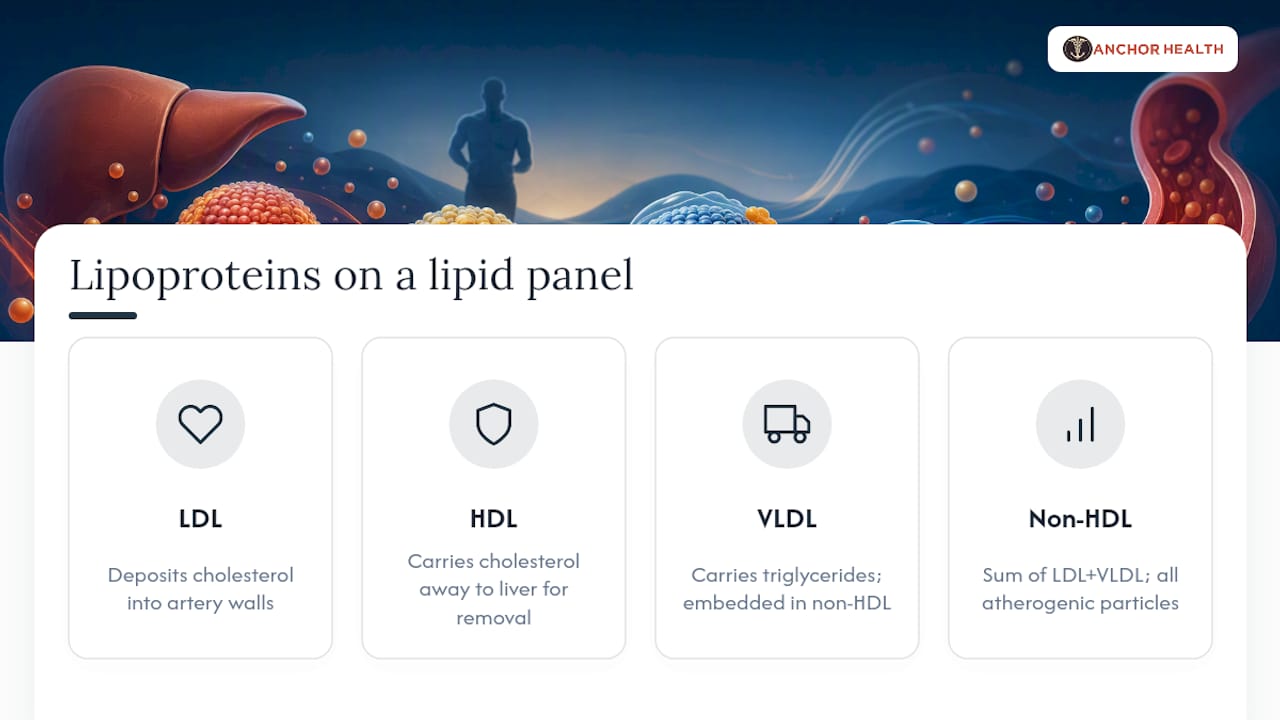
Triglycerides are fats your body makes from excess calories, especially from refined carbohydrates and alcohol. They are stored in fat tissue and released into the bloodstream between meals. VLDL (very-low-density lipoprotein) is the particle that carries triglycerides; labs rarely report VLDL directly, but it is embedded in your non-HDL number. Non-HDL cholesterol captures LDL plus VLDL and is increasingly preferred by clinicians because it accounts for all atherogenic (plaque-forming) particles in one figure.
Your lab report will list these values in mg/dL, the standard U.S. unit. Some reports also include a total/HDL ratio, which divides total cholesterol by HDL; a ratio below 5.0 is generally considered acceptable, though clinicians use it as a secondary check rather than a primary target.
Pro Tip: If your initial screening only measured total cholesterol, ask your provider to order a full lipid panel. Total cholesterol alone cannot distinguish between a high-LDL pattern and a high-HDL pattern, and those two situations call for very different responses.
What do the numbers on your lab report mean?
The ranges below reflect NHLBI and AHA guidance for adults in the United States. They are population-level reference points, not personal targets — your clinician may set a different goal based on your individual risk.
Alarming thresholds to know: Triglycerides at or above 500 mg/dL require urgent medical attention because of pancreatitis risk. LDL at or above 190 mg/dL often signals familial hypercholesterolemia, a genetic condition that typically requires medication regardless of other risk factors.
The Cleveland Clinic notes that HDL thresholds differ by sex: below 40 mg/dL for men and below 50 mg/dL for women are both considered low. Non-HDL is particularly useful when triglycerides are elevated, because high triglycerides can distort the LDL calculation.
Several factors can shift your numbers away from what the table predicts:
- Age and sex: LDL tends to rise with age; women often see LDL increase after menopause.
- Genetics: Familial hypercholesterolemia can produce LDL above 190 mg/dL even with an excellent diet.
- Medications: Corticosteroids, some blood pressure drugs, and hormonal therapies can raise LDL or triglycerides.
- Thyroid function: Hypothyroidism frequently elevates LDL independently of diet.
- Recent illness or surgery: Acute illness can temporarily lower LDL, masking an underlying problem.
Why your LDL goal depends on your personal risk level
A total cholesterol of 210 mg/dL means something very different for a 35-year-old nonsmoker with no other risk factors than it does for a 58-year-old with type 2 diabetes and a prior heart attack. That is why the ACC/AHA cholesterol guidelines do not set a single LDL target for everyone.
Clinicians use 10-year atherosclerotic cardiovascular disease (ASCVD) risk calculators, combined with your clinical history, to place you in a risk category and set a corresponding LDL goal. The AHA specifies that this assessment must incorporate age, smoking status, and blood pressure alongside cholesterol numbers.
Typical LDL targets by risk category:
- Low to moderate primary prevention risk: LDL below 100 mg/dL is a reasonable goal for most adults without established cardiovascular disease.
- Diabetes (age 40–75): LDL below 70 mg/dL is often recommended, depending on additional risk factors.
- Established ASCVD (prior heart attack, stroke, or stent): LDL below 70 mg/dL is a standard goal; many guidelines now suggest below 55 mg/dL for very high-risk patients.
- Very high risk (recurrent events or multiple major risk factors): LDL below 55 mg/dL, with some guidelines supporting even lower targets.
Factors that typically move someone into a lower LDL target group:
- Prior heart attack, stroke, or coronary artery bypass surgery
- Familial hypercholesterolemia (genetic high cholesterol)
- Diabetes with end-organ damage or multiple cardiovascular risk factors
- Chronic kidney disease
- Persistently elevated Lp(a) (lipoprotein(a)) above 50 mg/dL
Pro Tip: Ask your provider to calculate your 10-year ASCVD risk score at your next visit. That single number reframes the conversation from “is my cholesterol high?” to “what is my actual probability of a heart event in the next decade?” — and it determines whether lifestyle changes alone are enough or whether medication makes sense now.
Fasting vs. nonfasting: how your cholesterol test is done
Most adults can have a cholesterol panel drawn without fasting, and many U.S. labs now accept nonfasting samples for routine screening. Triglycerides, however, spike after meals, which is why fasting for 9–12 hours is still recommended when:
- Triglycerides were elevated on a prior test
- Your provider needs an accurate LDL calculation
- You are being monitored on lipid-lowering therapy
The LDL number on your lab report is usually calculated, not directly measured. Labs apply the Friedewald equation: LDL = Total Cholesterol − HDL − (Triglycerides ÷ 5). MedlinePlus explains that this calculation becomes unreliable when triglycerides exceed roughly 400 mg/dL, at which point a lab will use a direct LDL measurement instead. If your triglycerides are very high, your reported LDL may be artificially low, which is one more reason non-HDL cholesterol is a better marker in that situation.
- Nonfasting panel: acceptable for initial screening; triglycerides will read higher than a fasting value
- Fasting panel: preferred for repeat testing, medication monitoring, or when triglycerides are borderline or high
- Direct LDL: ordered when triglycerides exceed ~400 mg/dL or when accuracy is clinically critical
- Non-HDL preferred: when triglycerides are elevated and the calculated LDL is unreliable
Pro Tip: *Avoid heavy alcohol and high-carbohydrate meals the evening before a fasting lipid panel.
How to lower high cholesterol: lifestyle first, then medication
Lifestyle changes reduce cardiovascular risk and often bring numbers down meaningfully, but statins remain the most effective LDL-lowering therapy available and the one with the strongest evidence for reducing heart attacks and strokes.
Lifestyle changes with the clearest evidence
- Reduce saturated fat: replacing saturated fat with unsaturated fat lowers LDL; limit red meat, full-fat dairy, and tropical oils
- Add soluble fiber: oats, beans, lentils, and psyllium husk bind cholesterol in the gut and reduce LDL absorption
- Plant sterols and stanols: found in fortified foods and some spreads; 2 grams per day can lower LDL by roughly 5%–15%
- Weight loss: losing 5%–10% of body weight typically lowers triglycerides and raises HDL
- Aerobic exercise: 150 minutes per week of moderate activity raises HDL and lowers triglycerides
- Alcohol moderation: alcohol is one of the most potent dietary drivers of high triglycerides; cutting back often produces rapid improvement
- Smoking cessation: smoking lowers HDL; quitting raises it within weeks
Medications your provider may discuss
Statins (atorvastatin, rosuvastatin, simvastatin) are the first-line medication for elevated LDL. Mayo Clinic notes that statins also reduce triglycerides by roughly 10%–30%.
It is often the first add-on when a statin alone does not reach the target.
They are typically reserved for very high-risk patients or those with familial hypercholesterolemia.
Prescription omega-3 fatty acids (icosapentaenoic acid, such as Vascepa) are used specifically for very high triglycerides, generally above 500 mg/dL. Harvard Health is clear that over-the-counter fish oil supplements show inconsistent results for triglyceride lowering; prescription-grade, high-dose omega-3 is reserved for specific clinical cases under physician supervision.
Combination therapy, such as a statin plus ezetimibe, is common when a single agent does not reach the LDL goal. The decision is based on absolute risk reduction, not just the number on the lab report.
Pro Tip: Report any new muscle pain, weakness, or dark urine to your provider promptly after starting a statin. Statin-related muscle effects are uncommon but real, and your provider can check a creatine kinase level and adjust the dose or switch agents if needed.
How often should you get your cholesterol tested?
The AHA recommends that most adults begin cholesterol screening at age 19 and repeat testing every 4–5 years if results are normal and risk factors are absent. People with elevated numbers, established cardiovascular disease, or risk factors need more frequent monitoring.
Recommended testing cadence:
- General adults (low risk, normal results): every 4–5 years starting at age 19
- Adults with diabetes, hypertension, or family history of early heart disease: every 1–2 years, or as directed by your provider
- Adults starting a statin or other lipid therapy: recheck at 4–12 weeks after initiation, then every 3–12 months once stable
- After lifestyle changes: triglycerides can respond within 6–12 weeks of dietary change; LDL changes may take 3–6 months to fully reflect a new diet
For younger adults building preventive habits, a young adult preventive health checklist can help you track when to schedule your first lipid panel alongside other age-appropriate screenings.
Questions to bring to your next cholesterol appointment
Walking into a visit with specific questions produces better outcomes than a general “my doctor said my cholesterol is high.” Here is a focused checklist:
- “What is my 10-year ASCVD risk score?”
- “What LDL target should I be aiming for, given my full risk profile?”
- “Should I start a statin now, or is a 3-month lifestyle trial appropriate first?”
- “Is my non-HDL cholesterol within an acceptable range?”
- “Do any of my current medications affect my lipid numbers?”
- “Should I be tested for familial hypercholesterolemia given my family history?”
- “When should I recheck my labs after any changes we make today?”
Bring to the visit (or upload to your patient portal in advance):
- Prior lipid panel results, even from years ago
- A current medication and supplement list
- Family history of heart attack, stroke, or high cholesterol before age 55
- Recent blood pressure readings and weight
- A brief note on your typical diet and alcohol intake
Pro Tip: Be honest about recent diet and alcohol use. A triglyceride reading of 350 mg/dL after a week of holiday eating tells a different story than a fasting result of 350 mg/dL on a typical week. Your provider needs the context to counsel you accurately.
How clinicians use your lipid numbers to make treatment decisions
Clinicians do not treat a cholesterol number in isolation. They combine your lipid results with your full clinical picture using a structured decision framework rooted in the ACC/AHA cholesterol guidelines.
The typical decision flow:
- Step 1: Calculate 10-year ASCVD risk using a validated calculator (the Pooled Cohort Equations are the ACC/AHA standard), incorporating age, sex, race, blood pressure, smoking status, diabetes, and cholesterol values.
- Step 2: Classify the patient as primary prevention (no prior cardiovascular event) or secondary prevention (established ASCVD), since secondary prevention patients have lower LDL targets and more aggressive treatment thresholds.
- Step 3: Identify risk-enhancing factors: familial hypercholesterolemia, chronic kidney disease, inflammatory conditions, elevated Lp(a), or a high coronary artery calcium score on imaging.
- Step 4: Choose statin intensity: low-intensity (modest LDL reduction), moderate-intensity (30%–49% LDL reduction), or high-intensity (≥50% LDL reduction), with add-on agents as needed.
- Step 5: Monitor and adjust at 4–12 weeks, then every 3–12 months.
When the standard panel leaves questions unanswered, providers may order advanced lipid tests. Apolipoprotein B (apoB) measures the total number of atherogenic particles and can reveal risk that a normal LDL misses. Lipoprotein(a) is a genetically determined particle that raises cardiovascular risk independently of LDL and is not lowered by statins; testing is recommended when there is a strong family history of early heart disease or unexplained high LDL. Direct LDL particle number testing is another option when risk stratification remains uncertain after standard testing.
Does LDL particle size actually matter?
Standard lipid panels report LDL concentration, meaning the total amount of cholesterol carried inside LDL particles. What they do not tell you is how many particles are carrying that cholesterol or how large those particles are. That distinction has real clinical relevance.

Small, dense LDL particles penetrate artery walls more easily than large, buoyant ones, and they are more prone to oxidation, which is a key step in plaque formation. Two people with identical LDL cholesterol levels can have very different particle counts: one person might have fewer, larger particles, while another has many more small, dense ones, and the second person carries meaningfully higher risk.
LDL particle number (LDL-P), measured by NMR (nuclear magnetic resonance) spectroscopy, and apolipoprotein B (apoB) both capture this dimension better than standard LDL-C. ApoB is particularly practical because each atherogenic lipoprotein particle carries exactly one apoB molecule, so apoB is essentially a direct count of dangerous particles. Clinicians increasingly use apoB when a patient’s LDL appears controlled but cardiovascular risk still seems disproportionately high, or when metabolic syndrome and high triglycerides are present (a pattern that often comes with elevated small, dense LDL). The diabetes-cholesterol connection is one reason integrated primary care matters for metabolic risk management.
Common myths about cholesterol numbers worth correcting
Myth: A “normal” total cholesterol means you are safe. Total cholesterol below 200 mg/dL can coexist with a dangerously low HDL and elevated LDL. The breakdown matters far more than the total.
Myth: High HDL always protects you. HDL above 60 mg/dL is generally protective, but very high HDL (above 80–90 mg/dL) does not confer proportionally greater benefit, and some genetic causes of extremely high HDL are actually associated with increased risk. The AHA is explicit that HDL should not be treated as a primary treatment target.
Saturated and trans fats in the diet raise LDL more than dietary cholesterol itself does. Genetics, as the Cleveland Clinic notes, often determine baseline levels more than diet alone.
Myth: Statins are dangerous and should be avoided. Statins are among the most studied medications in history. Serious side effects, including significant muscle damage, occur in a small minority of patients. For people with established cardiovascular disease or high ASCVD risk, the benefit of statins vastly outweighs the risk for most individuals.
Myth: Once your numbers improve, you can stop medication. Cholesterol management is usually long-term. Stopping a statin typically causes LDL to return to its previous level within weeks. Any change to medication should be discussed with your provider, not made unilaterally.
Myth: Young people do not need to worry about cholesterol. Plaque begins accumulating in arteries during adolescence and young adulthood. Early screening, especially with a family history of heart disease, can identify risk decades before a cardiac event.
A clinician’s perspective on treating the whole picture, not just the number
The most common mistake patients make is fixating on a single number after getting their results. A patient with an LDL of 125 mg/dL who smokes, has poorly controlled blood pressure, and a father who had a heart attack at 52 carries far more risk than someone with an LDL of 145 mg/dL who has none of those factors. The number is a data point, not a verdict.
What actually moves outcomes is continuity: a provider who knows your history, tracks your trajectory over time, and adjusts the plan as your life changes. Telehealth primary care, done well, supports exactly that kind of longitudinal relationship. A secure video visit can accomplish a thorough lipid review, a risk discussion, lab ordering, and a medication conversation without the friction of scheduling around a physical office. For people managing cholesterol alongside weight, metabolic health, or diabetes, that continuity is where the real benefit accumulates.
Most lipid issues can be managed safely with a combination of lifestyle changes and guideline-based medication when needed. The goal is not a perfect number on one lab report. It is a sustained reduction in your actual probability of a heart attack or stroke over the next decade.
Myanchorhealthpc can help you review and manage your cholesterol
Knowing your numbers is the first step. Acting on them, with a provider who has the time and context to guide you, is what actually reduces risk.

Myanchorhealthpc is a Maryland-based telehealth primary care practice built around exactly that kind of relationship. Through secure video visits, your provider can review your full lipid panel, calculate your ASCVD risk, order follow-up labs, and discuss whether lifestyle changes, medication, or both make sense for your situation. For patients managing weight, metabolic health, or diabetes alongside cholesterol, the practice offers integrated support including GLP-1 medication management where appropriate. Visits are covered by most insurance plans, and an optional membership plan provides enhanced access and structured follow-up for those who want closer monitoring. To see how telehealth primary care fits your family’s needs, or to learn about membership-based primary care for ongoing lipid management, visit myanchorhealthpc.com and book your first visit.
This article provides general health information and is not a substitute for personalized medical advice. Confirm current guidelines and treatment decisions with a qualified clinician.
Sources
The following authoritative sources informed this article and are reliable starting points for learning more about cholesterol and cardiovascular risk:
- What Your Cholesterol Levels Mean | American Heart Association
- Cholesterol & Your Heart: What You Need to Know (NHLBI)
- LDL and HDL cholesterol and triglycerides | CDC
- Cholesterol levels: MedlinePlus Medical Test
- Should you worry about high triglycerides? | Harvard Health
Consult a licensed clinician for personalized interpretation of your specific lab results and risk profile.
Recommended
- Fertility Health Checkup Checklist: Your Complete Guide
- Senior Health Screening Checklist 2026: Essential Tests for 65+
- Telehealth vs Endocrinologist for Chronic Care in Maryland
- Women’s Annual Health Exam Checklist: 2026 Guide
Blog & Information Disclaimer
Last Updated: May 23, 2026
The information provided on the Anchor Health website (https://myanchorhealthpc.com/), including but not limited to blog posts, articles, newsletters, graphics, and other materials (collectively, the "Content"), is for general informational and educational purposes only.
By accessing and using this website, you acknowledge and agree to the following terms and conditions:
The Content on this website is not intended to be a substitute for professional medical advice, diagnosis, or treatment. Always seek the advice of your physician, nurse practitioner, or other qualified health provider with any questions you may have regarding a medical condition. Never disregard professional medical advice or delay in seeking it because of something you have read on this website.
Reading, interacting with, or sharing the Content on this website does not establish a patient-provider relationship between you and Anchor Health or any of its clinicians, including Paule Valery Joseph, PhD, MBA, CRNP, FAAN. A formal patient-provider relationship is only established after you have completed the formal intake process, signed our clinical consent forms, and participated in a secure clinical consultation.
If you are experiencing a medical emergency, call 911 or seek emergency medical services immediately.
Anchor Health is a primary care practice and does not provide emergency or crisis intervention services through its website or blog.
While Anchor Health strives to provide thoughtful, evidence-based information grounded in our Anchored Care℠ model, healthcare is a rapidly evolving field. We make no representations or warranties, express or implied, about the completeness, accuracy, reliability, or suitability of the information contained in the Content. Any reliance you place on such information is strictly at your own risk.
Anchor Health is a telehealth practice providing services to patients physically located within the state of Maryland. The information provided on this blog is intended for residents of Maryland and is governed by the laws and regulations of that state. Accessing this information from outside of Maryland does not imply that our clinicians are licensed to practice medicine or provide consultations in your jurisdiction.
Content related to Weight & Metabolic Health, including discussions of GLP-1 medications or other medical therapies, is provided for educational context regarding our clinical approach. Prescriptions and specific medical recommendations are only made following a comprehensive clinical evaluation, diagnostic testing, and shared decision-making within a formal patient-provider relationship.
This website may contain links to external websites that are not provided or maintained by or in any way affiliated with Anchor Health. Please note that Anchor Health does not guarantee the accuracy, relevance, timeliness, or completeness of any information on these external websites.
To the fullest extent permitted by law, Anchor Health, its owners, and its employees shall not be liable for any direct, indirect, incidental, consequential, or punitive damag
Related posts