Telehealth vs Endocrinologist for Chronic Care in Maryland

For most Maryland patients managing stable endocrine or metabolic conditions, a telehealth primary-care practice is the right first-line choice. Systematic reviews confirm that synchronous telehealth produces similar or better short-term glycemic outcomes compared with in-person visits, and research shows telehealth users gain additional months of connection to care. An endocrinologist adds clear value when complexity rises, but for the majority of patients, consistent primary-care telehealth management is both safe and effective.
Telehealth primary care fits best when you have:
- Stable type 2 diabetes, hypothyroidism, or metabolic syndrome managed on established medications
- Weight and metabolic concerns where GLP-1 therapy is being considered or titrated
- A need for frequent, low-friction follow-up and lab monitoring without long waits
An endocrinologist is the right call when:
- HbA1c remains persistently elevated despite multiple medication adjustments
- You have a rare or complex endocrine disorder (adrenal, pituitary, or parathyroid disease)
- Insulin pump management or advanced CGM interpretation requires specialist-level titration
- Diagnostic ambiguity exists around an endocrine condition
Table of Contents
- How long does it take to establish care with each option?
- What does care actually cost with each option?
- What does shared care actually look like in practice?
- How do telehealth and in-person endocrinology compare on the details that matter?
- How do you choose the right care path for your situation?
- Key Takeaways
- What I’ve learned managing chronic endocrine care through telehealth
- Myanchorhealthpc makes chronic endocrine care accessible in Maryland
- Useful sources
How long does it take to establish care with each option?
With a telehealth primary-care practice like Myanchorhealthpc, most Maryland patients can schedule a first visit within days. You complete intake paperwork online, share your insurance details, and receive lab orders before the appointment so results are ready to discuss at your first video visit. Follow-up appointments for medication titration or lab review typically happen every four to twelve weeks depending on your condition’s stability.
Establishing care with an endocrinologist in Maryland follows a different path. Most require a referral from a primary-care provider, and new-patient wait times commonly run eight to sixteen weeks at busy academic or specialty practices. Once seen, follow-up slots are often scheduled months apart, which can create gaps in medication management for conditions that need frequent adjustment.
What does care actually cost with each option?
Telehealth primary-care visits through Myanchorhealthpc are billed through insurance at primary-care copay rates, which typically run $20–$40 for commercially insured patients and $0–$10 under most Maryland Medicaid plans. Self-pay and HSA/FSA payments are accepted, and an optional membership plan provides enhanced access and longer visit times.
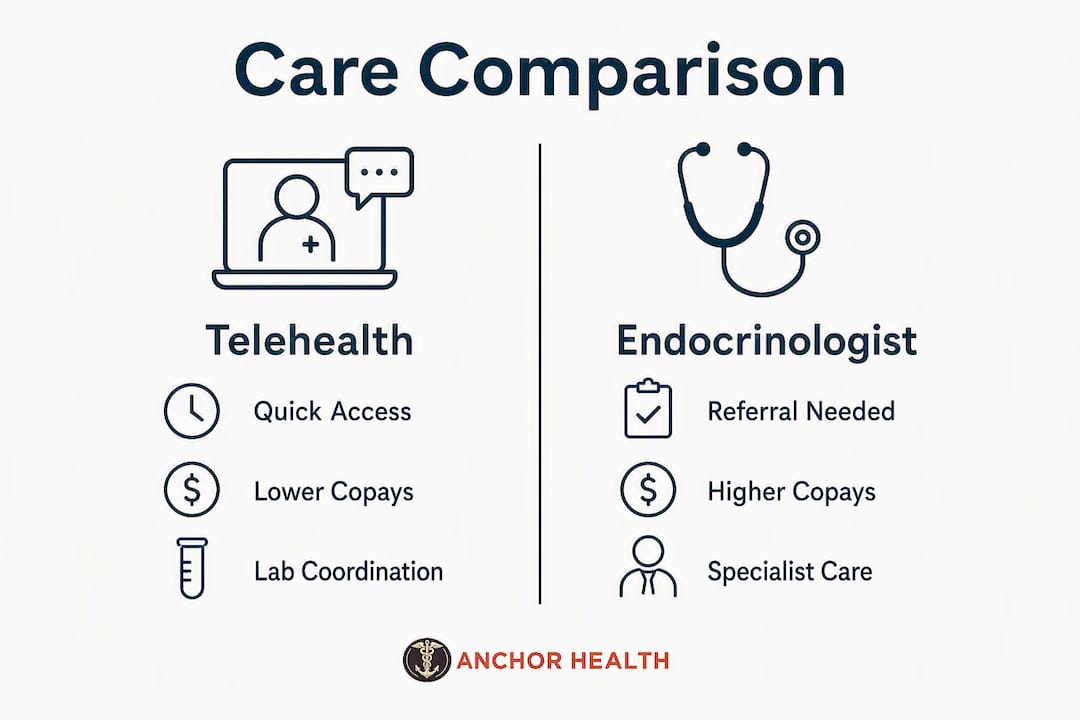
Endocrinology visits carry specialist copays, which commonly run $50–$75 or higher under commercial plans, and some insurers require prior authorization before covering specialist consultations. If your plan requires a referral and you skip that step, the visit may be billed at out-of-network rates. Lab work ordered by either provider is generally covered the same way regardless of who orders it.
What does shared care actually look like in practice?
The most effective model treats primary care as the medical home for day-to-day stability and reserves endocrinology for defined complex phases. As Dr. Kehinde Folawewo of Hilltop Endocrinology notes, primary care is best positioned to manage the whole person, including comorbid conditions like hypertension and dyslipidemia that a specialist focused on a single organ system may not address. When a patient’s diabetes becomes difficult to control, the primary-care provider initiates the referral, shares records, and resumes management once the specialist has resolved the acute complexity.
How do telehealth and in-person endocrinology compare on the details that matter?
| Dimension | Telehealth primary care | Endocrinologist |
|---|---|---|
| Best for | Stable T2DM, hypothyroidism, metabolic/weight care | Complex, rare, or treatment-resistant endocrine disease |
| Access and wait times | Days to a week | — |
| Continuity | Same provider, ongoing relationship | Episodic; may rotate residents or fellows |
| Specialist expertise | Broad primary-care scope | Deep endocrine-specific diagnostics |
| Labs and monitoring | Orders to local labs; reviews CGM data remotely | May have in-house testing; specialist interpretation |
| Medication management | GLP-1s, thyroid meds, metabolic medications | Complex insulin regimens, rare hormone therapies |
| Cost | Primary-care copay; membership option | Specialist copay; referral often required |

Nearly two-thirds of patients discontinue or alter metabolic medications within 12 months. Frequent telehealth touchpoints, built into a structured follow-up schedule, directly address that adherence gap in a way that quarterly specialist visits cannot.
Pro Tip: Ask any prospective telehealth provider whether they can order labs at a LabCorp or Quest location near you and review CGM data between visits. If the answer is yes, the workflow is genuinely set up for chronic endocrine management.
How do you choose the right care path for your situation?
Work through these questions before booking:
- Do you have comorbidities? Hypertension, high cholesterol, and metabolic syndrome alongside diabetes are exactly what primary-care chronic disease management is built for.
- Does your insurance require a referral for endocrinology? — Confirm this before scheduling a specialist visit to avoid unexpected costs.
Verify with any provider: Do they coordinate with local labs? Can they prescribe GLP-1 medications? What is their referral pathway if your condition becomes complex?
Key Takeaways
Telehealth primary care is the right default for most stable endocrine and metabolic conditions in Maryland; reserve endocrinology for complexity, treatment failure, or rare disorders.
| Point | Details |
|---|---|
| Telehealth is effective for stable conditions | Systematic reviews show telehealth produces similar or better short-term glycemic outcomes versus in-person visits. |
| Access is faster with telehealth | Telehealth primary care appointments are typically available within days; endocrinology new-patient waits run 8–16 weeks. |
| Cost favors primary care | Telehealth visits bill at primary-care copay rates; specialist visits carry higher copays and often require referrals. |
| Shared care is the strongest model | Primary care manages day-to-day stability; endocrinology handles defined complex phases, then hands back to primary care. |
| Myanchorhealthpc for Maryland patients | Myanchorhealthpc’s Anchored Care℠ᴵᴾ model provides structured telehealth primary care for diabetes, thyroid conditions, and metabolic health, with clear referral pathways when specialist input is needed. |
What I’ve learned managing chronic endocrine care through telehealth
The most common mistake I see patients make is treating telehealth and specialist care as an either/or decision. They either wait months for an endocrinologist when their stable hypothyroidism just needs a TSH recheck, or they avoid primary care entirely because they assume their diabetes is “too complex” for anyone but a specialist.
The reality is that managing diabetes through telehealth works well precisely because it removes the friction that causes people to skip follow-up. A 20-minute video visit to review your CGM trends and adjust your metformin dose is more valuable than a 90-minute round trip to a specialist office every six months. The research on adherence makes this plain: gaps between visits are where control slips.
What telehealth primary care does exceptionally well is hold the whole picture. Your blood pressure, your weight, your mood, your sleep, and your A1c are all connected. An endocrinologist who sees you twice a year for your thyroid will not necessarily notice that your fatigue is actually driven by undertreated depression or sleep apnea. Your primary-care provider, who knows you across visits and conditions, will.
Refer to an endocrinologist when the situation genuinely calls for it. But do not let the absence of a specialist relationship become a reason to leave your chronic condition without consistent, attentive oversight.
Myanchorhealthpc makes chronic endocrine care accessible in Maryland
Consistent, relationship-based management of diabetes, thyroid conditions, and metabolic health is exactly what Myanchorhealthpc’s Anchored Care℠ᴵᴾ model is built for. You get a trusted provider who orders labs at a local facility before your visit, reviews your results with you over a secure video call, manages GLP-1 prescriptions and thyroid medications, and coordinates a referral when specialist input is genuinely needed.
Before your first visit, gather your most recent lab results, your current medication list, and your insurance card. If you use a CGM or insulin pump, note your device model. Myanchorhealthpc accepts most major insurance plans, self-pay, and HSA/FSA funds, with an optional membership for enhanced access and follow-up. Same-day appointments are often available for urgent medication questions. To understand exactly how telehealth prescriptions work before you book, that page walks through the full process. Schedule your first visit at myanchorhealthpc.com.
This article provides general health information, not medical advice. Confirm your care plan and any medication decisions with a qualified healthcare provider.
Useful sources
- BMC Primary Care systematic review — supports the finding that synchronous telehealth produces similar or better short-term HbA1c outcomes compared with in-person visits for diabetes management.
- Journal of the American Board of Family Medicine — documents that telehealth users gained 4.49 additional months of connection to care and 0.89 additional months of HbA1c control in community health center populations.
- University of Manchester — telemedicine clinical effectiveness — meta-analyses showing telemedicine in primary care is at least as effective as usual care for HbA1c, blood pressure, and lipids in type 2 diabetes.
- MDPI meta-analysis on telemedicine and glycemic management — shows strongest HbA1c improvements at six months when telehealth is combined with remote monitoring.
- Endocrinology Authority — primary care vs endocrinology — describes the tiered care model, referral thresholds, and why primary care serves as the medical home for most stable endocrine conditions.
- MDedge — 10 reasons to refer to an endocrinologist — clinical triggers for endocrinology referral and the medication adherence challenge in metabolic care.
- Cleveland Clinic — what is an endocrinologist — clear overview of endocrinologist scope, conditions treated, and when specialist care is warranted.
Recommended
- Telehealth’s Role in Rural Maryland Healthcare Access
- How telehealth expands healthcare access for Maryland families
- Chronic Disease Telehealth Management Tips That Work
Blog & Information Disclaimer
Last Updated: May 23, 2026
The information provided on the Anchor Health website (https://myanchorhealthpc.com/), including but not limited to blog posts, articles, newsletters, graphics, and other materials (collectively, the "Content"), is for general informational and educational purposes only.
By accessing and using this website, you acknowledge and agree to the following terms and conditions:
The Content on this website is not intended to be a substitute for professional medical advice, diagnosis, or treatment. Always seek the advice of your physician, nurse practitioner, or other qualified health provider with any questions you may have regarding a medical condition. Never disregard professional medical advice or delay in seeking it because of something you have read on this website.
Reading, interacting with, or sharing the Content on this website does not establish a patient-provider relationship between you and Anchor Health or any of its clinicians, including Paule Valery Joseph, PhD, MBA, CRNP, FAAN. A formal patient-provider relationship is only established after you have completed the formal intake process, signed our clinical consent forms, and participated in a secure clinical consultation.
If you are experiencing a medical emergency, call 911 or seek emergency medical services immediately.
Anchor Health is a primary care practice and does not provide emergency or crisis intervention services through its website or blog.
While Anchor Health strives to provide thoughtful, evidence-based information grounded in our Anchored Care℠ model, healthcare is a rapidly evolving field. We make no representations or warranties, express or implied, about the completeness, accuracy, reliability, or suitability of the information contained in the Content. Any reliance you place on such information is strictly at your own risk.
Anchor Health is a telehealth practice providing services to patients physically located within the state of Maryland. The information provided on this blog is intended for residents of Maryland and is governed by the laws and regulations of that state. Accessing this information from outside of Maryland does not imply that our clinicians are licensed to practice medicine or provide consultations in your jurisdiction.
Content related to Weight & Metabolic Health, including discussions of GLP-1 medications or other medical therapies, is provided for educational context regarding our clinical approach. Prescriptions and specific medical recommendations are only made following a comprehensive clinical evaluation, diagnostic testing, and shared decision-making within a formal patient-provider relationship.
This website may contain links to external websites that are not provided or maintained by or in any way affiliated with Anchor Health. Please note that Anchor Health does not guarantee the accuracy, relevance, timeliness, or completeness of any information on these external websites.
To the fullest extent permitted by law, Anchor Health, its owners, and its employees shall not be liable for any direct, indirect, incidental, consequential, or punitive damag
Related posts