Men: Telehealth Prostate Screening That Helps 90% Decide

Telehealth can’t draw your blood, but it’s an excellent way to decide whether you need a PSA test, get one ordered, and review what the results mean. Guidance from the AUA supports this exact model, and clinics like Anchor Health use it every day. The next step is simple: book a telehealth visit, talk through your risk, and get a lab order if it’s the right time for you.
TL;DR:
- Telehealth prostate screening excels at facilitating in-depth, personalized risk discussions and shared decision-making, extending beyond just ordering a PSA test.
- Most telehealth visits support reviewing risk factors, walking through potential benefits and harms, and interpreting results within context, but cannot perform physical exams or draw blood.
- Key starting ages for screening conversations range from 40 to 50, with earlier and more frequent screening recommended for Black men, those with family history, or germline mutations.
- A typical telehealth consult includes preparation steps like gathering medication lists and previous PSA results, followed by an electronic lab order and result review.
- Red flags for in-person care include blood in urine, urinary retention, worsening symptoms, or abnormal PSA patterns that require physical exams or imaging.
Table of Contents
- What Telehealth Prostate Screening Actually Does Well
- Who Should Get Screened, and How Often
- How a Telehealth Prostate Screening Visit Actually Works
- When Telehealth Isn’t Enough: Red Flags for In-Person Care
- Getting Ready for Your Visit and What Happens After
- How Anchor Health Approaches Telehealth Prostate Screening
- Why Telehealth Changes the Screening Conversation More Than the Test Itself
- How Anchor Health Can Help You Start This Conversation
- Sources
What Telehealth Prostate Screening Actually Does Well
The strongest use case for prostate screening telehealth isn’t the test itself. It’s the conversation that happens before you ever order one. Prostate cancer screening involves real tradeoffs. A PSA test can catch something dangerous early, but it can also flag a slow-growing tumor that never would have caused harm, leading to biopsies and treatments with their own risks. That’s why guideline bodies keep coming back to the same phrase: shared decision-making, or SDM. It means you and your clinician actually walk through the numbers together instead of just checking a box on an annual physical.
Most in-person primary care visits don’t leave much room for that conversation. Appointment times are often brief. Telehealth visits, particularly ones built around a decision aid or risk calculator, tend to run longer and stay more focused. A 2024 study on navigator-guided telehealth sessions found that most participants rated their one-on-one telehealth decision session as good or excellent for helping them decide about prostate cancer screening, even among men with limited comfort interpreting numeric risk data.
Here’s what a telehealth visit for prostate health can realistically accomplish:
- Review your personal and family risk factors to figure out where you fall on the risk spectrum
- Walk through the benefits and harms of PSA testing using a decision aid, not just a recommendation
- Order a PSA test and route you to a lab, drive-through phlebotomy site, or home blood draw service
- Interpret your results in context, factoring in age, prior PSA trends, and symptoms
- Coordinate the next step, whether that’s a repeat test in a few months or a referral to a urologist
Telehealth screening consult volume: Over 90% of participants in a telehealth navigator program rated their session good or excellent for supporting screening decisions, even though many started with low baseline health numeracy.
What telehealth cannot do is just as important. A clinician can’t perform a digital rectal exam through a camera, and no video platform draws blood. Think of the telehealth visit as the front door to the screening pathway, not the whole hallway.
Pro Tip: Ask your telehealth clinician to show you a visual risk chart during the visit rather than just quoting percentages out loud. Seeing the numbers plotted tends to make the tradeoffs click faster than hearing them.
Who Should Get Screened, and How Often
Guideline groups don’t all use identical language, but they land in a similar place. The AUA recommends that clinicians engage average-risk men in shared decision-making and consider offering a baseline PSA test somewhere between ages 45 and 50. The NCCN patient guideline uses a similar marker, pointing to around age 45 as a reasonable starting point for that first conversation. The USPSTF focuses on ages 55 to 69 as the window where individualized decision-making matters most, and it recommends against routine screening for men 70 and older, largely because of how life expectancy changes the benefit-to-harm math.
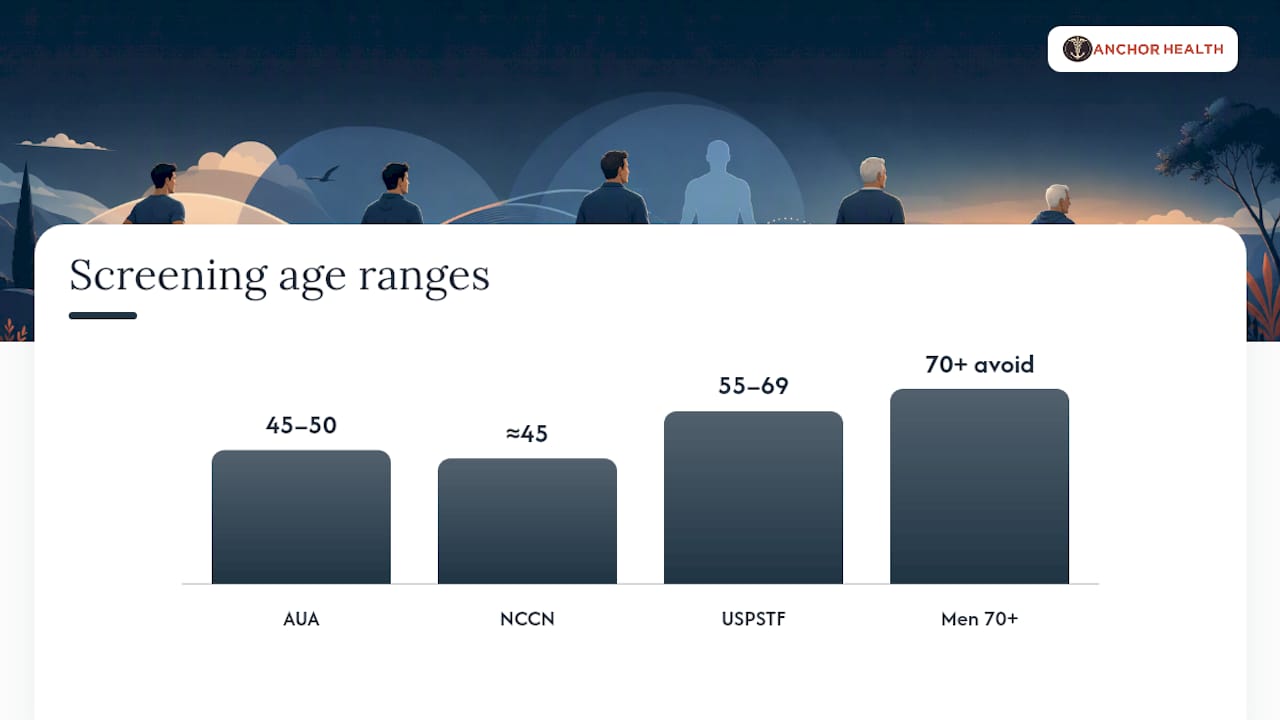
None of this is arbitrary. Randomized and observational data show screening can lower prostate cancer mortality for some men, but it also drives overdiagnosis and overtreatment in others. That tension is exactly why every major guideline body frames this as preference-sensitive rather than automatic.
A few groups warrant earlier or more assertive conversations:
- Black men, who face higher incidence and mortality rates and are typically encouraged to discuss screening starting around age 40 to 45
- Men with a first-degree relative diagnosed with prostate cancer, especially at a younger age
- Men carrying known germline mutations linked to prostate cancer risk, such as BRCA2
Once a baseline PSA is in, the interval isn’t fixed either. The AUA notes that men with a very low baseline PSA can often safely stretch the time between screens rather than repeating annually. That’s a detail worth bringing up on your own if your clinician doesn’t mention it first, since it can mean fewer needle sticks over the years without any loss of safety.
Screening age reference points at a glance:
| Group | When to start the conversation | Typical interval |
|---|---|---|
| Average risk | Around age 45–50 | Every 2–4 years, individualized |
| Black men, strong family history, or known mutation | Around age 40–45 | Often more frequent early on |
| Men 70+ | Individualized, weighing life expectancy | Routine screening generally not advised |
None of these numbers replace the conversation. They’re the starting point for it.
How a Telehealth Prostate Screening Visit Actually Works
A virtual prostate check follows a fairly predictable rhythm once you know the steps. Here’s how it typically unfolds.
- Before the visit, gather your medication list, especially anything containing nitrates, since that affects certain related prescriptions. Pull up your last PSA number if you’ve had one, jot down family history, and write out any urinary or sexual symptoms you’ve noticed.
- During the visit, your clinician reviews your risk profile and often walks through a decision aid together with you on screen. If a repeat PSA is warranted before moving to anything more invasive, this is where that gets flagged rather than jumping straight to a biopsy referral.
- Getting the order placed, your clinician sends a lab order electronically. From there you schedule a draw at a local lab, use a drive-through phlebotomy service, or in some areas, book an in-home phlebotomy visit. Turnaround for standard PSA results usually runs a few business days.
- Reviewing results, most clinics deliver PSA numbers through a secure portal message or a short follow-up telehealth visit, depending on whether the number is straightforward or needs discussion.
- Deciding next steps, a normal or expected result usually means resuming your regular interval. An unexpected number often triggers a repeat test before anything else happens, which avoids unnecessary alarm over a single elevated reading.
Pro Tip: If your first PSA comes back mildly elevated, ask specifically whether a repeat test is the standard next move before any referral. A single number rarely tells the full story, and guideline-based care usually confirms before escalating.
The logistics around lab work and billing can raise questions too, particularly around coding and coverage. Resources like EIV Diagnostics’ guide to PSA billing are useful if you want to understand how the test gets coded before you’re surprised by a bill.
When Telehealth Isn’t Enough: Red Flags for In-Person Care
Telehealth handles the decision and the paperwork. It doesn’t handle everything your body might be telling you, and knowing the difference matters.
Certain symptoms need a face-to-face evaluation, not a follow-up video call:
- Blood in your urine, even a single episode
- Sudden inability to urinate, or urinary retention with significant pain
- Severe lower urinary tract symptoms paired with fever, chills, or back pain, which can suggest infection rather than routine prostate changes
- Unexplained weight loss, bone pain, or other systemic symptoms alongside urinary changes
Certain PSA patterns also push care out of the virtual space. A markedly high absolute PSA value, or a PSA that keeps climbing on repeat testing rather than settling, typically warrants an in-person urologic workup rather than another telehealth check-in. This is also where imaging or a physical exam becomes necessary, since no camera can replace a digital rectal exam or an ultrasound.
Medication safety matters here too. If a telehealth visit for erectile dysfunction is part of your prostate health picture, screening for nitrate use and cardiovascular risk is a standard safety step before prescribing, and some cardiovascular red flags will prompt a clinician to route you toward in-person testing or cardiology clearance rather than prescribing remotely. If you’re also managing recurring urologic symptoms outside of screening, it’s worth reading about which urologic concerns telehealth can and can’t manage so you know where that line sits before symptoms show up.
Getting Ready for Your Visit and What Happens After
A little preparation turns a rushed telehealth appointment into a genuinely useful one. Here’s what to have ready before you log on:
- A current medication list, with particular attention to nitrates or anything for erectile dysfunction
- Your most recent PSA number and the date it was drawn, if you have one
- A written note of family history, including which relatives and at what age they were diagnosed
- Two or three specific questions you want answered, not just “should I get screened”
Once you’re on the call, don’t hesitate to ask your clinician to order the PSA test directly and give you clear lab instructions, including which lab options are covered by your insurance. If cost is a concern, ask whether your plan requires prior authorization and whether HSA or FSA funds can cover any out-of-pocket portion. Clarity here upfront avoids billing surprises down the line.
After your results come back, a few things should get clear answers: when your next PSA is due, whether any secondary biomarker or MRI is being considered, and what specific number or symptom would trigger a referral to a specialist. Save your lab reports somewhere you can find them later. Comparing PSA trends over several years matters more than any single number, and that history is easy to lose if it’s scattered across different portals. If you want a broader sense of how to communicate effectively during any virtual visit, this guide on preparing for a telehealth appointment applies directly here too.
How Anchor Health Approaches Telehealth Prostate Screening
Anchor Health’s Anchored Care℠ model is built around a simple idea: you shouldn’t have to re-explain your health history every time you log on. For prostate screening specifically, that continuity matters because tracking a PSA trend over years, not just a single number, is how you and your clinician actually judge whether something has changed.
A telehealth visit with Anchor Health can include:
- A full risk conversation using shared decision-making, not a rushed recommendation
- Direct PSA lab orders, with guidance on where locally to get blood drawn
- Result interpretation that accounts for your prior numbers and personal risk factors
- Coordination with a urologist if your results or symptoms call for in-person follow-up
- Continuity between visits, so the clinician reviewing your PSA trend next year is the same one who ordered it this year
That last point is easy to underestimate. Fragmented care means every visit starts from zero. Anchored Care℠ is designed so it doesn’t.
Why Telehealth Changes the Screening Conversation More Than the Test Itself
The debate over prostate screening has always focused on the wrong variable. People argue about PSA thresholds and age cutoffs, but the real failure point in most screening programs isn’t the test. It’s the ten-minute conversation that either happens rushed or doesn’t happen at all.
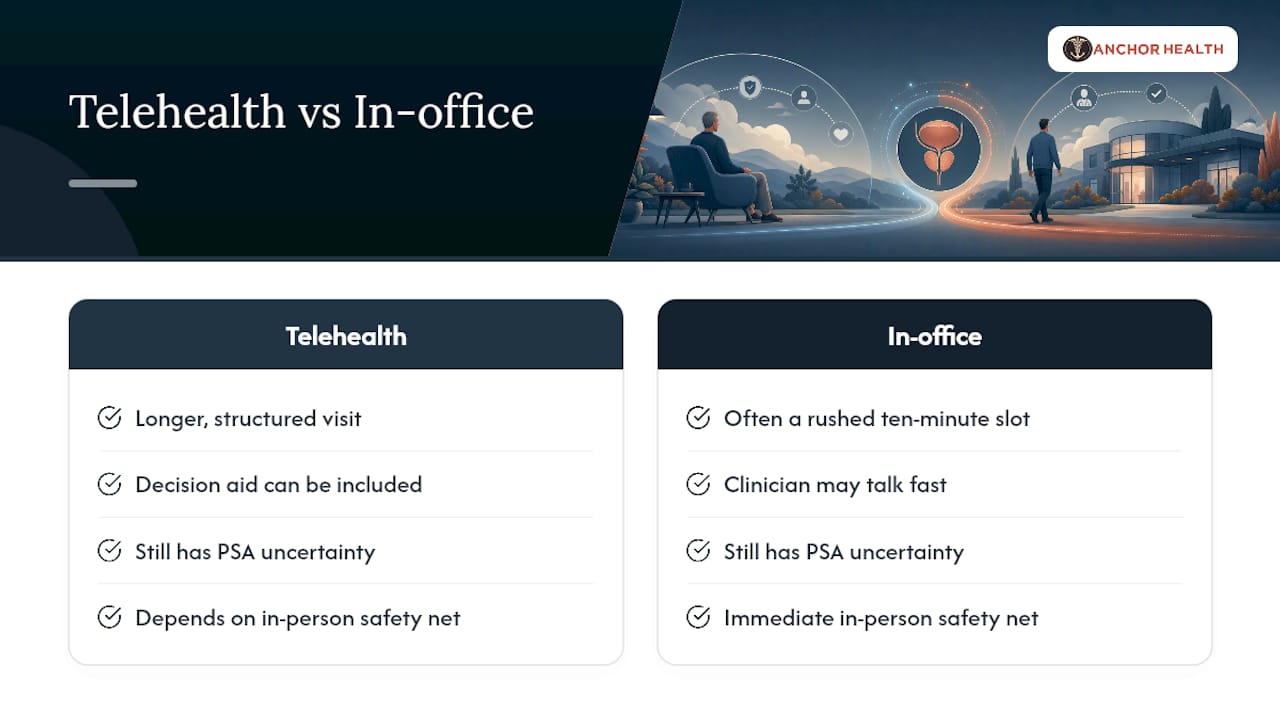
Telehealth doesn’t fix prostate cancer’s diagnostic uncertainty. Overdiagnosis is still real, and PSA is still an imperfect marker. What telehealth fixes is time and structure. A well-run virtual visit can run longer than a packed in-office slot, and it can build in a decision aid instead of a clinician talking fast while glancing at the clock. That’s not a small shift. It’s the difference between a man agreeing to a test because his doctor suggested it and a man understanding what he’s actually opting into.
The honest limitation is that telehealth still depends on a good in-person safety net. If a clinician isn’t disciplined about referring out for red-flag symptoms or abnormal PSA patterns, video visits alone become a liability, not a benefit. The model only works when the virtual front door leads somewhere real when it needs to.
— Paule
How Anchor Health Can Help You Start This Conversation
If you’ve been putting off the prostate screening conversation because your last physical felt rushed, or because you’re not sure your regular doctor even brought it up, Anchor Health gives you a more deliberate starting point. Every telehealth visit is built around Anchored Care℠, meaning the clinician who talks through your risk factors today is the same one reviewing your PSA trend next year, not a rotating cast of providers reading your chart cold.

Booking is straightforward: schedule a visit, complete a short intake on your medications and family history, and come to the appointment ready to talk through your options. Anchor Health accepts insurance and self-pay, and HSA or FSA funds can typically be applied toward any out-of-pocket cost. If your results warrant more than routine monitoring, your clinician coordinates the urology referral directly rather than leaving you to figure out the next step alone. To see how the model works for ongoing primary care beyond a single screening visit, review how to choose telehealth primary care and book your first visit when you’re ready.
This article is general information, not a substitute for advice from a qualified doctor. Consult a qualified healthcare professional about your own circumstances before acting on anything here.
Sources
- Early Detection of Prostate Cancer: AUA/SUO Guideline (2026 unabridged)
- Navigator-guided telehealth decision-making for prostate cancer screening (MDPI, 2024)
- NCCN Guidelines for Patients: Prostate Cancer Screening
Recommended
- How to Request Lab Work Through Telehealth
- How to Share Blood Pressure Readings With Your Telehealth Doctor
- How to Book a Telehealth Appointment as a Young Adult
Blog & Information Disclaimer
Last Updated: May 23, 2026
The information provided on the Anchor Health website (https://myanchorhealthpc.com/), including but not limited to blog posts, articles, newsletters, graphics, and other materials (collectively, the "Content"), is for general informational and educational purposes only.
By accessing and using this website, you acknowledge and agree to the following terms and conditions:
The Content on this website is not intended to be a substitute for professional medical advice, diagnosis, or treatment. Always seek the advice of your physician, nurse practitioner, or other qualified health provider with any questions you may have regarding a medical condition. Never disregard professional medical advice or delay in seeking it because of something you have read on this website.
Reading, interacting with, or sharing the Content on this website does not establish a patient-provider relationship between you and Anchor Health or any of its clinicians, including Paule Valery Joseph, PhD, MBA, CRNP, FAAN. A formal patient-provider relationship is only established after you have completed the formal intake process, signed our clinical consent forms, and participated in a secure clinical consultation.
If you are experiencing a medical emergency, call 911 or seek emergency medical services immediately.
Anchor Health is a primary care practice and does not provide emergency or crisis intervention services through its website or blog.
While Anchor Health strives to provide thoughtful, evidence-based information grounded in our Anchored Care℠ model, healthcare is a rapidly evolving field. We make no representations or warranties, express or implied, about the completeness, accuracy, reliability, or suitability of the information contained in the Content. Any reliance you place on such information is strictly at your own risk.
Anchor Health is a telehealth practice providing services to patients physically located within the state of Maryland. The information provided on this blog is intended for residents of Maryland and is governed by the laws and regulations of that state. Accessing this information from outside of Maryland does not imply that our clinicians are licensed to practice medicine or provide consultations in your jurisdiction.
Content related to Weight & Metabolic Health, including discussions of GLP-1 medications or other medical therapies, is provided for educational context regarding our clinical approach. Prescriptions and specific medical recommendations are only made following a comprehensive clinical evaluation, diagnostic testing, and shared decision-making within a formal patient-provider relationship.
This website may contain links to external websites that are not provided or maintained by or in any way affiliated with Anchor Health. Please note that Anchor Health does not guarantee the accuracy, relevance, timeliness, or completeness of any information on these external websites.
To the fullest extent permitted by law, Anchor Health, its owners, and its employees shall not be liable for any direct, indirect, incidental, consequential, or punitive damag

Related posts