How to Address Sports Injury Concerns Remotely

Many sports injury concerns can be safely managed remotely when you pair a structured telehealth workflow with continuous monitoring and a qualified clinician. The standard starting point is a typical virtual assessment lasting around half an hour that covers your injury history, a guided on-camera physical exam, and a personalized plan. Research shows high diagnostic agreement between telehealth and in-person assessments for certain ankle injuries between telehealth and in-person assessments for certain ankle injuries, giving you real confidence in what a video visit can accomplish.
Here is what to do right now:
- Book a virtual assessment with a qualified telehealth provider (a typical initial visit length is about half an hour).
- Prepare a short injury timeline: when it happened, what you felt, what makes it better or worse.
- Record a short movement video showing the affected area so your clinician can observe your gait, range of motion, or swelling before the visit.
- Start an app-based exercise log to track pain levels, swelling, and daily activity between appointments.
- Schedule regular follow-ups rather than treating the first visit as a one-off consultation.
One red flag that requires immediate in-person or emergency care: severe deformity, inability to bear any weight, progressive numbness or tingling, or signs of open injury. If any of these appear, go to an emergency room or urgent care clinic rather than waiting for a virtual appointment.
Maryland patients seeking continuity, insurance-friendly billing, and structured follow-up can work with Myanchorhealthpc, a telehealth primary care practice built around ongoing, relationship-based care.
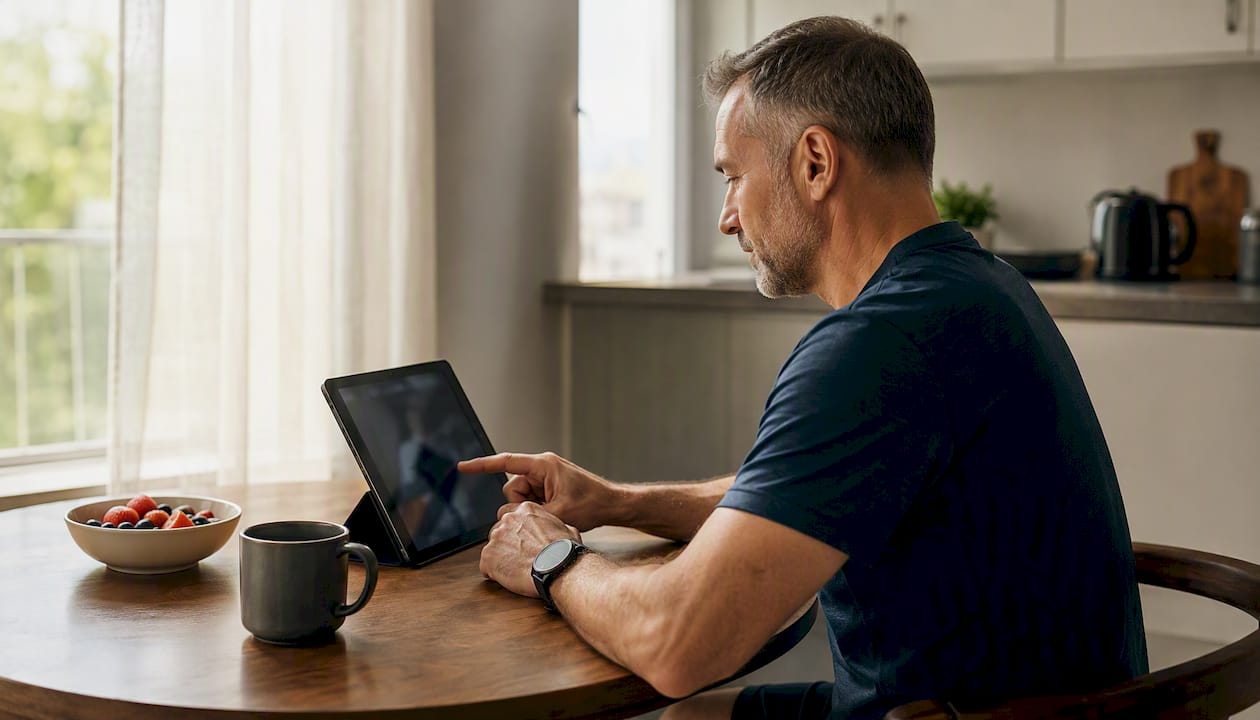
Table of Contents
- Why standard clinic follow-ups leave gaps in your recovery
- How telehealth and remote patient monitoring change your recovery
- Which tools help you address sports injury concerns remotely?
- What does a remote sports-injury care pathway actually look like?
- When is remote care appropriate — and when do you need in-person evaluation?
- How remote care supports the psychological side of recovery
- How Myanchorhealthpc supports remote sports-injury recovery
- Where remote sports-injury care is headed
- Key Takeaways
- Ready to start your remote recovery with Myanchorhealthpc?
Why standard clinic follow-ups leave gaps in your recovery
Episodic clinic visits create a visibility gap. Between appointments, your pain levels shift, your movement patterns change, and your rehab load may be too high or too low — and none of that reaches your clinician until the next scheduled slot.
The practical limitations compound quickly. Travel time and scheduling friction mean many patients stretch follow-ups to every three or four weeks. At that cadence, a clinician sees a snapshot, not a trend. They cannot observe how you move on a Tuesday when you are stiff versus a Friday after a full week of work. They cannot catch a subtle compensation pattern developing in your opposite hip. And they have no objective data on whether you are actually completing your exercises or modifying them in ways that slow progress.
The recovery gap is not just inconvenient — it is a clinical risk. When symptoms change between visits and there is no mechanism to report them, reinjury risk rises and recovery timelines extend. Structured remote monitoring exists specifically to close that gap.
Consider a common scenario: a recreational runner sprains their ankle, sees a clinician, gets a home exercise program, and returns three weeks later. In that window, they may have resumed running too early, developed a limp they have normalized, or stopped their exercises after day five because the pain seemed manageable. The clinician has no way to know any of this. The result is a recovery that stalls or regresses, not because the initial plan was wrong, but because there was no mechanism to monitor and adjust it.
Telehealth and remote patient monitoring address this directly by creating continuous, measurable touchpoints rather than isolated appointments.
How telehealth and remote patient monitoring change your recovery
Virtual assessments combined with remote patient monitoring (RPM) create a continuous recovery pathway rather than a series of disconnected appointments. That continuity is what makes the clinical difference.
A typical remote sports-injury workflow moves through these stages:
- Intake and history: You complete a structured questionnaire before the visit covering mechanism of injury, symptom timeline, prior injuries, and current medications.
- Guided on-camera musculoskeletal exam: Your clinician directs you through specific movements — weight-bearing tests, range-of-motion checks, functional tasks like a single-leg squat — while observing alignment, compensation, and pain response in real time.
- Objective measurements: Range of motion, gait patterns, and symmetry can be assessed visually and, with newer tools, measured through camera-based motion capture.
- Exercise prescription: You receive a written plan with video demonstrations, load parameters, and clear progression criteria.
- Asynchronous tracking: Between visits, you log pain scores, exercise completion, and any new symptoms through a rehab app or secure messaging.
- Scheduled check-ins: Weekly or bi-weekly video visits allow your clinician to adjust load, address questions, and confirm you are progressing safely.
The evidence supporting this model is meaningful. Studies report high diagnostic agreement between telehealth and in-person assessments for certain ankle injuries. For the most common sports injuries — sprains, strains, tendinopathies, and overuse conditions — online physiotherapy has been shown to produce similar improvements in pain and function compared to in-person care.
| Metric | What the evidence shows |
|---|---|
| Diagnostic agreement (ankle injuries) | Greater than 90% diagnostic agreement between telehealth and in-person assessments |
| Initial virtual consult length | a typical initial visit length is about half an hour |
| Conditions well-suited to remote care | Sprains, strains, tendinopathies, overuse injuries |
| Conditions requiring in-person assessment | Suspected fractures, neurovascular compromise, open wounds |
Remote care does have real limits. Palpation — the hands-on pressure testing that helps a clinician feel joint instability or localized tenderness — cannot be replicated on video. Certain special tests require physical contact. A good remote provider will tell you clearly when those limitations apply and refer you for in-person imaging or evaluation when needed.
Which tools help you address sports injury concerns remotely?
The right combination of tools gives your clinician objective movement data, frequent touchpoints, and a clearer picture of your adherence. No single tool does all of this. Here is what each category offers and what you should do with it.

Secure video platforms are the foundation. They allow your clinician to conduct a guided musculoskeletal exam, observe your movement, and adjust your plan in real time. What matters most is a stable connection, good lighting, and enough space to perform the movements your clinician requests.
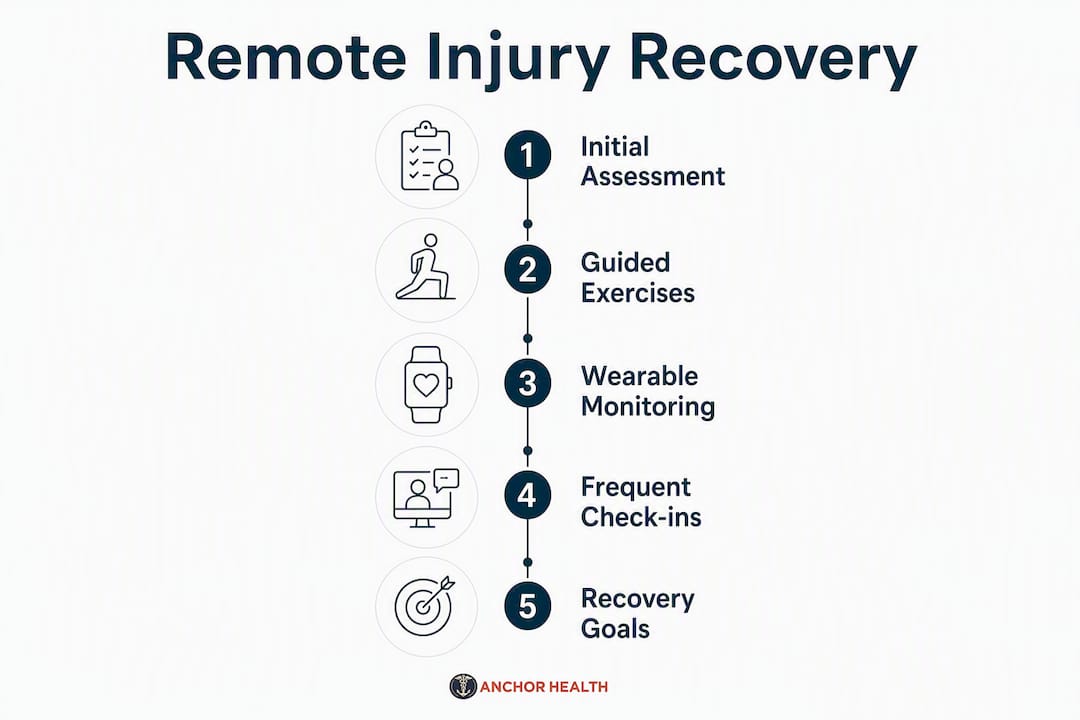
Rehab apps handle the between-visit work. They deliver your exercise program with video demonstrations, collect daily pain and swelling scores, and send that data to your clinician before each check-in. Progressive loading, movement retraining, and home-based self-management tools — resistance bands, foam rollers, massage tools — are core elements of most remote rehab programs.
Wearables add a layer of passive monitoring. Step count, heart rate variability, and sleep data give your clinician context about your daily load and recovery status without requiring you to log anything manually.
Camera-based motion capture is the most precise option available. Advanced virtual clinics now use smartphone cameras to measure range of motion objectively, converting home video into trended data across sessions. This turns a subjective “my shoulder feels looser” into a measurable degree-by-degree comparison.
Asynchronous messaging fills the gaps between scheduled visits. A quick photo of swelling, a short video of a movement that feels wrong, or a pain score update sent through a secure portal can prompt a same-day response from your care team rather than waiting for the next appointment.
Before your first virtual visit, check three things: your camera produces a clear image in your available space, your internet connection is stable enough for video, and you have a clear area large enough to perform basic functional movements like a squat or a lunge. These details determine whether your clinician can actually assess you.
Pro Tip: Wear form-fitting clothing to your virtual visit. Loose clothing hides joint alignment and muscle recruitment patterns that your clinician needs to see. Shorts and a fitted top are ideal for lower-body injuries; a tank top or sports bra works well for shoulder and upper-body assessments.
For parents managing a young athlete’s recovery, telehealth for younger patients follows the same tool set with age-appropriate modifications to the exam and exercise prescription.
What does a remote sports-injury care pathway actually look like?
Expect a structured, phased process rather than a single consultation. Here is how a typical remote care pathway unfolds from day one through return to full activity.
- Day 0 — Initial virtual consult (20–30 minutes): You complete a pre-visit intake form, then join a secure video call. Your clinician takes a detailed history, guides you through an on-camera movement assessment, and delivers a written plan before the call ends.
- Week 1–2 — Early load management: You follow your prescribed exercise program at home, logging pain scores and exercise completion daily. Your clinician reviews this data asynchronously and may send adjustments via secure messaging.
- Week 2–4 — First follow-up check-in: A 15–20 minute video visit to review your progress, adjust load, and address any new symptoms. If imaging is needed, your clinician provides a referral with clear instructions.
- Week 4–8 — Progressive loading phase: Check-ins shift to bi-weekly. Your program advances based on objective benchmarks: pain scores below a defined threshold, symmetry targets met, functional tests passed.
- Week 8 and beyond — Return-to-play assessment: A structured video session using objective performance tests (timed hop test, single-leg squat symmetry, ROM benchmarks) to determine readiness for full activity.
On billing and insurance: Most major insurers cover telehealth visits, though your specific copay and coverage tier depend on your plan. Before your first appointment, ask your provider three questions: Is this visit billed as a telehealth primary care visit or a specialist visit? Does my plan require a referral? Is the provider in-network? HSA and FSA funds are generally accepted for telehealth visits. Membership-based care models, like the one Myanchorhealthpc offers, provide more frequent access and longer visits for a predictable monthly cost, which can be useful when your recovery requires close monitoring over several weeks.
For college athletes or students navigating insurance for the first time, understanding how telehealth billing works before your first visit saves time and avoids unexpected costs.
- Confirm your insurer’s telehealth coverage tier before booking.
- Ask whether your employer’s flexible spending account covers remote visits.
- Request a superbill or itemized receipt if you need documentation for a claim or employer form.
- Keep a copy of your injury timeline and any imaging reports in case your insurer requires prior authorization for follow-up visits.
When is remote care appropriate — and when do you need in-person evaluation?
Minor-to-moderate sprains, strains, and most overuse injuries are generally appropriate for virtual care. Suspected unstable fractures, severe neurovascular compromise, and open wounds are not.
The decision is usually straightforward. If you can bear weight, move the joint through a reasonable range of motion, and your symptoms are not rapidly worsening, a virtual assessment is a reasonable first step. Many online medical services provide rapid access to licensed clinicians for exactly these presentations, including sprains, tendon issues, and overuse injuries that do not require immediate imaging or surgery.
Remote care has one firm clinical limit: palpation and certain special orthopedic tests require hands-on assessment. A skilled remote clinician will tell you when that threshold is reached and refer you appropriately rather than attempt to manage something beyond what video can safely evaluate.
Red flags that require immediate in-person or emergency evaluation:
- Visible deformity or bone prominence suggesting a fracture or dislocation
- Complete inability to bear any weight on the affected limb
- Rapid, uncontrolled swelling within the first hour of injury
- Progressive numbness, tingling, or weakness distal to the injury site
- Signs of infection: warmth, redness spreading beyond the injury, fever
- Loss of circulation: pale, cold, or pulseless limb
When any of these appear, the right path is an emergency room or urgent care clinic, not a virtual queue. Telehealth can appropriately reduce unnecessary ER visits for non-emergent presentations, but it is not a substitute for emergency evaluation when the signs above are present.
For presentations that fall in between — moderate swelling, uncertain weight-bearing, or a mechanism that suggests a possible fracture — a virtual triage call can help you decide whether urgent imaging is needed and where to go for it.
How remote care supports the psychological side of recovery
Psychological readiness is as important as physical recovery, and remote programs are well-positioned to provide the frequent reassurance and objective benchmarks athletes need to rebuild confidence.
The fear of reinjury is real and often underestimated. Athletes who clear a physical milestone but have not mentally processed the injury tend to compensate, guard, or avoid the movements that matter most. Frequent virtual check-ins address this directly because they create regular, structured moments to review progress, name fears, and set the next concrete goal. That cadence matters more than the medium.
Mental skills coaching integrated into a remote recovery plan can address performance anxiety, fear-avoidance patterns, and the identity disruption that often accompanies time away from sport. These are not secondary concerns. For many athletes, they are the primary barrier to full return.
A remote return-to-play plan built on objective data reduces the guesswork that feeds anxiety. When you can see that your single-leg hop symmetry has improved from 72% to 91%, the decision to return to training feels grounded rather than arbitrary.
Milestones to track in a remote return-to-play plan:
- Pain score at rest and during activity (target: below 2/10 during sport-specific movement)
- Single-leg hop test symmetry compared to the uninjured side
- Range of motion within 5–10 degrees of the uninjured side
- Strength symmetry on a standardized functional test
- Completion of a sport-specific movement sequence without compensation
Pro Tip: Insist on objective benchmarks at each progression point rather than a single clearance call. A clinician who clears you based on “how it feels” rather than measurable data is skipping the step that protects you most. Use a mobility restoration checklist to track these milestones systematically across your recovery.
Setting structured health goals with your telehealth provider from the first visit creates the framework that makes return-to-play decisions defensible and confidence-building rather than uncertain.
How Myanchorhealthpc supports remote sports-injury recovery
Myanchorhealthpc is a Maryland-based telehealth primary care practice built around the Anchored Care℠ᴵᴾ model: relationship-based, evidence-aligned care delivered through secure video visits with genuine continuity between appointments.
For sports-injury concerns, the practice offers:
- Virtual musculoskeletal assessment: A structured 20–30 minute video visit covering injury history, guided on-camera exam, and a written plan delivered before the call ends.
- Ongoing monitoring and follow-up: Scheduled check-ins at a cadence matched to your recovery phase, with asynchronous messaging between visits for questions or symptom updates.
- Imaging referrals when needed: When a presentation requires X-ray, MRI, or specialist evaluation, Myanchorhealthpc coordinates the referral and integrates the results into your ongoing care plan.
- Insurance, self-pay, HSA/FSA, and membership options: The practice accepts insurance and self-pay, and offers a membership model for patients who need more frequent or longer visits during an active recovery period.
- Integrated mental and emotional health support: Within the primary care scope, the practice addresses the psychological dimensions of recovery alongside the physical ones.
What to prepare before you book:
- Write a brief injury timeline: date, mechanism, initial symptoms, and how they have changed.
- Record a short movement video (30–60 seconds) showing the affected area and any movements that reproduce your symptoms.
- Gather your insurance card and any prior imaging reports or referral letters.
- List your current medications and any supplements you are taking.
- Note any prior injuries to the same area and how they were managed.
Myanchorhealthpc’s model is designed for patients who want a consistent provider rather than a different clinician at every visit. Follow-up scheduling is built into the care plan from the first appointment, not left to the patient to initiate. [Insert author credentials or qualifications.] [Insert proprietary clinical outcomes or patient satisfaction data.] [Insert case studies or testimonials specific to Paule or Anchor Health.]
Where remote sports-injury care is headed
AI and camera-based motion capture will increase the objectivity and early-detection capability of remote assessments, but human clinicians will remain central to interpreting context, managing risk, and making safety decisions.
The near-term developments worth watching:
- AI-assisted triage: Symptom-checking tools that flag red-flag presentations before a clinician even joins the call, reducing the risk of a serious injury being managed as a routine sprain.
- Automated range-of-motion measurement: Smartphone-based tools that measure joint angles to a fraction of a degree, converting home video into trended clinical data across sessions.
- Predictive analytics for reinjury risk: Algorithms that identify load-spike patterns or asymmetry trends before they produce a setback.
- Tele-rehab gamification: App-based adherence tools that use progress tracking, milestone rewards, and social accountability to keep patients engaged with their exercise programs between visits.
Technology improves measurement, but it does not replace judgment. An AI tool can flag that your knee flexion is 12 degrees below baseline. It cannot tell you whether that finding reflects protective guarding, true stiffness, or a new structural problem. That interpretation requires a clinician who knows your history, your goals, and the full clinical picture. The most effective remote care models will always pair better tools with better relationships.
Key Takeaways
Remote sports-injury management works best when continuous monitoring, structured follow-up, and clear escalation criteria replace the episodic clinic visit model.
| Point | Details |
|---|---|
| Telehealth diagnostic accuracy | Studies report greater than 90% diagnostic agreement between telehealth and in-person assessments for certain ankle injuries. |
| Standard initial visit | Expect a 20–30 minute virtual consult covering history, guided on-camera exam, and a written plan. |
| Red flags for in-person care | Severe deformity, inability to bear weight, progressive numbness, uncontrolled swelling, or signs of infection require immediate in-person evaluation. |
| Psychological readiness matters | Objective benchmarks (hop test symmetry, ROM targets) support return-to-play decisions and rebuild athlete confidence more reliably than subjective clearance. |
| Myanchorhealthpc for Maryland patients | Myanchorhealthpc offers structured virtual assessments, ongoing follow-up, insurance billing, and membership options for close monitoring during active recovery. |
A note on remote recovery from our practice
Patients who recover fastest are rarely the ones with the mildest injuries. They are the ones who stay connected to their care team between appointments, report changes early, and follow a plan built around objective milestones rather than how they feel on a good day. We have seen that pattern consistently: frequent virtual check-ins paired with app-based tracking catch the small regressions before they become setbacks. That is the core of what we do at Myanchorhealthpc, and it is why we structure every sports-injury case around continuity from the first visit rather than treating each appointment as a standalone event. If you are managing a sports injury right now and want that kind of steady, relationship-based support, we would like to be your consistent provider through recovery and beyond.
Ready to start your remote recovery with Myanchorhealthpc?
Recovering from a sports injury without a consistent care team is harder than it needs to be. Myanchorhealthpc gives Maryland patients a direct path to structured, relationship-based telehealth primary care: a thorough virtual assessment in your first visit, a written plan before the call ends, and scheduled follow-ups built into your care from day one. No waiting weeks between check-ins with no way to report changes. No starting over with a new clinician each time.

The practice accepts insurance, self-pay, HSA/FSA funds, and offers membership options for patients who need more frequent access or longer visits during an active recovery period. Booking is straightforward, and your first visit is designed to give you a clear picture of your injury and a concrete next step, not a referral to come back in three weeks.
Before your first visit, prepare:
- A written injury timeline (date, mechanism, symptoms, changes over time)
- A short movement video showing the affected area
- Your insurance card and any prior imaging or referral documents
- A list of current medications
- Any questions about return-to-play or activity restrictions
Choose the right telehealth primary care plan for your situation and book your first virtual assessment. Most appointments are available within a few business days.
Useful sources and further reading
| Source | What it covers |
|---|---|
| Telehealth MSK diagnostic agreement study (Springer) | Peer-reviewed evidence shows greater than 90% diagnostic agreement between telehealth and in-person musculoskeletal assessments for certain ankle injuries. |
| Virtual assessment workflow and visit length (SAGE Journals) | Clinical guidance on the standard 20–30 minute virtual consult structure, home setup requirements, and what clinicians need from patients during video exams. |
| Remote Rehab Physio — sports physiotherapy | Practical overview of how online physiotherapy uses exercise therapy, load management, and functional movement assessment for sports injuries. |
| Virtual Injury Assessments (LegalMed Virtual) | Explains how virtual injury assessments bring expert evaluation into the home and reduce travel and clinic delays. |
| Sports Injuries Online Treatment (MobiDoctor) | Overview of conditions commonly managed through online medical services, including sprains, strains, tendon issues, and overuse injuries. |
| Online Sports Injury Physio (sports-injury-physio.com) | Details on progressive loading, movement retraining, and home-based self-management tools used in remote rehab programs. |
| Myanchorhealthpc — telehealth primary care | Maryland-based telehealth primary care practice offering virtual assessments, ongoing follow-up, insurance billing, and membership options for sports-injury recovery support. |
Recommended
- Managing Family Health Appointments Remotely in 2026
- How Telehealth Handles Sick Child Visits for Families
- How to Book a Telehealth Appointment as a Young Adult
Blog & Information Disclaimer
Last Updated: May 23, 2026
The information provided on the Anchor Health website (https://myanchorhealthpc.com/), including but not limited to blog posts, articles, newsletters, graphics, and other materials (collectively, the "Content"), is for general informational and educational purposes only.
By accessing and using this website, you acknowledge and agree to the following terms and conditions:
The Content on this website is not intended to be a substitute for professional medical advice, diagnosis, or treatment. Always seek the advice of your physician, nurse practitioner, or other qualified health provider with any questions you may have regarding a medical condition. Never disregard professional medical advice or delay in seeking it because of something you have read on this website.
Reading, interacting with, or sharing the Content on this website does not establish a patient-provider relationship between you and Anchor Health or any of its clinicians, including Paule Valery Joseph, PhD, MBA, CRNP, FAAN. A formal patient-provider relationship is only established after you have completed the formal intake process, signed our clinical consent forms, and participated in a secure clinical consultation.
If you are experiencing a medical emergency, call 911 or seek emergency medical services immediately.
Anchor Health is a primary care practice and does not provide emergency or crisis intervention services through its website or blog.
While Anchor Health strives to provide thoughtful, evidence-based information grounded in our Anchored Care℠ model, healthcare is a rapidly evolving field. We make no representations or warranties, express or implied, about the completeness, accuracy, reliability, or suitability of the information contained in the Content. Any reliance you place on such information is strictly at your own risk.
Anchor Health is a telehealth practice providing services to patients physically located within the state of Maryland. The information provided on this blog is intended for residents of Maryland and is governed by the laws and regulations of that state. Accessing this information from outside of Maryland does not imply that our clinicians are licensed to practice medicine or provide consultations in your jurisdiction.
Content related to Weight & Metabolic Health, including discussions of GLP-1 medications or other medical therapies, is provided for educational context regarding our clinical approach. Prescriptions and specific medical recommendations are only made following a comprehensive clinical evaluation, diagnostic testing, and shared decision-making within a formal patient-provider relationship.
This website may contain links to external websites that are not provided or maintained by or in any way affiliated with Anchor Health. Please note that Anchor Health does not guarantee the accuracy, relevance, timeliness, or completeness of any information on these external websites.
To the fullest extent permitted by law, Anchor Health, its owners, and its employees shall not be liable for any direct, indirect, incidental, consequential, or punitive damag
Related posts