How the Telehealth Prescription Process Works

The telehealth prescription process is a regulated, secure method for licensed clinicians to evaluate patients remotely and prescribe medications electronically, sending them directly to a pharmacy of your choice. Known formally as telehealth prescribing or e-prescribing, this process covers everything from your first virtual appointment to picking up your medication. Understanding how telemedicine works at each step helps you know what to expect, what to prepare, and when a virtual visit is the right choice for your health needs.
What are the key steps in the telehealth prescription process?
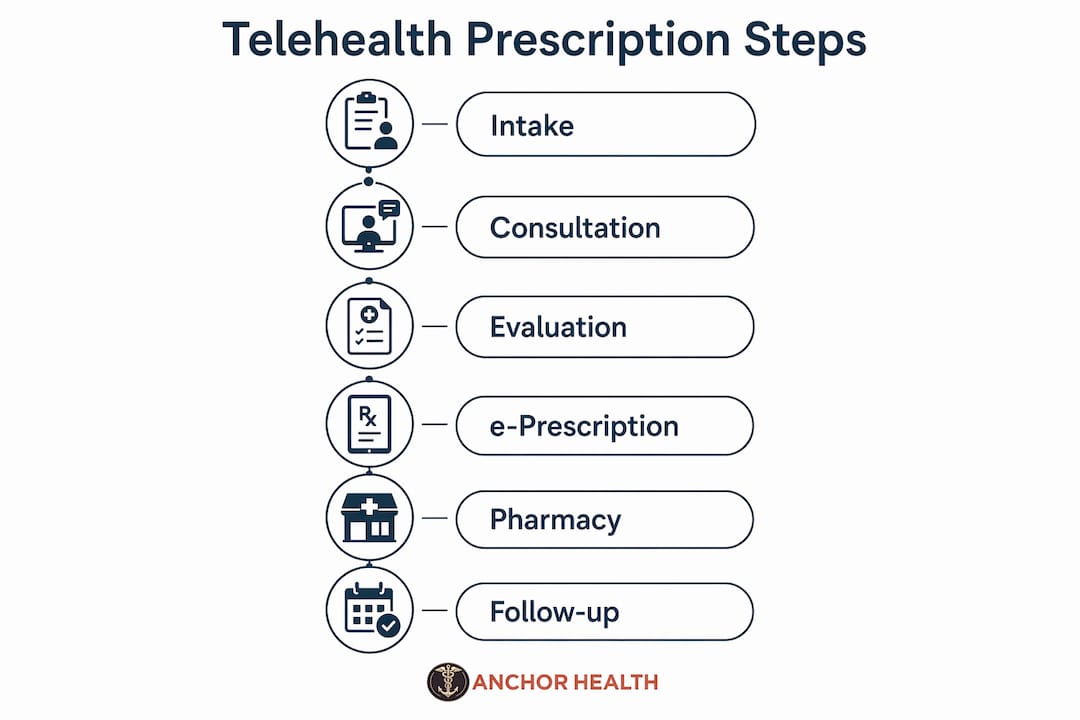
The telehealth prescription process follows a clear, sequential workflow that mirrors a traditional office visit in most respects. The main difference is that every interaction happens through a secure video or audio platform instead of a physical exam room.
Here is how the process typically unfolds from start to finish:
- Schedule your appointment. Choose a telehealth provider licensed in the state where you are physically located at the time of the visit. Before your appointment, gather your current medication list, pharmacy name and address, insurance information, and any recent lab results.
- Complete intake forms. Most platforms ask you to fill out a health history questionnaire before the visit. This gives your provider context and saves time during the consultation.
- Attend the virtual consultation. You connect with a licensed provider through a HIPAA-compliant video platform. The provider reviews your history, asks about your current symptoms or medication needs, and conducts a clinical evaluation.
- Provider makes a prescribing decision. A telehealth refill visit is designed as a focused consultation to confirm your stability before renewing a medication. The provider reviews your history, current medication effects, and health status before deciding whether a prescription is appropriate.
- Electronic prescription is sent. If the provider determines a prescription is warranted, they transmit it electronically to your chosen pharmacy. E-prescribing is required or strongly recommended in most states and reduces prescribing errors and turnaround times.
- Pick up or receive your medication. You collect your prescription at a local pharmacy or arrange for mail-order delivery, depending on the medication and your preference.
Pro Tip: Before your telehealth visit, confirm that your provider is licensed in your state and that your preferred pharmacy accepts electronic prescriptions. This prevents delays after your consultation ends.
How do laws and regulations affect telehealth prescribing?
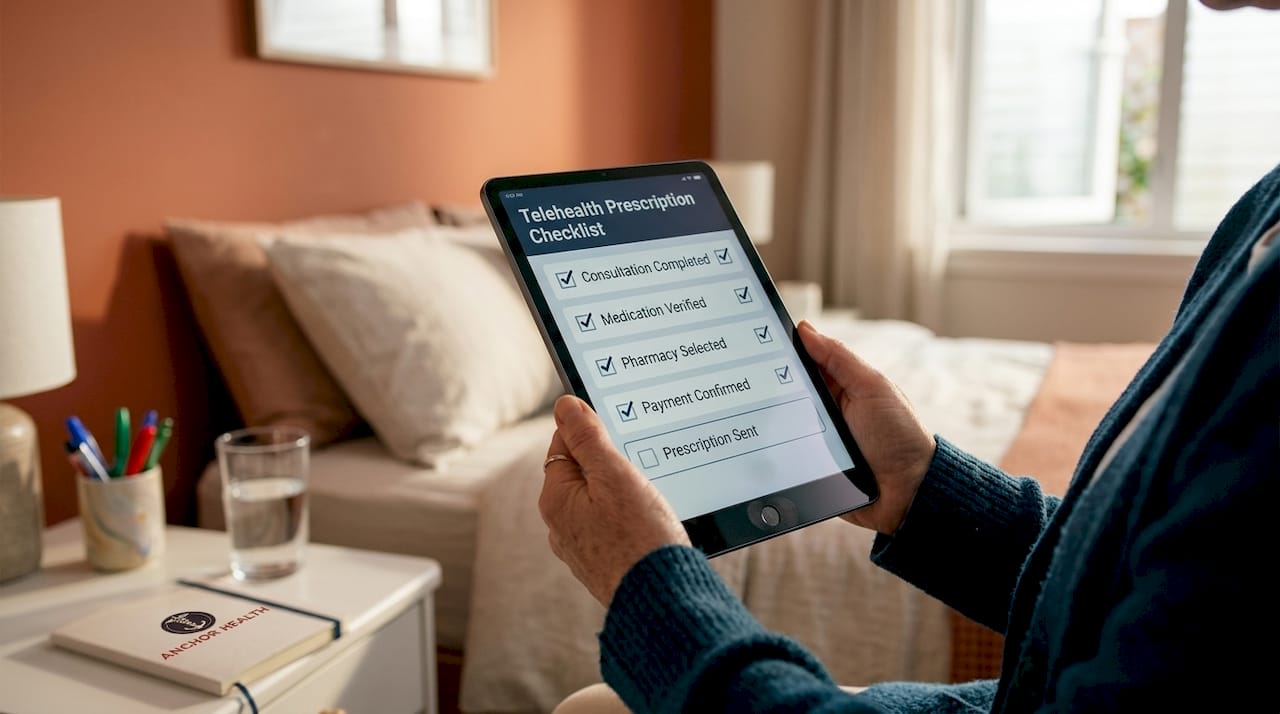
Telehealth prescribing is not a free-for-all. Federal and state laws create a framework that protects patients and holds providers accountable. Understanding these rules helps you recognize what a legitimate telehealth prescribing service looks like.
The Ryan Haight Act and controlled substances
The Ryan Haight Online Pharmacy Consumer Protection Act is the federal law that governs controlled substance prescribing via telehealth. Under this law, DEA-registered practitioners can prescribe many controlled substances via telehealth only after at least one prior in-person evaluation, with limited exceptions for VA providers and declared emergencies. This means that medications like stimulants for ADHD or opioids for pain management generally cannot be prescribed through a standard telehealth visit without prior in-person contact. Providers who do not follow this rule risk losing their DEA registration and face serious legal consequences.
State licensure and location verification
State medical boards require that a provider hold an active license in the state where the patient is physically located during the telehealth encounter. Location mismatch is a real and common issue: if your provider is licensed in Maryland but you are visiting family in Virginia during your appointment, they legally cannot prescribe to you in that moment. This rule exists to protect patients and maintain compliance with local medical standards. Reputable telehealth platforms verify your location at the start of each visit to prevent this problem.
Here is a quick comparison of how controlled and non-controlled medications are treated differently under telehealth prescribing rules:
| Category | Controlled substances | Non-controlled medications |
|---|---|---|
| In-person visit required | Yes, in most cases before telehealth prescribing | No, telehealth evaluation alone is typically sufficient |
| Federal oversight | DEA registration and Ryan Haight Act apply | Standard state medical board oversight |
| Examples | Stimulants, opioids, benzodiazepines | Antibiotics, blood pressure medications, diabetes medications |
| Prescription monitoring | State Prescription Drug Monitoring Program (PDMP) required | Varies by state; often not required |
Pro Tip: Always ask your telehealth provider whether they participate in your state’s Prescription Drug Monitoring Program. Legitimate providers check this database before prescribing any medication with abuse potential.
Effective telehealth platforms embed state-specific restrictions and clinical checklists directly into their workflows to minimize compliance errors. This means the platform itself acts as a safeguard, not just the individual provider.
What medications can be prescribed via telehealth?
Telehealth prescribing covers a wide range of common medications, but it is not appropriate for every clinical situation. Knowing the difference helps you decide when a virtual visit is sufficient and when you need to be seen in person.
Medications commonly prescribed through telehealth include:
- Chronic condition medications: Blood pressure medications, cholesterol-lowering drugs, thyroid medications, and diabetes medications including GLP-1 receptor agonists like semaglutide are well-suited for telehealth management.
- Antibiotics for straightforward infections: Urinary tract infections, sinus infections, and certain skin infections can often be assessed and treated remotely.
- Mental health medications: Antidepressants and anti-anxiety medications are frequently managed through telehealth, particularly for established patients.
- Contraceptives: Oral contraceptives and other hormonal medications are routinely prescribed through virtual visits.
- Refills for stable conditions: Telehealth is most effective as a complement to in-person care for chronic condition management, improving access and adherence.
Telehealth prescribing has real limits, and a responsible provider will tell you when you need to be seen in person. Physical exams are required for new, unexplained symptoms that need hands-on assessment. Severe or rapidly worsening conditions, suspected fractures, abdominal emergencies, and situations where diagnostic tests like blood draws or imaging are needed before prescribing all require an in-person visit. Providers typically do not prescribe controlled substances during standard telehealth visits due to federal and state restrictions, so if you need a medication in that category, plan for an in-person evaluation first.
The evidence for telehealth medication management is strong in chronic disease. Virtual diabetes management through telehealth reduces A1C levels by 0.6 percentage points on average compared to traditional in-person care. That is a clinically meaningful improvement, and it shows that remote prescription management is not a lesser substitute but a genuinely effective model for the right conditions.
What technology protects your privacy during a telehealth prescription visit?
The technology behind telehealth prescribing is designed to protect your privacy at every step. Patient privacy is protected in telehealth visits using HIPAA-compliant video platforms with encrypted communication, giving telehealth appointments equivalent confidentiality safeguards as in-person visits.
The core technologies involved include:
- HIPAA-compliant video platforms: Platforms like Doxy.me and Zoom for Healthcare use end-to-end encryption to prevent unauthorized access to your consultation.
- Electronic prescribing systems: E-prescribing software connects your provider directly to your pharmacy’s system, eliminating paper prescriptions and reducing the risk of forgery or transcription errors.
- Secure patient portals: Most telehealth services use portals where you can review your visit notes, prescription history, and lab results without relying on unsecured email.
- Identity verification tools: Providers use date of birth confirmation, insurance verification, and sometimes photo ID checks to confirm you are who you say you are before prescribing.
- Asynchronous communication options: Some platforms allow store-and-forward messaging, where you submit symptoms and photos for provider review without a live video call. This works well for straightforward refill requests.
Telehealth platforms also embed clinical checklists into their prescribing workflows, which means the software flags potential drug interactions, dosing errors, and state-specific restrictions before the provider finalizes a prescription. This layer of automated oversight reduces human error and adds a meaningful safety check that paper-based prescribing cannot replicate.
Key takeaways
The telehealth prescription process is a legally regulated, technology-supported workflow that allows licensed providers to evaluate patients remotely and transmit prescriptions electronically to pharmacies, provided state licensure and federal prescribing laws are met.
| Point | Details |
|---|---|
| Sequential workflow | The process runs from intake and virtual consultation to e-prescribing and pharmacy pickup in six clear steps. |
| Legal framework matters | The Ryan Haight Act and state licensure rules determine what can be prescribed and by whom during a telehealth visit. |
| Medication scope | Chronic condition drugs, antibiotics, and mental health medications are commonly prescribed; controlled substances require prior in-person evaluation. |
| Technology safeguards | HIPAA-compliant platforms, e-prescribing systems, and clinical checklists protect privacy and reduce prescribing errors. |
| Location verification | Your provider must be licensed in the state where you are physically located at the time of your visit. |
Why telehealth prescribing is more nuanced than most people expect
People often assume telehealth prescribing is either a rubber-stamp process or a regulatory minefield. Neither is accurate, and both misunderstandings lead to poor decisions.
The rubber-stamp concern is worth addressing directly. Telehealth platforms use structured intake and clinical evaluation to keep prescribing decisions medically appropriate rather than patient-driven. A good telehealth provider will decline to prescribe when the clinical picture does not support it. That is not a failure of the system. It is the system working correctly.
The regulatory minefield concern is also overstated for most patients seeking routine care. If you are managing a stable chronic condition, refilling a non-controlled medication, or addressing a common acute illness, the telehealth prescription process is genuinely straightforward. The complexity concentrates around controlled substances and new diagnoses, which is exactly where you would want more scrutiny anyway.
What I find most underappreciated is the licensure question. Many patients do not realize that traveling out of state during their appointment window can invalidate the visit entirely. If you are a Maryland resident using a Maryland-licensed provider and you happen to be in Pennsylvania when you log on, your provider cannot legally prescribe to you. This catches people off guard, and it is worth building a habit of confirming your location at booking.
The future of telehealth prescribing will likely bring more interstate compacts and federal flexibility, particularly for mental health medications. But for now, the safest approach is to use a provider who is transparent about their licensure, participates in your state’s drug monitoring program, and does not promise prescriptions before conducting a real evaluation.
— Paule
Get prescriptions through trusted telehealth care at Myanchorhealthpc
Managing your family’s medications should not require hours in a waiting room. Myanchorhealthpc offers secure, relationship-based telehealth primary care for Maryland families, with HIPAA-compliant video visits and e-prescribing built into every appointment.

Whether you need a refill for a chronic condition, support with weight and metabolic health including GLP-1 medications, or ongoing mental health prescription management, Myanchorhealthpc’s licensed Maryland providers handle it through a structured, evidence-based process. Learn more about telehealth care for your family or explore telehealth for kids to see how virtual prescribing works across every age in your household.
FAQ
What is the telehealth prescription process?
The telehealth prescription process is a regulated workflow where a licensed provider evaluates a patient through a secure video or audio visit and, if clinically appropriate, transmits a prescription electronically to a pharmacy. It follows the same clinical standards as an in-person visit.
Can a telehealth provider prescribe controlled substances?
In most cases, a telehealth provider cannot prescribe controlled substances without at least one prior in-person evaluation, as required by the Ryan Haight Act. Exceptions exist for VA providers and declared public health emergencies.
How do I know if my telehealth provider can prescribe in my state?
Your provider must hold an active medical license in the state where you are physically located during the visit. Reputable telehealth platforms verify your location at the start of each appointment to confirm prescribing eligibility.
What medications are most commonly prescribed through telehealth?
Telehealth providers commonly prescribe medications for diabetes, high blood pressure, thyroid conditions, mental health, and straightforward infections. Refills for stable chronic conditions are particularly well-suited to virtual visits.
Is my information safe during a telehealth prescription visit?
Yes. Telehealth platforms are required to use HIPAA-compliant, encrypted video technology, giving your visit the same privacy protections as an in-person appointment. E-prescribing systems also transmit your prescription directly to the pharmacy without paper records that could be lost or altered.
Recommended
- Telehealth for Kids Explained: What Parents Need to Know
- How to Choose Telehealth Primary Care for Your Family
Blog & Information Disclaimer
Last Updated: May 23, 2026
The information provided on the Anchor Health website (https://myanchorhealthpc.com/), including but not limited to blog posts, articles, newsletters, graphics, and other materials (collectively, the "Content"), is for general informational and educational purposes only.
By accessing and using this website, you acknowledge and agree to the following terms and conditions:
The Content on this website is not intended to be a substitute for professional medical advice, diagnosis, or treatment. Always seek the advice of your physician, nurse practitioner, or other qualified health provider with any questions you may have regarding a medical condition. Never disregard professional medical advice or delay in seeking it because of something you have read on this website.
Reading, interacting with, or sharing the Content on this website does not establish a patient-provider relationship between you and Anchor Health or any of its clinicians, including Paule Valery Joseph, PhD, MBA, CRNP, FAAN. A formal patient-provider relationship is only established after you have completed the formal intake process, signed our clinical consent forms, and participated in a secure clinical consultation.
If you are experiencing a medical emergency, call 911 or seek emergency medical services immediately.
Anchor Health is a primary care practice and does not provide emergency or crisis intervention services through its website or blog.
While Anchor Health strives to provide thoughtful, evidence-based information grounded in our Anchored Care℠ model, healthcare is a rapidly evolving field. We make no representations or warranties, express or implied, about the completeness, accuracy, reliability, or suitability of the information contained in the Content. Any reliance you place on such information is strictly at your own risk.
Anchor Health is a telehealth practice providing services to patients physically located within the state of Maryland. The information provided on this blog is intended for residents of Maryland and is governed by the laws and regulations of that state. Accessing this information from outside of Maryland does not imply that our clinicians are licensed to practice medicine or provide consultations in your jurisdiction.
Content related to Weight & Metabolic Health, including discussions of GLP-1 medications or other medical therapies, is provided for educational context regarding our clinical approach. Prescriptions and specific medical recommendations are only made following a comprehensive clinical evaluation, diagnostic testing, and shared decision-making within a formal patient-provider relationship.
This website may contain links to external websites that are not provided or maintained by or in any way affiliated with Anchor Health. Please note that Anchor Health does not guarantee the accuracy, relevance, timeliness, or completeness of any information on these external websites.
To the fullest extent permitted by law, Anchor Health, its owners, and its employees shall not be liable for any direct, indirect, incidental, consequential, or punitive damag
Related posts